

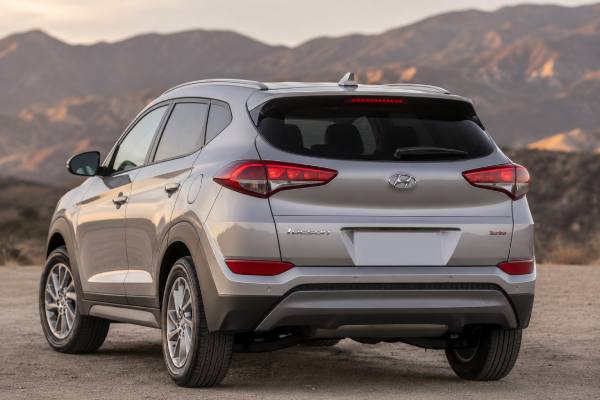

The 2016–2018 Hyundai Tucson AWD with the Gamma 1.6 T-GDi is the turbocharged version of the TL-generation Tucson, paired with a 7-speed dry dual-clutch transmission and an active on-demand all-wheel-drive system. It sits between ordinary compact crossovers and sportier turbo SUVs: quicker and more responsive than a basic 2.0-litre Tucson, but more maintenance-sensitive than a simple naturally aspirated engine with a torque-converter automatic.
For used buyers, the main question is not whether the 1.6 turbo has enough power. It does. The bigger question is whether the transmission has been serviced, updated, and driven in a way that suits a dry-clutch DCT.
Final Verdict
The Hyundai Tucson AWD 1.6 T-GDi is a good used compact SUV for buyers who want useful turbo torque, secure all-weather traction, a roomy cabin, and strong value without moving into premium-brand running costs. It suits family use, commuting, winter roads, and light towing where local ratings allow it. The main tradeoff is the 7-speed dry dual-clutch transmission, which can feel hesitant in traffic and is sensitive to heat, creeping, clutch wear, and software calibration. Buy one only with proof of recall completion, smooth low-speed operation, clean oil history, and no shudder during repeated stop-start driving.
| Pros | Cons |
|---|---|
| Strong mid-range torque from the 1.6 T-GDi turbo engine | Dry DCT can shudder or hesitate in heavy traffic |
| AWD adds useful traction on wet, snowy, or gravel roads | Fuel economy drops noticeably on short urban trips |
| Practical cabin, good rear space, and useful cargo capacity | Some safety tech was optional or trim-dependent |
| Good crash-test record for the TL-generation Tucson | Headlight performance varies sharply by trim and package |
| Parts availability is generally strong in many markets | Used examples need careful recall and DCT history checks |
Table of Contents
- Tucson TL 1.6 T-GDi AWD Overview
- Specifications and Technical Data
- Trims, Options, Safety and Driver Assistance
- Reliability, Common Issues and Service Actions
- Maintenance and Buyer’s Guide
- Driving, Performance and Real-World Economy
- How the Tucson 1.6 T-GDi AWD Compares to Rivals
Tucson TL 1.6 T-GDi AWD Overview
The TL-generation Hyundai Tucson 1.6 T-GDi AWD is best understood as the quicker, more sophisticated petrol Tucson, not the simplest one. It gives the compact SUV more useful passing power and better traction, but the extra hardware also adds inspection points for used buyers.
This version uses Hyundai’s Gamma-family 1.6-litre turbocharged direct-injection petrol engine. In North American form it is rated at 175 hp, while many metric-market brochures list it as 177 PS. Torque is the real attraction: 265 Nm arrives low in the rev range and stays available through much of everyday driving. That makes the Tucson feel more relaxed than the 2.0-litre naturally aspirated models when climbing hills, joining motorways, or carrying passengers.
The transmission is the important detail. Hyundai paired this engine with a 7-speed EcoShift dry dual-clutch transmission. A DCT works more like an automated manual gearbox than a conventional automatic. It can shift quickly and efficiently once moving, but it does not like being slipped for long periods in crawling traffic. Repeated creeping, hill-holding with the accelerator, and stop-start heat can accelerate clutch wear or bring out judder.
The AWD system is front-biased in normal driving and sends torque rearward when needed. It also includes a driver-selectable AWD lock function for low-speed slippery conditions. This is not a rock-crawling 4×4 system, but it is useful on snow, mud, steep wet driveways, loose gravel, and poor winter roads.
The 2016–2018 model years are also worth separating from later facelift versions. Some markets changed trim names, safety packages, engines, and availability from 2018 onward. Always check the VIN, build plate, owner’s manual, and market-specific brochure before assuming a car has the same equipment as another Tucson with the same engine.
The ideal example is a privately owned car with regular oil changes, completed recall work, matching tyres, smooth DCT behaviour, and no warning lights. A cheap car with a jerky gearbox, missing records, mixed tyres, or unresolved recalls can quickly become expensive.
Specifications and Technical Data
The 1.6 T-GDi AWD combines a turbocharged direct-injection four-cylinder engine, a 7-speed dry DCT, and active on-demand AWD. The layout gives useful performance for a compact SUV, but buyers should pay attention to transmission condition, tyre matching, and market-specific towing and fuel-economy figures.
| Item | Hyundai Tucson AWD 1.6 T-GDi |
|---|---|
| Generation / platform | TL-generation Hyundai Tucson |
| Model years covered | 2016, 2017, 2018 |
| Engine family | Gamma 1.6 T-GDi |
| Displacement | 1,591 cc |
| Layout | Inline 4-cylinder, DOHC, 16 valves, CVVT |
| Induction | Turbocharged |
| Fuel system | Gasoline direct injection |
| Maximum power | 175 hp / 130 kW at 5,500 rpm |
| Maximum torque | 265 Nm / 195 lb-ft at 1,500–4,500 rpm |
| Bore × stroke | 77 mm × 85 mm |
| Compression ratio | About 10.0–10.1:1, depending on market data |
| Timing drive | Timing chain |
| Fuel | Regular unleaded in markets where specified |
| Item | Specification |
|---|---|
| Transmission | 7-speed EcoShift dry dual-clutch transmission |
| Manual control | Sequential manual mode |
| Drive type | Active on-demand AWD |
| AWD function | Front-biased with rear torque transfer when needed |
| Driver AWD lock | Available for low-speed slippery conditions |
| 1st / 2nd / 3rd gear | 3.929 / 2.318 / 2.043 |
| 4th / 5th / 6th / 7th gear | 1.070 / 0.822 / 0.884 / 0.721 |
| Reverse gear | 5.304 |
| Final drive | 4.857 / 3.579 split final drive |
| Item | Value |
|---|---|
| Body style | 5-door compact SUV |
| Seats | 5 |
| Length | 4,475 mm / 176.2 in |
| Width | 1,850 mm / 72.8 in, excluding mirrors |
| Height | About 1,646–1,651 mm / 64.8–65.0 in |
| Wheelbase | 2,670 mm / 105.1 in |
| Ground clearance | About 163 mm / 6.4 in in North American data |
| Turning diameter | 10.6 m / 34.9 ft curb-to-curb |
| Front suspension | MacPherson strut |
| Rear suspension | Independent multi-link |
| Fuel tank | 62 L / 16.4 US gal |
| Curb weight, AWD 1.6T | About 1,588–1,672 kg / 3,500–3,686 lb |
| Item | Common specification |
|---|---|
| Common tyre sizes | 225/60 R17 or 245/45 R19, depending on trim |
| Front brakes | 305 mm ventilated discs |
| Rear brakes | 302 mm solid discs |
| Cargo volume, US method | 878 L / 31.0 cu ft behind rear seats |
| Maximum cargo, US method | 1,753 L / 61.9 cu ft with rear seats folded |
| Towing, US rating | 680 kg / 1,500 lb with trailer brakes |
| Towing, some non-US markets | Up to 1,600 kg braked where officially rated |
| Acceleration | About 9 seconds to 100 km/h / 62 mph |
| Top speed | About 200 km/h / 124 mph in published metric-market data |
| Version | Official economy |
|---|---|
| 1.6T AWD Eco, EPA-style figures | 25 city / 30 highway / 27 combined mpg US |
| 1.6T AWD Sport or Limited, EPA-style figures | 24 city / 28 highway / 25 combined mpg US |
| Metric equivalent, 27 mpg US combined | About 8.7 L/100 km |
| Metric equivalent, 25 mpg US combined | About 9.4 L/100 km |
Trims, Options, Safety and Driver Assistance
Trim names vary by country, but the 1.6 T-GDi AWD was usually placed in the better-equipped part of the Tucson range. That matters because wheels, headlights, driver-assistance systems, infotainment, and even DCT behaviour expectations can differ by trim.
In the United States, the 1.6T was associated with Eco, Sport, and Limited trims rather than the base SE. Eco models usually had smaller wheels and the best economy ratings. Sport and Limited models added more equipment and commonly used 19-inch wheels, which sharpen the look but reduce ride comfort and increase tyre cost.
In Australia, the 1.6 T-GDi AWD DCT appeared on higher trims such as Elite and Highlander. In some European markets, availability changed more often, and the 1.6 T-GDi could be sold in front-wheel-drive, AWD, manual, and DCT combinations depending on year and country.
Trim identifiers to check
Useful quick checks include:
- A 1.6T badge or engine label under the bonnet.
- DCT gear selector behaviour rather than a conventional automatic feel.
- AWD lock button or AWD indicator controls.
- Tyre size: 17-inch wheels often indicate economy-focused trims, while 19-inch wheels usually indicate sportier or higher-grade models.
- Larger infotainment screen, leather trim, panoramic roof, smart key, power tailgate, or premium audio on upper trims.
- Window sticker, build sheet, VIN report, or dealer service record confirming 1.6T AWD rather than 2.0 FWD.
Safety ratings
The TL Tucson performed well in major crash-testing programs for its time. IIHS rated the 2016 Tucson strongly in crashworthiness, including Good ratings in the main front, side, roof, and head-restraint tests used for the generation. With optional front crash prevention, it earned Top Safety Pick+ status. The important caution is that headlight performance varied by trim and lighting package; some headlamp configurations were rated much worse than others.
Euro NCAP awarded the 2015-tested Tucson five stars. The published category scores were strong for adult and child occupant protection, with lower but still competitive pedestrian and safety-assist scores for the period. These ratings apply to the generation and equipment tested, not every used vehicle in every market.
Driver assistance and passive safety
Standard passive safety equipment generally includes front airbags, front side airbags, side curtain airbags, anti-lock brakes, electronic stability control, traction control, brake assist, and tyre-pressure monitoring where required by market rules. ISOFIX or LATCH child-seat points are fitted on the rear outboard seats, with a centre top tether in many markets.
Advanced driver assistance is the area that needs the most checking. Depending on trim and market, the Tucson could be equipped with blind-spot monitoring, rear cross-traffic warning, lane keeping assistance, forward collision warning or automatic emergency braking, smart cruise control, high-beam assist, and parking sensors. In many 2016–2018 examples, these were not universal standard features.
After windscreen replacement, front-end collision repair, bumper work, suspension repair, or wheel alignment, camera and radar systems may need calibration. A used Tucson with warning lights, disabled ADAS functions, or mismatched bumper sensors should be inspected before purchase.
Reliability, Common Issues and Service Actions
The 1.6 T-GDi engine can be durable with frequent oil changes and good fuel, but the DCT is the ownership risk to understand first. Most serious complaints around this version involve low-speed transmission behaviour, clutch judder, delayed engagement, or software calibration rather than lack of engine power.
| Issue | Prevalence | Severity / cost | Typical clue |
|---|---|---|---|
| DCT hesitation from stop | Common enough to inspect carefully | Medium to high | Pause, flare, or no movement after throttle input |
| DCT clutch judder | Occasional to common with city use | Medium to high | Vibration when pulling away or creeping |
| Direct-injection carbon build-up | Occasional at higher mileage | Medium | Rough idle, misfires, reduced response |
| Ignition coil or spark plug misfire | Occasional | Low to medium | Check-engine light under boost |
| AWD coupling or driveline wear | Occasional | Medium | Binding, vibration, or noise on tight turns |
| Suspension bushes and wheel bearings | Age- and road-dependent | Low to medium | Knocks, humming, uneven tyre wear |
DCT symptoms and remedies
The 7-speed dry DCT is the most important inspection item. A good one should move away cleanly, shift without harsh banging, and creep gently without repeated shaking. It may feel different from a torque-converter automatic, but it should not feel unsafe or unpredictable.
Common symptoms include:
- Delay when accelerating from a stop.
- Shudder or vibration during low-speed take-off.
- Jerky parking manoeuvres.
- Hot clutch smell after heavy traffic or hill crawling.
- Harsh 1–2 or 2–3 shifts.
- DCT warning messages or stored transmission codes.
Likely causes include outdated TCU software, clutch adaptation values out of range, worn dry clutch packs, actuator issues, or overheating from repeated creeping. Remedies can include a software update, clutch relearn, judder test, adaptation reset, or dual-clutch replacement. For a used buyer, a road test from cold and hot is essential. Fifteen minutes around slow streets and gradients tells more than a short motorway drive.
Service actions and recalls
The major 1.6T DCT-related service action to know is Hyundai Recall 149 in the US, which addressed certain 2016 Tucson vehicles equipped with the 7-speed DCT. The concern involved delayed clutch engagement from a stop under certain conditions, and the remedy was a transmission control module software update.
Later technical service guidance also covered 2016–2018 Tucson 1.6T models for low-speed DCT judder diagnosis, TCU software updates, and double-clutch replacement when testing confirmed the fault. If a seller says “they all do that,” do not accept that as proof of normal operation.
Other market-specific recalls may include hood-latch, trailer-harness, lighting, ABS/HECU fire-risk, and other campaigns depending on VIN, production date, equipment, and country. Some engine-related recalls for other Tucson engines do not automatically apply to the 1.6 T-GDi. Always run an official VIN recall check and ask for dealer proof that open campaigns were completed.
Engine and turbo issues
The Gamma 1.6 T-GDi is a small turbo direct-injection engine, so it benefits from clean oil, correct spark plugs, and regular warm-up and cool-down habits. The timing chain is not a routine belt replacement item, but chain noise, cam timing correlation faults, poor oil history, or rattle at start-up should be taken seriously.
Watch for:
- Oil consumption between services.
- Oil leaks around the timing cover, valve cover, or turbo oil lines.
- Misfires under boost from worn plugs or weak coils.
- P0128 thermostat-related faults.
- Boost leaks from intercooler hoses or clamps.
- Carbon build-up on intake valves at higher mileage.
- Coolant stains around hoses, radiator, water pump, or expansion tank.
A pre-purchase scan should check engine, transmission, AWD, ABS, and ADAS modules, not just generic OBD codes.
Maintenance and Buyer’s Guide
A Tucson 1.6 T-GDi AWD is not difficult to maintain, but it should be treated like a turbocharged, direct-injection, AWD vehicle rather than a basic economy SUV. Short oil intervals, correct tyres, and DCT-friendly driving make a real difference.
| Interval | Recommended work |
|---|---|
| Every fuel stop or monthly | Check oil level, coolant level, tyre pressures, lights, and visible leaks |
| 8,000–10,000 km / 5,000–6,000 mi | Change engine oil and filter for severe, city, or short-trip use |
| 12,000–15,000 km / 7,500–9,300 mi | Oil service for easier use where the official schedule allows |
| Every 12 months | Replace cabin filter; inspect brakes, suspension, tyres, battery, and underbody |
| 30,000–45,000 km / 20,000–28,000 mi | Replace or inspect engine air filter; clean more often in dust |
| 45,000–75,000 km / 28,000–47,000 mi | Replace spark plugs if required by market schedule or symptoms |
| Every 2 years | Replace brake fluid; inspect brake hoses, calipers, and parking brake |
| 60,000–100,000 km / 37,000–62,000 mi | Service AWD transfer case and rear differential under severe use |
| About 100,000 km / 60,000 mi | Consider DCT fluid inspection or service in severe-use vehicles |
| 5–10 years or 100,000 km+ | Replace coolant according to market schedule and coolant condition |
For engine oil, use the viscosity and specification listed in the owner’s manual for the market and climate. Many 1.6 T-GDi service references use 5W-30 synthetic oil, with other approved viscosities depending on temperature and emission standard. A typical oil service fill is around 4.5 L with filter, but the dipstick and official service data should decide the final level.
For wheels, a useful quick reference is a wheel-nut torque around 107–127 Nm / 79–94 lb-ft on many Hyundai applications. Tyres should be matched by brand, model, size, tread depth, and wear pattern on AWD vehicles. Mismatched rolling circumference can stress the AWD coupling.
Buying checklist
Before buying, check:
- Cold start: no chain rattle, smoke, warning lights, or rough idle.
- Hot idle: stable idle with no misfire or fuel smell.
- DCT take-off: no long pause, harsh bang, or repeated shudder.
- Parking manoeuvres: smooth engagement in Drive and Reverse.
- Hill start: controlled launch without excessive clutch smell.
- Full-throttle pull: no boost cut, misfire, or check-engine light.
- AWD: no binding on tight turns and no rear driveline noise.
- Brakes: no pulsing, dragging, seized calipers, or ABS warnings.
- Suspension: no clunks over sharp bumps or uneven tyre wear.
- Body: inspect sills, subframes, rear suspension arms, brake pipes, and tailgate seams for corrosion.
- Electronics: test camera, sensors, blind-spot warnings, infotainment, smart key, windows, and seat heaters.
- Documents: confirm oil services, DCT updates, recall completion, tyre history, and any gearbox work.
The best years to seek are not simply the newest ones. A 2016 with documented recall work and a smooth replacement or updated clutch can be better than a neglected 2018 with shudder. Prioritize condition over trim. If choosing between similar cars, the smaller-wheel version may ride better and cost less to tyre, while the higher trim may bring better lighting and safety assistance.
Long-term durability is good when maintenance is proactive. The body and cabin age reasonably well, the engine is capable if oil is kept fresh, and AWD components are not usually troublesome when tyres are matched. The DCT remains the deciding factor: smooth, documented examples are worth considering; jerky, undocumented ones are better avoided.
Driving, Performance and Real-World Economy
The 1.6 T-GDi AWD feels quicker and more flexible than the base petrol Tucson, especially in the mid-range. It is not a performance SUV, but it has enough torque to make the TL Tucson feel confident on everyday roads.
The turbo engine pulls well from low rpm and is strongest through the middle of the rev range. Around town, the engine itself is not the limitation; the DCT calibration is. From a rolling start it responds well, but from a dead stop it can pause briefly while the clutches engage. This is normal to a point, but excessive delay or shaking is not.
On the open road, the 7-speed DCT shifts quickly and keeps revs low at cruise. Kickdown is usually clean, though it can hesitate if the driver asks for a sudden downshift while the gearbox is preparing another gear. Sport mode sharpens throttle response and holds gears longer, but it also makes low-speed driving less relaxed.
Ride comfort depends heavily on wheels. Seventeen-inch wheels with taller sidewalls suit the Tucson’s family-SUV character best. Nineteen-inch wheels look sharper and can improve initial steering response, but they make potholes, expansion joints, and tyre noise more noticeable. Steering is light and predictable rather than communicative. The Tucson feels stable on the motorway and tidy in corners, though not as agile as a Mazda CX-5.
Braking feel is generally secure when the discs, pads, and calipers are healthy. Used examples that have done short trips may show rear brake corrosion, sticky slide pins, or uneven pad wear. AWD traction is reassuring in rain and snow, but tyre quality matters more than the badge on the tailgate. A Tucson AWD on poor tyres will not outperform a front-wheel-drive rival on good winter tyres.
Real-world economy depends on trip type:
- City use: about 9.5–11.5 L/100 km, or 20–25 mpg US.
- Mixed use: about 8.5–10.0 L/100 km, or 24–28 mpg US.
- Steady highway use: about 7.5–8.8 L/100 km, or 27–31 mpg US.
Cold weather, roof boxes, short journeys, 19-inch tyres, hills, and repeated DCT creeping can push consumption higher. Towing or carrying a full load also increases fuel use and brake wear. In markets where higher towing ratings are published, the Tucson can handle light trailers, but it is not the best choice for frequent heavy towing because the dry DCT and small turbo engine work harder at low speed and on grades.
How the Tucson 1.6 T-GDi AWD Compares to Rivals
The Tucson 1.6 T-GDi AWD is strongest as a value-focused, comfortable, turbocharged compact SUV. Against rivals, its appeal is torque, equipment, warranty reputation, and practicality; its weakness is the DCT’s low-speed behaviour.
| Rival | Where the Tucson is better | Where the rival may be better |
|---|---|---|
| Mazda CX-5 AWD | Often better value with more turbo-like low-rpm pull | Sharper handling and conventional automatic feel |
| Toyota RAV4 AWD | More refined cabin feel in some trims | Stronger reputation for simple long-term durability |
| Honda CR-V AWD | More distinctive turbo response in this generation | Roomier cabin and more family-friendly packaging |
| Kia Sportage 1.6T AWD | Slightly more conservative ride and styling | Sportier tuning in some trims, same basic concern points |
| Volkswagen Tiguan 2.0 TSI AWD | Usually lower ownership cost and simpler parts sourcing | More premium feel and stronger high-speed refinement |
| Nissan Qashqai / Rogue Sport AWD | Stronger engine performance and more towing confidence | Smoother low-speed automatic feel in some conditions |
Choose the Tucson if you want a practical SUV with good torque, decent equipment, and useful AWD at a fair used price. Choose a Mazda CX-5 if steering feel matters more. Choose a RAV4 if simplicity and resale value come first. Choose a CR-V if rear-seat and cargo packaging are top priorities.
The Tucson becomes a smart buy when the price reflects its age and the DCT passes inspection. It becomes a risky buy when the seller cannot prove software updates, the gearbox shudders, or the car has lived in stop-start use with long oil intervals. The best examples feel smooth, quiet, and solid. The worst ones show their problems quickly if the test drive includes traffic, hill starts, reversing, and a hot restart.
References
- 2017 HYUNDAI TUCSON SPECIFICATIONS 2017 (Manufacturer specifications).
- 2016 Hyundai Tucson 2016 (Safety Rating). ([IIHS HLDI][1])
- Hyundai Tucson – Euro NCAP Results 2015 2015 (Safety Rating). ([Euro NCAP Newsroom][2])
- Part 573 Safety Recall Report 16V-628 2016 (Recall Database). ([NHTSA Static][3])
- Microsoft Word – 21-AT-014H – TCU Software Update and Dual Clutch Replacement (Matt-Stan Final) 2021 (TSB). ([NHTSA Static][4])
Disclaimer
This article is for informational purposes only and is not a substitute for professional diagnosis, repair, or inspection. Specifications, torque values, service intervals, fluids, software updates, recalls, and repair procedures can vary by VIN, market, build date, trim, and equipment. Always verify critical information against the official owner’s manual, service documentation, recall database, and a qualified Hyundai technician.
If this guide helped you, please share it on Facebook, X/Twitter, or your preferred car community to support our work.