

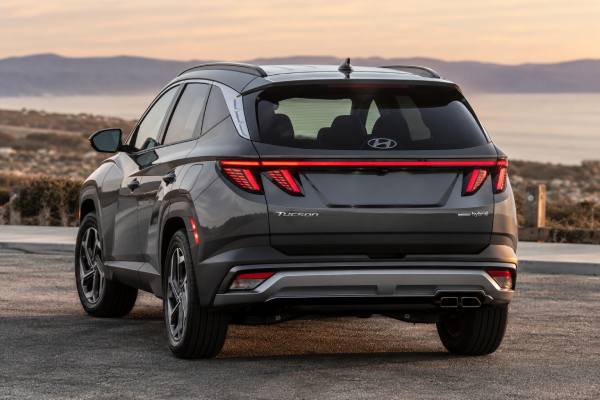

The facelifted Hyundai Tucson NX4 with the Smartstream 1.6 T-GDi 48V mild-hybrid engine and HTRAC all-wheel drive sits in a practical middle ground. It is not the full hybrid Tucson and it is not a plug-in hybrid. Instead, it uses a turbocharged petrol engine, a 48-volt starter-generator system, a 7-speed dual-clutch automatic gearbox, and on-demand AWD to give family-SUV usability with better stop-start smoothness and traction than the basic petrol versions.
For 2024–2025 buyers, the key question is simple: is the 160 hp 48V HTRAC Tucson the sweet spot, or should you step up to the full hybrid? The answer depends on driving pattern, budget, towing needs, and how much you value AWD over outright fuel economy.
Final Verdict
The Hyundai Tucson 1.6 T-GDi 48V HTRAC AWD is a good choice for drivers who want the facelifted NX4’s roomy cabin, strong safety equipment, automatic gearbox, and extra wet-road or winter traction without paying for the full hybrid or plug-in hybrid. Its strongest appeal is everyday practicality with AWD confidence and familiar petrol-engine servicing. The main tradeoff is fuel economy: the 48V system helps smoothness more than it transforms consumption, and the 7-speed DCT needs sympathetic use in heavy traffic. Buy one with full Hyundai service history, completed recall checks, and evidence that the DCT, AWD system, tyres, and 48V components have been inspected properly.
| Pros | Cons |
|---|---|
| HTRAC AWD improves traction in rain, snow, and loose surfaces | Uses more fuel than 2WD mild-hybrid and full hybrid models |
| 160 hp turbo engine gives useful mid-range torque | 7-speed DCT dislikes repeated creeping in heavy traffic |
| Facelift cabin has strong screens, storage, and family space | 48V system does not provide electric-only driving |
| High trims bring strong ADAS and comfort equipment | AWD version is usually tied to pricier upper trims |
| Five-year Hyundai warranty is a major ownership advantage | Correct VIN-specific servicing matters for DCT and 48V parts |
Table of Contents
- Tucson HTRAC AWD Overview
- Specifications and Technical Data
- Trims, Safety, and Driver Assistance
- Reliability, Issues, and Service Actions
- Maintenance and Buyer’s Guide
- Driving, Performance, and Efficiency
- How the Tucson Compares to Rivals
Tucson HTRAC AWD Overview
The 2024–2025 Tucson 1.6 T-GDi 48V HTRAC is best understood as a mild-hybrid petrol AWD model, not a self-charging full hybrid. The 48V system supports smoother restarting, energy recovery, and light engine assistance, but the petrol engine remains the main source of drive.
This facelift belongs to the fourth-generation Tucson, known by the NX4 code. The update brought a cleaner cabin layout, larger digital displays, revised controls, updated safety equipment, and trim changes, while keeping the sharp exterior design that made this generation stand out.
The Smartstream 1.6 T-GDi engine is a turbocharged direct-injection four-cylinder. In this 160 PS class version, it produces 265 Nm of torque across a broad mid-range, which matters more in daily driving than peak horsepower. It is paired with a 7-speed dual-clutch transmission, so it feels more direct than a CVT but needs smoother driving inputs at parking speeds.
HTRAC AWD is Hyundai’s electronically controlled all-wheel-drive system. In normal driving it behaves like a front-biased SUV, sending extra torque rearward when traction, throttle demand, steering angle, or stability-control logic calls for it. It is not a low-range off-road system, but it is useful for wet roads, winter tyres, gravel tracks, ski trips, and towing in poor weather.
The important buyer distinction is between this 48V model and the full hybrid Tucson. The full hybrid uses a larger electric motor and a conventional automatic gearbox, delivers stronger combined output, and is usually more efficient in town. The 48V HTRAC version is simpler, often cheaper, and still has AWD, but it will not match the hybrid’s urban economy or low-speed electric smoothness.
For families, the Tucson’s biggest strengths are space and usability. Rear-seat room is generous for the class, the boot remains practical even with the mild-hybrid hardware, and the cabin has enough storage for long trips. The facelifted interior also feels more modern than the early NX4 layout, especially because the climate and infotainment controls are easier to live with.
Specifications and Technical Data
This version uses a 1.6-litre turbo petrol engine with a 48V mild-hybrid system, 7-speed DCT automatic transmission, and HTRAC AWD. The 48V setup improves stop-start behaviour and energy recovery, but it does not make the Tucson an EV-capable hybrid. In UK and many European specifications, the AWD mild-hybrid is typically found on higher trims such as N Line S and Ultimate.
| Item | Hyundai Tucson 1.6 T-GDi 48V HTRAC AWD |
|---|---|
| Engine family | Smartstream G1.6 T-GDi 48V MHEV |
| Engine layout | Inline-4, DOHC, 16 valves |
| Displacement | 1,598 cc |
| Induction and fuel system | Turbocharged petrol, gasoline direct injection |
| Maximum power | 160 PS at 5,500 rpm, about 118 kW |
| Maximum torque | 265 Nm from 1,500–4,500 rpm |
| Hybrid type | 48V mild hybrid with belt starter-generator |
| Electric-only driving | No; engine remains the main drive source |
| Fuel tank | 54 litres |
| WLTP combined economy | About 7.0 L/100 km, or 33.6 mpg US / 40.4 mpg UK |
| WLTP CO₂ | About 158 g/km on 19-inch AWD versions |
| Item | Specification |
|---|---|
| Transmission | 7-speed dual-clutch automatic |
| Drive type | HTRAC AWD / 4WD, electronically controlled |
| Steering | Motor-driven power steering |
| Turning circle | 11.0 metres |
| Front suspension | MacPherson strut |
| Rear suspension | Multi-link |
| Brakes | Ventilated front discs, rear discs |
| Item | Value |
|---|---|
| Body style | 5-door compact SUV, 5 seats |
| Length | 4,510–4,520 mm, depending on trim styling |
| Width | 1,865 mm excluding mirrors |
| Height | About 1,650–1,653 mm |
| Wheelbase | 2,680 mm |
| Kerb weight | About 1,649 kg for 48V DCT AWD |
| Gross vehicle weight | About 2,160 kg |
| Payload | About 477 kg |
| Boot capacity | 577 litres seats up; 1,756 litres seats folded |
| Roof load | 100 kg |
| Item | Value |
|---|---|
| 0–62 mph | About 9.8 seconds |
| Top speed | 119 mph, about 192 km/h |
| Braked towing capacity | 1,510 kg |
| Unbraked towing capacity | 750 kg |
| Maximum tow ball weight | 100 kg |
| Common tyre size on AWD high trims | 235/50 R19 |
| Normal tyre pressure | 240 kPa / 35 psi front and rear |
| Wheel nut torque | 107–127 Nm |
| Item | Specification or capacity |
|---|---|
| Engine oil | SAE 0W-20, API SN PLUS/SP or ILSAC GF-6 |
| Engine oil refill | About 4.8 litres with drain and refill |
| DCT fluid | SAE 70W DCT fluid, about 1.6–1.7 litres |
| Brake fluid | DOT 4 LV / ISO 4925 Class 6 type |
| Rear differential oil | API GL-5 SAE 75W/85, about 0.53–0.63 litres |
| Transfer case oil | API GL-5 SAE 75W/85, about 0.48–0.52 litres for DCT AWD |
| Coolant | Ethylene-glycol coolant for aluminium engines, about 7.7–8.0 litres |
Trims, Safety, and Driver Assistance
In the UK-style facelift range, the 1.6 T-GDi 48V AWD is generally an upper-trim choice rather than the entry Tucson. That matters because used buyers will often find HTRAC AWD paired with larger wheels, better lighting, more safety tech, and higher purchase prices.
The main trim names commonly seen on the facelifted UK Tucson are Advance, Premium, N Line, N Line S, and Ultimate. The AWD mild-hybrid is most closely associated with N Line S and Ultimate, while lower trims are usually 2WD or different powertrains.
N Line S is the sportier-looking version. It brings the N Line body and interior treatment, 19-inch wheels, heated and ventilated front seats, tri-zone climate control, panoramic sunroof, Matrix LED headlights, and a stronger parking and camera equipment level. Ultimate takes a less sporty appearance but adds a more luxury-focused cabin feel, leather seat-facing options, memory function, and similar high-end convenience equipment.
The quick visual identifiers are simple. Look for HTRAC or 4WD badging in market literature, check the VIN build data, and verify the drivetrain from the underbody: the AWD model has rear driveline hardware that a 2WD Tucson lacks. Inside, DCT models use the shift-by-wire selector, and higher trims carry dual 12.3-inch displays, connected navigation, wireless Apple CarPlay and Android Auto, wireless charging, and Hyundai Bluelink services.
Safety is a strong point. Euro NCAP rated the NX4 Tucson at five stars under the 2021 test protocol, and the rating was reviewed for the 2024 facelift. The scores were 86% for adult occupant protection, 87% for child occupant protection, 66% for vulnerable road users, and 70% for safety assist. The rating applies to multiple Tucson variants, including the 1.6 T-GDi 48V MHEV 4×4 body style.
Standard or widely available safety features include:
- Front, side, curtain, and front-centre airbags.
- ISOFIX/i-Size child-seat points on the outer rear seats.
- Forward Collision-Avoidance Assist for cars, pedestrians, and cyclists.
- Lane Keep Assist and Lane Follow Assist.
- Intelligent Speed Limit Assist.
- Driver attention monitoring.
- Tyre pressure monitoring with individual tyre display.
- Trailer Stability Assist.
- Hill-start and downhill brake control.
- eCall emergency calling.
Higher trims add important driver-assistance upgrades. Highway Drive Assist is available on DCT and hybrid models from mid-level trims upward in the UK range. Junction-turning assistance, surround-view monitor, blind-spot view monitor, parking collision avoidance, and side parking distance warning depend on trim and powertrain. These systems are useful, but they raise the importance of proper calibration after windscreen replacement, bumper repair, radar removal, suspension work, or wheel-alignment correction.
For buyers, the best safety advice is to test every ADAS function during the inspection. Warning lights should clear normally, the front camera area should be clean and undamaged, parking sensors should not false-trigger constantly, and the lane and adaptive cruise systems should behave consistently on a road test.
Reliability, Issues, and Service Actions
The facelifted 2024–2025 Tucson 1.6 T-GDi 48V AWD is still relatively new, so long-term reliability patterns are based partly on the broader NX4 platform and Hyundai’s 1.6 T-GDi family. The main ownership risks are not exotic failures; they are missed servicing, DCT misuse, software updates, low-voltage battery issues, and AWD neglect.
| System | Prevalence | Severity | Symptoms and likely remedy |
|---|---|---|---|
| 7-speed DCT | Occasional | Medium | Judder, clutch smell, hesitation; inspect clutch adaptation and software |
| 48V MHEV system | Occasional | Medium | Stop-start faults, warning lights; check battery, HSG belt, DC-DC system |
| 12V battery | Occasional | Low to medium | No-starts or random warnings; test battery and charging strategy |
| ADAS sensors | Service-sensitive | Medium | Lane or radar warnings; inspect alignment and calibrate after repairs |
| Turbo GDI engine | Mostly age-related | Medium to high | Rough idle, oil neglect, carbon build-up; use correct oil and intervals |
| AWD driveline | Rare to occasional | Medium | Binding, vibration, oil leaks; inspect transfer case and rear differential |
The DCT is the part most affected by driving style. It works well on open roads because it shifts quickly and keeps the engine in its torque band. It is less happy if the car is held on the throttle on hills, crept forward inch by inch in traffic, or used for repeated tight reversing with a trailer. A good DCT Tucson should pull away smoothly once engaged, shift cleanly, and avoid strong shudder when warm.
The 48V mild-hybrid system adds parts that conventional petrol Tucsons do not have. These include the belt starter-generator, 48V battery, DC-DC converter, related wiring, and control software. Most faults show up as warning messages, disabled stop-start, rough restarting, or low-voltage trouble codes. A pre-purchase scan should include the hybrid control modules, not only the engine ECU.
The Smartstream 1.6 T-GDi engine needs clean oil, correct specification, and good thermal care. As a turbocharged direct-injection engine, it is more maintenance-sensitive than a simple naturally aspirated petrol engine. Short trips, long oil intervals, low-quality oil, and repeated hard driving before warm-up are the conditions that shorten turbo, timing, and oil-control life. Timing hardware is chain-based, so there is no routine timing-belt replacement, but chain stretch, guide wear, tensioner issues, or timing-correlation fault codes should never be ignored.
For service actions and recalls, treat every Tucson by VIN. Market matters. A North American Alabama-built Tucson can have different recalls from a Czech-built European vehicle. Notable official U.S. recall examples include a 2025 Tucson/Santa Cruz console wiring issue that could allow shifting out of Park without pressing the brake, and a 2022–2024 Tucson optional trailer wiring harness issue involving water ingress and potential electrical short risk. These are not automatically applicable to every European 1.6 T-GDi 48V HTRAC, but they show why VIN verification is important.
Before buying, ask for:
- Full Hyundai digital or stamped service history.
- Proof of completed recall and service campaign checks.
- Diagnostic scan of engine, transmission, AWD, ADAS, and 48V modules.
- Evidence of correct oil specification.
- Tyre matching across all four wheels.
- No unresolved warning lights or infotainment faults.
- ADAS calibration proof after windscreen or front-end repairs.
Maintenance and Buyer’s Guide
The best maintenance plan for this Tucson is conservative rather than extreme. Use the official VIN-specific service schedule, but do not stretch oil, brake-fluid, DCT, AWD, tyre, or 48V checks if the car does short trips, winter work, steep hills, towing, or heavy city driving.
| Item | Practical interval | Why it matters |
|---|---|---|
| Engine oil and filter | Up to 15,000 km / 10,000 miles or 12 months; shorter for severe use | Protects turbo, chain, and GDI engine internals |
| Engine air filter | Inspect yearly; replace about every 30,000 km or sooner | Dusty filters reduce performance and turbo efficiency |
| Cabin air filter | Every 12 months | Improves HVAC airflow and demisting |
| Spark plugs | Usually around 60,000 km; verify by VIN | Turbo GDI engines need correct heat range and clean ignition |
| Brake fluid | Every 2 years | Moisture lowers boiling point and affects braking feel |
| Coolant | Inspect yearly; replace according to official schedule | Protects aluminium engine, turbo cooling, and heat exchangers |
| DCT fluid | Inspect by schedule; consider earlier service in severe use | Helps shift quality and clutch/gearbox durability |
| Transfer case and rear differential oil | Inspect by schedule; service earlier for towing or winter use | AWD hardware is expensive if run low or contaminated |
| Tyre rotation and alignment | Every 10,000–12,000 km or at service | AWD systems prefer matching tyre wear and pressures |
| 12V battery test | Annually after year three | Weak batteries cause misleading electronic faults |
| 48V MHEV belt and system | Inspect at scheduled services | Supports starting, charging, and mild-hybrid operation |
When inspecting a used Tucson HTRAC, start with tyres. All four should be the same size, load rating, and preferably the same brand and tread depth. Mismatched tyres can cause AWD calibration problems, vibration, and unnecessary driveline stress.
Next, check the DCT. On a cold start, select Drive and Reverse with the brake held. Engagement should be clean, not delayed with a heavy thump. During the test drive, include slow traffic, a hill start, a smooth acceleration run, and a gentle stop. Clutch smell, repeated hesitation, or harsh low-speed shudder should trigger a specialist inspection.
Look underneath for transfer case, rear differential, driveshaft boot, and prop-shaft leaks. The Tucson is not a hard-core off-roader, but AWD models can still be exposed to salt, snow, gravel roads, and wet grass. Check subframes, suspension arms, brake pipe areas, exhaust hangers, and rear body seams for corrosion, especially in salted climates.
Inside, verify every screen, camera, parking sensor, seat motor, wireless charger, USB-C port, heated seat, and climate-control function. The facelift cabin is tech-rich, and most faults are small, but diagnosis can become time-consuming when several control modules are involved.
The best buy is a one-owner or dealer demonstrator N Line S or Ultimate AWD with matching tyres, annual Hyundai servicing, no accident history, and clear ADAS calibration records. Be cautious with cars used for frequent towing, private-hire work, heavy urban commuting, or repeated short journeys unless the maintenance history is unusually strong.
Long-term durability should be good if serviced properly. The weak point is not the basic structure of the Tucson; it is deferred maintenance on a complex modern drivetrain. Owners who keep oil fresh, avoid abusing the DCT, maintain tyres, and check recall status should see the best results.
Driving, Performance, and Efficiency
The 1.6 T-GDi 48V HTRAC Tucson drives like a relaxed family SUV with enough torque for daily use, not like a sporty crossover. Its strongest dynamic quality is confidence: stable motorway manners, secure wet-road traction, and predictable responses.
The engine’s 265 Nm torque band makes the Tucson feel stronger than the numbers suggest when pulling away from junctions or climbing moderate hills. It is not fast, but it rarely feels strained with two adults and luggage. The 0–62 mph time of about 9.8 seconds is adequate for overtaking planning, and the mid-range is more useful than the peak power figure.
The DCT gives the car a direct feel once moving. Upshifts are quick, and at steady speeds the gearbox helps keep revs down. The compromise appears at parking speeds and in stop-start congestion. Because a DCT uses clutches rather than a torque converter, the driver should avoid holding the vehicle on the accelerator, inching forward repeatedly, or forcing constant low-speed clutch slip.
The 48V system is most noticeable in smoother restarts and better engine-off coasting behaviour where enabled. It does not make the car glide silently through town like the full hybrid. Drivers coming from a full hybrid Toyota, Kia, or Hyundai may find the mild hybrid more conventional and less efficient in urban use.
Ride comfort depends heavily on wheel size. The AWD high trims commonly use 19-inch wheels with 235/50 R19 tyres. They look good and sharpen response, but they transmit more sharp-edge impact than smaller wheels. On good roads the Tucson is composed; on broken urban surfaces it can feel firmer than a RAV4 or some comfort-focused rivals.
Steering is light and easy around town, with enough accuracy for motorway and country-road driving. It does not offer much enthusiast feedback, but it suits the car’s role. Body roll is controlled, and the rear multi-link suspension helps the Tucson feel settled when loaded.
Real-world fuel economy depends on use:
- In city-heavy driving, expect roughly 8.0–9.5 L/100 km, or about 25–29 mpg US / 30–35 mpg UK.
- In mixed use, many drivers should see around 7.0–8.0 L/100 km, or about 29–34 mpg US / 35–40 mpg UK.
- On steady 100–120 km/h motorway runs, expect roughly 6.8–7.8 L/100 km, or about 30–35 mpg US / 36–42 mpg UK.
- In winter, with cold starts, winter tyres, short trips, and heater use, consumption can worsen noticeably.
Towing is within the Tucson’s ability when treated sensibly. The 1,510 kg braked tow rating is useful for small caravans, trailers, and leisure loads, but the DCT needs mechanical sympathy. Use steady throttle, avoid reversing uphill for long periods, and leave extra cooling time after long climbs. Expect fuel use to rise sharply when towing, especially at motorway speed.
How the Tucson Compares to Rivals
The Tucson 1.6 T-GDi 48V HTRAC AWD makes most sense when compared with other practical compact SUVs, not just the most fuel-efficient hybrids. Its advantage is the mix of space, warranty, equipment, and AWD availability; its weakness is that some rivals are smoother or more economical.
| Model | Where it beats the Tucson | Where the Tucson fights back |
|---|---|---|
| Kia Sportage 1.6 T-GDi AWD | Similar platform with Kia styling and long warranty appeal | Tucson cabin design and trim mix may feel more premium |
| Toyota RAV4 Hybrid AWD | Better urban economy and proven full-hybrid smoothness | Tucson is often cheaper used and feels more modern inside |
| Nissan Qashqai e-Power | Very smooth electric-drive feel in town | Tucson offers more conventional AWD utility |
| Volkswagen Tiguan eTSI | Refined road manners and strong brand appeal | Tucson usually gives more equipment for the money |
| Peugeot 3008 Hybrid | Distinctive interior and strong design identity | Tucson is roomier and easier to recommend as a family tool |
Against the Kia Sportage, the decision is mostly personal. They share broad engineering ideas and similar powertrain logic, so equipment, warranty terms, dealer support, driving feel, and styling should decide it. The Tucson’s facelifted dashboard may appeal more to drivers who want a clean dual-screen layout without a cockpit-style cabin.
Against the Toyota RAV4 Hybrid, the Tucson 48V AWD is less efficient in town. Toyota’s full-hybrid system is smoother at low speed and better for heavy urban driving. The Tucson counters with sharper interior presentation, often better value in high-spec used form, and a more European-feeling size and cabin layout.
Against the Volkswagen Tiguan, the Tucson is the value play. The Tiguan can feel more polished, but matching the Tucson’s equipment can become expensive. The Hyundai warranty also helps buyers who want predictable ownership costs.
The best reason to choose this exact Tucson is balanced use. It suits drivers who do mixed mileage, need AWD part of the year, want a large boot and high equipment level, and do not want the extra cost or complexity of a plug-in hybrid. It is not the best choice for drivers who spend most of their time in city traffic; those buyers should test the full hybrid before deciding.
References
- Hyundai TUCSON | Technical, Specifications and Pricing | Model year 2025 | May 2024 2024 (Manufacturer Specifications)
- OWNER’S MANUAL 2024 (Owner’s Manual)
- Euro NCAP | Hyundai TUCSON 2021, reviewed 2024 (Safety Rating)
- Part 573 Safety Recall Report 24V-877 2024 (Recall Report)
- Part 573 Safety Recall Report 25V893 2025 (Recall Report)
Disclaimer
This article is for informational purposes only and is not a substitute for professional diagnosis, repair advice, or official Hyundai service information. Specifications, torque values, fluid capacities, service intervals, recalls, procedures, and equipment can vary by VIN, country, trim, production date, and installed options. Always verify details against the official owner’s manual, service documentation, dealer records, and a Hyundai authorised repairer before buying, servicing, towing, or repairing the vehicle.
If this guide helped you, please consider sharing it on Facebook, X/Twitter, or with another Tucson buyer. It supports our work and helps more readers make better ownership decisions.