
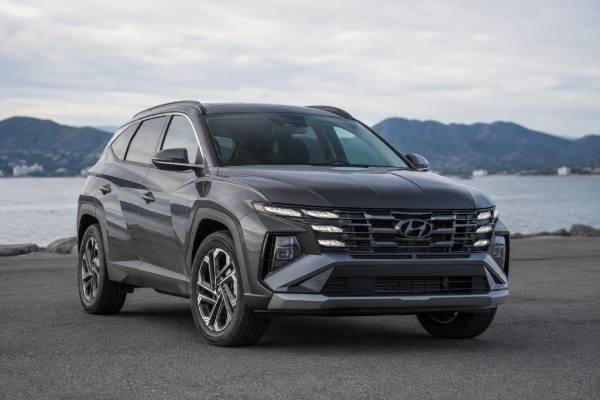
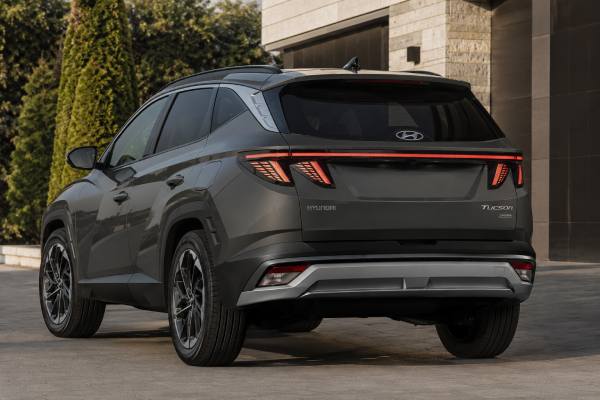
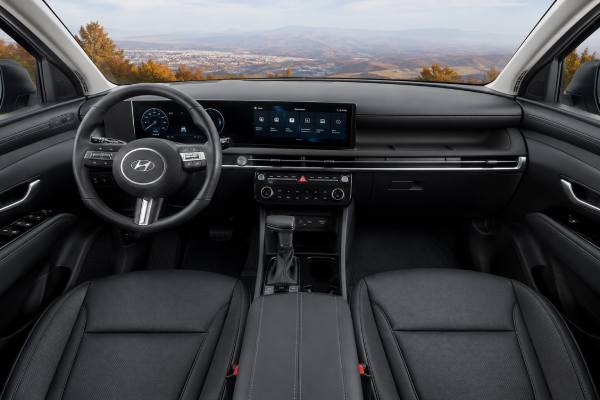
The facelifted Hyundai Tucson NX4 with the Smartstream 1.6 T-GDi 150 hp petrol engine is the simpler, front-wheel-drive version of Hyundai’s mid-size family SUV. It keeps the Tucson’s strongest everyday qualities: a roomy cabin, large boot, modern safety equipment, and a comfortable ride, but avoids the extra cost and complexity of the hybrid and plug-in hybrid models.
This guide focuses on the European-style 110 kW / 150 PS non-hybrid petrol version, especially the facelifted 2025-onward Tucson FWD sold with either a 6-speed manual or 7-speed dual-clutch transmission. Equipment, wheels, towing data, and service details can vary by market, so the most useful way to judge this model is to understand the engine, drivetrain, trim differences, real-world fuel economy, reliability risks, and the checks that matter before buying.
Final Verdict
The Hyundai Tucson FWD 1.6 T-GDi 150 hp is a good choice if you want a spacious, modern petrol SUV without paying for hybrid hardware. Its strongest appeal is the balance of cabin space, safety technology, warranty cover, and relaxed everyday performance from the turbocharged 1.6-litre engine. It suits family use, commuting, light towing, and long trips better than enthusiastic driving. The main tradeoff is that the 150 hp engine feels adequate rather than quick, and the 7-speed DCT needs sympathetic use in heavy traffic. Buy one with verified service history, completed software updates, and the correct tyres and maintenance records.
| Pros | Cons |
|---|---|
| Large 620-litre boot in petrol FWD form | 150 hp output is modest when fully loaded |
| 250 Nm torque arrives low for easy town driving | Dual-clutch gearbox dislikes constant creeping traffic |
| No hybrid battery or charging hardware to inspect | Fuel economy trails Tucson hybrid versions in cities |
| Strong safety kit and available highway assistance | Some advanced ADAS depends on trim and gearbox |
| Comfortable suspension with useful family practicality | 19-inch wheels can add road noise and firmness |
Table of Contents
- Hyundai Tucson 150 hp FWD Overview
- Specifications and Technical Data
- Trims, Safety and Driver Assistance
- Reliability, Common Issues and Service Actions
- Maintenance and Buyer’s Guide
- Driving and Performance
- How the Tucson 150 FWD Compares to Rivals
Hyundai Tucson 150 hp FWD Overview
The 150 hp front-wheel-drive Tucson is the practical petrol entry point in the facelifted NX4 range. It is best understood as the sensible family version: roomy, comfortable, well equipped, and mechanically less complex than the hybrid models.
The NX4-generation Tucson is a compact-to-mid-size SUV, depending on how each market classifies it. In real use, it feels closer to a roomy family crossover than a small SUV. The 2,680 mm wheelbase gives good rear legroom, the boot is large, and the cabin layout after the facelift has a cleaner, more digital design than the earlier NX4.
The 1.6 T-GDi engine is a turbocharged, direct-injection petrol unit from Hyundai’s Smartstream family. In this 150 PS tune, it produces 110 kW and 250 Nm of torque. That is enough for normal commuting, motorway travel, school runs, and holidays, but it is not the Tucson to choose if you regularly tow near the maximum rating or want strong overtaking performance with five people and luggage.
Front-wheel drive also shapes the ownership experience. It keeps weight, fuel use, tyre wear, and drivetrain complexity down compared with AWD versions. The downside is traction. In wet weather, on steep roads, or when towing, the front tyres have to handle both steering and pulling the car. Good tyres matter more than many buyers expect.
This version is also important because it avoids hybrid-specific inspection points. There is no traction battery, onboard charger, inverter coolant loop, or high-voltage drive motor to assess. That can make it appealing as a used buy for owners who want a modern SUV but prefer conventional petrol maintenance. The tradeoff is lower city efficiency than the Tucson Hybrid and Plug-in Hybrid.
The facelifted model also brought updated cabin technology, revised trim structures in many markets, and broader driver-assistance availability. In Germany, the 150 PS petrol version sits alongside a stronger 180 PS AWD petrol option and hybrid versions. In other markets, early facelift literature may show a 160 PS petrol tune, so buyers should check the registration document or build sheet carefully. The covered version here is the 110 kW / 150 PS FWD model.
Specifications and Technical Data
The Tucson 1.6 T-GDi 150 FWD uses a turbocharged four-cylinder petrol engine, front-wheel drive, and either a manual gearbox or a 7-speed dual-clutch transmission, depending on trim and market. Its technical appeal is not raw performance; it is the combination of usable low-rpm torque, a spacious body, and relatively simple petrol-SUV hardware.
| Item | Hyundai Tucson FWD 1.6 T-GDi 150 hp |
|---|---|
| Engine family | Hyundai Smartstream 1.6 T-GDi petrol |
| Configuration | Inline-four, DOHC, 16 valves |
| Displacement | 1,598 cc |
| Induction | Turbocharged |
| Fuel system | Gasoline direct injection |
| Maximum power | 110 kW / 150 PS |
| Maximum torque | 250 Nm (184 lb-ft) |
| Torque band | 1,500–4,000 rpm |
| Official WLTP combined fuel use | About 7.0–7.1 L/100 km (33–34 mpg US; 40 mpg UK) |
| CO₂ emissions | About 158–162 g/km, depending on trim and gearbox |
The wide torque band is more useful than the headline power figure. The engine pulls cleanly from low revs, so the Tucson does not need to be driven hard in normal traffic. It is still a small turbo petrol moving a family SUV, so expect downshifts on hills and when overtaking at motorway speeds.
| Item | Specification |
|---|---|
| Drive type | Front-wheel drive |
| Manual gearbox | 6-speed manual on selected entry versions |
| Automatic option | 7-speed dual-clutch transmission |
| AWD availability | Not normally paired with the 150 PS FWD version |
| Best use case | Daily family use, commuting, touring, light towing |
The 6-speed manual is the simpler long-term choice if you are comfortable changing gears. The 7-speed DCT is easier in daily use and suits higher trims, but it should be driven differently from a torque-converter automatic. Avoid holding the vehicle on the throttle on hills, avoid long creeping sessions when possible, and let the brake hold the car when stopped.
| Item | Value |
|---|---|
| Body style | Five-door SUV |
| Seats | Five |
| Length | About 4,510–4,535 mm, depending on trim styling |
| Width | 1,865 mm |
| Height | About 1,650 mm |
| Wheelbase | 2,680 mm |
| Turning circle | About 11.0 m |
| Front suspension | MacPherson strut |
| Rear suspension | Multi-link |
| Fuel tank | 54 litres |
| Boot capacity | Up to 620 litres seats up; 1,799 litres seats folded |
The boot capacity is one of the Tucson petrol model’s strengths. Hybrid packaging can reduce usable cargo space in some vehicles, but the non-hybrid petrol Tucson keeps a generous load area. The rear seat is also adult-friendly, which matters more in daily family use than a slightly quicker 0–100 km/h time.
| Item | Common value |
|---|---|
| Common tyre size | 215/65 R17 on lower trims |
| Common tyre size | 235/55 R18 on mid trims |
| Common tyre size | 235/50 R19 on higher and N Line trims |
| Braked towing capacity | Up to about 1,510 kg, market and gearbox dependent |
| Unbraked towing capacity | About 750 kg |
| Roof load | About 100 kg, including carrier system |
The 17-inch and 18-inch wheel packages are usually the better comfort choice. The 19-inch wheels look sharper, especially on N Line versions, but they can make the ride firmer and increase tyre replacement costs.
| Item | Practical note |
|---|---|
| Official service interval | Up to 30,000 km or 24 months in some European schedules |
| Practical oil interval | 10,000–15,000 km or 12 months for short-trip use |
| Timing drive | Chain-type service approach; inspect for noise or timing faults |
| Brake fluid | Typically every 2–3 years, depending on market service schedule |
| Transmission service | Check VIN-specific schedule, especially for DCT city use |
For exact fluids, capacities, spark plug type, wheel-nut torque, and gearbox procedures, use the VIN-specific Hyundai service information. These details can change by market, gearbox, emissions specification, and production date.
Trims, Safety and Driver Assistance
Trim choice matters because the 150 hp engine can feel like a different car depending on gearbox, wheels, and driver-assistance equipment. The best-value version is usually a mid trim with 18-inch wheels, the safety systems you need, and a clear service record.
Trim structure and equipment
In Germany and several European markets, the facelifted Tucson range includes trims such as Select, Trend, N Line, Prime, and N Line X. Names differ by country, but the pattern is similar: lower trims focus on value, mid trims add comfort and assistance systems, and top trims bring larger wheels, premium audio, more electric adjustment, and extra visual details.
Select is the basic point of entry and is the trim most likely to be found with the 6-speed manual. It gives the Tucson its core appeal without making the price climb too far. Trend is often the sweet spot because it adds useful comfort features and, on DCT versions, more advanced highway assistance availability.
N Line is mainly a styling and cabin package rather than a power upgrade. It brings sportier bumpers, larger wheels, N Line interior trim, and a more distinctive look. Prime and N Line X add luxury-oriented equipment such as upgraded lighting, head-up display, premium audio, electric seat functions, and more advanced convenience features, depending on market.
Important functional differences to check include:
- Gearbox: entry cars may be manual, while higher trims are often 7DCT.
- Wheel size: 17-inch wheels favour comfort; 19-inch wheels favour style.
- Lighting: matrix LED or higher-grade LED systems may be trim-dependent.
- ADAS: adaptive cruise and highway assistance often depend on trim and DCT availability.
- Parking aids: surround-view camera, blind-spot camera view, and remote parking features are usually not fitted to every trim.
Quick identifiers
The easiest way to identify the exact version is to check the registration document, VIN build sheet, and engine output. The 150 PS model should show 110 kW. A missing HTRAC or AWD badge usually supports that it is front-wheel drive, but badges alone are not enough because trims and market badging vary.
Inside, the gearbox is the quickest visual clue. A manual lever points to the simpler 6-speed version. DCT cars use the automatic selector layout fitted to the facelift interior. N Line cars are easy to spot from their sportier bumpers, darker interior details, larger wheels, and N Line seat trim.
Safety ratings
The Hyundai Tucson NX4 achieved a five-star Euro NCAP rating under the 2021 test protocol, and the rating has been reviewed for the facelifted model range. That is reassuring, but buyers should understand what it means. A 2021 five-star rating is strong, yet Euro NCAP protocols become tougher over time, so it should not be read as identical to a fresh five-star result under a later test year.
The rating applies across relevant Tucson variants in the tested range, including 1.6 T-GDi front-wheel-drive versions. Individual equipment still matters because some driver-assistance features, lighting systems, and parking aids depend on trim and market.
Safety systems and ADAS
The Tucson’s passive safety package includes multiple airbags, including a front centre airbag on many European facelift specifications. ISOFIX child-seat mounting points are provided for the rear outer seats, and electronic stability control, anti-lock braking, tyre-pressure monitoring, trailer stability assistance, and emergency call functions are part of the core safety package.
Typical available driver-assistance systems include:
- Forward collision-avoidance assist with pedestrian and cyclist detection
- Lane keeping assist and lane following assist
- Intelligent speed limit assistance
- Driver attention warning
- Blind-spot collision warning or assist on higher trims
- Rear cross-traffic alert or assist on higher trims
- Adaptive cruise control on equipped DCT models
- Highway Driving Assist on selected higher specifications
- Surround-view camera and blind-spot view monitor on top trims
ADAS calibration is an ownership point that buyers often miss. If the windscreen has been replaced, the front bumper repaired, the radar disturbed, or the suspension geometry changed, the camera and radar systems may need calibration. Warning lights, unavailable assistance functions, or poor lane-centering behaviour after repairs should not be ignored.
Reliability, Common Issues and Service Actions
The facelifted 150 hp Tucson is too new to have a deep long-term failure record, but its risk profile is clear. Expect generally solid reliability if serviced properly, with the main inspection focus on oil history, DCT behaviour, software updates, tyres, brakes, and electronic systems.
Reliability outlook
The 1.6 T-GDi is a modern small turbo petrol engine, so it rewards clean oil, correct spark plugs, good cooling, and sensible warm-up habits. It is not a fragile engine by design, but it is less tolerant of neglect than an old naturally aspirated port-injected petrol engine.
The FWD layout helps reliability because it avoids rear differential, AWD coupling, and extra driveshaft maintenance. That is one reason this model can make sense as a long-term family SUV. The 7DCT is the component that needs the most careful test drive, especially in cars used heavily in cities.
| Area | Prevalence | Severity | What to watch for |
|---|---|---|---|
| DCT clutch behaviour | Occasional | Medium | Judder, hesitation, shunting, heat warnings |
| Direct-injection deposits | Occasional over time | Medium | Rough idle, misfires, hesitation |
| Ignition components | Occasional | Low to medium | Misfire under load, warning light |
| Brake corrosion | Common in wet climates | Low to medium | Vibration, scraping, rusty disc edges |
| ADAS calibration | Occasional after repairs | Medium | Warning messages, disabled assistance |
| Suspension wear | Occasional on rough roads | Low to medium | Knocks, uneven tyre wear, wandering |
Symptoms, causes and remedies
A rough idle, hesitation, or misfire can point to spark plugs, ignition coils, intake deposits, sensor faults, or software calibration. Do not replace parts randomly. A proper scan should check fault codes, misfire counts, fuel trims, boost pressure, and engine temperature data.
A whistle, loss of power, or oil smell after hard driving may suggest an intake hose leak, turbo oil seep, PCV issue, or exhaust-side leak. Small turbo engines run hot, so oil quality and cooling system condition are important. Look for coolant staining, oil sweating around hoses, and evidence of rushed repairs.
On 7DCT cars, mild low-speed take-up feel is normal because the gearbox uses clutch packs rather than a fluid torque converter. What is not normal is repeated judder, harsh engagement, a burning smell, warning messages, or a delay when selecting drive or reverse. A dealer-level check can confirm software status, clutch adaptation values, and fault history.
Brake wear is usually straightforward, but a family SUV that sits outside or does short trips may develop rusty discs. Listen for scraping after the car has been parked and feel for steering-wheel vibration under light braking. Uneven rear brake wear can also appear if the car is used gently for long periods.
Software, recalls and service actions
Modern Hyundais depend heavily on software. Before buying, ask for proof of completed service campaigns, infotainment updates, engine ECU updates, transmission updates, and ADAS calibration records where relevant. A smooth test drive does not replace a proper VIN check.
For the exact 2025-onward European 150 PS FWD model, do not assume that recalls from another country or engine variant apply. Recall status is VIN-specific. Use the national Hyundai recall checker where available, ask a Hyundai dealer to check open campaigns, and keep printed or digital proof of completion.
The most useful pre-purchase documents are:
- Full service invoice history, not only stamped entries
- VIN campaign and recall status
- Gearbox software or adaptation records for DCT cars
- Evidence of correct oil specification and timely changes
- Tyre invoices showing matching sizes and quality brands
- Repair invoices after windscreen, bumper, suspension, or ADAS work
Maintenance and Buyer’s Guide
The Tucson 1.6 T-GDi 150 is not difficult to maintain, but it should not be treated as a low-tech petrol SUV. The engine is turbocharged and direct-injected, and the DCT version needs careful use, so preventive maintenance is worth paying for.
Practical maintenance schedule
Official service intervals can be long in some European markets, reaching up to 30,000 km or 24 months. That may suit ideal motorway use, but many owners do short trips, cold starts, school runs, and city driving. For that use, a shorter oil interval is a wise long-term choice.
| Item | Practical interval | Why it matters |
|---|---|---|
| Engine oil and filter | 10,000–15,000 km or 12 months | Protects turbocharger, chain, and direct-injection engine |
| Engine air filter | 20,000–30,000 km, sooner in dust | Helps turbo efficiency and sensor accuracy |
| Cabin air filter | 12–24 months | Improves demisting, HVAC airflow, and cabin air quality |
| Spark plugs | Follow VIN schedule; inspect sooner if misfiring | Turbo petrol engines are sensitive to plug condition |
| Coolant | Use official interval and coolant type | Protects turbo, cylinder head, radiator, and heater circuit |
| Brake fluid | Every 2–3 years | Maintains braking feel and corrosion protection |
| Brake pads and discs | Inspect every service | Short trips can cause corrosion before pad wear |
| Tyre rotation and alignment | Every 10,000–15,000 km | Protects front tyres on FWD versions |
| 12 V battery | Test from year three onward | Weak batteries cause many electronic warning issues |
| DCT inspection | At service; more often in heavy city use | Checks clutch feel, updates, leaks, and adaptation status |
The timing chain does not have a simple routine replacement interval like a belt. Instead, listen for rattling at cold start, check for cam/crank correlation faults, and investigate rough running or warning lights early. Chain wear is much cheaper to manage when caught before it becomes a major timing issue.
Auxiliary belts, coolant hoses, vacuum lines, and intake hoses should be inspected at every service once the car is out of its early warranty years. Heat, age, and oil contamination are the main enemies.
Fluid and parts guidance
Use Hyundai-approved oil specification, coolant, brake fluid, spark plugs, and transmission fluid for the exact VIN. Do not rely on a generic parts-store match for the DCT or engine oil. The wrong oil grade or low-quality filter can affect turbocharger life, chain wear, fuel economy, and warranty claims.
For buyers planning DIY maintenance, wheel-nut torque, sump plug torque, oil capacity, spark plug torque, and gearbox service procedures should come from official service data for the exact vehicle. These values are not safe to guess across markets and production dates.
Pre-purchase inspection checklist
A clean-looking Tucson can still hide expensive problems if it has missed services or been repaired poorly. Before buying, inspect the car cold and warm, and drive it in city traffic and on faster roads.
Check these points carefully:
- Cold start: listen for chain rattle, misfire, or uneven idle.
- Oil history: confirm correct oil and sensible change intervals.
- Coolant system: look for staining, low level, overheating signs, or sweet smell.
- DCT operation: test reverse, hill starts, parking manoeuvres, and low-speed traffic.
- Manual clutch: check bite point, slipping under load, and pedal feel.
- Steering and suspension: listen for knocks and check tyre wear patterns.
- Brakes: feel for vibration, scraping, sticking calipers, or rusty discs.
- Electronics: test cameras, sensors, infotainment, phone pairing, and HVAC.
- ADAS: confirm no warning lights and verify calibration after glass or body repairs.
- Body and underside: inspect subframes, jacking points, door seams, and stone-chip areas.
Best versions to buy
For most owners, a mid-trim 150 PS FWD with the equipment you actually use is the best buy. It gives the Tucson’s space and technology without the cost of the highest trims. The 6-speed manual is attractive for buyers who want simplicity and lower long-term gearbox risk. The 7DCT is better for commuting and resale, but only if it drives smoothly and has a clean service and update history.
Avoid cars with mismatched budget tyres, missing service invoices, unresolved warning lights, or unclear accident repairs. Also be cautious with top trims on 19-inch wheels if your roads are rough. They look good, but tyre cost, ride firmness, and wheel damage risk are higher.
Long-term durability should be good if the car is maintained properly. The safest ownership strategy is simple: change oil more often than the maximum interval if the car does short trips, keep software current, use good tyres, and investigate small warning signs early.
Driving and Performance
The 150 hp Tucson drives like a relaxed family SUV, not a sporty crossover. Its low-rpm torque makes it pleasant in normal traffic, but the engine has to work harder when the car is loaded, climbing, or overtaking at motorway speeds.
Powertrain character
The 1.6 T-GDi responds smoothly at low to medium throttle. Turbo lag is not dramatic in normal use because the 250 Nm torque peak starts low in the rev range. Around town, the Tucson feels stronger than its 150 hp figure suggests, especially when lightly loaded.
The difference appears at higher speeds. A full cabin, luggage, roof box, or trailer makes the engine work. The Tucson can do the job, but it does not have the effortless mid-range of the hybrid or stronger AWD petrol versions. Planning overtakes matters, especially on two-lane roads.
The manual gearbox gives the driver more control and avoids DCT clutch behaviour, but it also makes the Tucson feel more basic in traffic. The 7DCT is smoother and more convenient most of the time. It shifts quickly once moving, although it can hesitate if the driver asks for a sudden launch or repeatedly creeps forward in traffic.
Ride, handling and noise
The chassis is tuned for comfort and stability. The Tucson tracks well on the motorway, feels secure in rain, and has predictable steering. It is not as sharp as some sportier rivals, but it is easy to place on the road and does not feel nervous.
The multi-link rear suspension helps the Tucson feel more mature than cheaper torsion-beam crossovers. It also supports good rear-seat comfort. Wheel choice changes the feel noticeably. On 17-inch and 18-inch wheels, the ride is generally calmer and quieter. On 19-inch wheels, the car feels a little more direct, but sharp bumps and road noise are more obvious.
Braking feel is progressive rather than sporty. For family use, that is a good thing. The pedal is easy to modulate in traffic, and stability under braking is reassuring. As the car ages, disc condition and tyre quality will affect the braking experience more than the original specification.
Real-world fuel economy
Official WLTP combined fuel use sits around 7.0–7.1 L/100 km, but real-world results depend heavily on trip type. A sensible expectation is:
| Use case | Likely consumption | Approximate mpg US / UK |
|---|---|---|
| Urban short trips | 8.0–9.5 L/100 km | 25–29 mpg US / 30–35 mpg UK |
| Mixed driving | 7.0–8.0 L/100 km | 29–34 mpg US / 35–40 mpg UK |
| Steady motorway | 6.5–7.5 L/100 km | 31–36 mpg US / 38–43 mpg UK |
| Cold winter short use | Often 10–20% worse | Depends on route and tyres |
The Tucson Hybrid is better for urban economy because it can recover energy and move at low speeds with electric assistance. The 150 T-GDi is simpler, but it burns fuel whenever it moves. For drivers who mainly do motorway or rural driving, the difference may be less important.
Load and towing
With a braked towing rating of roughly 1.5 tonnes in many European specifications, the Tucson 150 FWD can handle a small caravan, trailer, bikes, or garden equipment. It is not the ideal heavy-tow Tucson. Front-wheel drive, modest power, and DCT heat management are the limiting factors.
For frequent towing, use high-quality tyres, keep the cooling system in good condition, stay well below the maximum rating where possible, and avoid repeated hill starts with a heavy trailer. If towing is a regular part of ownership, the stronger AWD petrol or hybrid versions are more convincing.
How the Tucson 150 FWD Compares to Rivals
The Tucson 150 FWD competes best as a spacious, well-equipped family SUV with strong warranty appeal. It is not the most efficient, quickest, or most premium choice, but it is one of the more rounded petrol options.
The Kia Sportage is the closest rival because it shares much of the same engineering base. The Sportage often offers similar engines, similar cabin space, and a comparable safety package. Choosing between them is mostly about styling, interior layout, trim pricing, dealer support, and warranty conditions in your country.
The Toyota RAV4 is more efficient in hybrid form and has a strong reputation for long-term durability. It is usually more expensive, and its petrol-hybrid character is different from the Tucson’s simpler turbo petrol setup. If you do a lot of city driving, the RAV4 Hybrid makes more sense. If you want a lower-cost conventional petrol SUV with a large boot, the Tucson remains attractive.
The Volkswagen Tiguan feels more premium in some versions and offers a polished driving experience, but pricing and options can climb quickly. The Hyundai counters with generous equipment and a strong ownership package. For many private buyers, the Tucson’s value equation is easier to justify.
The Nissan Qashqai is lighter and easier to drive in tight urban areas, but it is smaller inside. Families who regularly use the rear seats and boot will usually find the Tucson more useful. The Qashqai makes sense if parking ease and lower running costs matter more than cargo space.
The Peugeot 3008 and Renault Austral bring style and modern interiors, with strong hybrid options in some markets. The Tucson is more conservative in feel, but it offers a straightforward cabin, practical shape, and broad dealer support.
The best reason to choose the Tucson 1.6 T-GDi 150 FWD is not that it dominates every category. It is that it combines space, comfort, safety, equipment, and conventional petrol running costs in a package that works for a wide range of households. Choose the hybrid if city fuel economy is the priority. Choose the 150 FWD petrol if you want a simpler, roomy SUV and can accept adequate rather than lively performance.
References
- Der Hyundai TUCSON: Bei Design und Technik an der Spitze seines Segments 2026 (Manufacturer Press Kit)
- Hyundai TUCSON | Technical, Specifications and Pricing | Model year 2025 | May 2024 2024 (Manufacturer Technical Data)
- Hyundai TUCSON 2021/2024 (Safety Rating)
- Hyundai Owner’s Manual 2025 (Owner’s Manual)
- Hyundai Recalls & Service Campaigns: Home 2026 (Recall Database)
Disclaimer
This article is for informational purposes only and is not a substitute for professional diagnosis, repair advice, or official Hyundai service documentation. Specifications, torque values, fluids, intervals, procedures, recall applicability, and equipment can vary by VIN, market, production date, trim, and gearbox. Always verify service work against the official owner’s manual, dealer records, and VIN-specific service information.
If this guide helped you, please consider sharing it on Facebook, X/Twitter, or with another Tucson owner to support our work.