
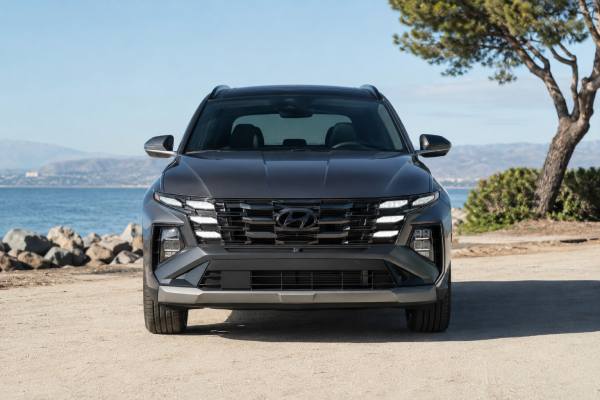
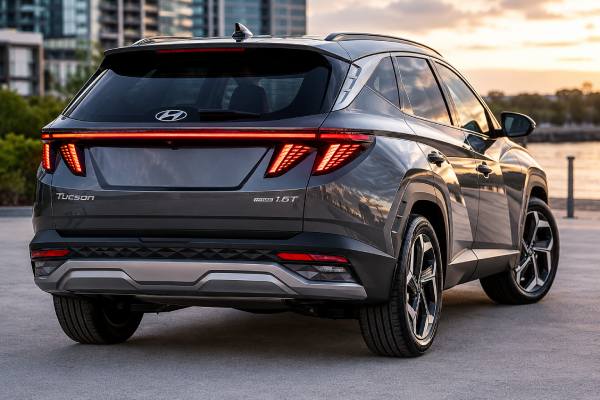
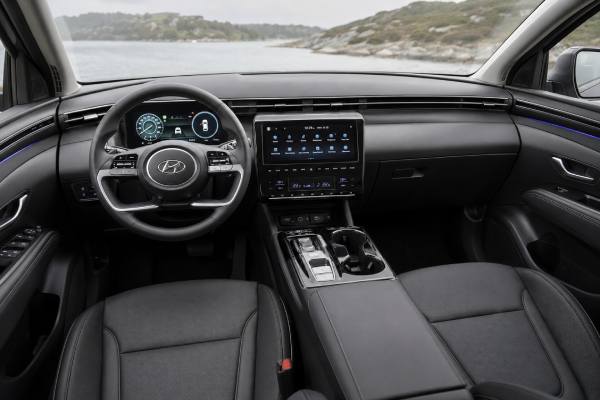
The facelifted Hyundai Tucson NX4 with the Smartstream 1.6 T-GDi 48V mild-hybrid engine is one of the most sensible versions of Hyundai’s mid-size family SUV. It combines a 160 PS turbo petrol engine, front-wheel drive, a 7-speed dual-clutch automatic transmission, and a small 48-volt electrical system that helps with stop-start operation and light energy recovery. It is not a full hybrid, but it is smoother and more efficient than a conventional petrol automatic in many day-to-day situations.
Final Verdict
The 2024–2025 Hyundai Tucson FWD 1.6 T-GDi 48V mild hybrid is a strong choice for drivers who want a roomy, modern SUV without the cost and complexity of a plug-in hybrid. Its best appeal is the blend of cabin space, safety equipment, refined styling, and useful 160 PS performance. It suits families, commuters, and company-car users who mostly drive on roads rather than rough tracks. The main tradeoff is the 7-speed dual-clutch gearbox, which needs sympathetic use in heavy traffic and should have a clean service history. Buy only with confirmed recalls, software updates, and correct oil maintenance.
| Pros | Cons |
|---|---|
| 160 PS turbo engine gives useful everyday punch | 48V system is mild hybrid, not EV-capable |
| Large boot and roomy rear seats for families | DCT can feel jerky when repeatedly creeping |
| Strong safety kit, including centre front airbag | Best driver aids depend on trim level |
| FWD version avoids 4WD weight and complexity | Real economy varies strongly with wheel size |
| Facelift cabin feels more digital and modern | Turbo direct injection rewards strict oil servicing |
Table of Contents
- Tucson 48V Detailed Overview
- Tucson 160 PS Specifications
- Trims, Options and Safety
- Reliability, Issues and Service Actions
- Maintenance and Buying Guide
- Driving, Performance and Economy
- How the Tucson Compares
Tucson 48V Detailed Overview
The Tucson 1.6 T-GDi 48V FWD is best understood as a petrol automatic SUV with mild electrical assistance, not as a true hybrid. The 48V system can smooth restarts, recover some energy during deceleration, and reduce engine load in small ways, but the petrol engine always remains the main source of drive.
This facelifted NX4 Tucson keeps the sharp exterior shape of the fourth-generation model but updates the cabin, screens, controls, safety technology, and trim structure. In UK-style European specification, the 160 PS 48V mild-hybrid model is paired with a 7-speed dual-clutch transmission and is available in 2WD and 4WD forms, with this guide focusing on the front-wheel-drive version.
The appeal is easy to see. You get the same practical SUV body as the higher-output full hybrid and plug-in hybrid models, but without a large traction battery, charging routine, or the extra purchase cost of the PHEV. The 577-litre boot on the 48V mild hybrid is smaller than the non-hybrid manual petrol’s 620 litres, but still large enough for family use. Rear seat space is generous, and the 40:20:40 rear bench makes the cargo area more flexible than many rivals.
The important distinction is the word “hybrid.” Hyundai markets this engine as a mild hybrid because it uses a 48-volt system, but it does not drive the vehicle on electric power alone. Buyers expecting Toyota-style low-speed EV running should look at the 215 PS Tucson full hybrid instead. Buyers who simply want a smoother, more efficient petrol automatic will find the 48V version more logical.
For long-term ownership, the engine and gearbox matter most. The Smartstream 1.6 T-GDi is a turbocharged direct-injection petrol engine. It gives strong torque from low revs, but it depends on clean oil, good fuel, healthy cooling, and regular inspections. The 7-speed DCT is efficient and responsive on the move, but it dislikes extended low-speed clutch slipping. A driver who spends every day crawling through steep city traffic should test it carefully before buying.
Tucson 160 PS Specifications
The 1.6 T-GDi 48V FWD version uses Hyundai’s 1,598 cc turbocharged four-cylinder petrol engine with a 48V mild-hybrid system and a 7-speed DCT. It is the lighter, simpler electrified Tucson compared with the 215 PS full hybrid and 252/253 PS plug-in hybrid versions.
| Item | Hyundai Tucson 1.6 T-GDi 48V FWD |
|---|---|
| Engine family | Smartstream G1.6 T-GDi |
| Fuel type | Petrol, turbocharged direct injection |
| Configuration | Inline 4-cylinder, DOHC, 16 valves |
| Displacement | 1,598 cc |
| Bore × stroke | 75.6 × 89.0 mm |
| Compression ratio | 10.5:1 |
| Maximum power | 160 PS at 5,500 rpm |
| Maximum torque | 265 Nm from 1,500–4,500 rpm |
| Hybrid type | 48V mild hybrid; no EV-only driving |
| Emissions standard | Euro 6e |
| WLTP combined economy | 6.3–6.4 l/100 km, depending on wheels and trim |
| WLTP CO₂ | 142–145 g/km on common FWD 48V trims |
| Item | Specification |
|---|---|
| Transmission | 7-speed dual-clutch transmission |
| Drive type | Front-wheel drive |
| Gear selector | Shift-by-wire on DCT models |
| DCT fluid quantity | 1.6–1.7 litres |
| DCT fluid type | API GL-4, SAE 70W DCT fluid |
| Item | Specification |
|---|---|
| Body style | 5-door SUV, 5 seats |
| Length | 4,510–4,520 mm |
| Width | 1,865 mm, excluding mirrors |
| Height | About 1,650–1,653 mm, depending on trim |
| Wheelbase | 2,680 mm |
| Turning circle | 11.0 metres |
| Front suspension | MacPherson strut |
| Rear suspension | Multi-link |
| Brakes | Ventilated front discs, solid rear discs |
| Kerb weight | Up to 1,618 kg in listed UK FWD 48V form |
| Fuel tank | 54 litres |
| Boot capacity | 577 litres seats up; up to 1,756 litres seats down |
| Item | Specification |
|---|---|
| 0–62 mph | 9.4 seconds |
| Top speed | 119 mph, about 192 km/h |
| Braked towing limit | 1,510 kg |
| Unbraked towing limit | 750 kg |
| Payload | 477 kg |
| Roof load | 100 kg |
| Item | Useful value |
|---|---|
| Engine oil capacity | 4.8 litres drain and refill |
| Engine oil grade | SAE 0W-20, API SN PLUS/SP or ILSAC GF-6 |
| Coolant capacity | 7.2 litres for G1.6 T-GDi DCT 2WD |
| Coolant type | Ethylene glycol base coolant for aluminium radiator |
| Brake fluid | DOT-4 LV / ISO4925 Class 6 type |
Trims, Options and Safety
Trim choice changes the Tucson’s cabin feel more than its basic mechanical character. The 160 PS 48V FWD model keeps the same engine, gearbox, towing rating, and core chassis layout, but wheels, lighting, audio, parking aids, and driver-assistance features vary by grade.
In UK-style model-year 2025 form, the main trims are Advance, Premium, N Line, N Line S, and Ultimate. Advance is the sensible value grade with 17-inch wheels, dual-zone climate control, roof rails, 12.3-inch navigation, a 12.3-inch driver display, wireless Apple CarPlay and Android Auto, parking camera, parking sensors, and the main safety systems. Premium adds more comfort equipment and usually feels like the best balance for private buyers.
N Line brings the sportier exterior and interior styling, including body-coloured arches and 19-inch wheels. It looks sharper but can ride more firmly. N Line S and Ultimate add the expensive-feeling equipment: Matrix LED headlights, panoramic sunroof, tri-zone climate control, surround-view monitor, blind-spot view monitor, and parking collision avoidance on DCT and hybrid versions. Ultimate is the plushest version, while N Line S is the one for buyers who want the sportier look with most of the high-end kit.
Quick identifiers are straightforward. The 48V model is normally badged as a 1.6T 160PS 48V Mild Hybrid 7DCT in sales listings. In the cabin, DCT cars use the shift-by-wire selector rather than a manual lever. N Line cars have N Line exterior trim, sportier seat materials, different bumpers, and 19-inch alloy wheels. Premium has 18-inch wheels, while Advance usually has 17-inch wheels.
Safety is a strong reason to buy this Tucson generation. The NX4 Tucson achieved a five-star Euro NCAP rating when assessed, and the rating validity includes the 1.6 T-GDI 48V MHEV 4×2 version. Euro NCAP also recorded a 2024 facelift review, so buyers should still check the exact rating applicability by VIN, market, steering side, and fitted safety equipment.
Standard safety equipment is broad. The Tucson includes ABS, electronic stability systems, tyre-pressure monitoring, trailer stability assist, hill-start assist, lane keeping assist, lane following assist, intelligent speed limit assist, forward collision avoidance for cars, pedestrians, and cyclists, eCall, front centre airbag, curtain airbags with rollover sensor, and ISOFIX points on the two outer rear seats. Junction-turning assistance, adaptive cruise with stop-and-go, and Highway Driving Assist become more equipment-dependent, especially across manual, DCT, and hybrid variants.
After windscreen replacement, front-end repairs, bumper removal, suspension alignment, or radar/camera work, the ADAS sensors may need calibration. A Tucson that pulls gently to one side, gives lane-support warnings, or has inconsistent adaptive cruise behaviour after accident repair should be checked with proper Hyundai diagnostic equipment rather than treated as a simple tracking issue.
Reliability, Issues and Service Actions
The Tucson 1.6 T-GDi 48V is too new in facelift form for a complete long-mileage record, so the best judgement comes from known NX4 patterns, Smartstream turbo maintenance needs, and the behaviour of Hyundai’s DCT systems. A well-serviced car should be dependable, but neglected oil changes, constant city creeping, and ignored software updates can shorten its life.
| Area | Prevalence | Cost risk | What to check |
|---|---|---|---|
| DCT clutch behaviour | Occasional | Medium to high | Judder, hesitation, overheating warnings in traffic |
| Oil quality and level | Common maintenance issue | High if ignored | Correct 0W-20 oil, no low-level history |
| Turbo and boost hoses | Occasional | Medium | Whistle, underboost, oil mist around hoses |
| 48V system warnings | Rare to occasional | Medium | Start-stop faults, battery warnings, charging messages |
| Brake corrosion | Common in wet climates | Low to medium | Rear disc scoring, pulsing, rusty inner faces |
| ADAS calibration | Repair-dependent | Medium | Post-windscreen or bumper repair calibration proof |
The engine’s most important reliability rule is simple: do not stretch oil changes. The Smartstream 1.6 T-GDi uses turbocharging and direct injection, so hot oil, short trips, and low oil level are a poor mix. Symptoms such as cold start rattling, rough idle, misfire under boost, poor fuel economy, or a persistent oil-level warning deserve fast diagnosis. Possible causes include low oil level, ageing spark plugs, ignition coil faults, intake deposits, boost leaks, turbo control faults, or software-related driveability issues.
Timing hardware is chain-driven rather than belt-driven. There is no routine belt replacement interval for the main timing drive, but the chain, guides, and tensioner should be investigated if there is prolonged cold-start rattle, cam/crank correlation faults, rough running, or metal debris in oil. A short noise just at start-up can be harmless on many engines, but repeated rattling is not something to ignore on a turbo petrol SUV.
The DCT needs a specific test drive. From cold, it should select Drive and Reverse without a harsh clunk. In traffic, it should creep smoothly with light throttle and should not flare, thump, or display overheating messages. A small amount of clutch feel at parking speed is normal for a dual-clutch gearbox, but shudder that shakes the vehicle is not. Avoid using the throttle to hold the car on hills, and do not let it inch forward for long periods while towing or climbing steep ramps.
The 48V system is simpler than a full hybrid. There is no charging port, no onboard AC charger for the user, and no large traction battery that gives EV-only range. The parts to watch are the 48V battery, DC-DC converter function, belt starter-generator operation, auxiliary belt system, wiring, and software. A weak 12V battery can also cause confusing warning messages, so both low-voltage and 48V checks matter.
Recalls and service actions should be checked by VIN, not guessed from model year. Some 2021–2023 Tucson vehicles in Europe have had safety-related actions for items such as curtain airbag installation and rear electric window anti-trap protection. Not every facelift 2024–2025 car is affected, but a buyer should still ask for a Hyundai dealer printout showing completed recalls, software updates, and service campaigns.
Maintenance and Buying Guide
The best maintenance plan for this Tucson is stricter than the minimum required for a lease return and focused on oil, DCT behaviour, brakes, tyres, cooling, and software. The factory European normal schedule lists 15,000 km or 12 months for engine oil on the Smartstream G1.6 T-GDi, but severe use can shorten the sensible interval dramatically.
| Interval | Work to prioritise |
|---|---|
| Monthly | Check oil level, coolant level, tyre pressures, lights, leaks |
| 10,000–15,000 km / 12 months | Engine oil and filter, tyre rotation, brake and suspension inspection |
| 30,000 km / 24 months | Brake fluid, cabin filter, deeper brake and chassis inspection |
| Every 30,000–60,000 km | Engine air filter as required; inspect intake and intercooler hoses |
| 75,000 km / 60 months | Spark plugs for Smartstream G1.6 T-GDi European schedule |
| 90,000 km / 72 months | Valve clearance check if noise or vibration is present |
| 100,000 km severe use | DCT fluid replacement under severe-use guidance |
| 200,000 km / 120 months | First coolant replacement, then every 40,000 km / 24 months |
For severe use, change the oil more often. Severe use includes repeated short trips, heavy traffic, extensive idling, dusty or salted roads, mountain driving, towing, roof loads, commercial use, frequent hard acceleration, and stop-and-go driving. Many family SUVs live exactly this kind of life, so a privately owned keeper is better served by oil changes around 8,000–10,000 km than by relying on the longest interval.
Use the correct oil. The 1.6 T-GDi requires 4.8 litres of SAE 0W-20 oil meeting API SN PLUS/SP or ILSAC GF-6. The coolant capacity is about 7.2 litres for the G1.6 T-GDi DCT 2WD, using ethylene glycol coolant suitable for an aluminium radiator. The brake fluid specification is DOT-4 LV / ISO4925 Class 6. DCT fluid is not normal automatic transmission fluid; it is an API GL-4 SAE 70W DCT fluid in a small 1.6–1.7 litre fill.
A used Tucson inspection should start with the service record. Look for annual servicing, correct oil grade, Hyundai dealer campaign checks, and a gearbox complaint history. On a cold start, listen for chain rattle, misfires, belt noise, and turbo whistle. On the road, check smooth upshifts, clean kickdown, steady boost, straight braking, and lane-assist warnings. After the test drive, check for coolant smell, oil leaks around the timing cover or turbo area, and uneven tyre wear.
The best buys are usually Premium or Ultimate models if comfort and equipment matter, or Advance if you want the simplest wheel-and-tyre package. N Line and N Line S look good, but 19-inch wheels bring more tyre cost and a firmer edge to the ride. For high-mileage motorway use, the 48V FWD version is a sensible pick. For mainly urban driving, compare it against the 215 PS full hybrid, which can be smoother and more economical in stop-start conditions.
Long-term durability should be good if the car is serviced properly and driven with mechanical sympathy. The engine is not a neglect-tolerant old naturally aspirated unit, and the DCT is not as forgiving as a torque-converter automatic in endless creeping. Treat those two systems well and the Tucson’s body, cabin, safety kit, and practicality make a strong ownership case.
Driving, Performance and Economy
The Tucson 1.6 T-GDi 48V FWD feels relaxed rather than sporty. It has enough torque for family use, overtaking, and motorway merging, but it is tuned for smooth everyday progress rather than sharp performance driving.
The 160 PS engine pulls well from low revs because its 265 Nm torque band starts at 1,500 rpm. Around town, the mild-hybrid system helps the engine stop and restart more smoothly than a basic petrol stop-start setup. The car moves away cleanly when the DCT is warm and traffic is flowing. In repeated crawling traffic, however, you can still feel that the gearbox uses clutches rather than a torque converter. Gentle throttle inputs help.
At higher speeds, the Tucson settles well. Straight-line stability is good, steering is light but accurate, and the cabin feels more mature than earlier Tucson generations. Wind noise is controlled, while tyre noise depends heavily on wheel size. Cars on 17-inch or 18-inch wheels generally feel more comfortable and quieter than N Line versions on 19-inch wheels.
The official 0–62 mph time of 9.4 seconds is quick enough for a family SUV of this size. The 50–80 mph overtaking feel is stronger than the headline figure suggests because the turbo engine has a broad torque plateau. Sport mode makes the throttle and gearbox more alert, but Normal mode suits the engine best most of the time.
Braking feel is secure, though mild-hybrid energy recovery can make the first part of deceleration feel slightly different from a conventional petrol car. The system is not as regen-heavy as a full hybrid or EV, so most drivers adapt quickly. In wet climates, the rear discs still need regular visual checks because family SUVs often spend long periods doing gentle braking where corrosion can build up.
Real-world economy depends on speed, temperature, tyre size, and journey type. As a guide, expect around 7.5–9.0 l/100 km in short urban use, 6.2–7.0 l/100 km on steady mixed roads, and 6.8–7.8 l/100 km at faster motorway speeds. In US mpg terms, that is roughly the high-20s to high-30s depending on use; in UK mpg, roughly the mid-30s to mid-40s. Cold weather and repeated short journeys can make the numbers worse because the turbo petrol engine spends more time warming up.
Towing is possible, but this is not the Tucson version for heavy regular towing. The 1,510 kg braked limit is useful for small trailers and lighter caravans, but the DCT should not be abused with repeated uphill creeping. If towing often, use proper trailer loading, avoid throttle-holding on gradients, and consider whether a different powertrain or 4WD version better fits the job.
How the Tucson Compares
The Tucson 1.6 T-GDi 48V FWD sits between ordinary petrol SUVs and more electrified rivals. It is more polished and efficient than a basic petrol automatic, but less economical in town than a full hybrid.
Against the Kia Sportage, the Tucson is very close mechanically. The Kia has a different design and cabin layout, while the Hyundai has its own trim structure and dashboard style. Buyers should choose based on price, warranty support, dealer quality, seat comfort, and preferred controls rather than expecting a major mechanical difference.
Against the Nissan Qashqai, the Tucson feels roomier and more substantial. The Qashqai is easier to place in tight streets and can be very efficient in e-Power form, but the Tucson has a larger boot, a stronger SUV feel, and a more generous rear cabin. If you carry adults or bulky child seats often, the Hyundai has an advantage.
Against the Toyota RAV4 Hybrid, the Tucson 48V is usually cheaper and more conventional, while the Toyota is the better economy choice for heavy urban use. The RAV4’s full-hybrid system is smoother in stop-start traffic and has a long reliability reputation, but it may cost more used and has a different driving character.
Against the Ford Kuga, the Tucson feels calmer and more practical, while the Ford is usually more engaging to steer. The Kuga PHEV can be excellent for drivers who charge daily, but without charging discipline the Tucson 48V may be the simpler ownership choice.
| Model | Where it beats the Tucson 48V | Where the Tucson fights back |
|---|---|---|
| Kia Sportage | Similar hardware with different styling and deals | Hyundai cabin and trim mix may suit more buyers |
| Nissan Qashqai | Easier urban size and strong e-Power efficiency | More boot space and stronger family-SUV presence |
| Toyota RAV4 Hybrid | Better full-hybrid town economy | Lower-cost mild-hybrid simplicity and modern cabin |
| Ford Kuga | Sharper handling and strong PHEV option | More relaxed cabin and practical family packaging |
The best reason to choose this Tucson is balance. It is not the most efficient hybrid, the sportiest SUV, or the cheapest family crossover, but it combines space, equipment, safety, performance, and warranty-backed ownership in a way that makes sense for many drivers. Choose the 48V FWD if you want a refined petrol automatic with mild efficiency help. Choose the full hybrid if most of your driving is urban. Choose the plug-in hybrid only if you can charge it regularly.
References
- Hyundai TUCSON | Technical, Specifications and Pricing | Model year 2025 | May 2024 2024 (Technical Specifications)
- Euro NCAP | Hyundai TUCSON 2021, facelift review 2024 (Safety Rating)
- Normal Maintenance Schedule (Europe) | 2025 Hyundai Tucson 2025 (Owner’s Manual)
- Recommended lubricants and capacities | 2025 Hyundai Tucson 2025 (Owner’s Manual)
- Home | Hyundai Recalls & Service Campaigns 2026 (Recall Database)
Disclaimer
This article is for informational purposes only and is not a substitute for professional diagnosis, servicing, or repair. Specifications, torque values, maintenance intervals, fluids, recalls, software updates, and repair procedures can vary by VIN, market, model year, trim, and equipment. Always verify critical information against the official Hyundai service documentation for the exact vehicle and consult a qualified technician before carrying out repairs.
If this guide helped you, please share it on Facebook, X/Twitter, or your preferred social platform to support our work.