
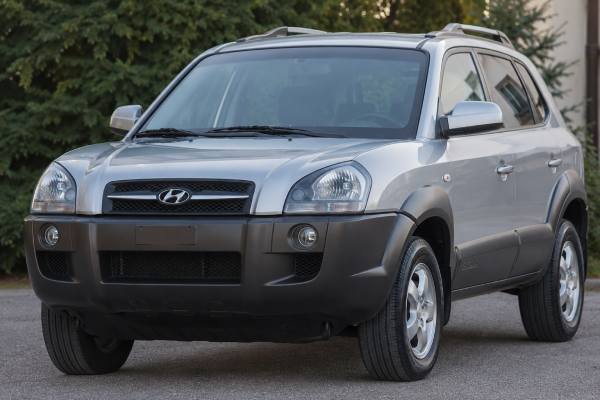
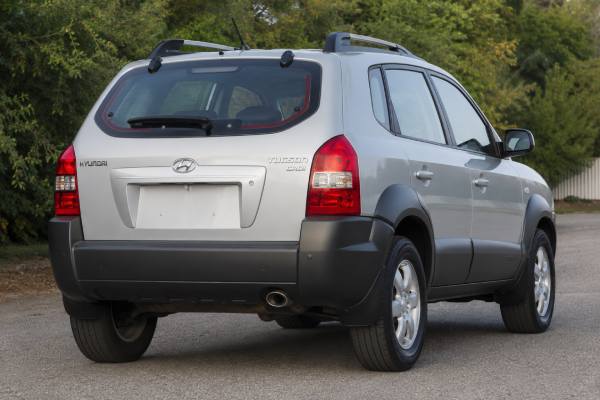
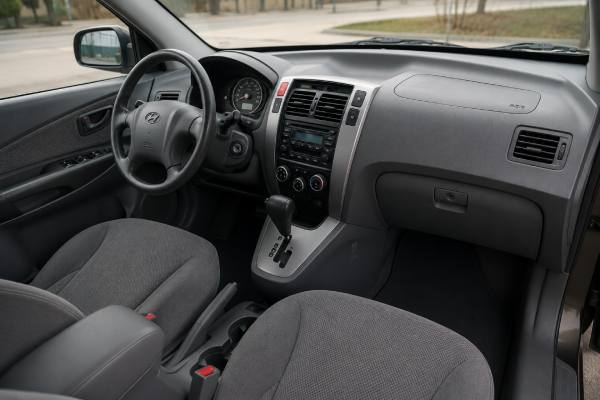
The first-generation Hyundai Tucson, known by the JM chassis code, is a compact SUV from the period when small crossovers were still simple, upright, and mechanically straightforward. In FWD form with the Beta II 2.0-liter gasoline engine, it is not the quickest Tucson of its generation, but it is one of the easier versions to understand, maintain, and buy sensibly on the used market.
This guide focuses on the 2.0-liter front-wheel-drive Tucson built around the G4GC/Beta II four-cylinder, rated at about 140 hp depending on market measurement. It suits buyers who want a practical five-seat SUV with modest running costs, simple mechanicals, decent visibility, and fewer driveline parts than the 4WD models.
Final Verdict
The Hyundai Tucson FWD (JM) 2.0 Beta II is a good used choice when simplicity, space, and repairability matter more than speed or refinement. Its strongest appeal is the combination of a durable naturally aspirated engine, practical cabin, and widely available service parts. It fits budget-conscious owners, small families, and drivers who want an easygoing compact SUV for commuting, errands, and light trips. The main tradeoff is modest performance, especially with passengers or highway hills. Buy only with proof of timing-belt service, clean coolant history, solid suspension, and no serious corrosion underneath.
| Pros | Cons |
|---|---|
| Simple Beta II 2.0 engine is familiar and repairable | Performance is modest for a compact SUV body |
| FWD layout avoids rear diff and transfer-case upkeep | Less traction than 4WD versions in snow or mud |
| Good cabin space, visibility, and cargo flexibility | Interior plastics and noise isolation feel dated today |
| Standard safety kit was strong for its era | No modern ADAS such as AEB or lane keeping |
| Parts availability is generally good in many markets | Rust, suspension wear, and neglected timing belts matter |
Table of Contents
- Hyundai Tucson JM 2.0 FWD Overview
- Beta II 2.0 FWD Specifications
- Trims, Options and Safety Equipment
- Reliability, Common Issues and Recalls
- Maintenance Schedule and Buyer’s Guide
- Driving, Performance and Fuel Economy
- Tucson 2.0 FWD Versus Rivals
Hyundai Tucson JM 2.0 FWD Overview
The Tucson JM 2.0 FWD is the simplest gasoline version of Hyundai’s first-generation compact SUV. It uses a front-mounted, naturally aspirated four-cylinder engine, a unibody platform, independent suspension, and front-wheel drive.
That makes it different in character from the heavier 2.7 V6 and 4WD models. The 2.0 FWD is more about low ownership cost than towing, off-road ability, or effortless acceleration. It works best as a practical road-biased SUV rather than a rugged utility vehicle.
The Beta II 2.0 engine is a conventional multi-point fuel-injected unit with dual overhead cams and 16 valves. In many markets it carries the G4GC engine code and uses a timing belt, not a timing chain. This is one of the most important ownership facts because timing-belt history has a direct effect on purchase risk.
The JM Tucson has an upright cabin, large windows, a wide tailgate opening, and a split-fold rear seat. Compared with many newer crossovers, it feels narrower, shorter, and easier to place on the road. Compared with a normal hatchback, it gives a higher seating position and more useful load height.
Its age now matters more than its original specification. A well-maintained 2.0 FWD can still be a sensible used buy, but a neglected one can quickly become uneconomical. At this age, condition beats trim level. Service records, corrosion condition, cooling-system health, suspension wear, and tire quality are more important than whether the car has a sunroof or upgraded audio.
The best examples are usually privately owned cars with regular oil changes, documented timing-belt replacement, clean coolant, no warning lights, matching tires, and a dry engine bay. Cars that have been run cheaply, used on salted roads, or ignored after the warranty years need a much more cautious inspection.
Beta II 2.0 FWD Specifications
The 2.0 FWD Tucson uses the Beta II 2.0 gasoline four-cylinder mounted transversely, driving the front wheels through either a 5-speed manual or a 4-speed automatic, depending on market and trim. The useful facts are the engine’s simple injection system, timing-belt layout, modest torque output, and lighter FWD driveline.
| Item | Hyundai Tucson FWD 2.0 Beta II |
|---|---|
| Generation / chassis | First-generation Tucson, JM |
| Model years covered | 2005–2009 |
| Engine family / code | Beta II 2.0, commonly G4GC |
| Fuel type | Regular unleaded gasoline |
| Layout | Inline-4, front transverse |
| Displacement | 1,975 cc / 2.0 L |
| Valvetrain | DOHC, 16 valves, CVVT |
| Fuel system | Multi-point fuel injection |
| Induction | Naturally aspirated |
| Power | 140 hp at 6,000 rpm |
| Torque | 184–186 Nm, about 136–137 lb-ft at 4,500 rpm |
| Timing drive | Timing belt |
| Item | Value or note |
|---|---|
| Drive type | Front-wheel drive |
| Manual gearbox | 5-speed manual |
| Automatic gearbox | 4-speed automatic where offered |
| Steering | Power-assisted rack and pinion |
| Front suspension | MacPherson struts |
| Rear suspension | Multi-link independent suspension |
| Front brakes | Ventilated discs |
| Rear brakes | Disc or drum depending on market and specification |
| Item | Value |
|---|---|
| Body style | 5-door compact SUV |
| Seats | 5 |
| Length | 4,325 mm (170.3 in) |
| Width | 1,795 mm (70.7 in) |
| Height | 1,680 mm (66.1 in), excluding some roof-rail variation |
| Wheelbase | 2,630 mm (103.5 in) |
| Typical curb weight | About 1,470 kg (3,240 lb) for 2.0 manual FWD |
| Cargo volume | About 644 L (22.7 cu ft) seats up |
| Fuel tank | 58 L (15.3 US gal) on 2.0 models |
| Common tires | 215/65R16 or 235/60R16 depending on trim |
| Item | Typical value |
|---|---|
| 0–100 km/h | About 10.4–11.5 seconds, depending on gearbox and market |
| Top speed | About 175–180 km/h (109–112 mph) |
| EPA 2WD manual | 20 city / 25 highway / 22 combined mpg US |
| EPA 2WD automatic | 19 city / 25 highway / 22 combined mpg US |
| Combined fuel use, converted | About 10.7 L/100 km from 22 mpg US |
| Item | Specification or capacity |
|---|---|
| Engine oil grade | API SJ/SL or above; SAE 5W-20, 5W-30, or 10W-30 by climate |
| Engine oil capacity | 4.0 L (4.23 US qt) with filter |
| Manual transaxle oil | SAE 75W/85 API GL-4, about 2.1 L |
| Automatic fluid | Hyundai/Kia SP-III type, about 7.8 L total capacity |
| Coolant | Ethylene glycol for aluminum radiator, about 7.0 L |
| Brake fluid | DOT 3 or DOT 4 |
| Spark plug gap | 1.0–1.1 mm (0.039–0.043 in) |
| 2.0 valve clearance | Adjustable; inspect/adjust according to service schedule |
Trims, Options and Safety Equipment
The 2.0 FWD Tucson was usually the entry or lower-mid powertrain, while larger-engine and 4WD versions carried more equipment in many markets. Trim names varied by region, so the badge alone should not be treated as proof of the exact mechanical specification.
Trim and equipment identifiers
In North America, early Tucson brochures positioned the 2.0 four-cylinder mainly with the GL trim, while GLS and LX models often used the 2.7 V6. Other regions sold the 2.0 petrol engine across different grade names, sometimes with more equipment than the North American GL.
Useful identifiers include:
- Engine bay label or registration data showing 1,975 cc gasoline engine.
- VIN and market build sheet confirming FWD rather than 4WD.
- 5-speed manual or 4-speed automatic depending on market.
- Tire size, wheels, fog lamps, seat trim, and audio system as trim clues.
- Absence of rear differential and propshaft underneath for FWD confirmation.
Mechanically, the big differences are not leather seats or stereo equipment. The important split is FWD versus 4WD, 2.0 four-cylinder versus 2.7 V6, and manual versus automatic. A FWD 2.0 avoids transfer-case oil, rear axle oil, propshaft joints, and rear driveline wear, which helps reduce long-term cost.
Safety ratings and crash-test context
For its era, the Tucson offered a strong safety package, especially in markets where six airbags, ABS, traction control, and electronic stability control were standard or widely available. That was a major selling point when many compact SUVs still treated side-curtain airbags or stability control as optional.
The IIHS rated the 2005 Tucson “Acceptable” in the original moderate-overlap front test and “Acceptable” in the original side test, with ratings applying to 2005–2009 models. Roof strength was rated “Poor” under the later roof-strength evaluation, which is an important reminder that crash-test expectations have changed sharply since the mid-2000s.
ANCAP’s 2006 Tucson assessment recorded a 4-star result under the older test regime, with good side-impact scoring but poor pedestrian protection and no modern crash-avoidance technology. The tested Australasian specification used a different engine than this 2.0 FWD article focus, but the result still gives useful context for the JM body structure.
Safety systems and ADAS
The Tucson JM belongs to the pre-modern-ADAS era. Do not expect autonomous emergency braking, adaptive cruise control, blind-spot monitoring, lane keeping, or driver-attention systems.
Depending on market and trim, safety equipment may include:
- Dual front airbags.
- Front seat-mounted side airbags.
- Front and rear roof-mounted side-curtain airbags.
- ABS with electronic brake-force distribution in many versions.
- Electronic stability control and traction control in many markets.
- Three-point rear belts.
- Rear child-seat anchors such as LATCH or ISOFIX, depending on market.
Any warning lights for ABS, ESC, or airbags should be taken seriously. On an older Tucson, these may be caused by wheel-speed sensors, clockspring faults, seat wiring, low battery voltage, previous crash repairs, or control-unit issues. Repairs are usually not exotic, but diagnosing them properly matters.
Reliability, Common Issues and Recalls
A well-serviced Tucson 2.0 can be durable, but age and maintenance history decide the outcome. The most important risks are timing-belt neglect, cooling-system deterioration, oil leaks, suspension wear, brake issues, sensors, and corrosion.
| Issue | Prevalence | Cost risk | Typical signs |
|---|---|---|---|
| Timing belt overdue | Common on neglected cars | High | No service proof, belt age unknown |
| Valve-cover or cam/crank seal leaks | Common with age | Low to medium | Oil smell, wet engine, drips |
| Cooling-system wear | Occasional to common | Medium | Coolant loss, overheating, stained radiator |
| Suspension bushings and ball joints | Common at high mileage | Medium | Clunks, wandering, uneven tire wear |
| Wheel bearings | Occasional | Medium | Humming that changes with speed |
| ABS/ESC sensor faults | Occasional | Low to medium | ABS or ESC warning light |
| Underside corrosion | Market-dependent | Medium to high | Rusty subframes, brake lines, mounts |
Engine and timing-belt issues
The Beta II 2.0 is a known Hyundai/Kia engine family, and its basic design is not especially complex. It uses a belt-driven cam system, so timing-belt service is not optional. On a used Tucson, a “looks okay” belt is not enough. You want an invoice showing belt, tensioner, idlers, and ideally water pump replacement.
Symptoms that need attention include:
- Rattles or slaps from the belt cover area.
- Oil leaks near the cam or crank seals.
- Coolant staining around the water pump.
- Rough idle from vacuum leaks, dirty throttle body, ignition parts, or valve-clearance issues.
- Misfire under load from old plugs, coils, or wires depending on market specification.
Oil consumption is not usually the headline problem when compared with some later engines, but old engines can consume oil from worn rings, valve-stem seals, clogged PCV systems, or neglected service. A buyer should check oil level before and after a test drive and look for blue smoke after idling.
Transmission and driveline
The 5-speed manual is generally simple. Check clutch bite, synchro feel, gearbox whine, and evidence of gear-oil changes. A high clutch pedal, judder when pulling away, or difficulty selecting gears can point to clutch wear, hydraulic issues, or linkage adjustment.
The 4-speed automatic is old-fashioned but usually smooth when healthy. Avoid cars with harsh engagement, delayed Drive or Reverse selection, flare between gears, burnt-smelling fluid, or vibration under light throttle. Correct SP-III-type fluid matters; random universal ATF can cause shift quality problems.
The FWD version avoids the rear driveline issues that can affect older 4WD vehicles. That is a real ownership advantage if you do not need all-weather traction beyond good tires.
Suspension, steering, brakes, and corrosion
At this age, suspension condition often separates a good Tucson from a tired one. Listen for clunks over small bumps, inspect lower arms and ball joints, and check rear suspension links and bushings. Uneven tire wear can point to worn components or poor alignment.
Brake issues are usually ordinary wear, but rusty lines, seized calipers, handbrake problems, and warped or heavily corroded discs are worth checking. A soft pedal or old dark fluid suggests overdue service.
Corrosion is a major buying point in cold or coastal regions. Inspect:
- Front and rear subframes.
- Lower control arms and rear suspension mounts.
- Brake and fuel lines.
- Inner sills and jacking points.
- Rear wheel arches and tailgate seams.
- Exhaust mounts and heat shields.
Recalls and service actions
Known recall themes for early Tucson models include driver airbag replacement on certain 2005–2007 vehicles, parking-brake lever concerns on some 2005 vehicles, electronic stability program recalibration on some ESP-equipped vehicles, and stop-lamp switch recalls affecting multiple Hyundai models.
Recall eligibility depends on VIN, production date, country, and previous repair completion. A seller’s statement is not enough. Ask for dealer records or check the VIN through the official recall database for the market where the vehicle is registered.
Maintenance Schedule and Buyer’s Guide
The Tucson 2.0 FWD is affordable to maintain only when routine work is kept current. Deferred timing-belt service, old fluids, cheap tires, rusty brakes, and worn suspension can exceed the value of a low-priced example.
| Item | Practical interval |
|---|---|
| Engine oil and filter | Every 7,500 miles / 12,000 km, or sooner in severe use |
| Severe-use oil service | About every 3,000 miles / 4,800 km or 3 months |
| Engine air filter | Inspect regularly; replace sooner in dusty use |
| Cabin air filter | Every 12 months or when airflow/odor worsens |
| Timing belt | Replace at age/mileage interval; verify by invoice |
| Spark plugs | Use correct platinum plugs for 2.0; replace by schedule |
| Valve clearance | Inspect/adjust on 2.0 when scheduled or noisy |
| Coolant | Inspect often; renew by time/mileage schedule |
| Manual gearbox oil | Inspect by schedule; replace under severe use |
| Automatic fluid | Use SP-III-type fluid; shorten interval in heat or city use |
| Brake fluid | Every 2 years is a sensible used-car practice |
| Tires and alignment | Rotate 6,000–8,000 miles; align after suspension work |
| 12 V battery | Test yearly after 3 years; replace when weak |
What to inspect before buying
Start with the service file. A clean Tucson with no timing-belt proof should be priced as if the belt service is due immediately. The 2.0 engine is not difficult for a competent shop, but the belt, tensioner, idlers, water pump, coolant, accessory belts, and seals can still add up.
During inspection, focus on:
- Cold start: should fire cleanly without heavy smoke or long cranking.
- Idle: should settle smoothly without hunting or stalling.
- Engine bay: look for oil leaks, coolant stains, cracked hoses, and poor previous repairs.
- Test drive: check clutch or automatic shift quality, steering straightness, braking stability, and suspension noise.
- Underside: inspect rust before negotiating.
- Electronics: check every window, lock, mirror, light, air-conditioning mode, and warning lamp.
- Tires: mismatched or cheap tires often signal low-budget maintenance.
Recommended versions
For a low-cost daily driver, the best version is a clean FWD 2.0 with manual transmission if you are comfortable driving manual. It is mechanically simple, lighter than 4WD, and easier to keep alive cheaply. The automatic is fine when serviced correctly, but it needs a more careful test drive.
Avoid buying only by mileage. A 180,000 km car with service history, clean underbody, and recent belt work can be better than a 110,000 km car with old fluids, rust, and no records.
Long-term durability outlook
A sorted Tucson 2.0 FWD can remain useful well beyond 15 years, but it is now an age-sensitive vehicle. The engine can last well if oil, coolant, belts, and ignition parts are maintained. The body, suspension, and previous ownership quality are often the limiting factors. Buy the best-maintained example, not the cheapest one.
Driving, Performance and Fuel Economy
The Tucson 2.0 FWD drives like a simple, upright compact SUV, not a sporty crossover. It is easy to see out of, easy to park, and comfortable enough for daily use, but it needs revs when fully loaded.
The 2.0 engine makes its torque high in the rev range, so low-rpm pull is only moderate. Around town, it feels willing enough when lightly loaded. On hills, highway merges, and overtakes, it asks for downshifts. The manual gearbox helps the driver keep the engine in its stronger range; the automatic is more relaxed but less responsive.
Ride comfort is generally decent on standard 16-inch wheels. The Tucson absorbs ordinary city bumps well when the suspension is fresh. Worn struts, bushings, or rear links make it feel loose and noisy, so a harsh or clunky example should not be dismissed as “normal old SUV behavior.”
Steering is light and practical rather than communicative. Body roll is present, as expected from a tall compact SUV of this era. Stability is acceptable for normal driving, but good tires are critical. FWD with quality all-season or winter tires is usually better than neglected 4WD on poor tires.
Cabin noise is higher than in modern crossovers. Expect engine noise during acceleration, wind noise at highway speeds, and some road roar on coarse surfaces. The cabin feels airy, but not especially premium.
Real-world economy depends heavily on gearbox, traffic, tires, and maintenance. Expect roughly:
- City use: about 11.5–13.5 L/100 km, or 17–20 mpg US / 20–24 mpg UK.
- Highway use: about 8.5–10.0 L/100 km, or 24–28 mpg US / 29–34 mpg UK.
- Mixed use: about 9.5–11.5 L/100 km, or 20–25 mpg US / 24–30 mpg UK.
Cold weather, roof racks, short trips, old oxygen sensors, dragging brakes, underinflated tires, and a lazy thermostat can all make economy worse. A Tucson that struggles to reach normal operating temperature or smells rich should be inspected rather than accepted as merely thirsty.
Towing should be treated conservatively with the 2.0 FWD. It can handle light utility use where rated, but it is not the version to choose for frequent heavy trailers, mountain towing, or hot-weather hauling. If towing history is evident, check the clutch or automatic fluid condition carefully.
Tucson 2.0 FWD Versus Rivals
The Tucson 2.0 FWD is usually strongest on value, simplicity, visibility, and safety equipment for its age. Its weaker points are performance, refinement, and fuel economy compared with some car-based alternatives.
| Rival | How it compares |
|---|---|
| Kia Sportage 2.0 | Closely related mechanically; condition and price matter most. |
| Toyota RAV4 | Often more durable reputation, usually higher used prices. |
| Honda CR-V | More refined and practical, but can cost more to buy. |
| Nissan X-Trail | Roomier feel, but rust and engine issues need careful checks. |
| Suzuki Grand Vitara | More rugged image, often heavier and less car-like. |
| Ford Escape / Mazda Tribute | Stronger engines available, but age-related rust and driveline checks matter. |
Against the Toyota RAV4 and Honda CR-V, the Tucson usually wins on purchase price and equipment for the money. It loses on polish, resale strength, and in some cases fuel economy. Against the related Kia Sportage, the difference is mostly condition, local parts supply, and trim.
The Tucson 2.0 FWD makes the most sense when the price is fair and the car is genuinely clean. It is not worth overpaying for because the market has many alternatives, and repair costs can quickly erase a cheap purchase. The right one is a simple, honest compact SUV. The wrong one is an old vehicle with deferred maintenance hidden behind a low asking price.
References
- Hyundai Tucson 2005 2005 (Brochure)
- Hyundai Tucson 2005 Owner’s Manual 2005 (Owner’s Manual)
- Gas Mileage of 2005 Hyundai Tucson 2026 (Fuel Economy)
- 2005 Hyundai Tucson 2026 (Safety Rating)
- Hyundai Tucson | Safety Rating & Report | ANCAP 2026 (Safety Rating)
Disclaimer
This article is for informational purposes only and is not a substitute for professional diagnosis, inspection, repair, or official service information. Specifications, torque values, intervals, procedures, equipment, and safety features can vary by VIN, market, production date, trim, and previous repairs. Always verify critical data against the official service documentation for the exact vehicle before buying parts or performing maintenance.
If you found this guide useful, please consider sharing it on Facebook, X/Twitter, or your favorite automotive community to support our work.