
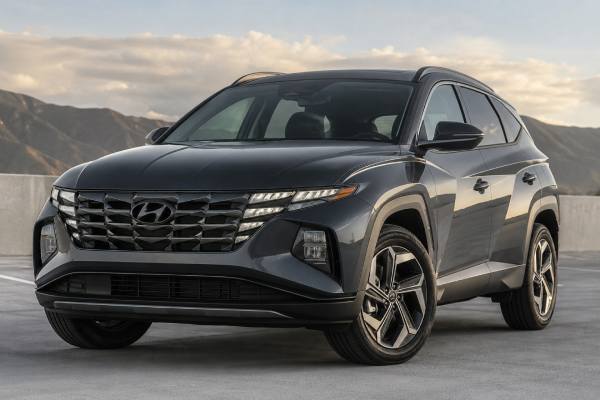
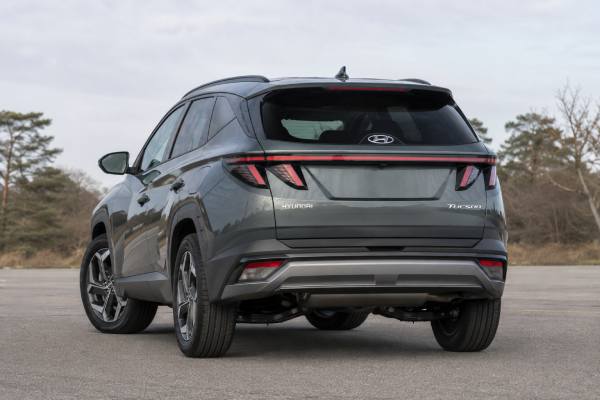
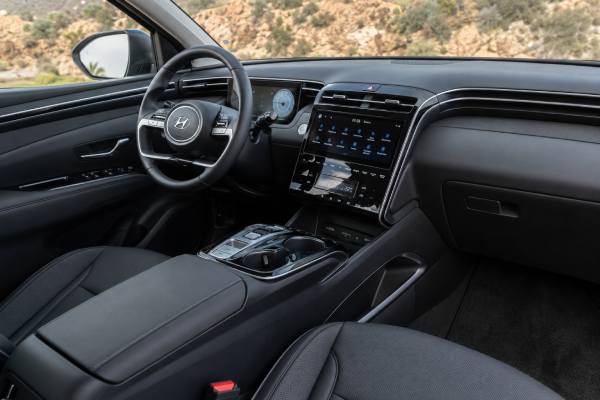
The 2022–2024 Hyundai Tucson Hybrid HTRAC AWD is the fourth-generation NX4 Tucson with Hyundai’s turbocharged 1.6-liter Smartstream hybrid powertrain. It sits in the busy compact SUV class, but it stands out because it combines strong torque, standard all-wheel drive, a conventional 6-speed automatic transmission, and excellent cabin practicality without giving up much cargo space to the hybrid hardware.
For used buyers, the appeal is simple: it is quicker and more efficient than the regular gasoline Tucson, more refined than many CVT-style hybrids, and roomy enough for family use. The main questions are whether the 1.6 T-GDi hybrid system is dependable, how the HTRAC AWD system behaves, what to check before buying, and whether it is a better choice than rivals such as the Toyota RAV4 Hybrid, Honda CR-V Hybrid, and Kia Sportage Hybrid.
Final Verdict
The 2022–2024 Hyundai Tucson Hybrid HTRAC AWD is a strong used compact SUV choice if you want family space, standard AWD, good real-world efficiency, and stronger acceleration than most non-hybrid rivals. Its biggest appeal is the smooth turbo-hybrid powertrain with a normal 6-speed automatic rather than a droning CVT. It suits commuters, small families, and cold-weather drivers who value traction and comfort. The main tradeoff is complexity: the turbo engine, hybrid cooling, 12 V electronics, and AWD hardware need proper service history. Buy one only after a VIN recall check, hybrid-system scan, and evidence of regular oil and fluid maintenance.
| Pros | Cons |
|---|---|
| 226 hp hybrid system feels stronger than the gas Tucson | Turbo-hybrid layout is more complex than a simple naturally aspirated SUV |
| Standard HTRAC AWD gives useful wet-weather and winter traction | AWD fluid service matters if used in snow, hills, or towing |
| 6-speed automatic feels more natural than many hybrid CVTs | Shift quality can suffer if software or fluid service is neglected |
| Hybrid battery packaging preserves excellent cargo space | 12 V and hybrid diagnostics require a capable scan tool |
| Strong safety equipment and good crash-test performance | ADAS sensors require calibration after windshield or front-end repairs |
Table of Contents
- Detailed Overview
- Specifications and Technical Data
- Trims, Safety, and Driver Assistance
- Reliability, Issues, and Service Actions
- Maintenance and Buyer’s Guide
- Driving and Performance
- How the Tucson Hybrid Compares to Rivals
Detailed Overview
The Tucson Hybrid HTRAC AWD is the version to choose if you want the NX4 Tucson’s space and design with better performance and fuel economy than the standard 2.5-liter gasoline model. In North America, the hybrid came with standard all-wheel drive, while the regular gas Tucson could be bought with front-wheel drive or AWD.
The powertrain pairs a 1.6-liter turbocharged gasoline engine with an electric motor, a small lithium-ion battery, and a 6-speed automatic transmission. This matters because it gives the Tucson Hybrid a more familiar driving feel than hybrids that use an eCVT. Acceleration is smooth, the engine does not flare noisily as often, and the transmission provides defined gear changes when climbing hills or passing.
The NX4 Tucson is also larger than older Tucson generations. The 108.5-inch wheelbase and upright cabin make it feel closer to a midsize SUV inside, especially in rear-seat legroom and cargo volume. The hybrid version keeps the same useful cargo floor as the gasoline model, unlike the plug-in hybrid, which gives up more cargo space because of its larger battery.
From a buyer’s point of view, the 2022–2024 model years are closely related. The 2022 model introduced the new generation. The 2023 model year brought equipment reshuffling and broader availability of desirable technology. The 2024 model year kept the same 226 hp hybrid output before the 2025 facelift arrived with updated styling and a revised hybrid rating.
This version is best understood as a comfortable, efficient, all-weather family SUV rather than a rugged off-roader or a performance SUV. HTRAC AWD improves traction on slippery roads, but it does not turn the Tucson into a trail vehicle. Its strengths are commuting, road trips, daily family use, and light towing within its rated limit.
The biggest used-buying advantage is value. Compared with a Toyota RAV4 Hybrid, the Tucson Hybrid often offers more equipment for the money, a quieter cabin, and a richer interior feel. Compared with the Honda CR-V Hybrid, it feels punchier at low speeds and offers a more conventional automatic-transmission feel. The tradeoff is that Hyundai’s turbo-hybrid setup rewards careful maintenance more than simpler hybrid systems.
Specifications and Technical Data
The 2022–2024 Tucson Hybrid HTRAC AWD uses Hyundai’s Smartstream 1.6 T-GDi hybrid system. The gasoline engine, electric motor, and 6-speed automatic work through a mechanical AWD system rather than a separate electric rear axle. The most important figures are the 226 hp combined output, 258 lb-ft of system torque, 1.49 kWh battery, standard HTRAC AWD, and EPA combined fuel economy of up to 38 mpg on the Blue trim.
| Item | Specification |
|---|---|
| Engine family | Smartstream 1.6 T-GDi hybrid |
| Engine layout | Turbocharged inline-4, DOHC, 16 valves |
| Displacement | 1,598 cc / 1.6 L |
| Bore × stroke | 75.6 × 89.0 mm |
| Compression ratio | 10.5:1 |
| Gasoline engine output | 180 hp at 5,500 rpm; 195 lb-ft at 1,500–4,500 rpm |
| Combined system output | 226 hp; 258 lb-ft |
| Electric motor | Permanent-magnet synchronous motor, 44.2 kW / 59 hp |
| Hybrid battery | Lithium-ion, 1.49 kWh, 270 V maximum |
| Recommended fuel | Regular unleaded gasoline |
| Item | Specification |
|---|---|
| Transmission | 6-speed torque-converter automatic |
| Drive system | HTRAC AWD, active on-demand |
| Final drive ratio | 3.320 |
| Front suspension | MacPherson strut with coil springs |
| Rear suspension | Multi-link with coil springs |
| Steering | Motor-driven rack-and-pinion power steering |
| Turning diameter | 38.6 ft / 11.8 m |
| Front brakes | Ventilated discs, 325 mm |
| Rear brakes | Solid discs, 300 mm |
| Item | Specification |
|---|---|
| Body style | 5-door compact SUV, 5 seats |
| Wheelbase | 108.5 in / 2,756 mm |
| Length | 182.3 in / 4,630 mm |
| Width | 73.4 in / 1,864 mm |
| Height | 66.3 in / 1,684 mm for AWD specification |
| Ground clearance | 8.3 in / 211 mm for AWD specification |
| Curb weight | About 3,692–3,837 lb / 1,675–1,740 kg by trim |
| Fuel tank | 13.7 US gal / 51.9 L |
| Cargo volume | 38.7 cu ft seats up; 74.5 cu ft seats folded |
| Towing rating | 2,000 lb braked; 1,650 lb unbraked |
| Item | Specification or note |
|---|---|
| EPA fuel economy, Blue | 38/38/38 mpg US city/highway/combined |
| EPA fuel economy, other trims | 37/36/37 mpg US city/highway/combined |
| Metric equivalent, Blue combined | About 6.2 L/100 km |
| Metric equivalent, other trims combined | About 6.4 L/100 km |
| Engine oil capacity | 4.8 L / about 5.1 US qt |
| Common oil viscosity | 0W-20 full synthetic, verify by VIN and market |
| Common tire pressure | 35 psi / 240 kPa for normal load |
| Wheel lug nut torque | 79–94 lb-ft / 107–127 Nm |
Trims, Safety, and Driver Assistance
The core Tucson Hybrid trims for 2022–2024 are Blue, SEL Convenience, N Line, and Limited, depending on model year. All share the same basic 226 hp hybrid AWD powertrain, so the main differences are comfort, infotainment, lighting, driver assistance, wheels, and interior trim rather than engine output.
Blue is the efficiency-focused trim. It usually has smaller wheels, the best EPA rating, cloth seating, and the most sensible ownership costs. It is the trim to seek if you want maximum fuel economy and fewer expensive features.
SEL Convenience is the balanced choice. It commonly adds the larger infotainment screen, more convenience equipment, heated seats, upgraded interior features, and a stronger value position on the used market.
N Line is mostly a styling and equipment package, not a performance model. It adds sportier exterior trim, unique interior details, and 19-inch wheels, but it does not receive a more powerful engine, special differential, or performance suspension tune.
Limited is the luxury and technology trim. It can include leather-trimmed seating, ventilated front seats, a panoramic sunroof, Bose audio, surround-view camera, Blind-Spot View Monitor, Remote Smart Parking Assist in some markets, and the more complete driver-assistance package. It is desirable, but it also has more sensors, cameras, and electronic features to inspect.
Quick identifiers are simple. Hybrid models have hybrid badging, a 1.6T hybrid powertrain on the window sticker, and standard AWD in the U.S. market. Limited models are easiest to identify by their projector-style LED headlights, higher-grade cabin materials, larger digital displays, and surround-view or blind-spot camera features where fitted.
For safety, the NX4 Tucson performed well in IIHS testing. The 2023 Tucson earned Top Safety Pick+ status, and the structure received good ratings in the main crashworthiness categories used for those model years. Headlight ratings vary by trim and build period, so Limited models and later lighting configurations may perform differently from reflector-headlight trims.
NHTSA ratings and recall records should be checked by exact year, body, drivetrain, and VIN. This is important because public recall listings sometimes group Tucson gasoline, Tucson Hybrid, and Tucson Plug-in Hybrid separately, while some campaigns affect only a narrow production range.
Safety and driver-assistance equipment is a major strength. Common systems include:
- Forward Collision-Avoidance Assist with pedestrian and cyclist detection
- Lane Keeping Assist and Lane Following Assist
- Blind-Spot Collision-Avoidance Assist
- Rear Cross-Traffic Collision-Avoidance Assist
- Driver Attention Warning
- Safe Exit Warning
- Smart Cruise Control on better-equipped trims
- Highway Driving Assist on Limited or higher-equipment versions
- Parking Collision-Avoidance Assist, surround-view, and Blind-Spot View Monitor on Limited
Child-seat support is also good. The Tucson has two full lower-anchor LATCH positions in the rear outboard seats and a tether anchor for the middle rear position. Families should still test real child seats before buying, because the rear seat is roomy but lower anchors can sit somewhat deep in the cushions.
ADAS calibration is a real ownership point. Windshield replacement, front bumper work, alignment changes, or collision repair can require camera or radar calibration. A used Tucson with unexplained warning lights, a replaced windshield, mismatched bumper paint, or a history of front-end damage deserves extra inspection.
Reliability, Issues, and Service Actions
The Tucson Hybrid has generally been a solid modern hybrid SUV, but it is not a low-complexity vehicle. The best examples are dealer-serviced, software-updated, and driven regularly enough to keep the 12 V system, brakes, fluids, and hybrid cooling system healthy.
Common or more likely issues are usually low-to-medium severity:
- 12 V battery weakness: Symptoms include no-start warnings, random electronic faults, or infotainment resets. The likely cause is low state of charge, aging battery condition, or charging-system logic. Test the 12 V battery before chasing deeper faults.
- Brake rotor surface corrosion: Hybrids use regenerative braking, so friction brakes may work less often in gentle driving. Symptoms are scraping, vibration, or rough brake feel after wet weather. Regular harder stops in a safe setting and brake inspections help.
- Infotainment and driver-assistance glitches: Camera, navigation, Bluetooth, or warning-message issues are often software-related. Check for dealer updates before replacing parts.
- Oil dilution or fuel smell after short trips: Any small turbo direct-injection engine can be sensitive to repeated cold starts. Short-trip use calls for shorter oil intervals.
- Interior rattles and trim noises: Usually low cost, but panoramic-roof and tailgate-area noises should be separated from roof-molding or body-trim issues.
Occasional but more important checks include the hybrid cooling circuit, inverter coolant condition, AWD coupler behavior, rear differential noise, and transmission shift quality. A well-running Tucson Hybrid should move away smoothly, blend electric and gasoline power cleanly, and shift without flare, harsh engagement, or repeated hunting on light throttle.
The 1.6 T-GDi uses a timing chain, not a routine timing belt. That means there is no scheduled belt replacement, but chain health still matters. Listen for extended cold-start rattle, check for cam/crank timing-correlation codes, and avoid neglected oil-change history. Direct injection can also build carbon on intake valves over high mileage, especially in short-trip use. Symptoms include rough idle, misfire, reduced economy, and hesitation.
The high-voltage battery is small and normally operates within a controlled charge window, so severe degradation is not a widespread early-life concern. Still, a pre-purchase inspection should include a scan of hybrid battery state of health, cell balance, inverter and battery coolant temperatures, DC–DC converter operation, and stored hybrid-control codes. A Tucson Hybrid should not show high-voltage isolation faults, repeated reduced-power warnings, or abnormal cooling-fan behavior.
For recalls and service actions, do not rely on model-year summaries alone. Verify by VIN through Hyundai or NHTSA. Important Tucson-related campaigns and checks include:
- Certain early 2022 Tucson vehicles had an Integrated Central Control Unit software issue that could affect exterior lighting.
- Certain 2022 Tucson vehicles were recalled for roof moldings that could detach because of retention issues.
- Some 2023 Hyundai vehicles, including certain Tucson gasoline vehicles, were involved in electric oil-pump controller recalls. Confirm whether the specific hybrid VIN is included before assuming applicability.
- Certain 2022–2024 Tucson vehicles equipped with an OEM trailer wiring harness became subject to a trailer-harness-related recall due to water ingress risk. This is especially important on used SUVs with dealer-installed tow equipment.
Before buying, request service records showing oil changes, recall completion, software updates, tire replacements, brake service, and any collision repair. A clean history is worth paying for because hybrid diagnostic time, ADAS calibration, and AWD repairs can erase the savings from a cheaper neglected example.
Maintenance and Buyer’s Guide
The Tucson Hybrid is not difficult to maintain, but it needs hybrid-aware servicing rather than generic quick-lube treatment. The most important habits are frequent correct oil changes, clean cooling systems, healthy 12 V power, proper tires, and VIN-based recall checks.
A practical ownership schedule looks like this:
| Interval | Service items |
|---|---|
| Every 5,000–7,500 miles / 8,000–12,000 km | Replace engine oil and filter; rotate tires; inspect brakes, lights, wipers, and leaks |
| Every 12 months | Inspect hybrid cooling, 12 V battery, brake condition, tires, alignment wear, and software campaigns |
| Every 15,000–20,000 miles / 24,000–32,000 km | Replace cabin filter; inspect engine air filter, belts, hoses, suspension, and steering joints |
| Every 30,000–40,000 miles / 48,000–64,000 km | Replace engine air filter if dirty; inspect AWD transfer and rear axle fluids; inspect brake fluid |
| Every 45,000–60,000 miles / 72,000–96,000 km | Inspect or replace spark plugs by VIN schedule; consider transmission and AWD fluids under severe use |
| Every 60,000–100,000 miles / 96,000–160,000 km | Service coolant by official schedule; inspect inverter and hybrid cooling loops carefully |
Use 0W-20 full synthetic oil where specified for the market and VIN, and do not extend oil intervals on a turbo hybrid that does mainly short trips. The gasoline engine may run cold, shut off, restart, and carry high torque loads when it does run. Fresh oil is cheap protection for the turbocharger, timing chain, cam phasers, and hydraulic components.
Brake fluid should be tested regularly and replaced when moisture content is high or at the interval in the official schedule. Because hybrids use regenerative braking, the pads can last a long time, but the calipers, slide pins, and rotors still need inspection. Low mileage does not always mean healthy brakes.
Transmission and AWD fluids are often treated as “inspect” items in normal schedules, but used buyers should be more conservative. If the SUV has been used in mountains, heavy traffic, snow, heat, or towing, a fluid service around 45,000–60,000 miles is sensible. Use Hyundai-approved fluids only.
The timing chain does not have a routine replacement interval. Replace it only if diagnostics show stretch, guide or tensioner wear, noisy operation, or timing-correlation faults. The same practical rule applies to hybrid gasoline engines: regular oil changes prevent most timing-chain problems.
When inspecting a used Tucson Hybrid, check:
- Cold start, warm restart, and smooth engine shutdown/startup
- No hybrid warning lights or pending diagnostic trouble codes
- Battery state-of-health report from a capable scan tool
- No coolant smell, coolant loss, or hybrid-cooling fault codes
- Smooth 1–2 and 2–3 shifts under light and moderate throttle
- AWD operation with no rear-end binding or clunking
- Even tire wear and matching tire brand, size, and tread depth
- Brake rotors free from heavy rust lips or pulsing
- Roof moldings, windshield trim, tailgate, and underbody for water or corrosion signs
- Proper operation of adaptive cruise, lane support, cameras, parking sensors, and blind-spot systems
Best used picks are usually SEL Convenience or Limited with full service history. Blue is the smartest economy choice if equipment needs are modest. N Line is worthwhile only if you like the styling; it is not mechanically special. Avoid cars with missing maintenance records, unresolved recalls, accident repairs without calibration paperwork, repeated 12 V failures, or any high-voltage warning history that has not been properly diagnosed.
Long-term durability should be good if maintained well. The hybrid battery and electric motor are not the weak points most buyers should fear. Neglected oil service, weak 12 V batteries, poor body repairs, corroded brakes, and skipped AWD fluid attention are more realistic concerns.
Driving and Performance
The Tucson Hybrid feels quicker and more relaxed than the regular gasoline Tucson. The electric motor fills in low-speed torque, the turbo engine pulls well in the midrange, and the 6-speed automatic gives the driver a more normal rhythm than many hybrid CVTs.
In everyday city driving, the Tucson Hybrid is smooth and easy. It can creep and pull away on electric assist, then start the gasoline engine with little drama. The transition is not luxury-car invisible, but it is well controlled when the car is healthy. A rough handoff, a hard clunk, or a repeated shudder is a reason to inspect engine mounts, transmission behavior, software status, and hybrid controls.
On the highway, the Tucson is stable and quiet for the class. Wind and tire noise depend heavily on tire choice and wheel size. The Blue trim with smaller wheels usually rides more softly and tends to be quieter over broken pavement. N Line and Limited models with larger wheels look better but can ride more firmly and make replacement tires more expensive.
Steering is light, accurate, and easy to live with. It is not very communicative, but the Tucson does not feel loose. Body roll is controlled enough for family-SUV driving, and the rear multi-link suspension gives it a composed ride when loaded with passengers.
Braking feel is better than many older hybrids because Hyundai blends regenerative and friction braking fairly naturally. Still, used buyers should test several gentle and firm stops. Pulsation, scraping, or a grabby first stop after the car has sat can point to rotor corrosion, pad deposits, or caliper service needs.
Performance is one of this powertrain’s strongest points. Independent tests have generally put 0–60 mph in the low-7-second range depending on trim, tires, and conditions. More important in real use, the Tucson Hybrid has strong 30–60 mph response for merging and passing because the electric motor supports the turbo engine before boost and revs build.
Real-world economy depends on speed, weather, tires, and driving style. Expect the best results in moderate-speed commuting where the hybrid system can recover energy. Highway speeds above 70 mph reduce the advantage because the turbo engine runs more often and aerodynamic drag rises quickly. Cold weather can also cut economy because the engine runs more to provide heat and maintain emissions temperature.
Typical expectations:
- City and suburban driving: about 35–42 mpg US / 6.7–5.6 L/100 km
- Mixed driving: about 33–38 mpg US / 7.1–6.2 L/100 km
- Fast highway driving: about 30–35 mpg US / 7.8–6.7 L/100 km
- Cold winter use: often 10–20 percent worse than mild-weather use
HTRAC AWD is tuned for security rather than playfulness. It can send torque rearward when needed and gives the Tucson good traction on wet roads, snow, and gravel lanes. Tires matter more than the AWD badge, though. A Tucson Hybrid on worn all-season tires will not perform like one on quality winter tires.
For towing, stay within the rated limit and use trailer brakes where required. The hybrid system’s torque helps at low speed, but towing adds heat load to the engine, transmission, brakes, and tires. If a used example has a hitch, inspect the wiring harness, cooling system, rear suspension, brake condition, and transmission behavior carefully.
How the Tucson Hybrid Compares to Rivals
The Tucson Hybrid’s closest rivals are the Toyota RAV4 Hybrid, Honda CR-V Hybrid, Kia Sportage Hybrid, Ford Escape Hybrid, and, depending on market, other electrified compact SUVs. Its strongest position is value, cabin space, comfort, and strong standard AWD performance.
Against the Toyota RAV4 Hybrid, the Hyundai feels more refined inside and has a smoother conventional automatic feel. The RAV4 Hybrid has the stronger long-term reputation, a simpler naturally aspirated hybrid engine, and excellent resale value. Buyers who prioritize proven durability may lean Toyota. Buyers who want more equipment for the money and a quieter cabin may prefer Hyundai.
Against the Honda CR-V Hybrid, the Tucson has stronger low-speed shove and a more traditional transmission feel. The CR-V counters with excellent seats, a very mature chassis, and strong resale value. The Honda is often the calmer choice; the Hyundai is the punchier and more feature-rich one.
Against the Kia Sportage Hybrid, the comparison is very close because the two vehicles share related engineering. The Kia has bolder cabin design and similar powertrain strengths. The Tucson’s advantage is mainly styling preference, trim availability, dealer support, and used pricing in your area.
Against the Ford Escape Hybrid, the Hyundai feels more substantial and more SUV-like. The Ford can be efficient and pleasant, but the Tucson usually has a richer interior and stronger AWD hybrid performance. Ford may appeal to buyers who want a lighter, simpler-feeling commuter.
The Tucson Hybrid is not the lowest-risk hybrid in the class, but it is one of the most well-rounded. It is quicker than many rivals, practical enough for family life, and efficient enough to make the regular gasoline Tucson hard to justify. The best buying strategy is not to chase the cheapest listing. Choose the cleanest VIN, the best maintenance history, and the trim that matches your needs without adding expensive features you do not care about.
References
- 2024 Tucson Product Guide 2024 (Specifications)
- 2023 Hyundai Tucson 2023 (Safety Rating)
- Vehicle Detail Search – 2024 HYUNDAI TUCSON HEV | NHTSA 2024 (Safety and Recall Database)
- Manuals & Warranties | Hyundai Resources | MyHyundai 2024 (Owner’s Manual and Warranty Resources)
- Part 573 Safety Recall Report 25V893 2025 (Recall Report)
Disclaimer
This article is for informational purposes only and is not a substitute for professional diagnosis, repair, inspection, or official service information. Specifications, torque values, fluid requirements, service intervals, safety equipment, recalls, and procedures can vary by VIN, market, trim, production date, and equipment. Always verify details against the official owner’s manual, warranty booklet, Hyundai service information, and a qualified technician.
If this guide helped you, please consider sharing it on Facebook, X/Twitter, or your favorite automotive forum to support our work.