
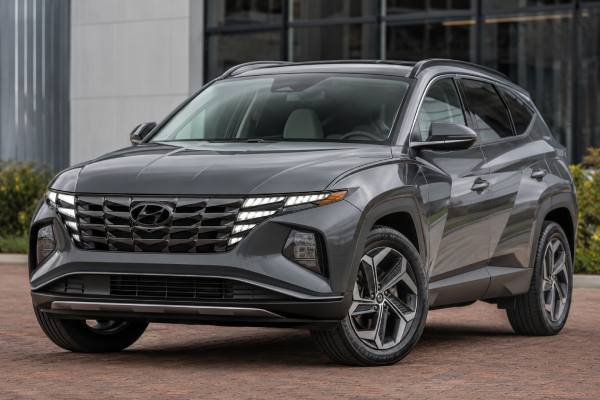
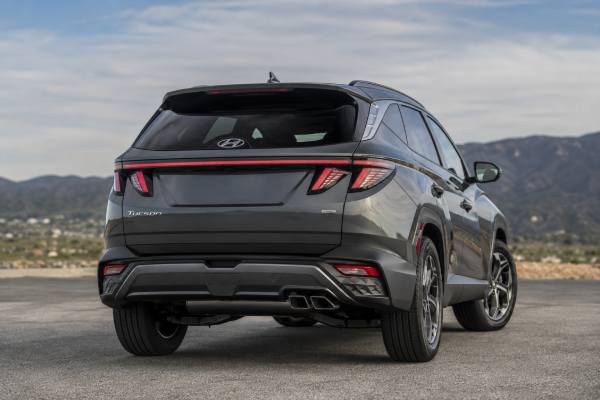
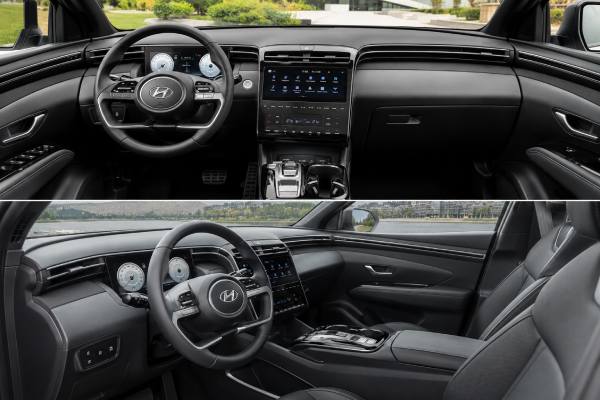
The Hyundai Tucson Plug-in Hybrid HTRAC AWD is the most powerful version of the NX4-generation Tucson sold for the 2022–2024 model years. It combines Hyundai’s Smartstream 1.6-liter turbocharged gasoline engine with a high-output electric motor, a 13.8 kWh battery, a 6-speed automatic transmission, and standard HTRAC all-wheel drive.
Its appeal is simple: it drives like a stronger compact SUV, can cover many daily trips on electric power, and keeps the familiar practicality of the Tucson body. The important ownership question is not only whether it is efficient, but whether your driving pattern lets you charge often enough to make the plug-in system worthwhile.
Final Verdict
The 2022–2024 Hyundai Tucson PHEV HTRAC AWD is a strong used compact SUV choice for drivers who can charge at home or work and want more performance than the regular Tucson Hybrid. Its best qualities are its 261 hp output, standard AWD, roomy cabin, useful EV range, and broad safety equipment. The main tradeoff is complexity: the battery, onboard charger, inverter coolant system, AWD hardware, and turbo engine all need proper inspection and service history. Buy one only after confirming recall completion, charging behavior, hybrid-system health, and maintenance records by VIN.
| Pros | Cons |
|---|---|
| 261 hp system output gives strong daily acceleration | Efficiency drops sharply if it is rarely charged |
| EPA-rated 33-mile EV range suits many commutes | Battery packaging reduces cargo space versus non-PHEV Tucson |
| HTRAC AWD is standard on the plug-in model | More drivetrain parts mean more inspection points used |
| Comfortable cabin with generous rear-seat space | Small 11.1-gallon fuel tank limits gas-only touring range |
| Strong driver-assistance package, especially on Limited trim | ADAS repairs may require calibration after body or glass work |
Table of Contents
- Hyundai Tucson PHEV NX4 Overview
- Specifications and Technical Data
- Trims, Safety and Driver Assistance
- Reliability, Common Issues and Service Actions
- Maintenance and Buyer’s Guide
- Driving, Performance and Efficiency
- How the Tucson PHEV Compares to Rivals
Hyundai Tucson PHEV NX4 Overview
The Tucson PHEV is best understood as a practical compact SUV with a useful electric commute mode, not as a full EV replacement. It is strongest when used by an owner who charges regularly, drives many short trips, and still wants gasoline range for longer journeys.
The NX4 Tucson arrived with a much bolder design than the previous generation. The plug-in hybrid version added the most complex and capable powertrain in the range. It pairs a turbocharged 1.6-liter gasoline engine with a single electric drive motor and a lithium-ion battery large enough for meaningful EV-only driving. Unlike some hybrid SUVs that use a continuously variable transmission, the Tucson PHEV uses a conventional 6-speed automatic. That gives it a more familiar shift feel and helps it feel closer to a normal automatic SUV.
The 261 hp combined output is the key difference from lower Tucson versions. The regular gasoline Tucson feels adequate, the standard hybrid feels lively, and the plug-in hybrid feels genuinely strong for the class. It is not a performance SUV, but it has enough low-speed electric torque and mid-range turbo assist to make city driving, merging, and two-lane passing feel easy.
HTRAC AWD is standard on this version. It is an active on-demand system rather than a heavy-duty off-road setup. In normal driving, it prioritizes efficiency, then sends torque rearward when traction or stability requires it. For snow, rain, gravel driveways, and steep wet roads, it gives the Tucson PHEV a useful advantage over front-drive plug-in rivals.
The main compromise is packaging. The battery and hybrid hardware add weight, reduce some cargo room, and make the vehicle more dependent on correct maintenance. A used Tucson PHEV should be checked more carefully than a regular gasoline Tucson because it has more systems that must work together: turbo engine, high-voltage battery, onboard charger, inverter cooling, hybrid automatic transmission, AWD coupling, regenerative braking, and ADAS sensors.
For the right owner, though, the Tucson PHEV is one of the more rounded compact plug-in SUVs of its period. It is quiet in town, quick enough on the highway, comfortable for family use, and still easy to live with as a normal gasoline SUV when the battery is depleted.
Specifications and Technical Data
The 2022–2024 Tucson Plug-in Hybrid uses Hyundai’s Smartstream 1.6 T-GDi engine with electric assistance and standard HTRAC AWD. The layout is important because it combines a real automatic transmission with plug-in capability, rather than using a pure EV-style single-speed drive or a conventional hybrid eCVT.
| Item | Hyundai Tucson PHEV HTRAC AWD |
|---|---|
| Engine | Smartstream 1.6 T-GDi turbocharged gasoline inline-4 |
| Displacement | 1,598 cc / 1.6 liters |
| Valvetrain | DOHC, 16 valves, CVVD |
| Fuel system | Gasoline direct injection |
| Gasoline engine output | 180 hp and 195 lb-ft |
| Combined system output | 261 hp and 258 lb-ft |
| Electric motor | 66.9 kW permanent-magnet motor |
| Battery | 13.8 kWh lithium-ion polymer pack |
| Fuel | Regular unleaded gasoline |
| Item | Specification |
|---|---|
| Transmission | 6-speed automatic with torque converter |
| Drive system | HTRAC active on-demand all-wheel drive |
| Shift controls | Shift-by-wire with paddle shifters |
| Final drive | 3.320:1 |
| Onboard AC charger | 7.2 kW |
| 240 V charging time | About 1.7–2.0 hours |
| DC fast charging | Not supported |
| Item | Value |
|---|---|
| Body style | 5-door compact SUV, 5 seats |
| Length | 4,630 mm (182.3 in) |
| Width | 1,865 mm (73.4 in) |
| Wheelbase | 2,756 mm (108.5 in) |
| Height with roof rails | 1,684 mm (66.3 in) |
| Ground clearance | 211 mm (8.3 in) |
| Curb weight | 1,867–1,913 kg (4,115–4,217 lb) |
| Fuel tank | 42 liters (11.1 US gal) |
| Cargo volume, seats up | 903 liters (31.9 cu ft) |
| Cargo volume, seats folded | 1,878 liters (66.3 cu ft SAE) |
| Item | Value or practical note |
|---|---|
| EPA electric range | 33 miles (53 km) |
| EPA combined efficiency | 80 MPGe on electricity and gasoline |
| Gasoline-only economy | 35 mpg US combined |
| Total driving range | About 420 miles |
| 0–60 mph | Typically in the low-to-mid 7-second range |
| Towing capacity | 907 kg (2,000 lb) with trailer brakes |
| Unbraked towing | 748 kg (1,650 lb) |
| Turning diameter | 11.8 m (38.6 ft) |
| Item | Useful service value |
|---|---|
| Engine oil capacity | 4.8 liters with filter |
| Front brakes | 325 mm ventilated discs |
| Rear brakes | 300 mm solid discs |
| Suspension | MacPherson strut front, multi-link rear |
| Steering | Column-mounted motor-driven power steering |
| Wheel-nut torque | Verify by manual; commonly 107–127 Nm (79–94 lb-ft) |
The numbers show why this version feels different from a normal compact SUV. It is heavier than a gasoline Tucson, but it also has much more torque at low speed. The 13.8 kWh battery is large enough to matter in daily driving, while the 6-speed automatic and fuel tank keep it easy to use on road trips.
Trims, Safety and Driver Assistance
The Tucson PHEV was sold mainly as a well-equipped plug-in model rather than a bare-bones economy trim. In North America, the key versions were SEL and Limited, with the Limited adding the strongest comfort, camera, and driver-assistance package.
Trims and equipment
The SEL trim is usually the value pick. It gives the same 261 hp plug-in hybrid drivetrain, HTRAC AWD, EV driving capability, heated front seats, modern infotainment, and core safety systems. On the used market, it often costs less than a Limited while keeping the mechanical advantages that matter most.
The Limited trim is the comfort and technology version. It commonly adds features such as a larger digital display setup, ventilated front seats, premium audio, surround-view camera, blind-spot view monitor, parking sensors, remote smart parking features in some markets, highway driving assist, and more advanced convenience equipment.
Mechanical differences are limited. The PHEV’s main hardware—engine, motor, battery, transmission, and HTRAC AWD system—is shared across the trim range. The differences are mostly in cabin materials, infotainment, camera systems, ADAS features, roof and lighting equipment, and comfort items. That is good news for used buyers because a lower trim is not mechanically downgraded.
Quick identifiers include the charging port on the rear quarter panel, Plug-in Hybrid badging, HTRAC AWD badging, model-specific energy displays in the infotainment system, and an EV/HEV drive-mode interface. A true PHEV should also show charge scheduling and battery-charge information in the menus.
Safety ratings
The NX4 Tucson has a strong safety record, but the exact rating depends on year, market, build date, and test version. For U.S. shoppers, IIHS data is especially useful. The 2024 Tucson earned Top Safety Pick+ status for vehicles built after March 2024, with strong crashworthiness results and improved performance under newer side-impact and moderate-overlap evaluations.
Earlier 2022–2024 Tucson models also performed well in original crash-test categories, but rating labels can change as test standards become tougher. This matters when comparing used examples: a 2022 model may not carry the same headline award as a later 2024 build, even if its basic structure is similar.
For European-market cars, safety equipment and rating scope may differ from U.S. models. Always compare the exact VIN, trim, production date, and standard safety equipment in the market where the vehicle was sold.
Driver assistance and ADAS
The Tucson PHEV’s standard and available safety technology is one of its major strengths. Typical equipment across the range includes forward collision-avoidance assistance, pedestrian and cyclist detection, lane keeping assistance, lane following assistance, blind-spot collision warning or assistance, rear cross-traffic collision avoidance, stability control, traction control, ABS, tire-pressure monitoring, and multiple airbags.
Limited models are more desirable if you want the fullest ADAS package. They may add navigation-based smart cruise control, highway driving assist, surround-view monitor, blind-spot view monitor, parking collision avoidance, and additional parking sensors.
The important ownership detail is calibration. Radar sensors, front cameras, side cameras, parking sensors, and windshield-mounted driver-assistance cameras can need calibration after windshield replacement, bumper repair, suspension work, wheel alignment, or collision repair. A used Tucson PHEV with mismatched panels, an aftermarket windshield, warning lights, or inconsistent lane-centering behavior should be inspected carefully before purchase.
Child-seat installation is helped by LATCH/ISOFIX provisions and a wide rear bench, but the sloped rear door opening and thick seat cushions can make some bulky child seats more awkward than expected. Test your actual child seat before buying if family use is a priority.
Reliability, Common Issues and Service Actions
The Tucson PHEV does not have the long mechanical history of a simple gasoline SUV, so used buyers should focus on evidence rather than reputation. A good example with completed recalls, correct coolant service, regular oil changes, and normal charging behavior is far more attractive than a cheaper car with missing records.
| Area | Prevalence | Cost risk | What to check |
|---|---|---|---|
| Charging system | Occasional | Medium to high | Charge port, cable lock, onboard charger behavior |
| Inverter coolant warning | Occasional | Medium | Coolant level, warning messages, dealer service history |
| Brake rotor corrosion | Common in wet climates | Low to medium | Rust lips, pulsing, weak friction-brake use |
| Turbo GDI maintenance sensitivity | Common pattern | Medium | Oil-change records, misfires, rough cold starts |
| ADAS sensor faults | Occasional | Medium | Warning lights, camera calibration, bumper repairs |
| Trailer wiring recall exposure | VIN-dependent | High if ignored | OEM tow harness, recall completion, lamp operation |
Hybrid and charging system checks
The high-voltage battery is not usually the first thing to fear, but it should never be ignored. Ask for a dealer scan or hybrid-system report where possible. A healthy Tucson PHEV should charge consistently, show normal EV range for the temperature, switch smoothly between EV and hybrid operation, and show no battery, inverter, charging, or powertrain warning messages.
The onboard charger is a key part because the Tucson PHEV relies on AC charging. Test it on a Level 2 charger if possible. It should start charging without repeated plug-in errors, should not stop unexpectedly, and should estimate a full charge in roughly two hours from low battery on a 240 V supply.
The charge port should lock and release properly. Inspect for broken doors, corrosion, bent pins, water intrusion, or signs that the car has been charged outdoors with poor cable support. Charging problems can be simple, but diagnosis can become expensive if the onboard charger or control module is involved.
Engine and transmission concerns
The 1.6 T-GDi is a turbocharged direct-injection engine, so oil quality matters. Short trips, long oil intervals, poor oil level control, and repeated cold operation are harder on this engine than steady warm driving. Listen for rattles on startup, rough idle, misfires under boost, oil leaks, coolant smell, and hesitation when the gasoline engine starts after EV driving.
Direct-injection engines can develop intake-valve deposits over time because fuel does not wash the back of the valves. This is usually a higher-mileage concern, but symptoms include rough idle, poor cold running, and misfire codes. Good oil service and occasional longer warm drives help reduce the risk.
The 6-speed automatic should shift smoothly. Light shift feel changes when the engine starts or stops are normal in a hybrid, but harsh engagement, flare, clunking, delayed drive selection, or shudder should not be dismissed. Transmission fluid service is often overlooked because many owners assume modern automatics are sealed for life. For long-term ownership, fluid condition matters.
Brakes, suspension and AWD
Regenerative braking reduces pad wear, but it can also allow rotors to rust in wet or salty climates. Check the inner rotor faces, not only the visible outer faces. A car that was driven gently in EV mode may have plenty of pad thickness but rusty or uneven rotors.
The HTRAC AWD system should operate without binding, groaning, rear-end vibration, or warning lights. During a test drive, make slow tight turns in a parking lot, accelerate gently from a stop on a hill, and listen for driveline noises. Uneven tire brands or mismatched tread depth can stress AWD components, so all four tires should match in size, type, and wear.
Suspension durability is generally acceptable for the class, but the PHEV’s extra weight makes tire quality, alignment, and bushing condition important. Uneven tire wear can point to alignment issues, worn suspension parts, or past impact damage.
Recalls and service actions
The most important rule is simple: check the VIN with Hyundai or an authorized dealer before purchase. Campaigns differ by build date, market, trim, and installed accessories.
| Campaign area | Affected examples | Concern | Remedy to confirm |
|---|---|---|---|
| Trailer wiring harness | Certain 2022–2024 Tucson models with OEM tow harness | Water intrusion may affect trailer or stop lamps and create heat risk | Harness replacement or official recall repair |
| Roof molding retention | Certain early 2022 Tucson builds | Roof molding may loosen or detach | Inspection and replacement or securement |
| Lighting control software | Small number of 2022 Tucson vehicles | Lighting operation issue from control-unit software | Dealer software update |
| Power steering assist | Certain 2024 Tucson builds | Possible loss of power steering assist | MDPS component inspection or replacement |
| Inverter coolant warning | Some hybrid and plug-in hybrid vehicles | Warning message or coolant-level concern | Dealer inspection, refill, bleeding, or software procedure |
A completed recall sticker or seller statement is not enough. Ask for dealer paperwork or run the VIN through the official recall system. If the vehicle has a tow hitch, be especially careful: aftermarket wiring and damaged trailer connectors can create their own problems even when the vehicle itself is not covered by a specific campaign.
Maintenance and Buyer’s Guide
The best Tucson PHEV to buy is not necessarily the newest or highest-trim car. It is the one with clear service records, clean charging behavior, matching tires, completed recalls, and no unresolved hybrid-system warnings.
Practical maintenance schedule
Use the official schedule for the exact VIN and market, but the following intervals are sensible reference points for the 1.6 T-GDi plug-in hybrid drivetrain.
| Interval | Service items |
|---|---|
| Every 8,000 km / 5,000 mi or 6 months | Engine oil and filter; inspect belts, hoses, fluids, brakes, tires |
| Every 16,000 km / 10,000 mi | Rotate tires; inspect suspension, steering, AWD boots and brake wear |
| Every 24,000 km / 15,000 mi | Replace cabin air filter; inspect engine air filter |
| Every 48,000 km / 30,000 mi | Inspect brake fluid condition, coolant condition, alignment and 12 V battery |
| Around 56,000 km / 35,000 mi or 36 months | Service PHEV coolant circuit where specified by market schedule |
| Around 96,000 km / 60,000 mi | Automatic transmission fluid service where specified or used heavily |
| Around 104,000 km / 65,000 mi | Replace hybrid starter-generator belt where specified |
| Yearly | Check charge port, charging cable, brake rotor corrosion and software updates |
Engine oil is especially important because the gasoline engine may start cold after EV driving and then be asked to provide boost quickly. Use the Hyundai-approved synthetic oil grade listed for the VIN and climate. Do not rely only on the dashboard reminder if the car does repeated short trips, winter driving, or long periods between gasoline-engine warmups.
The timing drive is a chain, not a normal belt-replacement item. That does not mean it can be ignored. Listen for chain rattle, check for cam/crank correlation fault codes, and investigate tensioner or guide noise promptly. Timing-chain problems are much less likely when oil changes are frequent and the correct oil is used.
Spark plugs on turbocharged direct-injection engines should not be stretched far beyond the service schedule. Misfires under boost can damage the catalytic converter and create poor hybrid transitions. If the car hesitates when the engine starts, feels rough under load, or logs misfire codes, plugs and coils should be checked early.
Fluids and service details
| System | What matters |
|---|---|
| Engine oil | 4.8 liters with filter; use Hyundai-approved synthetic grade by VIN |
| Automatic transmission | Use Hyundai-specified ATF only; avoid generic multi-vehicle fluid |
| Engine coolant | Use the specified long-life coolant; never mix unknown coolant types |
| Inverter coolant | Dealer-level low-conductivity coolant service may be required |
| Brake fluid | Replace by time and moisture content; verify DOT rating on cap/manual |
| AWD components | Inspect rear coupling, axle boots and leaks at routine services |
| 12 V battery | Test from year three onward; weak 12 V batteries cause odd warnings |
Do not treat the inverter coolant circuit like a normal top-up bottle. If the level is low or the car shows a coolant warning, it should be diagnosed correctly. Using the wrong coolant or leaving air in the system can create expensive hybrid-system problems.
Used buying checklist
Before buying a 2022–2024 Tucson PHEV, check these items:
- Full dealer or specialist service history, especially oil changes and hybrid coolant work.
- Completed recalls and service campaigns by VIN.
- Smooth Level 2 charging from low battery to full.
- Normal EV range estimate for the season and temperature.
- No hybrid, charging, battery, inverter, ABS, ESC, or ADAS warning lights.
- Matching tires with even tread depth on all four corners.
- Clean underbody, rear suspension, brake lines, and subframe areas.
- No signs of accident repair around radar, bumper, windshield, or camera areas.
- Brake rotors free of heavy inner-face corrosion.
- Transmission shifts cleanly in EV, hybrid, city and highway driving.
- Fuel engine starts smoothly after EV running.
- Tow hitch wiring installed correctly or recall repair completed.
Recommended buys are well-documented SEL models for value or Limited models if you want the strongest driver-assistance and comfort package. Avoid cars with unresolved charging errors, missing service history, aftermarket electrical work, accident repair near ADAS sensors, or mismatched tires.
Long-term durability should be good if the vehicle is maintained properly, but this is not the cheapest Tucson to run if neglected. Its strongest resale candidates will be low-to-moderate mileage cars with regular charging use, dealer software updates, and clear hybrid-system records.
Driving, Performance and Efficiency
The Tucson PHEV drives best when the battery has charge. In that state, it feels smooth, quick off the line, and more refined in town than the standard gasoline Tucson.
At low speeds, the electric motor does most of the work when EV mode is available. Response is immediate, quiet, and easy to control. In traffic, parking lots, and suburban streets, the Tucson PHEV can feel almost like a small EV. The gasoline engine joins smoothly most of the time, though it can sound slightly coarse when it starts during hard acceleration or cold weather.
The 6-speed automatic is a major part of the driving character. It gives real gear changes, which many drivers prefer over the droning feel of some CVT-style hybrids. Under light throttle, shifts are calm. Under heavier throttle, the transmission may hold gears longer and the gasoline engine becomes more noticeable, but the overall response is strong for a family SUV.
Ride comfort is one of the Tucson’s better traits. The PHEV’s extra battery weight gives it a planted feel, and the suspension is tuned more for comfort than sharp handling. It is stable on the highway, composed over rough urban pavement, and quiet enough for long trips. The tradeoff is that it does not feel especially sporty in tight corners. The weight is noticeable if you push it, and the steering is accurate but not highly communicative.
Braking feel is generally good for a plug-in hybrid, but the blend between regenerative braking and friction braking can feel different from a normal gasoline vehicle. A well-maintained car should stop smoothly and predictably. Pulsation, scraping, or grabby braking usually points to rotor corrosion or uneven pad deposits.
Efficiency and electric range
The official 33-mile electric range is realistic for mild-weather commuting when speeds are moderate and the battery is fully charged. In city use, careful drivers may get close to the rating. In winter, on fast highways, or with heavy cabin heating, the EV range can fall into the mid-20-mile area or lower.
When the battery is depleted, the Tucson PHEV behaves like a heavy hybrid SUV. The 35 mpg US combined gasoline rating is still respectable, but it is not dramatically better than the regular Tucson Hybrid. This is why charging matters. If you plug in every night and drive short trips, fuel use can be very low. If you never charge, you are carrying extra battery weight without getting the main benefit.
A realistic ownership pattern looks like this:
- Short city commute with daily charging: often mostly electric.
- Mixed suburban driving with several charges per week: strong fuel savings.
- Long highway trips after the battery is depleted: about normal hybrid-SUV economy.
- Cold winter use with heat and snow tires: noticeably lower EV range and MPG.
- Towing or full-load travel: expect a clear range and fuel-economy penalty.
AWD, traction and towing
HTRAC AWD works well for the Tucson PHEV’s mission. It is not designed for rock crawling, deep mud, or heavy off-road use, but it improves confidence on wet, snowy, or loose surfaces. Drive modes can adjust throttle response and stability-control behavior, though tires make a bigger difference than modes. A Tucson PHEV on quality winter tires will be far more capable in snow than one on worn all-season tires.
The 2,000 lb braked tow rating is useful for a small trailer, light utility trailer, or small recreational load. It should not be treated like a midsize tow vehicle. Keep trailer weight modest, use proper trailer brakes when required, watch tongue weight, and expect higher fuel consumption. On long grades, the gasoline engine will work harder once the battery buffer is reduced.
How the Tucson PHEV Compares to Rivals
The Tucson PHEV sits in the middle of the plug-in compact SUV class: more practical and affordable than premium PHEVs, more powerful than many economy models, but not as fast or EV-capable as the strongest rival from Toyota.
| Rival | Where the Tucson is stronger | Where the rival may be better |
|---|---|---|
| Toyota RAV4 Prime / Plug-in Hybrid | Comfortable cabin, conventional automatic feel, often better value used | More power, longer EV range, stronger reputation for hybrid durability |
| Kia Sportage PHEV | Similar hardware with Hyundai styling and trim differences | Kia design, cabin layout or warranty position may appeal more |
| Ford Escape PHEV | Standard AWD and stronger traction in poor weather | Escape can be cheaper and efficient, but is commonly front-drive only |
| Mitsubishi Outlander PHEV | More conventional compact-SUV feel and easier urban size | Outlander offers a larger body and a more EV-like AWD character |
| Lexus NX 450h+ | Lower purchase price and more mainstream running costs | Lexus is quicker, quieter, more premium and more expensive |
Against the Toyota RAV4 Prime, the Hyundai’s biggest challenge is reputation and EV range. Toyota’s plug-in hybrid system is highly regarded and very quick. The Tucson counters with a refined cabin, strong equipment, and a normal automatic feel that some drivers prefer.
Against the Ford Escape PHEV, the Tucson’s standard AWD is the decisive advantage. The Escape can be efficient and good value, but buyers in snowy regions often prefer the Hyundai because it does not force them to give up rear-axle traction.
The Kia Sportage PHEV is the closest mechanical rival. Choosing between the two often comes down to styling, interior controls, price, warranty terms, and dealer support. If both are available at similar money, compare service records, tires, charging behavior, and trim equipment more than badges.
The Mitsubishi Outlander PHEV is better for buyers who want a larger plug-in SUV feel, while the Lexus NX 450h+ is the premium choice for those willing to pay more. The Tucson PHEV’s sweet spot is value: it gives strong power, AWD, useful EV range, and family practicality without stepping into luxury-brand pricing.
References
- 2024 Tucson Product Guide 2024 (Manufacturer Specifications)
- 2024 Hyundai Tucson Plug-in Hybrid 2024 (EPA Fuel Economy)
- 2024 Hyundai Tucson 2024 (Safety Rating)
- Part 573 Safety Recall Report 25V893 2025 (Recall Database)
- 9. Maintenance 2022 (Owner’s Manual)
Disclaimer
This article is for informational purposes only and is not a substitute for professional diagnosis, repair, or official Hyundai service information. Specifications, torque values, service intervals, fluids, software updates, recalls, and procedures can vary by VIN, model year, market, trim, and equipment. Always verify details against the official owner’s manual, service documentation, recall database, and a qualified Hyundai technician before buying, servicing, or repairing the vehicle.
If this guide helped you, please consider sharing it on Facebook, X/Twitter, or another platform to support our work.