
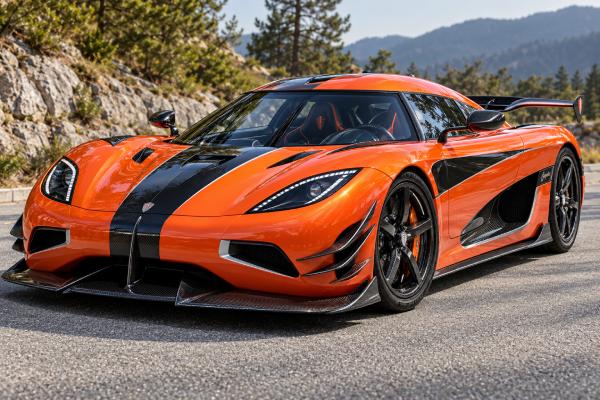
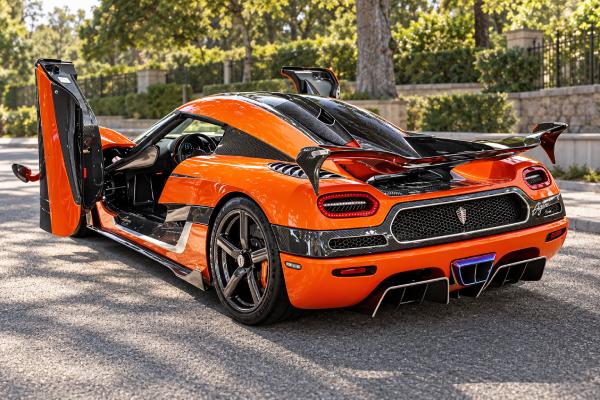
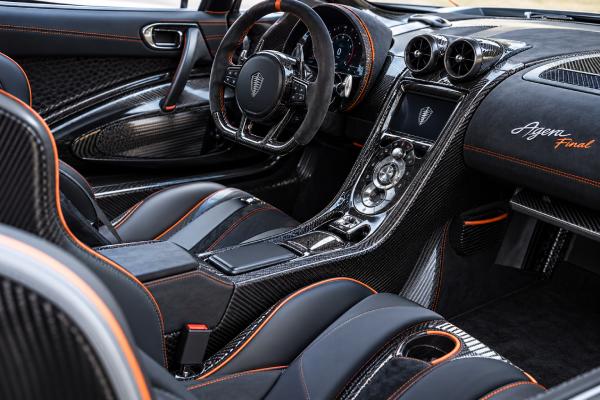
The Koenigsegg Agera Final is a three-car farewell program created to close the Agera line, not a conventional trim with one fixed appearance. Announced in 2016, it placed the Agera RS platform, the optional 1 MW flex-fuel engine, and unusually broad personalization in the hands of three clients. The first car, One of One, appeared at the 2016 Geneva Motor Show; Thor and Väder completed the program at the end of Agera production in 2018. Each received its own aerodynamic and visual treatment, so a single generic photo or option list cannot describe all three accurately. Their shared core is still recognizable: a carbon monocoque, rear-wheel drive, seven-speed paddle-shift transmission, removable roof, active chassis systems, ceramic brakes, and a twin-turbo 5.0-liter V8 rated at 1,360 hp on E85. This guide separates the program history from the individual cars, identifies the reliable technical baseline, explains where bespoke engineering creates variation, and provides practical direction for preservation, authentication, and any future transaction involving one of these exceptionally rare machines.
Table of Contents
- A Three-Car Finale, Not a Regular Trim
- One of One, Thor, and Väder
- The Shared 1 MW Technical Foundation
- Bespoke Aerodynamics and Chassis-Specific Setup
- What the Final Cars Are Like to Use
- Preserving a One-of-Three Koenigsegg
- Authentication, Provenance, and Acquisition
A Three-Car Finale, Not a Regular Trim
The Agera Final was Koenigsegg’s official three-car conclusion to the Agera family. It was announced in 2016 after the 25-car Agera RS allocation had sold, and it gave each client access to the company’s options without the usual additional charge plus the opportunity to develop aerodynamic features reserved for that individual car.
A conventional edition usually has a shared paint scheme, equipment package, or mechanical specification repeated across every example. The Agera Final instead used common high-performance foundations while inviting deliberate divergence. Its identity comes from three commissioned cars and the factory process behind them, not from one spoiler design or one interior color.
Koenigsegg’s history identifies the first as One of One, built for the 2016 Geneva Motor Show. The other two were completed at the end of the Agera RS production run. Their owners, with Koenigsegg’s approval, called them Thor and Väder and collectively described the pair as Final Edition cars. The terms are easy to mix up: “Agera Final” refers to the full run of three, while “Final Edition” is commonly used for the last two.
The production dates also need care. The project spans 2016 to 2018, but that does not mean one car was built in every calendar year or that there were annual model revisions. One of One represented the announcement in 2016; Thor and Väder marked physical completion of the line in 2018. Registration or model-year documents can use different dates depending on market and delivery, so chassis records are more authoritative than a generalized year label.
All three were presented as 1,360 hp cars using Koenigsegg’s 1 MW engine specification. That output is associated with E85 and flex-fuel management. It should not be confused with the regular Agera RS’s 1,160 hp gasoline rating, even though the underlying RS architecture and many components are shared.
The Agera introduced Koenigsegg’s move from twin superchargers to twin turbochargers in 2010 and became the base for the Agera R, Agera S, One:1, and Agera RS. By allowing three customers to combine lessons from those developments with personal aero and finish work, the Final cars functioned as closing statements about what the platform had become.
One of One, Thor, and Väder
The three Agera Finals are best understood as separate commissions. Their common power rating does not make their bodywork interchangeable, and descriptive details should always be tied to the named chassis rather than applied to the trio without evidence.
| Car | Public milestone | Documented distinguishing features |
|---|---|---|
| One of One | Presented at the 2016 Geneva Motor Show | Bespoke rear wing, roof air intake, revised front splitter and venturi treatment, twin-exit 3D-printed titanium exhaust, and special cabin details |
| Thor | Completed in 2018 at the end of Agera production | Two-tone clear carbon with diamond-flake sections, large Le Mans-style central fin, custom front winglets, and enlarged aero elements |
| Väder | Completed alongside Thor in 2018 | Clear carbon with diamond flake, white-gold-leaf highlights, small rear winglets, and an enlarged active rear wing supported by open-cut strakes |
One of One was the public proof of the concept. Its name emphasized the client-specific approach, while its body showed that the program could go beyond selecting catalog equipment. Contemporary reporting identified a roof-fed intake, unique rear wing, revised front aero, a custom venturi arrangement, and a titanium exhaust produced with additive manufacturing. Polished aluminum switchgear added a visible cabin distinction.
Thor and Väder were revealed after the first car had already established the Final name. Thor’s central fin created a strong vertical form and was described as a stability feature, while its clear-carbon finish used diamond-flake accents. Väder followed a different visual logic: white-gold-leaf detailing contrasted with clear carbon, and the rear-wing supports used openings that exposed their skeletal construction.
Both final 2018 cars received custom front winglets, enlarged front and rear aerodynamic pieces, and the 1 MW engine upgrade. Their differences were not cosmetic decals placed over a standard RS body. The shapes, supports, finishes, and interactions with active aero formed part of each commission.
Spelling matters in records. The third car is widely shown as Väder, with an umlaut over the “a,” although English-language reports and catalogues sometimes print Vader. A proper provenance file should preserve the spelling used by Koenigsegg and the owner’s original documentation, while noting alternate published forms for search purposes.
Photography also needs disciplined interpretation. Lighting can make clear carbon, tinted carbon, painted carbon, metallic flakes, and gold-leaf details appear different from one image set to another. A restoration or authenticity decision should never be based only on web photographs. Original finish samples, build photographs, invoices, paint codes, carbon layup records, and factory inspection are stronger evidence.
The Shared 1 MW Technical Foundation
The Agera Final’s reliable technical baseline is the Agera RS with the optional 1 MW flex-fuel power package. It is a non-hybrid, rear-wheel-drive two-seat car with a removable roof, a dry-sump twin-turbo V8, a seven-speed paddle-shift transmission, and integrated electronic control of the engine, differential, stability systems, ride height, and active aerodynamics.
Because each Final has bespoke bodywork and equipment, the tables below describe the shared RS/1 MW architecture rather than claiming that every visible dimension, aero value, or curb-weight detail is identical across all three finished cars.
| Item | Specification |
|---|---|
| Engine type | Koenigsegg aluminum 5.0-liter twin-turbo V8 |
| Valvetrain | Double overhead camshafts, four valves per cylinder |
| Bore × stroke | 92.0 × 95.25 mm |
| Compression ratio | 9.3:1 for the published Agera RS engine baseline |
| Lubrication | Dry sump |
| Induction | Twin ceramic-ball-bearing turbochargers and carbon-fiber intake manifold |
| Fuel control | Sequential multipoint injection, flex-fuel engine management, dual knock sensing, back-pressure sensing, and wideband lambda feedback |
| Peak output | 1,000 kW / 1,360 hp on E85 |
| Fuel-dependent context | Maximum quoted output requires the correct ethanol fuel and supported calibration |
| System | Specification |
|---|---|
| Transmission | Seven-speed paddle-shift gearbox with automatic mode |
| Drivetrain | Rear-wheel drive |
| Differential | Koenigsegg electronically controlled differential |
| Monocoque | Carbon fiber with aluminum honeycomb and integrated fuel tanks |
| Published tub rigidity | 65,000 Nm per degree |
| Published tub mass | 70 kg including tanks |
| Suspension layout | Double wishbones, pushrod-operated gas-hydraulic dampers, and rear Triplex system |
| Ride height | Electronically adjustable, with hydraulic lift assistance |
| Measurement | Published RS reference |
|---|---|
| Length | 4,293 mm before any effect of chassis-specific protruding aero |
| Width | 2,050 mm |
| Height | 1,120 mm before chassis-specific roof features are considered |
| Wheelbase | 2,662 mm |
| Fuel capacity | 82 liters |
| Luggage capacity | 150 liters |
| RS dry-weight reference | 1,295 kg |
| RS curb-weight reference | 1,395 kg |
The 1 MW rating is conditional rather than universal across fuels. Ethanol’s knock resistance and charge-cooling characteristics support the higher-load calibration, while its lower energy per liter requires substantial fuel flow. Actual blend content can vary, so the control system’s detected composition and the car’s current software must be confirmed before maximum demand.
| Area | Published reference |
|---|---|
| Front brakes | 397 × 40 mm ventilated ceramic discs with six-piston calipers |
| Rear brakes | 380 × 34 mm ventilated ceramic discs with four-piston calipers |
| Front wheel | 19 × 9.5-inch center-lock Aircore hollow carbon wheel |
| Rear wheel | 20 × 12.5-inch center-lock Aircore hollow carbon wheel |
| Front tire | 265/35 R19 |
| Rear tire | 345/30 R20 |
| Published road-tire choices | Michelin Pilot Sport Cup 2 or approved Super Sport application, depending on use and chassis specification |
Published RS downforce is often quoted as 485 kg at 250 km/h, but that number cannot automatically be assigned to every Agera Final. The Final program specifically permitted one-off aerodynamic development. A correct technical file should include the individual car’s aero drawings, settings, software, and any measured or simulated data supplied by Koenigsegg.
Bespoke Aerodynamics and Chassis-Specific Setup
The defining engineering feature of an Agera Final is that its aerodynamic package belongs to its chassis. A wing, fin, roof intake, front winglet, or venturi change can affect drag, downforce, cooling, pressure distribution, and balance, so it must be preserved and set up as an engineered system rather than treated as styling jewelry.
A large rear wing increases available load only when the supporting structure, angle, active mechanism, front balance, ride height, and underfloor flow work together. Adding rear load without the intended front response can change steering authority. Changing a roof scoop can influence engine-air delivery and local flow toward the rear wing. Even small winglets may redirect wake around a wheel or body opening.
That interaction explains why generic RS setup data can be incomplete. Alignment, spring and damper settings, active-wing maps, front-flap behavior, hydraulic ride height, and tire pressures may reflect the individual aero package. Before adjusting anything, a technician should retrieve the chassis-specific baseline and record the car’s present values.
Aero inspection should include more than visible cracks. Check internal mounts, bonded joints, hinge play, actuator travel, hydraulic or electrical connections, position sensors, fasteners, witness marks, drainage paths, and clearances throughout the movement range. On Thor, the central fin deserves particular attention at its base and adjacent surfaces. On Väder, the open-cut rear supports require inspection of both their visible finish and load-bearing structure. On One of One, the roof intake, exhaust outlet area, and custom venturi treatment need their own examination.
Surface finish can be functional. Clear coat protects exposed carbon, while paint, metallic particles, and leaf work create a specific build thickness and appearance. Repairs must account for ultraviolet protection, resin compatibility, heat, edge sealing, and the original visual boundary between materials. Heavy refinishing can add mass to movable aero or obscure evidence of a prior repair.
The underbody is especially vulnerable during transport and road use. The splitter, floor, venturi surfaces, and diffuser sit close to the ground, and a small loading error can damage a unique component. Use the lift system according to the car’s instructions, measure trailer angles, and employ operators familiar with very low carbon-bodied vehicles.
No aerodynamic performance claim should be inferred from visual aggression. The only dependable values are those documented for the individual car and configuration. Where the file contains no chassis-specific downforce or drag figure, an honest description should say so.
What the Final Cars Are Like to Use
An Agera Final combines extreme output with several practical Agera features: two seats, climate control, a removable roof that can be stored in the car, adjustable pedals and steering column, hydraulic lift, and usable front luggage space. It remains demanding because 1,360 hp reaches only the rear wheels and because its bespoke carbon body is difficult to repair.
At low speed, the main challenges are width, visibility, steering angle, clutch engagement, heat, and protecting the aero. The published RS width is 2,050 mm, so parking structures, gates, loading ramps, and narrow roads need planning. The nose lift creates clearance but does not protect the floor or rear diffuser from every crest.
The seven-speed transmission can operate automatically, but its character and calibration differ from a mass-produced dual-clutch road car. Smooth use depends on temperature, clutch condition, software, throttle request, and adaptation. A buyer should not judge it from one abrupt cold shift, nor dismiss repeated poor engagement as “normal for a hypercar.”
The engine’s flexibility changes with fuel. On a supported gasoline blend, a flex-fuel car may operate at reduced output compared with its E85 rating. After refueling, the system needs time and correct operation to recognize the new mixture. Full-load use should wait until fuel quality, detected ethanol content, temperatures, and fault status are known.
Removing the roof changes the sensory experience and may impose speed or storage limits described in the individual manual. The panel must be latched, carried, and stowed exactly as designed. Inspect seals, latch operation, painted or exposed-carbon edges, and the storage restraints; damage to a one-off finish can occur during handling rather than driving.
Tires determine whether the power can be used safely. Cup 2-type tires need suitable temperature and dry pavement, while a more road-oriented approved tire still cannot make cold rain harmless. Age is critical on collector cars. A Final with deep tread but old, flat-spotted, or poorly stored tires is not ready for meaningful performance use.
The best road routine is deliberate: inspect fluids and tires, verify lift and warning systems, warm every system progressively, use modest boost until the car is stable, and cool it according to factory guidance. Public roads are not a place to explore the 1 MW rating. The value of a drive is mechanical exercise and controlled enjoyment, not proving a headline number.
Preserving a One-of-Three Koenigsegg
Preservation should keep each Agera Final mechanically functional and historically complete. Sealing the car away without fuel, hydraulic, battery, tire, and climate management can create deterioration that low mileage hides.
| Area | Practical priority | Records to keep |
|---|---|---|
| Flex-fuel system | Control fuel age, moisture exposure, blend changes, pressure, and injector health | Fuel log, ethanol readings, filter and pump work, diagnostic reports |
| Engine and cooling | Use correct dry-sump procedure and maintain sealed, clean cooling paths | Fluid analyses, service invoices, pressure and temperature findings |
| Battery and electronics | Use approved maintenance charging and preserve fault history | Battery tests, software versions, module replacements, fault scans |
| Hydraulics and active aero | Exercise and inspect lift, ride height, wing, and flap systems | Calibration reports, leak repairs, actuator and sensor records |
| Wheels, tires, and brakes | Inspect carbon wheels, center locks, tire age, and ceramic components | Serial information, torque records, date codes, disc and pad measurements |
| Bespoke body and finish | Protect original carbon, paint, leaf, mounts, and one-off pieces | Build photos, finish codes, repair maps, material and factory approvals |
Service should follow the VIN-specific factory schedule, not an interval copied from another Agera. Public technical pages do not contain workshop torque figures, fluid-filling procedures, software dependencies, or test limits. Every invoice should identify the work, measurements, parts, calibration status, and reasons for replacement.
Storage climate should be stable and dry, with protection from ultraviolet light, condensation, pests, and accidental contact. The car needs correct tire support and periodic inspection, but rolling it a few meters does not replace a proper operating cycle. Any exercise plan should be approved for the car’s fuel and service condition.
Recommissioning after a long pause should begin before the engine starts. Inspect fuel age, leaks, wiring, hoses, belts, coolant, dry-sump level, turbo plumbing, exhaust shielding, battery capacity, tires, wheel locks, brakes, suspension, underbody, and aero mechanisms. Scan systems and preserve existing fault information. Then start and warm the car under supervision, checking pressure, temperature, mixture, charging, and hydraulic behavior.
Transport is part of conservation. Photograph all sides, the roof, wheels, splitter, diffuser, floor, and interior before loading. Specify enclosed transport, shallow ramp angles, soft wheel protection, approved tie-down locations, and an operator trained in the lift controls. Document custody at every handoff.
Original parts should remain with the car even when a replacement is necessary. A damaged one-off wing, exhaust, switch, or trim piece may contain manufacturing evidence that future experts need. Label removed components, record orientation and date, protect them from further damage, and retain the factory decision that authorized replacement.
Authentication, Provenance, and Acquisition
Authentication begins by proving membership in the three-car Agera Final program and then proving the identity of the specific commission. Because One of One, Thor, and Väder are publicly recognizable, imitation details or a creative sales description should never substitute for direct factory and chassis documentation.
The core file should include the original order, commission correspondence, build sheet, invoice, certificate material, market homologation documents, delivery record, and Koenigsegg confirmation. Bespoke-aero drawings, finish samples, material specifications, build photographs, software references, and inspection records are unusually important because they define features that cannot be checked against a normal production catalogue.
Match physical identifiers across the monocoque, body, engine, gearbox, electronic modules, wheels, and documents. Do not publish sensitive identifiers unnecessarily, but have qualified representatives inspect them. Determine whether any component has been replaced and whether the replacement was produced, supplied, or approved by Koenigsegg.
A chronological provenance review should reconcile mileage and dates across registrations, services, transport, insurance, displays, events, photography, and earlier sales. The 2016 Geneva appearance of One of One and the 2018 completion and public presentation of Thor and Väder provide useful public anchors, but they do not document every later movement or repair.
Finish examination requires expert restraint. Variations in clear carbon or metallic effect can result from lighting and camera processing, while true repairs may be subtle. Compare the car with original high-resolution factory images and physical samples, then use composite inspection, paint and clear-coat analysis, and repair documentation as appropriate. A conventional paint-depth reading is not sufficient for every carbon structure.
Mechanical inspection should be cold and staged. Confirm current fuel, calibration, software, fluid condition, battery health, hydraulic function, active aero, brake measurements, tire age, wheel condition, underbody integrity, clutch behavior, and cooling performance. A full-power drive is neither necessary nor responsible before these checks are complete.
Any transaction should define exactly what accompanies the car: removable roof and storage hardware, keys, tools, chargers, diagnostic accessories, manuals, certificates, spare parts, original removed parts, luggage, models or presentation items, digital records, and rights to relevant design material. Photograph and inventory each item at contract and delivery.
Valuation cannot be reduced to an ordinary Agera RS comparison. The three-car status, individual identity, originality, condition, public history, quality of documentation, and completeness of bespoke components all affect the result. A heavily repaired but famous car and an exceptionally original private car may require entirely different analysis.
The strongest Agera Final is therefore the one whose story remains attached to its engineering. Its name, unique aero, finish, 1 MW configuration, software, removed parts, services, displays, and custody should form one consistent record. That continuity—not simply a low odometer or an online nickname—is what preserves the final expression of the Agera.
References
- History (Official Agera Final Program History)
- Agera RS – Technical Specifications (Shared Platform Technical Reference)
- Agera RS (Official Model and 1 MW Upgrade Overview)
- This is the last ever Koenigsegg Agera 2016 (One of One Launch Report)
- Final Two Koenigsegg Ageras Built, Aptly Named Thor And Väder 2018 (Thor and Väder Completion Report)
- These are the last ever Koenigsegg Agera RS hypercars 2018 (Final Edition Features Report)
Disclaimer
This guide is informational and cannot replace an inspection, legal review, or the factory documentation for One of One, Thor, or Väder. Specifications, fuel permissions, software, service methods, component identity, equipment, and homologation may differ by chassis, market, build stage, and later Koenigsegg update. Confirm all decisions directly with qualified specialists and the records for the individual car.
Please share this article on Facebook, X/Twitter, or another platform if it helps preserve accurate information about the Agera Final program.