
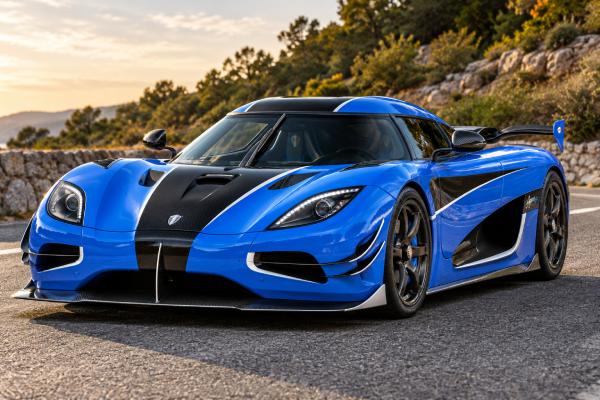
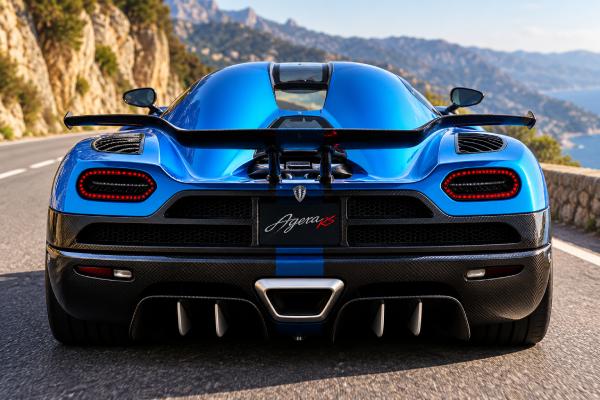
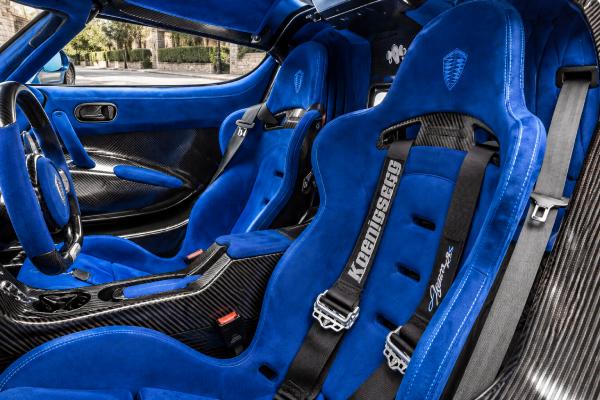
The 1 MW Koenigsegg Agera RS is the factory-upgraded, flex-fuel version of the 25-car Agera RS series, rated at 1,360 hp when operated on E85. It is not simply another name for every Agera RS: the regular car was launched with 1,160 hp on gasoline, while selected customer cars received the optional megawatt power package. That distinction matters because the celebrated Nevada speed-record car used the 1 MW specification, and because fuel, calibration, documentation, and service requirements determine whether a particular chassis can legitimately claim the higher output. Beneath the record story is a carefully integrated road car with a 5.0-liter twin-turbo V8, seven-speed paddle-shift transmission, rear-wheel drive, active aerodynamics, a carbon monocoque, Aircore wheels, and substantial ceramic brakes. This guide explains how the upgrade works, what E85 contributes, which specifications apply, why the 2017 records were credible, how to care for the car, and how buyers can verify a genuine factory-backed 1 MW example.
Table of Contents
- The Factory Upgrade Behind the Records
- One-Megawatt Agera RS Technical Data
- Why E85 Unlocks 1,360 hp
- Engineering for the 400 km/h Zone
- How the 2017 Record Runs Unfolded
- Fuel-System Service and Safe Operation
- Verifying and Buying a Genuine 1 MW RS
The Factory Upgrade Behind the Records
The 1 MW Agera RS is an optional high-output configuration within the Agera RS program, not a separate production series. Koenigsegg built 25 customer Agera RS cars from 2015 to 2018, and the company offered a 1-megawatt engine upgrade that raised the stated output from the regular gasoline car’s 1,160 hp to 1,360 hp on E85.
“One megawatt” describes 1,000 kilowatts of engine power. In Koenigsegg’s metric-horsepower convention, that equals about 1,360 hp. The designation connects the car directly to the One:1 program, whose 1,360 hp engine and extreme aerodynamic development supplied lessons for the more road-usable RS. The upgraded RS retained the removable roof, luggage space, road homologation, climate control, and other practical features that made the RS broader in purpose than the One:1.
The upgrade must be understood as a complete, documented specification. An Agera RS does not become a 1 MW car merely because its engine control unit can recognize ethanol, because it has an aftermarket tune, or because its seller quotes the power of the record car. Hardware, software, permissible fuel, factory records, and the chassis build history all matter. Koenigsegg’s technical information lists flex-fuel management and notes the 1 MW option, while its model overview separates 1,150 bhp petrol output from 1,360 bhp with the MW upgrade.
For owners and buyers, the best definition is therefore simple: a genuine 1 MW Agera RS is a chassis whose Koenigsegg-supported build or upgrade records identify the megawatt package and whose current fuel, engine-control, and mechanical configuration remains consistent with those records.
One-Megawatt Agera RS Technical Data
The 1 MW RS is a rear-wheel-drive, two-seat, removable-roof megacar built around a carbon-fiber monocoque. Its internal-combustion powertrain uses a dry-sump 5.0-liter twin-turbo V8, a seven-speed paddle-shift transmission, an electronically controlled differential, and flex-fuel engine management; there is no hybrid system, traction motor, or high-voltage battery.
| Item | Specification |
|---|---|
| Engine | Koenigsegg aluminum 5.0-liter twin-turbo V8 |
| Valvetrain | DOHC, four valves per cylinder |
| Displacement | 5.0 liters |
| Bore × stroke | 92.0 × 95.25 mm |
| Compression ratio | 9.3:1 |
| Lubrication | Dry sump |
| Engine weight | 189 kg |
| Fuel and management | Flex fuel; sequential multipoint injection, dual knock sensing, back-pressure sensing, and closed-loop wideband lambda control |
| Peak output in this specification | 1,000 kW / 1,360 hp on E85 |
| Transmission | Seven-speed paddle-shift with automatic mode |
| Driven wheels | Rear |
| Differential | Koenigsegg electronic differential |
The V8 uses twin ceramic-ball-bearing turbochargers, a carbon-fiber intake manifold, and a thin-wall Inconel exhaust manifold with a merge collector. Koenigsegg lists 1.3 bar boost on gasoline and 1.4 bar with E85 for the RS technical package. The current public specification page does not present a complete, internally consistent torque line specifically for the optional 1 MW calibration, so torque should be checked against the individual car’s factory documentation rather than copied from a generic listing. Period descriptions commonly associate the upgrade with approximately 1,371 Nm, while Koenigsegg’s current model overview displays 1,280 Nm for the RS range.
| Item | Specification |
|---|---|
| Body | Two-door, two-seat carbon-fiber body with detachable, stowable hardtop |
| Chassis | Carbon-fiber monocoque with aluminum honeycomb and integrated fuel tanks |
| Monocoque mass | 70 kg including tanks |
| Torsional rigidity | 65,000 Nm per degree |
| Dry weight | 1,295 kg |
| Curb weight | 1,395 kg |
| Weight distribution | 44 percent front / 56 percent rear |
| Fuel capacity | 82 liters |
| Luggage capacity | 150 liters |
| Measurement | Value |
|---|---|
| Length | 4,293 mm |
| Width | 2,050 mm |
| Height | 1,120 mm |
| Wheelbase | 2,662 mm |
| Low-speed ground clearance | 105 mm |
| Track-mode ground clearance | 85 mm |
| Front lift activated | 150 mm |
The chassis combines double wishbones, pushrod-operated gas-hydraulic dampers, electronically adjustable ride height, Z-style anti-roll bars, and Koenigsegg’s rear Triplex arrangement. Electronic stability control provides Wet, Normal, and Track settings. Those systems make the enormous engine output usable over a wider range of roads, but they do not repeal the traction limits of two driven tires.
| System | Specification or function |
|---|---|
| Rear aero | Dynamically active rear wing |
| Front aero | Independent active front flaps, splitter, and winglets |
| Underbody | Flat floor, venturi treatment, and active underbody management |
| Published downforce | Up to approximately 450–485 kg at 250 km/h, depending on the Koenigsegg source and stated configuration |
| Front brakes | 397 × 40 mm ventilated ceramic discs, six-piston calipers |
| Rear brakes | 380 × 34 mm ventilated ceramic discs, four-piston calipers |
| Steering | Hydro-electric power assistance, 2.7 turns lock to lock |
| Position | Wheel | Tire size |
|---|---|---|
| Front | 19-inch center-lock Koenigsegg Aircore hollow carbon wheel | 265/35 R19 |
| Rear | 20-inch center-lock Koenigsegg Aircore hollow carbon wheel | 345/30 R20 |
| Road choices | Approved 19/20-inch applications | Dedicated Michelin Pilot Sport Cup 2 or Michelin Super Sport, subject to chassis and market specification |
Published acceleration figures require context. Koenigsegg’s public RS technical page contains legacy performance lines that do not cleanly separate every RS calibration, so they should not be treated as a guaranteed test result for each 1 MW car. The strongest verified measures for the record chassis are the timed 0–400–0 km/h and high-speed runs discussed below.
Why E85 Unlocks 1,360 hp
E85 enables the 1 MW output because its high knock resistance and strong charge-cooling effect allow the turbocharged V8 to operate at a more aggressive high-load calibration. The extra power is not created by the fuel label alone; it depends on the correct ethanol content, fuel delivery, sensors, software, thermal condition, and engine hardware working as one system.
E85 is nominally a blend containing up to about 85 percent ethanol, but its actual seasonal and regional composition can vary. Ethanol has a higher effective octane rating than ordinary pump gasoline and absorbs substantial heat as it vaporizes. In a boosted engine, those qualities reduce the tendency for uncontrolled end-gas combustion, or knock, when cylinder pressure and temperature rise.
Koenigsegg’s control strategy monitors combustion and mixture using knock sensors, wideband lambda feedback, and other inputs. A flex-fuel system can adjust fueling and ignition for the detected blend, but “flexible” does not mean every blend produces maximum power. With less ethanol or lower-quality fuel, the safe calibration may reduce boost, ignition advance, or output. Owners should use only fuel accepted by the car’s current factory documentation.
Ethanol also requires greater fuel volume for a comparable energy release because it contains less energy per liter than gasoline. That raises the importance of pump capacity, injector performance, filters, electrical supply, fuel pressure, and clean delivery. A restriction that seems minor during gentle road use can become critical when a 1,000 kW engine demands fuel continuously at high load.
Fuel storage needs planning. Ethanol blends can absorb moisture and can change during long storage. The proper response is not a universal internet recipe, because seals, pumps, calibration, local fuel composition, and storage duration are chassis-specific. Before laying up the car, the owner should obtain written guidance from Koenigsegg or the servicing specialist on acceptable fuel, tank level, circulation, restart procedure, and whether the system should be changed to an approved gasoline blend.
The safest ownership principle is that 1,360 hp is a conditional factory capability, not a permanent number independent of fuel and condition. On the wrong fuel, with stale ethanol, or with a weak delivery system, demanding record-level output can damage an exceptionally valuable engine.
Engineering for the 400 km/h Zone
A 400 km/h-capable Agera RS depends more on stability, tires, aero balance, cooling, and road control than on peak power alone. The 1 MW engine provides the energy to overcome rapidly increasing aerodynamic drag, but the rest of the car must remain predictable while the distance covered each second becomes extreme.
Aerodynamic drag rises approximately with the square of speed, while the power needed to overcome it rises approximately with the cube. That means the final increase from 400 to 440 km/h demands disproportionately more power than an equal increase at ordinary road speed. The MW package is therefore especially meaningful at the far end of the speed range, where an additional 200 hp can be consumed by drag rather than translated into dramatic low-speed acceleration.
The RS’s active rear wing and front flaps help manage balance rather than simply chase the largest downforce number. Front and rear aerodynamic load must remain coordinated as speed, braking, ride height, and pitch change. Too little rear stability is dangerous; too much drag or an unbalanced setup can prevent the car from reaching its target while overworking tires and suspension.
Tires are the narrowest safety margin. Size and brand alone do not establish suitability for a maximum-speed run. Manufacturing batch, age, internal condition, prior heat cycles, pressure growth, load, road temperature, wheel integrity, balance, and approval for the exact event all matter. The Nevada effort used specially prepared logistics and tire support; it was not an invitation to test an old low-mileage road set.
Braking performance explains why Koenigsegg’s record program included 0–400–0 km/h. Large ceramic discs, suitable pads, aerodynamic drag, active aero, tires, and stable chassis control must convert enormous kinetic energy into heat without destabilizing the car. Brake fluid age, disc condition, pad thickness, caliper seals, cooling paths, pedal behavior, and ABS or stability faults should be assessed under the service procedure—not inferred from a clean appearance.
Finally, public-road records require public-road closure and professional control. Sight distance, surface survey, crosswind, gradient, temperature, wildlife, debris, emergency services, communications, timing equipment, and run direction are all part of the engineering problem. No owner should attempt to imitate the record on an open road.
How the 2017 Record Runs Unfolded
The 1 MW Agera RS established its defining records in two stages during 2017: a 0–400–0 km/h run in Denmark and a two-direction maximum-speed program on a closed public road in Nevada. Factory driver Niklas Lilja drove the customer-owned record car.
On October 1, 2017, at Vandel Airfield in Denmark, the car accelerated from rest to 400 km/h and stopped again in 36.44 seconds. Koenigsegg released video and data for that attempt. It demonstrated more than acceleration: the result required controlled launch, rapid shifting, straight-line stability, brake performance, and a clean transition from full power to maximum deceleration.
About a month later, on November 4, Nevada authorities closed an approximately 11-mile section of State Route 160 near Pahrump. The Agera RS ran in both directions, a method intended to reduce the effect of wind and road gradient. The two-way average became the central production-car speed claim.
| Measure | Reported result | Context |
|---|---|---|
| 0–400–0 km/h, Denmark | 36.44 seconds | October 1 at Vandel Airfield |
| 0–400–0 km/h, Nevada | 33.29 seconds | Improved during November record program |
| Two-way maximum-speed average | 447.19 km/h / 277.87 mph | Opposite-direction runs on closed public road |
| Flying kilometer, two-way average | 445.63 km/h / 276.9 mph | Timed distance result |
| Flying mile, two-way average | 444.76 km/h / 276.36 mph | Timed distance result |
| Highest speed in one direction | 457.94 km/h / 284.55 mph | Not the two-way average |
Koenigsegg’s current public pages contain a small inconsistency: the company history gives 447.19 km/h with 277.87 mph, while the current RS model page prints 446.97 km/h with the same 277.87 mph. The mph figure converts to approximately 447.19 km/h, and that is the value used in the table. Careful articles should acknowledge the source difference instead of combining numbers without explanation.
The two-direction average is more meaningful than the highest single reading. A tailwind, favorable grade, or momentary measurement cannot dominate the final number in the same way when the car must return in the opposite direction. That does not make record definitions universal: organizations may apply different requirements for production volume, timing, run interval, road type, or witness procedure. The accurate claim is tied to the method Koenigsegg documented—a homologated production car, a customer-owned example, a closed public road, and an average of opposing runs.
The result also should not be treated as a guaranteed top speed for every 1 MW RS. Manufacturing variation, aero specification, alignment, wheel and tire package, weather, fuel, driver, road, and preparation can change the outcome. The record belongs to the model and configuration as demonstrated, not to a promise that any owner can reproduce it.
Its lasting importance is engineering credibility. The car did not produce only a simulated number or a one-direction peak on a private runway. It accelerated, remained stable on a real road surface, ran in both directions, and stopped. That combination gave the 1 MW package a public identity far beyond its option-sheet description.
Fuel-System Service and Safe Operation
A 1 MW RS should be maintained as a low-volume, high-load flex-fuel system, not as an ordinary collector car that only needs an annual oil change. Fuel quality, electrical health, cooling, hydraulics, tires, and software are interconnected, and long storage can be as harmful as high mileage.
Start with the factory schedule and the requirements attached to the exact VIN. Public specifications are useful for identification but do not provide service torque values, diagnostic routines, fluid procedures, or calibration steps. Work should be carried out by Koenigsegg or a specialist recognized for the model, with invoices that name the operations, measurements, software versions, and parts used.
Before each drive, inspect for fluid or fuel odor, warning messages, weak battery behavior, abnormal pump noise, tire-pressure loss, wheel damage, underbody contact, and hydraulic leakage. Verify the correct dry-sump oil level using the approved temperature and running procedure. Do not add oil by guesswork; overfilling can be as serious as underfilling.
Fuel records deserve their own log. Note supplier, grade, ethanol content when measured, date, quantity, and the blend already in the tank. Keep receipts where possible. If the car has been stored, do not assume a clear-looking sample is suitable for full load. Have the system and detected blend checked before asking for MW output.
Battery voltage matters because pumps, control modules, valves, ignition, data systems, and transmission control all depend on stable supply. Use only an approved maintainer and correct connection procedure. A battery that can crank the engine may still sag under diagnostic or hydraulic demand. Load testing and fault-history review are more useful than charging the battery immediately before a sale.
A recommissioning after extended storage should normally address:
- Fuel composition, tank condition, filters, pump delivery, and injector performance.
- Engine oil, filter, dry-sump level, coolant, brake fluid, and age-sensitive seals.
- Battery capacity, charging system, grounds, and stored low-voltage faults.
- Turbocharger plumbing, intake sealing, wastegate or control function, and exhaust shielding.
- Tire age and internal condition, Aircore wheel inspection, center-lock process, and alignment.
- Carbon-ceramic disc and pad measurements, caliper condition, and brake cooling.
- Ride-height hydraulics, dampers, bushings, steering, Triplex system, and active aero calibration.
- Underbody, splitter, diffuser, body mounts, roof seals, and structural carbon inspection.
- Engine, gearbox, stability-control, and chassis software status.
High-speed use requires a separate event inspection. It should include current tire approval, road and weather limits, data monitoring, emergency plan, trained personnel, and a controlled venue. A normal road service, even when complete, does not certify a car for a 400 km/h attempt.
Verifying and Buying a Genuine 1 MW RS
The safest purchase is a chassis whose 1 MW status is confirmed directly through its factory build or upgrade history. Auction copy, a dyno claim, E85 in the tank, or a “record specification” description is not enough to establish that the car left Koenigsegg—or later returned to Koenigsegg—with the supported megawatt package.
Ask for the original order, build sheet, invoice, certificate material, delivery file, market homologation documents, factory correspondence, and every service invoice. Look for an explicit reference to the MW or 1 MW engine option, not merely “flex fuel.” Determine whether the package was installed during initial assembly or added later, and confirm that any later work was factory authorized.
Do not assume the Nevada record car’s details apply to another chassis. “Same model as the record holder” is a defensible statement; “the record car specification” needs evidence. Optional wheel packages, roll protection, aero choices, ride settings, and special preparation may differ. A claim that a car itself participated in testing or records should be supported by serial-number-linked documents, dated media, logistics records, and factory confirmation.
Provenance should form an uninterrupted chronology. Cross-check dates and mileage among registrations, service bills, transport records, event appearances, photographs, fuel logs, tire invoices, and prior sale catalogues. Long gaps may be harmless, but they require an explanation and a recommissioning record. Extremely low mileage does not eliminate ethanol degradation, battery damage, seal aging, tire aging, or hydraulic leakage.
The physical inspection should cover the carbon monocoque, suspension pick-up points, front and rear crash structures, floor, splitter, diffuser, wheel wells, roof openings, and signs of bottoming. Painted carbon can hide repairs, while exposed carbon may show cosmetic marks that are not structural. Use a carbon-composite specialist and advanced inspection methods when an impact, repair, or unexplained finish change warrants them.
Finally, budget for immediate service even when the file is strong. Purchase price is only the entry point; tires, carbon wheels, ceramic brakes, hydraulic components, bespoke bodywork, transport, insurance, ethanol management, and factory-level diagnostics can create substantial costs. A pre-purchase reserve protects the car and prevents an owner from delaying essential work.
A genuine 1 MW Agera RS is valuable because its identity is specific: it combines the RS’s road usability with the E85-enabled megawatt output proven by one of the most carefully documented high-speed programs of its era. The best example is not necessarily the one with the lowest odometer. It is the car with factory-confirmed specification, complete chronology, correct current calibration, healthy fuel and thermal systems, sound carbon structure, approved wheels and tires, and an owner prepared to operate it within professional limits.
References
- Agera RS – Technical Specifications (Technical Specifications)
- Agera RS (Model Overview)
- History (Company History and Record Results)
- Koenigsegg Agera RS 0-400-0 2017 (Official Koenigsegg Record Video)
- Watch Koenigsegg’s Complete Record-Breaking Top-Speed Run Right Here 2017 (Record-Car Configuration Report)
- Watch Koenigsegg Set Top-Speed Record: 277.9 MPH! 2017 (Independent Record Report)
Disclaimer
This article provides general information, not operating authorization, professional diagnosis, or a substitute for Koenigsegg workshop instructions. Fuel limits, power calibration, software, service procedures, parts, torque values, tires, homologation, and equipment can vary by VIN, market, build date, and factory update. Confirm every technical decision with current documentation for the individual car and qualified Koenigsegg support.
Please share this guide on Facebook, X/Twitter, or another platform if it was useful and may help another enthusiast understand the 1 MW Agera RS accurately.