

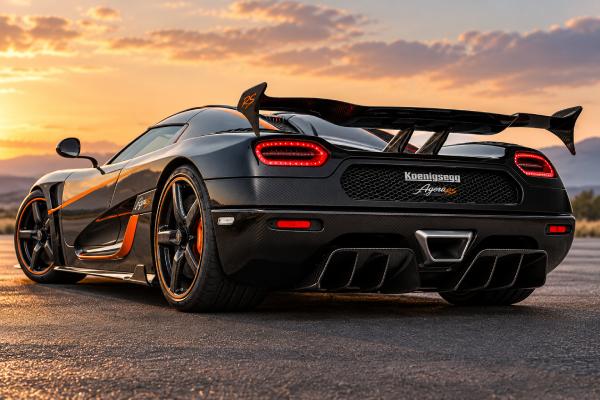
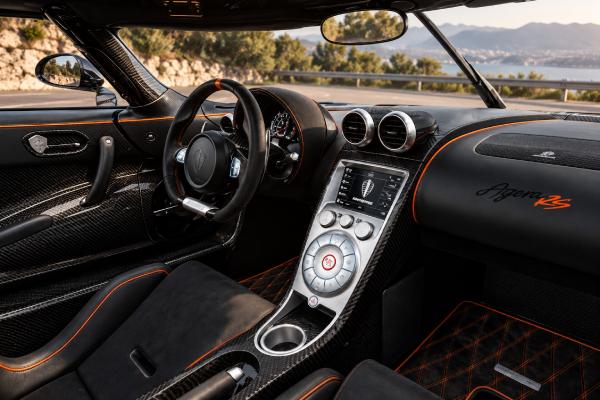
The 1,160 hp Koenigsegg Agera RS is the standard gasoline version of the model, not the optional E85-powered 1 MW configuration that later became famous for speed records. That distinction matters because output, boost, fuel requirements, provenance, and collector claims can differ substantially between two cars that both wear Agera RS badges. Introduced in 2015, the RS combined lessons from the extreme One:1 with the removable roof, front luggage space, road equipment, and worldwide homologation expected of the Agera line. Its 5.0-liter twin-turbo V8 produced 865 kW, or 1,160 metric hp, on 95-octane gasoline, with 1,280 Nm of torque and an 8,250 rpm redline. Active front flaps, a dynamic rear wing, Triplex rear suspension, Aircore carbon wheels, and extensive lightweight composites made it a serious track car, yet it retained climate control, parking assistance, and a stowable hardtop. This guide focuses only on the regular gasoline specification and explains how to identify, maintain, evaluate, and buy it without confusing optional hardware with standard equipment.
Table of Contents
- Why the Gasoline RS Deserves Its Own Guide
- Agera RS 1,160 hp Specifications
- Turning One:1 Technology Into a Road Car
- Gasoline V8 Response and Transmission
- Active Aero, Suspension, and Tire Choices
- Ownership, Service, and Recommissioning
- Buying the Correct 1,160 hp Car
Why the Gasoline RS Deserves Its Own Guide
The standard Agera RS made 1,160 hp on 95 RON gasoline while remaining globally homologated and more usable than the One:1. It was the highest-output Koenigsegg gasoline calibration at launch and formed the baseline for a production run of 25 customer examples from 2015 through 2018.
Calling every Agera RS a “1,360 hp car” is inaccurate. Koenigsegg offered a separate 1 MW engine option that raised output on E85, but the technical specification for the regular car is 865 kW, stated as 1,160 hp, at 7,800 rpm. The standard engine uses 1.3 bar of boost, while the official page identifies 1.4 bar with E85. A sales description should state whether the individual chassis has the factory 1 MW package, a later factory update, or the normal gasoline setup.
The horsepower notation can also create confusion. Koenigsegg’s 1,160 hp figure is metric horsepower; the current model page also expresses it as roughly 1,150 bhp. Those are unit differences, not evidence that one source describes a detuned car.
The RS was intended to occupy a useful space between the Agera R and One:1. It received advanced aero, lightweight construction, a higher redline, more power, and electronic chassis features developed through the One:1 program. At the same time, it kept the Agera’s detachable hardtop, 150-liter front luggage area, sound insulation, road tires as an option, and everyday controls. Koenigsegg described this balance as road-and-track versatility rather than a pure maximum-speed specification.
The Agera RS name also covers unusually bespoke cars. Owners could select alternative aero packages, exposed carbon finishes, individualized interiors, active self-leveling chassis equipment, connected Pre-Active suspension settings, and other options. Two nominally standard 1,160 hp examples may therefore differ visually and functionally without either being incorrect.
Most importantly, the Nevada two-way top-speed record was set by a customer-owned Agera RS with the 1 MW package. It demonstrates the capability of the RS platform, but it is not evidence that an unmodified 1,160 hp gasoline car has the record engine specification. Keeping that boundary clear protects the technical accuracy of this variant and the market value of documented 1 MW cars.
Agera RS 1,160 hp Specifications
This Agera RS is a gasoline-powered ICE hypercar with a mid-mounted 5.0-liter twin-turbo V8, rear-wheel drive, and a seven-speed paddle-shift transmission. The tables below use the standard 1,160 hp gasoline configuration and do not substitute the optional 1 MW E85 output.
| Item | Standard Agera RS |
|---|---|
| Engine | Koenigsegg aluminum 5.0L twin-turbo V8 |
| Valvetrain | Double overhead camshafts, four valves per cylinder |
| Bore × stroke | 92 × 95.25 mm |
| Compression ratio | 9.3:1 |
| Lubrication | Dry sump |
| Fuel and control | 95 RON gasoline calibration with sequential multipoint injection, dual knock sensors, backpressure sensors, and wideband lambda control |
| Turbochargers | Twin ceramic ball-bearing units with variable geometry and backpressure-reduction system |
| Gasoline boost pressure | 1.3 bar |
| Engine weight | 189 kg |
| Item | Value |
|---|---|
| Maximum power | 865 kW / 1,160 metric hp at 7,800 rpm |
| Maximum torque | 1,280 Nm at 4,100 rpm |
| Broad torque output | 1,000 Nm from 2,700 to 6,170 rpm |
| Redline | 8,250 rpm |
| Transmission | Seven-speed paddle-shift with automatic mode |
| Differential | Koenigsegg Electronic Differential |
| Drive | Rear-wheel drive |
| Stability system | Koenigsegg Electronic Stability Control with Wet, Normal, and Track settings |
| Item | Specification |
|---|---|
| Front aero | Track-oriented splitter, winglets, and independently active underbody flaps |
| Rear aero | Dynamically active rear wing and diffuser |
| Downforce at 250 km/h | 485 kg on the official technical specification |
| Frontal area | 1.873 m² |
| Monocoque | Carbon fiber with aluminum honeycomb and integrated fuel tanks |
| Monocoque weight | 70 kg including tanks |
| Torsional rigidity | 65,000 Nm per degree |
| Body | Pre-impregnated carbon fiber/Kevlar with lightweight sandwich reinforcement |
| System | Specification |
|---|---|
| Suspension layout | Double wishbones with pushrod-operated, two-way adjustable gas-hydraulic dampers |
| Rear control | Triplex damper and carbon-fiber upper wishbones |
| Ride height | Electronically adjustable, independently controlled per wheel |
| Anti-roll bars | Koenigsegg Z-style progressive front and rear |
| Steering | Hydro-electric assisted rack and pinion, 2.7 turns lock-to-lock |
| Turning circle | 11 meters |
| Front brakes | 397 × 40 mm ventilated ceramic discs, six-piston calipers |
| Rear brakes | 380 × 34 mm ventilated ceramic discs, four-piston calipers |
| Position or use | Specification |
|---|---|
| Front wheel | 19 × 9.5-inch center-lock Aircore hollow carbon wheel |
| Rear wheel | 20 × 12.5-inch center-lock Aircore hollow carbon wheel |
| Front tire size | 265/35 R19 |
| Rear tire size | 345/30 R20 |
| Track-oriented tire | Dedicated Michelin Pilot Sport Cup 2 |
| Road-oriented tire | Optional Michelin Super Sport |
| Monitoring | Tire-pressure monitoring system |
| Measure | Value |
|---|---|
| Length | 4,293 mm |
| Width | 2,050 mm |
| Height | 1,120 mm |
| Wheelbase | 2,662 mm |
| Dry weight | 1,295 kg |
| Curb weight | 1,395 kg |
| Fuel capacity | 82 liters |
| Front luggage volume | 150 liters |
| Ground clearance | 105 mm at low speed; 85 mm in track mode; 150 mm with front lift |
| Roof | Removable hardtop designed for storage in the front compartment |
Koenigsegg’s current technical page includes a block of older Agera performance data alongside the RS engine specification. Values such as 960 hp, a 7,500 rpm redline, and 1.5 g should not be copied into an RS table merely because they appear on the same page. The RS-specific powertrain, aero, weight, and chassis entries are the relevant figures for this article.
Turning One:1 Technology Into a Road Car
The Agera RS translated One:1 development into a package that could carry luggage, remove its roof, meet wider market rules, and tolerate road use. Its achievement is not that it matched the One:1 in every metric, but that it retained much of the engineering while becoming easier to own.
The One:1 used a roof scoop, extreme body openings, an elevated rear wing, specialized spring hardware, and a 1,360 kg curb-weight target. The RS adopted active underbody management, front winglets, advanced composite layups, an active rear spoiler, revised cooling exits, and connected chassis capability without copying the entire track-only emphasis. This produced a shorter, lower body with normal Agera roof storage and a quoted 1,395 kg curb weight.
Weight was controlled even as equipment returned. The RS could include climate control, audio with Apple CarPlay, adjustable pedals and steering column, cameras, parking sensors, airbags, a digital owner’s manual, and a lithium battery. Lightweight insulation and more efficient composite construction allowed Koenigsegg to add function while keeping the car lighter than the Agera R and S according to the company.
Worldwide homologation was another major difference. The RS was presented as compliant with safety, emissions, and registration requirements across key markets. That does not guarantee that any chassis can be imported anywhere today, but it made the model a broader commercial proposition than the very small One:1 program.
The removable roof is central to the road-use concept. It turns the RS into an open car without requiring a separate body style, and the panel can occupy the front luggage space when removed. Owners should still inspect the seals, latches, locating points, headliner, storage restraints, and paint edges. A roof that looks fine when installed may whistle, leak, or move if adjustment has drifted.
Options can alter the character considerably. Pre-Active chassis settings could use connected data to prepare damping for known road or track conditions. Alternative aero packages changed appearance and load. Active sound cancellation and differing cabin specifications affected refinement. An accurate evaluation therefore begins with the chassis build sheet, not a generic statement that all RS cars are identical.
Gasoline V8 Response and Transmission
The standard RS engine is remarkable because it reaches 1,160 hp without requiring ethanol for the published rating. Its 9.3:1 compression ratio, 1.3 bar boost, backpressure sensing, knock control, and lightweight air-and-exhaust hardware support high output while the broad torque curve makes the car usable below the redline.
Peak torque arrives at 4,100 rpm, but the more useful figure is 1,000 Nm available from 2,700 to 6,170 rpm. This gives the engine a wide operating window rather than one narrow surge. On a road, small throttle openings can produce substantial acceleration before maximum boost. On a circuit, the driver can choose gears around corner balance instead of chasing one exact engine speed.
The 8,250 rpm limit is unusually high for a large turbocharged V8. Maximum power at 7,800 rpm means acceleration continues near the top of the range, unlike engines that deliver a dramatic midrange hit and then fade. That character places heavy demands on oil control, ignition strength, turbo speed, fuel pressure, and valve-train integrity, which is why correct warm-up and data-led service matter.
Koenigsegg’s backpressure-reduction exhaust concept uses an Inconel manifold with thin walls and a merge collector. Lower exhaust restriction helps turbine response and reduces pumping losses, while backpressure sensors give the control system information it can use for turbo management. The carbon-fiber intake manifold reduces mass and shapes the intake paths. These parts are expensive, heat-exposed, and specific enough that improvised repairs are inappropriate.
The seven-speed paddle-shift transmission includes an automatic mode, but it should not be judged against a modern luxury-car automatic. Its control strategy, clutch operation, and shift feel reflect a small-volume high-performance unit designed around very high torque. A healthy car should be consistent and predictable, not necessarily imperceptible. During inspection, compare cold and warm behavior, low-speed clutch take-up, manual shifts at different loads, reverse engagement, and any diagnostic history.
Rear-wheel drive preserves steering clarity and saves the mass of an all-wheel-drive system, but it leaves tire grip as the limiting factor at lower speeds. Stability control has Wet, Normal, and Track settings; Track is not a general road mode. Temperature, surface texture, tire compound, and pressure can change the amount of throttle the car accepts far more than a driver familiar with ordinary high-performance cars may expect.
Fuel quality remains important even though this is the gasoline article. The official history identifies 95-octane gasoline, meaning 95 RON in markets that use Research Octane Number. In North America, pump labels normally use AKI, and the numerical value is lower for roughly equivalent resistance to knock. Owners must follow the market-specific factory requirement instead of matching the number printed in a foreign article.
Active Aero, Suspension, and Tire Choices
The RS generates grip through coordinated aerodynamics, suspension position, and tire behavior. Its active rear wing and independent front flaps can change load distribution, while electronic ride-height control helps keep the body inside the intended aero window.
At 250 km/h, Koenigsegg’s technical page quotes 485 kg of total downforce. The model overview uses 450 kg in narrative text, likely reflecting a different aero statement or configuration. A careful article should acknowledge the official difference rather than merge it into an invented average. For a specific car, its installed aero package and factory setup determine the appropriate figure.
The front splitter, small winglets, side skirts, underbody flaps, diffuser, and rear wing do more than create a dramatic outline. They control where pressure builds and falls around the car. Balance matters: extra rear-wing angle without the expected front contribution can change high-speed response, while underbody damage can disturb flow even when the top surface looks untouched.
The carbon monocoque is exceptionally stiff, giving the suspension a stable platform. Double wishbones locate the wheels, and the Triplex rear system helps resist squat and heave under acceleration and aerodynamic load. Two-way electronically adjustable dampers permit the car to separate road compliance from track control more effectively than a fixed setup.
Ride height should be tested through every commanded position. The low-speed setting, track position, and lift function rely on hydraulics, sensors, valves, and software. Uneven response, slow lowering, warning messages, or one corner sitting differently can indicate a leak, calibration issue, sensor fault, or mechanical binding. Measuring the car on a level surface is more reliable than judging wheel-arch gaps by eye.
Wheel and tire work requires model-specific procedure. Aircore wheels are hollow carbon structures with center locks, so mounting equipment, protection, torque process, and inspection skill matter. Check for impact evidence, bead damage, center-lock wear, heat exposure, and prior refinishing. Cosmetic clear-coat work should not hide the wheel’s service history.
Cup 2 tires need temperature and dry conditions to deliver their best. Super Sports are more appropriate for mixed road use, but neither option makes heavy rain or cold pavement trivial at this output. Tire age is often more important than tread depth on low-mileage cars. A seller should provide date codes, installation invoices, storage conditions, and confirmation that the exact specification is accepted for the chassis.
Carbon-ceramic brakes offer low unsprung mass and repeated high-temperature performance, but they are not immune to damage. Chips, surface condition, oxidation or wear measurements, pad compatibility, fluid age, and caliper seals all deserve inspection. A quiet, low-speed test alone cannot establish readiness for track braking.
Ownership, Service, and Recommissioning
Agera RS ownership works best when the car is exercised regularly, serviced by an authorized or factory-recognized specialist, and documented at component level. Mileage alone is a poor measure of condition because storage can create fuel, battery, seal, tire, and hydraulic problems without moving the odometer.
Begin with the official maintenance schedule for the VIN and market. The publicly available technical page is not a workshop manual and does not provide the torque values, fluid procedures, or software steps needed for service. Invoices should identify fluids, filters, updates, measurements, fault findings, and replaced parts rather than simply state “annual service.”
A pre-drive routine should cover fluid leaks, tire pressure and age, wheel security, brake condition, ride height, warning messages, battery voltage, fuel level, and visible underbody damage. Start the car in a ventilated area, allow pressures to stabilize, and use gentle load until oil, coolant, transmission, brakes, and tires are properly warm. Extended stationary idling is not a substitute for a complete operating cycle.
Cooling deserves close attention. The RS must reject heat from a compact engine bay under high boost, and its performance depends on clear heat exchangers, correct fans and pumps, intact ducting, healthy coolant, and sealed intake paths. Dried residue, staining, sweet odor, temperature divergence, or frequent top-ups requires diagnosis before hard use.
Transmission and hydraulic systems should be operated, not merely viewed. Cycle reverse and forward engagement, manual and automatic modes, front lift, ride heights, active wing, and any chassis-specific functions. Slow operation after storage may reveal low pressure, weak voltage, sticky valves, or leakage. Record diagnostic codes before clearing them because history can be more informative than the current warning lamp.
A recommissioning inspection after long storage should include:
- Fuel condition and delivery pressure
- Engine oil and dry-sump level using the correct procedure
- Coolant, brake fluid, and other age-sensitive fluids
- Battery load test and charging-system health
- Tire age, flat spots, and wheel inspection
- Brake disc and pad measurements
- Turbo, intake, exhaust, and heat-shield checks
- Suspension hydraulics, dampers, bushings, and alignment
- Active aero calibration and underbody fasteners
- Software version, stored faults, and outstanding factory work
Transport planning is part of ownership. The RS is wide, low, and fitted with vulnerable carbon aero. A suitable enclosed transporter needs shallow ramps, appropriate tie-down points, wheel protection, and operators who understand lift operation. Document the condition of the splitter, floor, wheels, and body before and after loading.
Buying the Correct 1,160 hp Car
The first buying question is not color or mileage; it is whether the chassis is genuinely in standard 1,160 hp gasoline specification. Confirm that point through Koenigsegg documentation, engine calibration records, invoices, and physical equipment rather than a badge, auction headline, or seller’s recollection.
Request the original order, build sheet, delivery documents, certificate material, market homologation record, service file, and factory correspondence. The build sheet should identify optional aero, chassis, interior, wheels, infotainment, and any bespoke work. Later changes need their own dated records and should be classified as factory, authorized specialist, or third-party work.
To separate a standard car from a 1 MW example, ask direct questions:
- Was the 1 MW package installed at original build?
- Was a factory power upgrade added later?
- Which fuels does the current calibration permit, and at what output?
- Are the associated hardware, control software, and documentation present?
- Has the engine ever been returned to standard specification?
A documented later factory conversion may be desirable, but it means the car no longer matches this assignment’s regular gasoline scope. Conversely, a seller should not price a standard RS as a 1 MW car merely because the engine control system has flex-fuel capability or because another Agera RS set records.
Inspect provenance as a chronological record. Match dates and mileage across registration documents, service invoices, transport receipts, event photographs, tire invoices, diagnostic reports, and sales records. Investigate long silent periods rather than assuming they represent careful storage. A consistent 8,000-km car can be a better ownership proposition than a 500-km example with old fluids and missing history.
Body and chassis inspection should be performed by someone experienced with structural carbon fiber. Check the tub, suspension pick-up points, floor, splitter mounts, diffuser, panel cores, wheel wells, roof apertures, and evidence of underbody contact. Paint-depth readings can assist on painted panels but do not reveal every carbon repair. Thermography, ultrasound, or other specialist methods may be appropriate when history or impact signs justify them.
Evaluate the car in stages: cold inspection, diagnostic scan, warm static function test, careful road drive, lift inspection, and document review. Note clutch take-up, shift consistency, steering centering, brake feel, alignment, damping, noises, temperatures, and active-system behavior. A full-power demonstration is unnecessary and can conceal more than it proves if the seller uses speed to distract from evidence.
Finally, value the specification honestly. Standard 1,160 hp cars have their own importance: they represent the RS as launched, make extraordinary output on gasoline, and preserve the road-and-track balance Koenigsegg intended. They do not need borrowed 1 MW claims to be compelling. The strongest purchase is an accurately described example with factory-confirmed identity, complete history, healthy systems, correct tires and wheels, and a realistic plan for service after the sale.
References
- Agera RS – Technical Specifications (Technical Specifications)
- Agera RS (Model Overview)
- History (Company History)
- It’s the 1160bhp Koenigsegg Agera RS 2015 (Launch Report)
- GENEVA MOTOR SHOW: Koenigsegg Agera RS 2015 (Launch Technical Report)
- 2016 Koenigsegg Agera RSR 2024 (Chassis-Specific Auction Catalogue)
Disclaimer
This article is for informational purposes and is not a substitute for professional diagnosis or repair. Specifications, torque values, intervals, software, procedures, fuel requirements, and equipment can vary by VIN, market, and factory update. Confirm all work and operating decisions with the car’s official service documentation and current Koenigsegg guidance.
Please share this article on Facebook, X/Twitter, or another platform if it helped and you would like to support our work.