
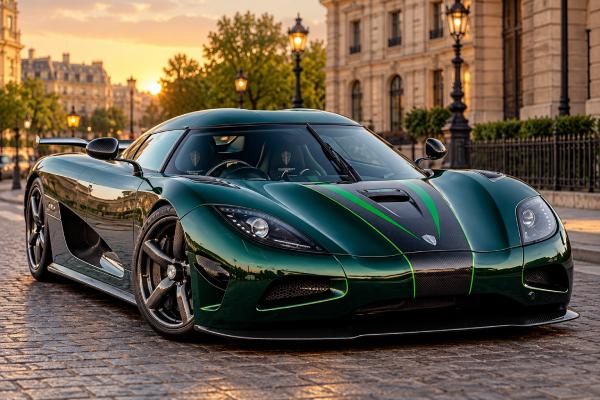
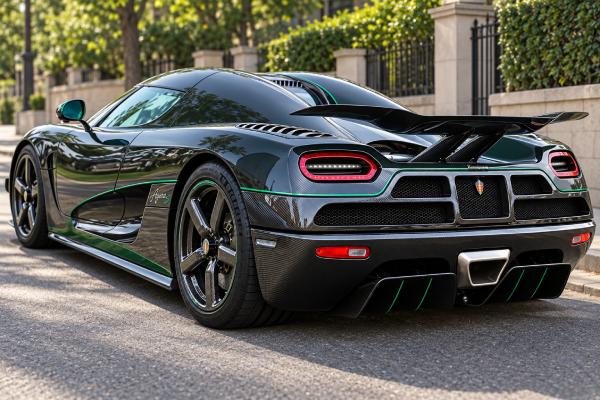
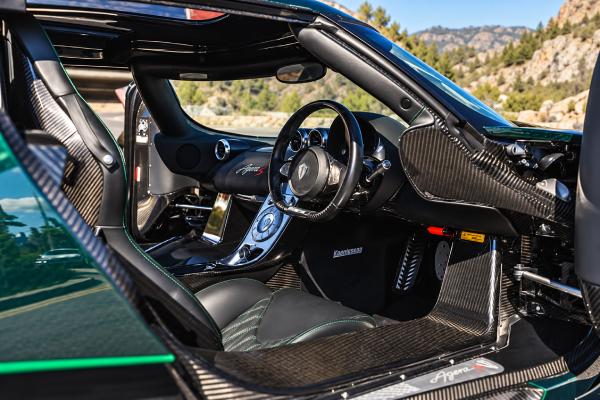
The Koenigsegg Agera S answered a practical question that only a hypercar maker would face: how do you deliver four-figure power in countries where E85 is hard to find? Koenigsegg’s solution was a petrol-focused version of the Agera R, calibrated to produce 1,030 hp and 1,100 Nm on 98 RON or 93 AKI premium gasoline. Only five examples were built from 2012 to 2014, making the S one of the smallest factory-defined groups in the Agera family. It also introduced Aircore, Koenigsegg’s one-piece hollow carbon-fiber wheel technology, which removed about 20 kg of unsprung mass compared with the company’s already light alloy wheels. The result was not simply an Agera R with less peak power. It was a market-specific engineering package with a high 8,250 rpm redline, rear Triplex suspension, carbon-ceramic brakes, and more than 400 km/h of claimed capability without relying on ethanol. Because each car was heavily personalized, correct identification and factory records are as important as the headline specifications.
Table of Contents
- Why Koenigsegg Created the Agera S
- Agera S Specifications and Measurements
- Petrol Calibration and High-RPM Character
- Aircore Wheels and Chassis Response
- What the Agera S Is Like to Use
- Service Priorities and Storage
- How to Buy One of Five
Why Koenigsegg Created the Agera S
The Agera S exists because the Agera R’s maximum output depended on ethanol-rich fuel that was not widely available in every target market. Koenigsegg retuned the same basic 5.0-liter twin-turbo architecture for premium gasoline and created a distinct model rather than asking owners to accept the R’s reduced gasoline output.
On E85 or E100, an Agera R could make 1,140 hp. On 95-octane gasoline, its protection strategy reduced output to roughly 960 hp. The Agera S closed much of that gap by using hardware and mapping optimized around high-quality pump gasoline. Koenigsegg specifies 1,030 hp with 98 RON fuel, equivalent to 93 AKI in markets that use the North American pump-number system.
That distinction made the S especially relevant in parts of Asia and other regions where ethanol blends were uncommon, inconsistent, or difficult to store. The owner could access the car’s rated output without testing fuel alcohol content or managing a blend-dependent calibration. It was still sensitive to octane and fuel freshness, but the intended operating condition was simpler.
The S retained nearly all of the Agera R’s broader package: the carbon monocoque, removable and stowable hardtop, seven-speed paddle-shift transmission, electronic differential, rear Triplex suspension, active rear wing, hydraulic ride-height adjustment, and large carbon-ceramic brakes. It was therefore positioned as a full-performance Agera, not a comfort-oriented downgrade.
Only five were produced between 2012 and 2014. One of the best-known is the Hundra, built to mark Koenigsegg’s 100th production car and finished with extensive gold-leaf detailing. Other Agera S examples have individual names, colors, aero details, and later changes. With such a small population, the model cannot be understood through an “average car.” Each VIN needs its own build-sheet and service history.
The model’s other major significance is the debut of Aircore wheels. Koenigsegg had already used forged, turbine-like aluminum wheels on the Agera, but the S moved to a hollow carbon-fiber construction developed and manufactured in-house. That innovation later became a recognizable part of the brand’s engineering identity.
Agera S Specifications and Measurements
The Agera S is a gasoline-only, rear-wheel-drive ICE hypercar with a 5.0-liter twin-turbo V8, a 1,330 kg dry weight, and 1,030 hp at 7,100 rpm. Its technical specification closely follows the Agera R chassis while substituting a petrol-optimized engine calibration and Aircore carbon wheels.
| Specification | Value |
|---|---|
| Engine | Koenigsegg aluminum 5.0-liter V8 |
| Position and orientation | Mid-mounted, longitudinal |
| Valvetrain | Double overhead camshafts, 4 valves per cylinder |
| Bore × stroke | 91.7 × 95.25 mm |
| Compression ratio | 9.0:1 |
| Induction | Twin turbochargers, 1.4 bar maximum boost |
| Injection | Sequential multipoint fuel injection |
| Intake | Carbon-fiber manifold with optimized tracts |
| Exhaust | Ceramic-coated Inconel manifolds with merge collector |
| Lubrication | Dry sump |
| Engine weight | 197 kg (434 lb) |
| Rated fuel | 98 RON or 93 AKI premium gasoline |
| Specification | Value | Condition |
|---|---|---|
| Maximum power | 1,030 hp (758 kW) | At 7,100 rpm |
| Maximum torque | 1,100 Nm (811 lb-ft) | At 4,100 rpm |
| Torque plateau | More than 1,000 Nm | 2,700–6,170 rpm |
| Redline | 8,250 rpm | Official specification |
| 0–100 km/h | 2.9 seconds | Manufacturer claim |
| 0–200 km/h | 7.9 seconds | Manufacturer claim |
| 0–200–0 km/h | 12.8 seconds | Manufacturer claim |
| 0–300–0 km/h | 22.7 seconds | Manufacturer claim |
| Top speed | More than 400 km/h (249 mph) | Manufacturer claim |
| Lateral acceleration | 1.6 g | Manufacturer claim |
| Specification | Value |
|---|---|
| Transmission | Koenigsegg-developed 7-speed paddle-shift unit |
| Clutch concept | Dual-clutch functionality with one input shaft |
| Drive type | Rear-wheel drive |
| Differential | Electronically controlled |
| Front suspension | Pushrod double wishbones with two-way adjustable Öhlins dampers |
| Rear suspension | Pushrod double wishbones, Öhlins dampers, and Triplex third damper |
| Ride height | Electronically adjustable |
| Anti-roll bars | Koenigsegg Z-style front and rear |
| Steering | Electro-hydraulic rack and pinion |
| Steering travel | 2.7 turns lock-to-lock |
| Turning circle | 11 m (36.1 ft) |
| Specification | Value |
|---|---|
| Monocoque | Carbon fiber with aluminum honeycomb and integrated fuel tanks |
| Monocoque weight | 70 kg (154 lb), including tanks |
| Torsional rigidity | 65,000 Nm per degree |
| Front brakes | 392 × 36 mm ventilated ceramic discs, 6-piston calipers |
| Rear brakes | 380 × 34 mm ventilated ceramic discs, 4-piston calipers |
| 100–0 km/h braking distance | 30.5 m (100 ft) |
| Drag coefficient | Cd 0.33–0.37, depending on wing position |
| Frontal area | 1.873 m² |
| Downforce | 300 kg (661 lb) at 250 km/h |
| Underbody | Flat floor with rear Venturi tunnels |
| Position | Wheel | Tire |
|---|---|---|
| Front | 19 × 9.5-inch hollow carbon-fiber Aircore, center-lock | 265/35 R19 Michelin Supersport |
| Rear | 20 × 12.5-inch hollow carbon-fiber Aircore, center-lock | 345/30 R20 Michelin Supersport |
| System feature | One-piece hollow-core carbon construction | Tire-pressure monitoring |
| Mass reduction | About 20 kg total unsprung-mass saving versus earlier alloy wheels | Koenigsegg figure |
| Tire capability | Dedicated application | Rated for more than 420 km/h |
| Specification | Value |
|---|---|
| Body | 2-door, 2-seat coupe with detachable, stowable hardtop |
| Length | 4,293 mm (169.0 in) |
| Width | 1,996 mm (78.6 in) |
| Height | 1,120 mm (44.1 in) |
| Wheelbase | 2,662 mm (104.8 in) |
| Ground clearance | 100 mm (3.9 in) front and rear |
| Dry weight | 1,330 kg (2,932 lb) |
| Curb weight | 1,435 kg (3,164 lb), fluids plus 50% fuel |
| Maximum laden weight | 1,650 kg (3,638 lb) |
| Weight distribution | 44% front, 56% rear |
| Fuel capacity | 80 L (21.1 US gal) |
| Front luggage volume | 120 L (4.2 cu ft) |
The published consumption figures are 12.5 L/100 km on the highway and 14.7 L/100 km combined, equal to about 18.8 and 16.0 mpg US. Those numbers describe a test condition, not the likely result of frequent boost use or short urban operation.
Petrol Calibration and High-RPM Character
The Agera S earns its 1,030 hp through gasoline-specific optimization rather than ethanol’s high knock resistance. That makes fuel quality the first technical requirement: the rated output assumes premium fuel that genuinely meets the stated octane level.
RON and AKI are different rating systems. European pumps commonly display Research Octane Number, while North American pumps use Anti-Knock Index, the average of Research and Motor octane tests. Koenigsegg’s 98 RON and 93 AKI references describe broadly equivalent premium grades, not two performance levels.
A high-boost engine reacts strongly to low octane, excessive intake temperature, old fuel, contamination, or an incorrect calibration. The engine management can protect the powertrain by reducing ignition advance or boost, but that protection should not be treated as permission to use unsuitable gasoline. Repeated knock correction increases heat and can mask a fuel-supply or cooling problem.
The S has a notably higher published redline than the contemporary Agera R technical page: 8,250 rpm rather than 7,500 rpm. Peak power still arrives at 7,100 rpm, so the extra engine-speed range is not simply there to create a larger power number. It provides headroom during acceleration and can delay an upshift in situations where changing gear would interrupt the car’s balance or push the next ratio below the strongest part of the torque curve.
Broad torque is more important in normal driving. More than 1,000 Nm is available from 2,700 to 6,170 rpm, and peak torque arrives at 4,100 rpm. The car can therefore accelerate violently without being near redline. The driver’s main task is not finding power but judging how much rear-tire grip is available.
The seven-speed transmission is an in-house solution that does not behave exactly like a mass-market dual-clutch automatic. It uses paddle control, wet-clutch functionality, and a single input shaft. A healthy gearbox should engage consistently and shift decisively, but low-speed operation may feel more mechanical than in a modern grand tourer. During inspection, behavior should be assessed cold, warm, at parking speed, and under load.
Aircore Wheels and Chassis Response
Aircore wheels matter because they reduce both unsprung and rotating mass, two forms of weight that affect a car more than the same mass fixed to the body. Koenigsegg states that the carbon set saved about 20 kg over its previous forged aluminum wheels.
Unsprung mass includes components that move with the wheel rather than being supported by the springs. A lighter wheel can follow bumps with less inertia, allowing the tire to stay in contact with the road more consistently. The damper has less mass to control, so it can respond more quickly to small surface changes.
Rotating mass also resists changes in speed. Reducing it can improve acceleration, braking response, and steering agility. The actual benefit depends on where the mass is removed; weight near a wheel’s outer rim has a larger rotational effect than weight near the hub.
Koenigsegg’s wheel is a one-piece hollow carbon-fiber structure rather than a metal wheel with a cosmetic carbon cover. That construction demands specialized inspection. Surface chips, curb contact, heat exposure, previous repair, center-lock damage, and internal structural concerns cannot be judged by appearance alone.
The Aircore wheels work with the Agera S’s pushrod suspension and rear Triplex system. The main springs and dampers control individual wheel movement, while the third rear element resists the body’s tendency to squat when both rear wheels compress under acceleration. This allows the chassis to retain compliance without letting the rear aerodynamic platform collapse.
The carbon monocoque provides the stable reference for those components. At 65,000 Nm per degree, it limits structural twisting, helping the suspension geometry and aerodynamic surfaces work predictably. The removable roof does not change the basic load path in the way it would in a conventional steel coupe whose roof contributes heavily to rigidity.
Aerodynamics complete the system. The rear wing changes the drag coefficient within a stated range, while the flat floor and Venturi tunnels create downforce under the body. At 250 km/h, the published total is 300 kg. That load increases tire grip but also adds force to the suspension, wheels, bearings, and body mounts, which is why high-speed condition cannot be assessed through engine health alone.
What the Agera S Is Like to Use
The Agera S is more usable than its numbers suggest, but it remains a two-meter-wide, rear-wheel-drive car with 1,030 hp and minimal tolerance for careless inputs. Its practical features reduce inconvenience; they do not make the performance ordinary.
The detachable roof can be stored in the front compartment, converting the car into an open-topped experience without a heavy folding mechanism. The compromise is cargo space. With the roof stowed, much of the 120-liter compartment is occupied, so touring luggage must be planned around the chosen roof configuration.
The hydraulic lift system is valuable on ramps, speed bumps, and transporters. The static ground clearance is only 100 mm, and the long wheelbase can still place the floor or splitter at risk on sharp crests. Drivers should approach obstacles slowly and diagonally only where safe, while remembering that the lift cannot compensate for every breakover angle.
At low speeds, the steering and wide front track demand attention. Door operation also needs lateral and vertical clearance, even though the dihedral mechanism is designed to reduce the space required compared with a conventional long door. Parking sensors help, but carbon corners are too costly to trust to sensors alone.
Once moving, low mass gives the S a more immediate character than an all-wheel-drive hybrid hypercar. There is no front motor pulling the car out of a corner and no electric torque filling every gap. The twin-turbo V8, transmission, electronic differential, and rear tires do the work. That makes throttle position, road crown, tire temperature, and stability-control mode easy to feel in the car’s response.
The ride can be firm without being crude because the pushrod suspension and low unsprung mass allow controlled wheel movement. Still, alignment settings and damper condition have an outsized effect. A car adjusted for display stance or occasional track use may not feel like the factory road setup.
Service Priorities and Storage
An Agera S should be serviced through Koenigsegg or a factory-authorized specialist, and every interval or fluid choice should come from VIN-specific documentation. Public specifications do not provide enough information to improvise maintenance on a five-car model.
The most important preventive areas are straightforward to identify even when exact intervals remain factory-controlled:
- Fuel: Use fresh 98 RON or 93 AKI gasoline from a trusted source. Record storage duration and avoid assuming that “premium” means the same octane in every country.
- Dry-sump oil system: Follow the official warm-level procedure. Checking at the wrong temperature or engine state can produce a false reading and encourage overfilling.
- Turbo and cooling hardware: Inspect charge pipes, clamps, radiators, fans, reservoirs, heat shielding, exhaust joints, and any sign of coolant or oil mist.
- Transmission and differential: Preserve diagnostic scans and investigate changes in engagement, adaptation, shift speed, noise, or temperature rather than resetting faults.
- Triplex and lift systems: Look for leakage, uneven ride height, slow pump operation, stored warnings, and settings changed without documentation.
- Carbon-ceramic brakes: Assess disc condition with the approved method, not only a visual check. Pad wear, heat history, fluid age, and caliper seals are equally important.
- Aircore wheels: Use trained tire fitters and the correct center-lock procedures. A tire machine or lifting mistake can damage an irreplaceable component.
- Tires: Replace based on age, condition, heat history, and approved specification, not tread depth alone.
- Lithium battery: Use a compatible maintainer and investigate repeated low-voltage faults. A weak power supply can create misleading messages across multiple systems.
Storage should be dry, temperature-stable, and spacious enough to open the doors safely. Tires should be protected from flat spotting according to factory guidance, and the car should be exercised through complete heat cycles rather than started briefly and shut down cold. Short idling sessions can add moisture without fully warming the oil and exhaust.
A very low-mileage Agera S may require more recommissioning than a regularly serviced car. Fuel pumps, seals, dampers, brake fluid, tires, batteries, and hydraulic components age with time. The correct maintenance budget begins with an inspection, not a generic annual figure.
How to Buy One of Five
Buying an Agera S is primarily an exercise in proving identity and condition. With only five cars, a rare-looking specification is not enough; the buyer should obtain direct factory confirmation of what the VIN was, what it became, and which changes Koenigsegg recognizes.
Start by verifying the original build sheet, delivery market, paint and exposed-carbon finish, interior materials, engine calibration, wheels, aero package, and named special-edition status. Bespoke cars can evolve through factory refinishing or later upgrades, and those changes may be desirable when fully documented.
The pre-purchase inspection should include:
- A true cold start with voltage, oil-pressure, smoke, idle, and warning behavior recorded.
- A complete factory-capable diagnostic scan before any codes are cleared.
- Fuel-pressure, boost, ignition-correction, temperature, and adaptation data under controlled conditions.
- Transmission engagement and shifts in every gear, including reverse and hot low-speed maneuvering.
- Carbon-monocoque, underfloor, splitter, sill, door-aperture, roof, and crash-structure inspection.
- Aircore wheel assessment, correct wheel position, center-lock hardware, tire dates, and mounting history.
- Brake-disc and pad condition, fluid history, caliper inspection, and evidence of high-temperature use.
- Suspension geometry, Triplex function, damper leakage, ride-height operation, bushings, bearings, and alignment.
- Verification of keys, charger, roof bag, tools, manuals, covers, luggage, and chassis-specific accessories.
- Legal review of registration, import status, emissions compliance, taxes, and any modification affecting road use.
Mileage should be judged alongside the service file. A museum-kept car can hide old fuel, aged tires, stuck actuators, or incomplete software work. A driven car can show stone chips and seat wear yet have stronger mechanical continuity. Neither profile is automatically preferable.
The Agera S also requires an ownership route before the sale closes. Confirm transport arrangements, the nearest authorized support point, parts already on order, scheduled service capacity, insurance terms, and storage dimensions. A car of this rarity may need to travel across borders for specialist work.
For collectors, the S combines three strong themes: five-car scarcity, petrol-only market relevance, and the first use of Aircore wheels. For drivers, it offers a high-revving, rear-wheel-drive version of the Agera architecture without blend-dependent ethanol management. The best example is the one whose originality or factory-sanctioned evolution is fully traceable and whose condition supports the way the next owner intends to use it.
References
- Agera S – Technical Specifications (Technical Specifications)
- Agera S (Model Overview)
- Aircore hollow carbon wheels (Engineering Overview)
- The Legacy of Ultimate Performance (Company History)
- Preview: Koenigsegg Agera S 2013 (Period Model Overview)
- Agera S (Official Retailer Model Information)
Disclaimer
This article is for informational purposes and is not a substitute for professional diagnosis or repair. Specifications, fuel requirements, torque values, service intervals, software, and procedures can vary by VIN, market, equipment, and factory updates. Verify all maintenance and repair decisions against the car’s official service documentation and current Koenigsegg guidance.
Please share this article on Facebook, X/Twitter, or another platform if it helped and you would like to support our work.