
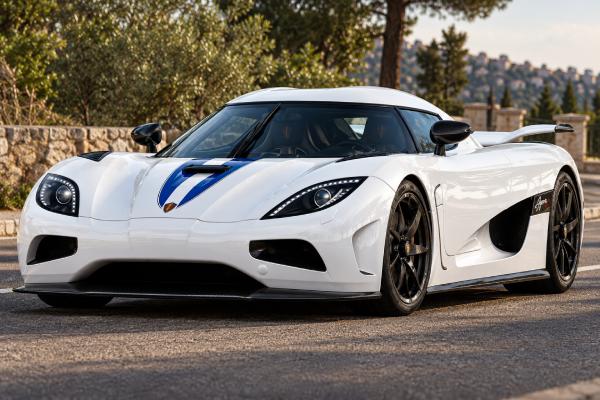
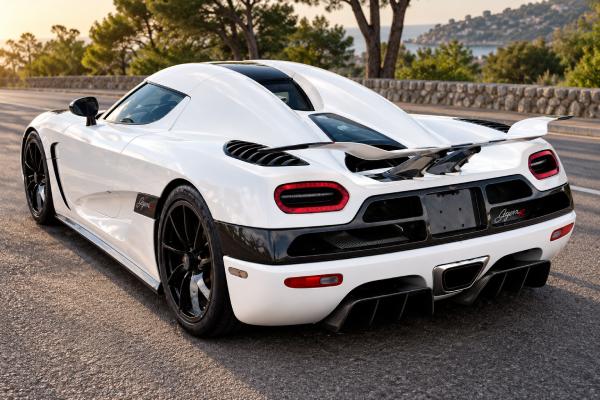
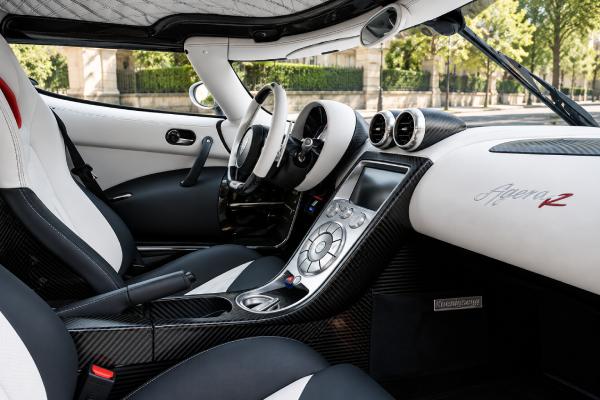
The Koenigsegg Agera R turned fuel choice into a performance control. On ordinary 95-octane gasoline, its 5.0-liter twin-turbo V8 was limited to 960 hp and 1,100 Nm; with E85 or E100 in the tank, the same engine management system could raise output to 1,140 hp and 1,200 Nm. That distinction is essential because the headline specification belongs to the ethanol-capable calibration, not to every tank of fuel or every market. Built from 2011 through 2014 in a run of 18 examples, the Agera R also introduced the rear Triplex suspension, stronger braking hardware, revised turbochargers, and a fuel-delivery system with extraordinary flow capacity. Its 21.19-second 0–300–0 km/h record made the model famous, but ownership today is less about repeating a number than preserving a highly specialized system. Fuel history, software, pumps, injectors, tires, carbon components, and factory documentation all affect whether an Agera R is merely collectible or genuinely ready to drive.
Table of Contents
- What Defines the Agera R
- Agera R Specifications by System
- How the Flex-Fuel Powertrain Works
- Record Performance and Driver Demands
- Fuel, Storage, and Maintenance Strategy
- Pre-Purchase Checks for an Agera R
- Collector and Driver Perspective
What Defines the Agera R
The Agera R is the ethanol-capable, higher-output development of the original Agera, not simply an Agera with a larger wing. Its defining hardware includes a flex-fuel management system, four high-output fuel pumps, dual injectors per cylinder, revised turbochargers, a rear Triplex damper, and model-specific aerodynamic details.
Koenigsegg produced 18 examples between 2011 and 2014. That makes the R more numerous than the standard Agera but still rare enough that individual cars can differ meaningfully in color, options, wheel specification, aero components, software level, and later factory upgrades. A buyer should therefore separate the official model specification from the exact configuration of a particular chassis.
The R badge represented two ideas. First, the car could exploit the high octane rating of ethanol blends. Higher octane does not contain more energy per liter; in fact, E85 generally contains less. Its advantage in this application is resistance to knock, allowing the engine to run more boost and more aggressive ignition timing. Second, the chassis was developed to handle the additional output and higher sustained speeds.
The fuel system is a major part of the engineering story. Because ethanol-blended fuel carries less energy per unit volume, the engine must consume a larger volume of fuel to create the same energy release. Koenigsegg stated that the Agera R’s returnless system had to flow at a rate comparable to the gasoline demand of a roughly 2,000 hp engine. Four pumps and two injectors per cylinder allowed the system to meet that requirement while the engine control module continuously adjusted for the detected fuel mixture.
The Agera R also introduced a more sophisticated rear suspension arrangement. The Triplex system adds a third, horizontally mounted spring-and-damper element that acts on both rear wheels. Its purpose is to resist squat under hard acceleration without requiring excessively stiff main springs. That helps preserve ride quality and mechanical grip while keeping the body’s aerodynamic attitude under control.
Visually, an Agera R may have exposed carbon on the nose, front winglets, a revised exhaust, and a more assertive rear wing. Some cars were shown with a roof box, an intentionally startling demonstration that the removable-roof hypercar could still carry equipment. Those details should not be assumed to be identical on every chassis, especially after years of personalization.
Agera R Specifications by System
The Agera R is a rear-wheel-drive flex-fuel ICE car whose maximum 1,140 hp rating requires E85 or E100. On 95-octane gasoline, Koenigsegg specified 960 hp, so fuel condition must always be stated beside the output figure.
| Specification | Value |
|---|---|
| Engine | Koenigsegg aluminum 5.0-liter twin-turbo V8 |
| Valvetrain | DOHC, 4 valves per cylinder |
| Internal features | Titanium connecting rods, dry-sump lubrication, negative crankcase pressure function |
| Bore × stroke | 91.7 × 95.25 mm |
| Compression ratio | 9.0:1 |
| Turbocharging | Twin turbochargers, maximum 1.4 bar boost |
| Throttle bodies | Dual 70 mm electronic units |
| Injection | Sequential multipoint, dual injectors per cylinder |
| Fuel pumps | 4 high-output pumps in a returnless system |
| Fuel compatibility | 95-octane gasoline through E100, including mixtures |
| Engine weight | 197 kg (434 lb) |
| Fuel condition | Power | Torque |
|---|---|---|
| E85 or E100 | 1,140 hp (838 kW) at 7,100 rpm | 1,200 Nm (885 lb-ft) at 4,100 rpm |
| 95-octane gasoline | 960 hp (706 kW) | 1,100 Nm (811 lb-ft) |
| Broad torque band on high-output calibration | More than 1,000 Nm available | 2,700–7,300 rpm |
| Engine speed limit | 7,500 rpm | Official specification |
| Boost onset reference | 0.5 bar at 2,300 rpm | Full spool stated at 2,700 rpm |
| Test | Result |
|---|---|
| 0–100 km/h (0–62 mph) | 2.8 seconds |
| 0–200 km/h (0–124 mph) | 7.8 seconds |
| 0–200–0 km/h | 12.6 seconds |
| 0–300 km/h | 14.53 seconds in the 2011 record run |
| 300–0 km/h | 6.66 seconds in the 2011 record run |
| 0–300–0 km/h | 21.19 seconds in the 2011 record run |
| 100–0 km/h braking distance | 30.5 m (100 ft) |
| Maximum lateral acceleration | 1.6 g |
| Dry weight-to-power ratio | 1.19 kg per hp |
| Specification | Value |
|---|---|
| Transmission | 7-speed Koenigsegg paddle-shift unit with dual-clutch functionality and one input shaft |
| Driven wheels | Rear-wheel drive |
| Differential | Electronically controlled |
| Front suspension | Pushrod double wishbones with two-way adjustable Öhlins gas-hydraulic dampers |
| Rear suspension | Pushrod double wishbones, adjustable Öhlins dampers, and Triplex third damper |
| Ride height | Electronically adjustable |
| Anti-roll system | Koenigsegg Z-style anti-roll bars front and rear |
| Stability control | Koenigsegg Electronic Stability Control with selectable modes |
| Steering | Electro-hydraulic rack and pinion, 2.7 turns lock-to-lock |
| Specification | Value |
|---|---|
| Monocoque | Carbon fiber with aluminum honeycomb and integrated fuel tanks |
| Monocoque rigidity | 65,000 Nm per degree |
| Monocoque weight | 70 kg (154 lb), including tanks |
| Front brakes | 392 × 36 mm ventilated ceramic discs, 6-piston calipers |
| Rear brakes | 380 × 34 mm ventilated ceramic discs, 4-piston calipers |
| Drag coefficient | Cd 0.33–0.37 with adaptable rear wing |
| Downforce | 300 kg (661 lb) at 250 km/h |
| Front wheel and tire | 19 × 9.5-inch; 265/35 R19 Michelin Supersport |
| Rear wheel and tire | 20 × 12.5-inch; 345/30 R20 Michelin Supersport |
| Tire speed rating | More than 420 km/h |
| Specification | Value |
|---|---|
| Body and seating | 2-door, 2-seat coupe with detachable, stowable hardtop |
| Length | 4,293 mm (169.0 in) |
| Width | 1,996 mm (78.6 in) |
| Height | 1,120 mm (44.1 in) |
| Wheelbase | 2,662 mm (104.8 in) |
| Ground clearance | 100 mm (3.9 in) front and rear |
| Dry weight | 1,330 kg (2,932 lb) |
| Curb weight | 1,435 kg (3,164 lb), fluids plus 50% fuel |
| Maximum laden weight | 1,650 kg (3,638 lb) |
| Weight distribution | 44% front, 56% rear |
| Fuel tank | 80 L (21.1 US gal) |
| Luggage compartment | 120 L (4.2 cu ft) |
Koenigsegg published 14.7 L/100 km combined and 12.5 L/100 km highway figures, but these should not be applied blindly to ethanol operation. E85 requires more fuel volume than gasoline for the same energy output, and real consumption depends heavily on blend, boost use, temperature, and driving pattern.
How the Flex-Fuel Powertrain Works
The Agera R does not require the driver to select a fixed gasoline or ethanol map manually. Its engine management detects the fuel blend and adjusts boost pressure, ignition timing, fueling, and related controls so the engine can operate across the range from 95-octane gasoline to E100.
This adaptive strategy is practical, but it also means the displayed or advertised 1,140 hp is conditional. Filling with ordinary gasoline does not preserve the E85 output. The control system reduces performance to protect the engine from detonation because the lower-octane fuel cannot tolerate the same cylinder pressure and timing advance.
Ethanol offers strong charge-cooling behavior as it evaporates, which can reduce intake-charge temperature and improve knock resistance. Those characteristics are valuable in a high-boost engine. The tradeoff is fuel volume. The pumps, lines, injectors, seals, and control logic must supply more liquid while remaining compatible with alcohol-based fuel.
The returnless arrangement also deserves explanation. In a conventional return system, excess fuel travels from the rail back to the tank. A returnless setup controls pressure and delivery without continually circulating hot fuel through a return line. This can reduce heat pickup and evaporative emissions, but it places substantial importance on pump control, pressure sensing, and clean electrical supply.
The revised turbocharger design reduced rotating inertia in the turbine wheel and shaft. Less inertia helps the turbo accelerate sooner when exhaust flow rises, improving response. Koenigsegg paired that change with its low-back-pressure exhaust philosophy, dual throttle bodies, a carbon-fiber intake manifold, and dry-sump lubrication.
For an owner, the engineering translates into three rules. Use known fuel, allow the system time to adapt after a significant blend change, and do not treat a claimed ethanol content at the pump as proof of the actual blend. Seasonal E85 can contain less ethanol, and regional labeling standards differ. Any diagnosis of reduced power should begin with verified fuel composition and logged engine data, not an assumption that the car is faulty.
Record Performance and Driver Demands
The Agera R’s best-known achievement is its 21.19-second 0–300–0 km/h run on September 2, 2011. That result combined 14.53 seconds of acceleration with 6.66 seconds of braking and demonstrated that the chassis could remain stable through both phases.
A straight-line record at this level tests more than engine power. The car must manage wheelspin, gear changes, aerodynamic balance, tire growth, brake temperature, and the transition from full acceleration to maximum deceleration. Koenigsegg’s carbon-ceramic brakes, active aero, rigid monocoque, and rear suspension were all involved.
The Triplex system is especially relevant under acceleration. When a powerful rear-drive car squats, its nose rises and rear ride height falls. That movement changes suspension geometry and aerodynamic attitude. The third rear element resists simultaneous compression of both rear wheels, allowing the normal wheel springs to remain more compliant over bumps.
Even so, the Agera R is not an easy car to exploit. Period road testing emphasized its mechanical noise, sudden speed accumulation, and ability to overwhelm the rear tires in poor conditions. Those reports often involved cold roads or unsuitable tires, but the lesson remains: 1,200 Nm through two driven wheels demands restraint.
The electronic differential and stability system assist the driver, yet they cannot create grip that the tires and surface do not have. Full output should be approached only with current, correct tires at proper temperature and pressure, on a dry surface with large safety margins. Public-road acceleration figures are not an invitation to reproduce record testing outside a controlled environment.
Braking also requires preparation. Carbon-ceramic systems may feel different when cold, and pedal response can change with pad material, disc condition, and temperature. The 30.5 m claim from 100 km/h assumes a healthy system and suitable tires. Any car that pulls, pulses, triggers warnings, or produces inconsistent pedal travel needs investigation before high-speed use.
The roof-off configuration changes the sensory experience and may affect aerodynamic behavior. Owners should use the car only in approved configurations and should not assume that record-calibration settings, wing positions, or tire pressures apply to casual road driving.
Fuel, Storage, and Maintenance Strategy
The Agera R’s maintenance plan must account for alcohol-compatible fuel hardware and the way ethanol behaves during storage. E85 can absorb moisture, and old blended fuel can create starting, corrosion, and deposit problems even when the car is driven very little.
There is no safe generic public interval that replaces the VIN-specific service documentation. Koenigsegg or an authorized center should determine fluids, service timing, software, and inspections. Still, owners can organize care around the systems most exposed to age and fuel condition.
Fuel system care
Before long storage, decide with the servicing dealer whether the car should be left with a specific stabilized gasoline blend, ethanol blend, or another factory-approved procedure. Do not improvise by mixing additives. Record what is in the tank, when it was purchased, and the measured ethanol content where relevant.
A car that hesitates, takes longer to start, shows fuel-pressure faults, or loses expected output may have a pump, injector, sensor, electrical, blend, or calibration issue. Replacing parts without logging rail pressure, commanded fueling, and fuel composition can waste time and create further risk.
Heat, fluids, and seals
The turbochargers, Inconel exhaust, catalysts, coolant circuits, and dry-sump oil system operate under high thermal load. Inspect heat shields, hoses, clamps, reservoir levels, evidence of vapor or staining, and cooling-fan operation. Oil levels must be checked according to the official warm procedure; an incorrect reading can lead to overfilling or underfilling.
Brake fluid, transmission fluid, differential service, coolant, and hydraulic lift fluid should follow factory guidance. Time can matter as much as mileage because moisture, seals, and additive packages age while the car is stored.
Tires, wheels, and suspension
Tire age and heat history are critical. Tread depth cannot reveal internal aging, flat spotting, storage damage, or repeated high-speed heat cycles. Confirm the exact approved tire, date codes, position, and installation history. Inspect wheels for impact, repair, incorrect position, and center-lock handling.
The Triplex damper, Öhlins units, ride-height system, bushings, and alignment should be examined for leaks, sticking, imbalance, or settings changed without documentation. A car may look level in a showroom yet behave poorly under braking or acceleration.
Battery and electronic systems
The lightweight lithium iron phosphate battery requires compatible support equipment. Low voltage can create cascades of warnings, disturb adaptations, and strain pumps or actuators. Use the approved maintainer, preserve diagnostic reports, and investigate recurring faults instead of clearing them before sale.
Pre-Purchase Checks for an Agera R
An Agera R purchase should be treated as a chassis-specific technical audit. The label on the car is not enough; the buyer must confirm whether its current engine, fuel, software, aero, wheels, and documentation match the specification being represented.
Start with factory verification. Ask Koenigsegg to confirm the VIN, production date, original market, original colors, build equipment, delivered fuel calibration, wheel type, and subsequent factory work. This is particularly important because some cars have received later styling or performance updates.
Then inspect the history in a logical order:
- Fuel records: Determine what fuels were used, how the car was stored, and whether pumps, injectors, lines, sensors, or tank components have been serviced.
- Software and diagnostics: Obtain a complete scan and verify current factory software. Check whether faults were recently cleared and whether adaptations are within expected ranges.
- Engine health: Review cold-start behavior, oil pressure, leak-down or other factory-approved condition checks, boost logs, fuel trims, ignition corrections, smoke, and fluid analysis where appropriate.
- Driveline behavior: Test reverse, launch from rest, low-speed clutch modulation, every gear, hot shifts, overrun, and electronic-differential behavior.
- Carbon structure: Inspect the monocoque, underbody, crash structures, body mounts, door apertures, roof interface, and evidence of repair beneath wraps or paint.
- Suspension geometry: Measure alignment and corner condition; inspect Triplex hardware, dampers, uprights, bearings, bushings, lift components, and tire wear.
- Brakes: Assess disc mass or wear using the approved method, pad thickness, caliper condition, fluid age, cooling ducts, and any track-use documentation.
- Wheels and tires: Verify correct size and position, center-lock condition, date codes, approved specification, and whether replacements are available.
- Accessories and completeness: Confirm the roof, storage hardware, tools, charger, keys, manuals, luggage, covers, and any model-specific equipment that belonged with the car.
- Market legality: Verify registration, emissions status, import history, taxes, and whether modifications affect road legality in the intended jurisdiction.
A 2014 example offered by RM Sotheby’s illustrates why chassis documentation matters: auction catalogs can provide useful history, but they remain starting points rather than substitutes for factory verification. Every claim about rarity, mileage, originality, or service should be supported by the car’s own file.
Do not let low mileage shorten the inspection. A static car may need fuel-system cleaning, new tires, damper service, seals, battery work, fluid replacement, and careful recommissioning. Conversely, a higher-mileage car with continuous authorized maintenance may be more immediately usable.
Collector and Driver Perspective
The Agera R appeals to collectors because it links Koenigsegg’s early flex-fuel experiments with the later One:1 and Agera RS. It also appeals to drivers because it delivers its performance through a comparatively light, rear-wheel-drive package without hybrid assistance.
Its strongest qualities are specificity and contrast. The car can cruise with a removable roof, climate control, luggage space, and a hydraulic lift, yet its engine, gearbox, sound, and acceleration remain intensely mechanical. The flex-fuel system adds another layer: the car genuinely changes output according to the fuel it detects.
That feature is also the main source of misunderstanding. A seller who quotes 1,140 hp while the car is configured, fueled, or maintained only for ordinary gasoline is describing maximum capability rather than current operating condition. A serious buyer should confirm both.
The Agera R is therefore not a casual addition to a collection. It needs a fuel plan, a specialist relationship, suitable storage, scheduled exercise, and disciplined tire management. It also needs a driver willing to learn how rear-wheel drive, boost, gearshifts, and road surface interact.
For the right owner, those demands are part of the attraction. The Agera R is not memorable because it makes immense speed easy; it is memorable because its engineering makes that speed possible while leaving the driver aware of every decision. A well-documented, correctly fueled, freshly inspected example remains one of the clearest expressions of Koenigsegg’s early megacar philosophy.
References
- Agera R – Technical Specifications (Technical Specifications)
- Agera R (Model Overview)
- The Legacy of Ultimate Performance (Company History and Record Documentation)
- Koenigsegg Agera R Sets Guinness 0-300-0 km/h World Record 2011 (Record Documentation)
- Koenigsegg’s Agera R. The Stig. A frozen lake 2011 (Road Test)
- 2014 Koenigsegg Agera R 2019 (Auction Documentation)
Disclaimer
This article is for informational purposes and is not a substitute for professional diagnosis or repair. Specifications, fuel requirements, torque values, intervals, software, and procedures can vary by VIN, market, equipment, and later factory updates. Confirm all work against the vehicle’s official service documentation and current instructions from Koenigsegg or an authorized service center.
Please share this guide on Facebook, X/Twitter, or another platform if it was useful and you would like to support our work.