


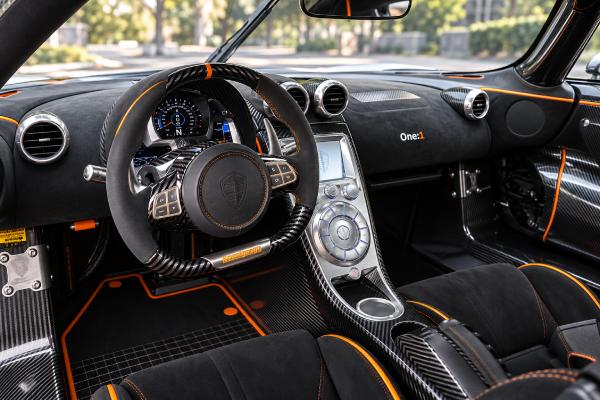
The Koenigsegg One:1 is the Agera family’s most track-focused expression and the car that made “megacar” a useful technical description rather than a marketing fantasy. Its name refers to a claimed one-to-one relationship between metric horsepower and curb weight: 1,360 hp pushing 1,360 kg. That output requires E85 bioethanol, while the flex-fuel engine can also run on gasoline at reduced power. Koenigsegg built six customer cars and one factory development car during 2014 and 2015, making every surviving example both historically important and intensely individual. The One:1 was not simply an Agera R with more boost. It gained a roof-fed intake, larger cooling paths, active underbody aerodynamics, an elevated rear wing, carbon suspension components, bespoke Michelin tires, and a chassis calibration intended to sustain extreme speed on a circuit. This guide explains the exact specifications, how the one-megawatt powertrain works, why its aerodynamic package matters, what its records actually prove, and how to approach maintenance or purchase without treating rarity as a substitute for evidence.
Table of Contents
- What One-to-One Really Means
- One:1 Technical Specifications
- How the V8 Reaches One Megawatt
- Aerodynamics That Load the Chassis
- Records, Driving Character, and Limits
- Maintenance for a Low-Volume Megacar
- Authenticating and Buying a One:1
What One-to-One Really Means
The One:1 name describes a specific engineering target: one metric horsepower for every kilogram of curb weight. Koenigsegg paired a 1,360 hp E85 rating with a stated 1,360 kg ready-to-drive mass, creating the first homologated production road car that the company says achieved that ratio.
The terminology needs careful handling. Koenigsegg’s 1,360 hp figure is metric horsepower, often written PS, and one megawatt equals about 1,341 mechanical horsepower. Both descriptions refer to the same maximum output rather than two engine calibrations. The car’s identity therefore rests on three linked numbers: 1 MW, 1,360 metric hp, and 1,360 kg.
Reaching the ratio required more than increasing engine output. Koenigsegg says roughly 100 kg was removed compared with the Agera R. The One:1 uses extensive carbon fiber, a lighter track-centered interior, Aircore hollow carbon wheels, carbon rear suspension members, and a body shaped around cooling and downforce rather than luggage capacity or discreet styling. The removable roof remained, but the roof scoop changed how the panel and its storage were treated; owners should verify the exact factory arrangement for an individual chassis rather than assume normal Agera roof usability.
Production numbers also require precision. Koenigsegg’s historical account separates six customer cars from one factory development car. Its current model page describes seven examples in total. Auction catalogues may call a customer car “one of six,” while general articles may say “one of seven.” Both can be correct when their counting method is stated. A buyer should never accept a vague rarity claim without identifying whether the seller is including the development chassis.
The One:1’s place in the range is equally important. It was developed from the Agera architecture but received enough unique hardware and calibration to function as a separate flagship. Its lessons later flowed into the more road-versatile Agera RS, including active aerodynamics, lightweight construction methods, higher-output engine work, and electronically managed chassis systems. In that sense, the One:1 was both a production model and a concentrated development program.
One:1 Technical Specifications
The One:1 is an ICE flex-fuel, rear-wheel-drive, two-seat carbon-fiber road car. Its 5.0-liter twin-turbo V8 reaches the headline 1 MW output on E85, sends power through a seven-speed paddle-shift transmission and electronic differential, and works with active suspension and aerodynamics rather than an electric hybrid system.
| Specification | Koenigsegg One:1 |
|---|---|
| Powertrain type | Flex-fuel internal-combustion engine |
| Engine | Koenigsegg aluminum 5.0L twin-turbo V8 |
| Valvetrain | DOHC, four valves per cylinder |
| Bore × stroke | 92 × 95.25 mm |
| Compression ratio | 9.0:1 |
| Induction | Variable-geometry twin turbochargers, 1.8 bar boost |
| Fuel system | Sequential multipoint injection, flex-fuel management |
| Lubrication | Dry sump |
| Engine weight | 197 kg |
| Fuel capacity | 80 liters |
| Specification | Value |
|---|---|
| Maximum output on E85 | 1 MW / 1,360 metric hp at 7,500 rpm |
| Maximum torque | 1,371 Nm at 6,000 rpm |
| Broad torque claim | More than 1,000 Nm from 3,000 to 8,000 rpm |
| Engine speed limit | 8,250 rpm |
| Transmission | Specially developed seven-speed paddle-shift unit with dual-clutch function and one input shaft |
| Driven wheels | Rear |
| Differential | Electronically controlled |
| Stability control | Koenigsegg Electronic Stability Control; Wet, Normal, and Track modes |
| Measure | Factory figure |
|---|---|
| 0–400 km/h | Approximately 20 seconds |
| 400–0 km/h | Approximately 10 seconds |
| 100–0 km/h braking distance | 28 meters |
| Maximum lateral acceleration | 2.0 g |
| Drag coefficient | 0.45–0.50, depending on active rear-wing position |
| Frontal area | 1.910 m² |
| Downforce at 260 km/h | 610 kg |
| Downforce at 440 km/h | 830 kg |
| Component | Specification |
|---|---|
| Structure | High-modulus carbon-fiber monocoque with aluminum honeycomb core and integrated fuel tanks |
| Monocoque weight | 72 kg |
| Torsional rigidity | 65,000 Nm per degree |
| Suspension | Double wishbones, pushrod operation, electronically adjustable gas-hydraulic dampers |
| Rear suspension | Triplex damper with carbon-fiber upper wishbones and carbon bevel springs |
| Ride height | Electronically adjustable with front lift |
| Front brakes | Ventilated carbon-ceramic discs with six-piston calipers |
| Rear brakes | Ventilated carbon-ceramic discs with four-piston calipers |
| Steering | Power-assisted rack and pinion, 2.7 turns lock-to-lock |
| Position | Wheel | Tire |
|---|---|---|
| Front | 19 × 9.5-inch center-lock Aircore carbon wheel | 265/35 R19 specially developed Michelin Pilot Sport Cup 2 |
| Rear | 20 × 12.5-inch center-lock Aircore carbon wheel | 345/30 R20 specially developed Michelin Pilot Sport Cup 2 |
| Speed validation | Koenigsegg rating | 440 km/h |
| Measure | Value |
|---|---|
| Length | 4,500 mm |
| Width | 2,060 mm |
| Height | 1,150 mm |
| Wheelbase | 2,662 mm |
| Front/rear track | 1,700 / 1,650 mm |
| Curb weight | 1,360 kg with 50% fuel and full operating fluids |
| Weight distribution | 44% front / 56% rear |
| Front ground clearance | 59–100 mm, plus 50 mm lift function |
| Rear ground clearance | 74–90 mm |
Two cautions make these figures more useful. First, the official technical page contains overlapping brake entries, so the correct installed disc dimensions should be confirmed against the chassis build record rather than selected from a generic online list. Second, the 1,360 kg figure uses Koenigsegg’s stated curb-weight condition, not an empty dry weight. That is what makes its one-to-one claim meaningful in the company’s own definition.
How the V8 Reaches One Megawatt
The One:1 reaches one megawatt by combining E85’s knock resistance and charge-cooling effect with 1.8 bar of boost, high-flow air and exhaust paths, and precise in-house engine control. It is flex-fuel, but the full 1,360 hp rating should not be assumed when the tank contains ordinary gasoline.
E85 typically contains a high proportion of ethanol, although the exact seasonal blend can differ by region. Ethanol permits more aggressive ignition and boost calibration because it resists detonation better than normal pump gasoline. It also carries less energy per liter, so the engine must deliver more fuel to make full power. That places unusual importance on fuel quality, flow capacity, pressure stability, injector performance, and the accuracy of the ethanol-content reading.
The V8 itself is compact and light for its output. The aluminum block and heads, carbon-fiber intake manifold, dry-sump system, and Inconel exhaust assembly help keep the quoted engine mass to 197 kg. Dry-sump lubrication supports oil control under the high longitudinal and lateral loads the One:1 was designed to generate. It also allows the engine to sit low in the chassis, helping the center of gravity.
A roof scoop feeds the engine with a direct, high-pressure air path. This is not a decorative addition. At one-megawatt heat rejection, the intake, intercoolers, oil circuit, coolant system, transmission, and brakes all need stable airflow. The One:1 therefore carries larger body openings and less visual restraint than an Agera S. Cooling capacity was part of the performance target, not a secondary response to it.
Variable-geometry turbochargers help broaden the useful response range. Koenigsegg claims more than 1,000 Nm from 3,000 to 8,000 rpm, with 1,371 Nm at 6,000 rpm. That broad plateau matters more on track than one isolated peak. A driver can exit a corner with meaningful thrust, stay in gear as speed builds, and still reach maximum power at 7,500 rpm before the 8,250 rpm limiter.
Running gasoline is possible, and a period Car and Driver test reported about 1,161 hp in that condition. The practical lesson is that fuel choice changes the car’s available performance. Before hard use, an owner should know what is actually in the tank, allow the control system time to identify the blend, and follow factory guidance for switching fuels. Mixing unknown old fuel with fresh E85 and immediately demanding maximum boost is poor practice.
Aerodynamics That Load the Chassis
The One:1’s aerodynamic system is designed to add substantial vertical load while keeping the car balanced as speed and ride height change. Its elevated rear wing, active underbody surfaces, extended venturi tunnels, front winglets, side splitters, and adaptive suspension work as one package.
The top-mounted rear wing is a defining feature. Mounting the supports above the airfoil can leave the lower surface—the area especially important to downforce generation—cleaner than a conventional bottom-mounted arrangement. The wing changes angle to suit the operating condition, which is why Koenigsegg quotes a drag-coefficient range rather than one fixed number. A high-downforce position improves braking and cornering support; a lower-drag position is more suitable for maximum speed.
Active underbody flaps and the venturi floor influence pressure beneath the car. Their effectiveness depends on ride height and pitch. If the nose rises, the rear squats, or a damper is outside its intended calibration, the aerodynamic balance can shift. This explains why the suspension is not merely a comfort system. Electronically controlled dampers and ride height help place the body where the aerodynamic map expects it to be.
Koenigsegg’s quoted 610 kg of downforce at 260 km/h is already extraordinary for a road car. The stated 830 kg at 440 km/h shows why component condition matters at speeds that most owners will never approach. Wing mounts, hinges, actuators, underbody panels, fasteners, wheel bearings, tires, and alignment are subjected to loads far beyond normal road driving. A cosmetically repaired aero panel can be unsafe if its laminate, mounting point, or geometry is wrong.
The rear Triplex arrangement adds a third spring-and-damper element that helps manage heave and squat separately from one-wheel bump movement. Carbon bevel springs and carbon upper wishbones reduce mass and contribute to the One:1’s distinct hardware. Active damping and ride-height control can also be linked to stored track information, allowing settings to change by location. Period reports described GPS-based behavior, including automatic nose lifting at known obstacles.
The bespoke Michelin Pilot Sport Cup 2 tires are part of the engineering system, not a consumable to replace with any same-size alternative. Age, heat cycles, storage flat-spotting, sidewall condition, and exact specification all matter. A car showing deep tread can still have unsuitable tires for serious speed because rubber ages even when mileage is low.
Records, Driving Character, and Limits
The One:1 proved its concept most clearly in acceleration, braking, and circuit work rather than through a certified production top-speed run. Its best documented straight-line result is a 17.95-second 0–300–0 km/h test completed by the heavier factory development car in 2015.
That run broke into 11.92 seconds from rest to 300 km/h and 6.03 seconds from 300 km/h back to zero. Top Gear reported that the development car carried a roll cage adding about 50 kg, which makes the result especially useful as a demonstration of the powertrain, braking system, stability, and aero working together. It should still be described as a manufacturer test rather than an independently certified world-record procedure.
Koenigsegg also recorded circuit achievements at Spa-Francorchamps and Suzuka in 2015. These matter because the One:1 was not developed only to chase a theoretical terminal velocity. The company’s 2.0 g lateral claim, high downforce, active chassis, and track tires point to a car intended to brake late, support speed through long corners, and remain stable during rapid transitions.
A road driver experiences a different challenge. At low speed, the engine can be tractable, steering accurate, and ride quality more compliant than the exterior suggests. The car still demands planning because it is wide, has limited outward visibility, uses a low front splitter, and directs enormous torque only to the rear axle. Lift systems and parking assistance reduce risk but do not erase the need for a spotter around steep ramps or unfamiliar loading equipment.
Traction is the governing limit below aerodynamic speeds. In wet or cold conditions, the car can overwhelm the rear tires in several gears. Car and Driver’s period account described stability control working hard even on partial throttle and wheelspin continuing well into triple-digit speeds. As velocity rises, downforce presses the tires harder into the surface, but that does not make standing water, cold rubber, or contaminated pavement safe.
Top-speed numbers require disciplined language. Koenigsegg designed the car around a 440 km/h tire rating and quoted downforce at that speed, while period media discussed a 273 mph theoretical maximum. The One:1 did not establish the later two-way public-road production-car record associated with the Agera RS. A seller who markets an individual car as a “273 mph record car” is blending design capability with an event that did not occur.
Maintenance for a Low-Volume Megacar
Maintaining a One:1 means preserving a tightly integrated system, not completing a generic annual oil change. The safest approach is scheduled factory-authorized inspection combined with condition-based checks before and after every meaningful drive.
Service history should show continuity even when mileage is low. Long periods without use can age fuel, absorb moisture into ethanol blends, flatten tires, discharge batteries, dry seals, corrode brake surfaces, and leave actuators unused. A car driven 500 km over several years may require more recommissioning than a regularly exercised example with higher mileage.
Fuel management deserves its own routine. E85 should not be treated as an indefinitely stable storage fluid. Before extended storage, the owner should follow current Koenigsegg guidance on fuel choice and system preparation rather than relying on general enthusiast advice. After storage, fuel composition and pressure should be confirmed before full-load operation. Hard starting, unstable idle, unusual correction values, or inconsistent boost can point to fuel quality or delivery issues, but diagnosis should come before parts replacement.
The following areas deserve documented attention:
- Engine oil condition, dry-sump level procedure, filters, leaks, and crankcase ventilation
- Coolant concentration, hoses, heat exchangers, intercooler circuit, and evidence of dried seepage
- Fuel pumps, injectors, lines, seals, ethanol-content sensing, and tank condition
- Turbocharger control, wastegate or variable-geometry operation, intake integrity, and exhaust heat shielding
- Transmission calibration, clutch adaptation, hydraulic behavior, differential operation, and shift consistency
- Active wing, underbody flap, ride-height, damper, and lift-system function through a complete commanded cycle
- Carbon-ceramic disc condition, pad life, caliper operation, brake-fluid age, and signs of thermal damage
- Aircore wheels, center-lock hardware, tire age and specification, alignment, and wheel-bearing condition
- Carbon monocoque and body attachment points, especially after any underbody strike, transport incident, or off-track excursion
- Battery health, charging system, telematics, control modules, sensors, and software configuration
Transport can create damage that driving does not. The splitter and venturi floor require a suitable approach angle, correct lift points, soft restraints, and a transporter familiar with very low carbon-bodied cars. Straps must not load suspension or aero parts incorrectly. Photographs before loading and after unloading help establish responsibility if damage appears.
Software and configuration history are also part of maintenance. The One:1 uses networked control for engine, transmission, traction, stability, ride height, and body systems. A replaced module may need coding, and an update can affect behavior or fault interpretation. The service file should identify factory campaigns, calibration revisions, replaced components, and who performed the work.
For occasional road use, a disciplined pre-drive check is more valuable than starting the engine for a few minutes in a garage. Brief idling may add moisture without bringing fluids, brakes, tires, and gearbox to operating condition. Either store the car correctly or drive it through a complete, gentle heat cycle under suitable conditions.
Authenticating and Buying a One:1
A credible One:1 purchase begins with chassis identity, factory specification, and uninterrupted history. Rarity raises the importance of evidence because paint changes, replacement carbon, later updates, and reconstructed narratives can alter both safety and collector value.
Start by reconciling the chassis number with Koenigsegg records, original invoice, market specification, delivery date, and customer-versus-development-car status. Do not rely on color alone. Individual cars can be refinished, updated, repaired, or reconfigured, and internet chassis lists frequently repeat unverified details.
The build specification should describe exterior carbon finish, accent colors, interior materials, seats, harnesses, road equipment, wheel finish, aero parts, and any chassis-specific features. Compare that record with the car in front of you. A difference is not automatically negative—factory work may be legitimate—but every change needs a dated explanation and invoice.
Accident and repair investigation must be carbon-specific. Inspect laminate continuity, core condition, mounting points, panel gaps, paint depth where meaningful, underbody abrasions, suspension pick-up areas, and alignment data. Repairs should be supported by factory or recognized specialist documentation. A photograph of a finished panel does not reveal whether structural work was performed correctly.
The mechanical inspection should be carried out with the car cold and then repeated through a controlled warm operating cycle. Record start quality, fluid pressures and temperatures, diagnostic faults, charging voltage, clutch and gearbox behavior, ride-height response, active-aero movement, steering feel, brake operation, and cooling-fan function. A high-speed demonstration is not necessary to prove condition and can introduce needless risk.
Consumables need a replacement budget even when the sale description calls them “like new.” Check tire date codes and exact homologated specification, carbon-ceramic measurements, pads, brake fluid, filters, battery age, seals, and service-due dates. Ask whether replacement One:1-specific aero, wheel, suspension, and trim components are available and what lead times apply.
Provenance should be examined as a timeline, not a pile of documents. A strong file connects delivery, registrations, mileage readings, service visits, transport, events, repairs, updates, and ownership transfers without unexplained gaps. A recent auction catalogue can help, but it is not a substitute for primary invoices and factory confirmation. One public example catalogued by RM Sotheby’s showed recurring specialist services and factory updates, illustrating the level of continuity a serious buyer should seek.
Legal eligibility is chassis- and country-specific. Confirm title, taxes, import status, emissions or show-and-display treatment, registration restrictions, and whether any modifications affect road use. “Homologated production car” does not mean every One:1 can be freely registered in every jurisdiction.
Finally, decide what kind of ownership the purchase is meant to support. A static collection prioritizes originality, preservation, and controlled storage. Road touring adds concern for local fuel, tire support, transport, and service access. Track use requires current safety equipment, fresh consumables, technical support, data review, and acceptance that heat cycles and stone damage affect condition. The best One:1 is not simply the lowest-mileage car; it is the example whose identity, maintenance, condition, and intended use form one coherent, verifiable story.
References
- One:1 – Technical Specifications (Technical Specifications)
- One:1 (Model Overview)
- History (Company History and Record Documentation)
- Driven and Survived: 1341-hp Koenigsegg One:1 2015 (First Drive)
- Koenigsegg One:1 smashes 0-300kmh-0 record 2015 (Performance Test Report)
- 2015 Koenigsegg One:1 2026 (Chassis-Specific Auction Catalogue)
Disclaimer
This article is for informational purposes and is not a substitute for professional diagnosis, repair, valuation, or legal advice. Specifications, torque values, service intervals, software, procedures, and road eligibility can differ by VIN, market, equipment, and factory update. Verify all decisions against the individual car’s official service documentation and current Koenigsegg guidance.
Please share this article on Facebook, X/Twitter, or another platform if it was useful and you would like to support our work.