
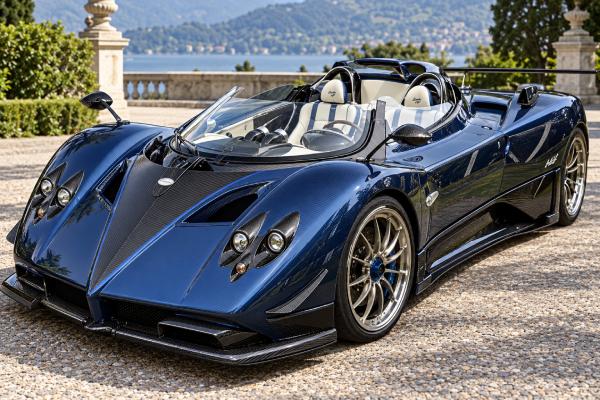
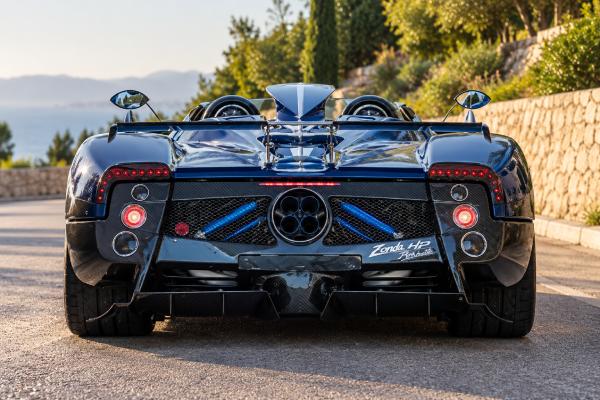
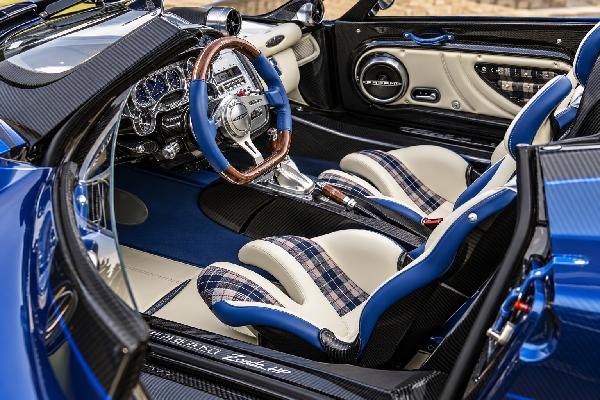
The Pagani Zonda HP Barchetta is a three-car, roofless Zonda conceived by Horacio Pagani as a personal interpretation of the model he introduced in 1999. Revealed in 2017, it combines a naturally aspirated 7.3-liter AMG V12, six-speed manual transmission, 1,250 kg dry weight, Carbo-Titanium/Carbo-Triax structure, carbon-ceramic brakes, and an intentionally extreme barchetta body with a cut-down windscreen and rear-wheel fairings. One accuracy point matters immediately: the familiar “800 hp” label is shorthand. Contemporary specifications quote 800 PS, which converts to about 789 mechanical horsepower or 588 kW. Pagani’s present technical page confirms the chassis, transmission, running gear, tyre specification, and weight but does not publish a factory acceleration time, top speed, torque figure, or engine displacement on that page. This guide therefore separates verified HP Barchetta data from commonly repeated claims, then focuses on what makes the car technically unusual, how its 2022 public accident affects provenance questions, and what an owner or buyer should document.
Table of Contents
- The Three-Car Project and What “HP” Means
- Verified Technical Data: V12, Manual Gearbox, Chassis, and Running Gear
- Carbo-Triax HP52 and the Late-Zonda Material Architecture
- Why the Short Screen, Open Roof, and Rear-Wheel Fairings Matter
- Operating an 800 PS Manual Hypercar Without Invented Performance Claims
- The 2022 Accident and Why Repair Provenance Is Part of the Specification
- Stewardship, Authentication, and Purchase Due Diligence
The Three-Car Project and What “HP” Means
The HP Barchetta is not a normal production trim added to the Zonda range. Pagani describes it as a tailor-made creation conceived by Horacio Pagani and his team for Horacio himself, then built as an extremely limited Uno-di-Uno project. Pagani’s current press material confirms that only three examples were produced.
That origin explains the initials better than a conventional model hierarchy does. “HP” points to Horacio Pagani, while “Barchetta” places the design in the tradition of very open, minimal-roof sports cars rather than describing a removable-roof roadster. The current Pagani page calls the car a reinvention of the Zonda using late-generation technologies and handcraftsmanship, not merely a Zonda with its roof panel deleted.
The timeline also deserves precision. The car was presented in 2017, eighteen years after the Zonda’s 1999 Geneva debut. The assignment range of 2017–2022 is useful for covering the public story through the well-documented 2022 crash involving one example, but it should not be interpreted as six years of ordinary series production. Public factory material consistently describes a three-car series. For chassis-by-chassis completion, registration, delivery, or later rebuild dates, the individual factory record is more authoritative than a broad model-year range.
| Item | Supported detail |
|---|---|
| Model | Pagani Zonda HP Barchetta |
| Public debut era | 2017 |
| Concept | Roofless, tailor-made Zonda created by Horacio Pagani and his team for Horacio Pagani |
| Program | Uno-di-Uno / highly individualized Pagani special-project work |
| Series size | Three cars |
| Horacio Pagani connection | Conceived by and for Horacio Pagani |
| Engine layout | Longitudinal central-rear Mercedes-Benz AMG V12 |
| Driven wheels | Rear-wheel drive |
| Dry weight | 1,250 kg (2,756 lb, converted) |
The power number needs similar care. Top Gear reported in August 2017 that Pagani had confirmed 789 bhp. That is consistent with 800 metric horsepower, or PS: 800 PS is approximately 588 kW and 789 hp. Calling the car “800 hp” is common in headlines and listings, including the assignment identifier, but a technical table should not silently equate PS with mechanical horsepower.
The 7.3-liter displacement belongs to the naturally aspirated AMG V12 lineage used by late road-going Zondas. Pagani’s current HP Barchetta technical page identifies the engine as a 60-degree Mercedes-Benz AMG V12 but does not state displacement, bore, stroke, torque, or engine speed. For that reason, this article does not fill those missing rows with numbers copied from another Zonda version. In a car this individualized, omission is more accurate than assuming every late Zonda shares identical calibration.
Verified Technical Data: V12, Manual Gearbox, Chassis, and Running Gear
The strongest HP Barchetta specification is the one Pagani itself publishes: a 60-degree AMG V12, rear-wheel drive, six-speed manual transmission, mechanical self-locking differential, composite monocoque, adjustable Öhlins suspension, Brembo CCM brakes, and staggered 20/21-inch APP wheels. These details establish the car’s engineering character without relying on speculative acceleration or top-speed figures.
| Specification | HP Barchetta |
|---|---|
| Engine family | Mercedes-Benz AMG V12 |
| Cylinder arrangement | 60-degree V12 |
| Induction | Naturally aspirated 7.3-liter configuration associated with the HP Barchetta |
| Published peak output | 800 PS / 588 kW / about 789 mechanical hp |
| Engine position | Longitudinal, central-rear |
| Drive | Rear-wheel drive |
| Transmission | Six-speed manual plus reverse |
| Differential | Mechanical self-locking differential |
The manual gearbox is especially important to the model’s identity. Pagani had already demonstrated automated-manual and sequential solutions on other Zonda derivatives, yet the HP Barchetta pairs its high-output naturally aspirated V12 with a conventional manual change. The combination puts driver timing—clutch release, throttle application, gear selection, and traction management—at the center of the experience. It also means that clutch condition and shift quality are meaningful parts of any inspection rather than secondary details hidden by electronic shift control.
| Area | Factory-published specification |
|---|---|
| Central structure | Pagani Carbo-Titanium and Carbo-Triax HP52 monocoque |
| Front/rear frames | CrMo Vanadium steel-tube structures |
| Fuel-tank enclosure | Ballistic-derived composite protection |
| Crash strategy | Front and rear structures designed for controlled impact-energy absorption |
| Front suspension | Independent double wishbone |
| Rear suspension | Independent double wishbone |
| Spring/damper layout | Upper rocker arm, coil spring, adjustable Öhlins damper |
| Roll control | Anti-roll bar |
| Item | Specification |
|---|---|
| Brake system | Four ventilated Brembo CCM carbon-ceramic discs |
| Front discs | 380 × 34 mm |
| Front calipers | Monobloc six-piston |
| Rear discs | 380 × 34 mm |
| Rear calipers | Monobloc four-piston |
| Wheels | Forged monobloc APP aluminum alloy |
| Front wheel diameter | 20 inches |
| Rear wheel diameter | 21 inches |
| Tyres | Pirelli P Zero Corsa HP Spec |
The wheel diameter is a useful reminder not to import older Zonda F tyre or wheel data into this car. HP Barchetta’s 20-inch front and 21-inch rear wheels are explicitly listed by Pagani, as is the P Zero Corsa HP specification. Exact tyre sizes, pressures, cold/hot targets, alignment values, and wheel-nut procedures should come from the chassis documentation rather than from another Zonda model.
| Feature | Verified description |
|---|---|
| Roof | No conventional roof |
| Windscreen | Short, wraparound barchetta-style screen |
| Rear wheels | Partially covered by carbon-fiber fairings |
| Rear aero | Fixed rear wing |
| Engine intake feature | Roof-scoop-style central intake retained as a Zonda visual/functional signature |
| Dry weight | 1,250 kg |
| Dry-weight conversion | Approximately 2,756 lb |
| Production scale | Three examples |
No factory 0–100 km/h time is presented on Pagani’s current HP Barchetta page. The same is true of a factory top speed and torque figure there. Those omissions are deliberate here. A complete-looking table populated from unsourced secondary lists would be less useful than a shorter table whose rows can be traced to the exact model.
Carbo-Triax HP52 and the Late-Zonda Material Architecture
The HP Barchetta’s most consequential engineering change is not the missing roof; it is the material system underneath the shape. Pagani specifies a central monocoque made from Carbo-Titanium and Carbo-Triax HP52, with CrMo Vanadium steel structures at the front and rear and controlled-energy crash structures around the cell.
Carbo-Titanium is central to Pagani’s later Zonda story because it combines carbon-fiber composite architecture with titanium reinforcement. The HP Barchetta goes further by listing Carbo-Triax HP52 in the monocoque. Pagani states that the fuel-tank enclosure also uses ballistic-derived composites. Those descriptions matter because this car was created after the Huayra program had expanded Pagani’s experience with advanced composite recipes, processing methods, and structural integration.
The practical effect for an owner is that “carbon car” is too vague a maintenance description. Different pieces can have different structural jobs, fiber architectures, resins, surface finishes, fastener interfaces, and repair limits. A stone chip on a cosmetic carbon panel is not the same problem as impact damage near a suspension pick-up or monocoque interface. Inspection should identify which component is damaged before deciding how serious the mark is.
That distinction becomes more important around the front and rear steel-tube frames. A collision can load a composite cell through attached metal structures even if the visible carbon surface appears intact. Conversely, sacrificial or replaceable structures may absorb energy as designed while preserving the central cell. Only dimensional checks, material inspection, factory records, and the actual repair documentation can establish what happened to a particular chassis.
The 1,250 kg dry weight is therefore impressive for more than headline power-to-weight ratio. Pagani retained a substantial V12, manual transmission, large ceramic brakes, wide wheels, safety structures, and bespoke interior while keeping the published dry mass close to the lightest road-going hypercar territory of its period. The material choices are part of the reason the car could be radically open without being described by Pagani as a stripped display object.
Owners should treat exposed composite surfaces as both finish and evidence. Clear coat can haze, scratch, yellow, or be polished unevenly; none of those conditions automatically imply structural damage. More serious clues include fiber distortion, resin whitening, cracks that continue across load paths, changed panel gaps, unusual fastener witness marks, or repairs whose material stack and cure history cannot be documented. Those findings call for factory-level examination rather than cosmetic correction.
Because only three HP Barchettas exist, replacement strategy can also affect provenance. A newly fabricated factory component may be technically superior to a repaired old part, but the historical record should state what was replaced, when, why, and by whom. On a car whose identity rests partly on extreme hand-built specificity, the repair ledger is not separate from authenticity; it is part of it.
Why the Short Screen, Open Roof, and Rear-Wheel Fairings Matter
The HP Barchetta’s body is an exercise in deliberately exposed driving rather than a conventional convertible solution. There is no normal roof to deploy, the windscreen is dramatically reduced, and the rear wheels are partially enclosed by carbon-fiber fairings. Those choices alter airflow, visibility, cockpit exposure, service access, and damage risk all at once.
A low screen means airflow reaches the occupants differently from a Zonda coupe or full-height roadster. Eye protection, loose objects, hats, cameras, microphones, and anything stored in the cockpit become real operating considerations even at moderate speed. A passenger compartment that looks clean after static display can collect fine grit in seams, switchgear, leather perforations, harness hardware, and exposed trim after a short open-air drive.
The rear-wheel fairings are more than theatrical styling. They define the HP Barchetta visually and sit in a vulnerable zone where tyre debris, road grit, stones, heat, wheel service, and loading mishaps can affect the finish. A pre-drive walk-around should confirm secure mounting, adequate clearances, and absence of contact marks. After tyre or brake work, those checks are worth repeating before the car is driven.
The staggered 20/21-inch wheel package reinforces the unusual proportions. Top Gear’s 2017 report also highlighted different color inlays on the left and right wheels of the debut car—gold on one side and blue on the other. That is a good example of why chassis-level evidence matters. A distinctive treatment seen on Horacio Pagani’s car should not automatically be generalized to every one of the three without a build record for the specific example.
Aerodynamic claims require the same discipline. The fixed rear wing, central intake, open cockpit, short screen, and wheel fairings clearly manage airflow, but Pagani’s current technical page does not publish a downforce figure for the HP Barchetta. Reusing Zonda F, Cinque, or track-model numbers would create a false specification. If an individual build book contains test or aero data, that chassis-specific material should take priority.
Weather protection is correspondingly limited. This is not a car to evaluate by asking whether a roof mechanism works. Instead, inspection should concentrate on water and sun exposure histories, windscreen and cockpit seals where fitted, drainage, interior leather and fabric, switchgear, electrical connectors, exposed fasteners, and any supplied protective covers. Storage needs to prevent condensation while also shielding the open cabin from dust and UV.
Transport deserves planning too. The unusual fairings, low aero surfaces, bespoke wheels, and exposed cockpit create multiple contact points that a generic carrier may not expect. A suitable transporter should use approved tie-down locations and ramp angles, protect the cabin without allowing a cover to chafe finishes, and avoid straps or equipment touching fairings or suspension components. Photographs before loading and after unloading can turn a later mark into a traceable event.
Operating an 800 PS Manual Hypercar Without Invented Performance Claims
The HP Barchetta combines approximately 789 mechanical hp with 1,250 kg dry weight, rear-wheel drive, a mechanical limited-slip differential, and a six-speed manual. That is enough to describe an exceptionally demanding performance envelope without publishing an unsupported sprint time or maximum speed.
At low speed, the important inputs are ordinary but amplified by value and mechanical concentration. The clutch must engage cleanly, the gearbox should select every ratio without forcing the mechanism, steering effort should remain consistent, and brake response should be progressive. Repeated clutch slipping during parking, transporter loading, concours positioning, or congested event driving can create wear that odometer mileage does not reveal.
Cold condition matters. A high-output naturally aspirated V12, transaxle, differential, ceramic brakes, dampers, and tyres do not all reach useful operating temperature at the same rate. The correct warm-up process and fluid specifications belong to current Pagani documentation for that chassis. Aggressive throttle or high engine speed before a stable thermal state is not justified by the car’s rarity, and generic internet oil-temperature rules are not a substitute for factory procedure.
The Pirelli P Zero Corsa HP Spec tyres are a core chassis component. Age, storage temperature, flat-spotting, sidewall condition, prior puncture repair, and heat-cycle history can matter more than tread depth on a lightly used collector car. A visually perfect old tyre can be unsuitable for meaningful performance driving. Replacement fitment should match current Pagani/Pirelli approval for the exact wheel and chassis rather than simply matching diameter.
Carbon-ceramic brakes likewise need condition-based assessment. The published hardware is substantial—380 × 34 mm discs at both axles with six-piston front and four-piston rear monobloc calipers—but disc life cannot be inferred from mileage alone. Inspection should consider impact damage, wear measurement required by the manufacturer, pad condition, caliper seals, fluid age, brake ducts, and evidence of repeated high-temperature use.
The adjustable Öhlins dampers create another trap for casual setup changes. Adjustment range does not mean every click combination is appropriate for public-road use. Record the existing settings before any change, establish whether the car is at its documented factory baseline, and preserve corner-weight, ride-height, and alignment records. On a three-car project, “this feels better” is not adequate documentation for altering a carefully developed setup.
The safest first drive after long storage is diagnostic rather than demonstrative. Check pressures and fluids, inspect underneath, confirm tyre dates, start from cold, watch instruments and warnings, and build load gradually. After the drive, inspect again for seepage, heat marks, loose fasteners, tyre contact, or fresh debris around the wheel fairings. A successful recommissioning session is one that produces information, not a performance video.
The 2022 Accident and Why Repair Provenance Is Part of the Specification
One HP Barchetta was involved in a publicly documented road collision in Croatia on September 2, 2022. Motor1 reported that nobody was injured and published images showing extensive visible damage on the driver’s side, including damaged wheel areas, rear bodywork, and suspension. Public images establish the event, not a complete structural diagnosis or later repair scope.
That distinction is essential. Photographs taken beside a road can show broken bodywork and displaced suspension, but they cannot reliably determine hidden composite condition, dimensional integrity, load paths through the subframes, fuel-system condition, or whether the central monocoque exceeded repair criteria. Statements about the ultimate structural outcome should come from Pagani and the repair record, not from visual speculation.
For an affected chassis, a serious provenance file should therefore include the incident date and circumstances that can be documented, pre-repair measurements, dismantling photographs, non-destructive inspection where applicable, component disposition, factory repair instructions, replacement-part identifiers, curing or bonding records for structural composite work, alignment and geometry data, system checks, and final sign-off. If parts were sent back to Pagani or fabricated from preserved tooling, that should be recorded as well.
A post-repair inspection should not be reduced to paint-meter readings. The relevant questions are whether the central cell was measured, which front or rear frame components were replaced, whether suspension pick-up points and wheel centers are within specification, whether brake and steering systems were renewed or tested, whether composite repairs use the correct materials and processes, and whether the car’s final geometry matches Pagani data.
The event also illustrates why public accident history should be handled neutrally. An accident does not make a rare car unauthentic, and a repaired car is not automatically unsafe. Conversely, rarity and factory involvement do not erase the event. The useful standard is transparency: the physical condition, repair documents, authentication record, and sales description should all tell the same story.
For the two cars not involved in that specific public event, the 2022 crash is still a useful due-diligence lesson. Do not assume that the absence of online photographs proves an accident-free history. Review factory and insurer records where available, inspect structural interfaces, look for evidence of refinishing or component replacement, and ask direct questions about transport damage, wheel impacts, off-road excursions, track use, and prior repairs.
Because HP Barchetta values are often discussed in extraordinary headline numbers, provenance can become distorted by price talk. Motor1’s 2022 article repeated a reported valuation figure, but such a number is not a factory specification or an appraisal of every example. There are only three cars, each can differ, and a private transaction may include circumstances that public reporting cannot see. Chassis condition and documentary quality are more useful than a generalized “worth” figure.
Stewardship, Authentication, and Purchase Due Diligence
Buying or maintaining an HP Barchetta is best approached as management of a unique archive attached to a functioning machine. With only three examples, chassis identity, build details, subsequent changes, repair history, and accompanying objects can matter as much as odometer mileage.
Pagani Puro gives that process a factory framework. Pagani says the program compares a car with the company database, including component history, serial numbers, photographs, and construction information, and subjects eligible cars to more than 400 checks. The resulting Puro documentation is especially relevant to an HP Barchetta because casual visual comparison with another example is a poor way to judge originality in an Uno-di-Uno project.
Start the file with the chassis and factory build record. Then add delivery documentation, registration history, service invoices, software or electrical updates, tyre and brake replacements, damper work, clutch work, body refinishing, accident or transport claims, and every factory visit. Photograph important serial numbers and identifying marks without publishing sensitive security information.
The inspection itself should be split into systems rather than compressed into a generic “PPI.” For the powertrain, assess cold start, fluid condition, leaks, cooling behavior, clutch operation, gearbox selection, differential noise, mounts, exhaust condition, and post-drive behavior. For the chassis, inspect composite surfaces, steel subframes, suspension attachments, underbody, wheel fairings, aero pieces, dampers, bearings, and geometry. For the open cabin, review windscreen condition, leather, tartan or other chassis-specific trim, switches, instruments, harnesses, exposed hardware, and signs of moisture or UV damage.
Consumables need dates, not adjectives. Record tyre manufacture dates and fitment dates, brake-fluid service, engine and drivetrain fluid services, battery replacement, and any flexible hose or seal work required by Pagani. A car described as “as new” because it has barely moved can still contain age-sensitive materials. Conversely, a correctly maintained car that has been driven is not inherently less desirable mechanically.
The build record should explain what physically accompanied the commission. With only three cars, an unusual case, protective piece, or color-matched component may belong to one chassis rather than to the series. Photograph those items with their paperwork and keep custody traceable. The aim is to preserve this particular Uno-di-Uno order, not to assemble a generic checklist.
If major restoration is needed, involve Pagani Officina before independent work begins. Pagani’s own service programs are built around the company archive and factory knowledge, which is particularly valuable when a three-car project needs structural composite work, a remade bespoke component, or a documented return to an earlier configuration.
A buyer should also reconcile the advertised identity with the power-unit description. The required “800 hp” headline should not lead a sales file to misstate units. Ask whether documentation expresses output in PS, kW, bhp, or another standard, and preserve the original wording. Likewise, do not add a torque figure or acceleration claim to a valuation sheet merely because it appears in an aggregate database.
Before money changes hands, confirm title and registration status in the relevant jurisdiction, import/export history, taxes, liens or finance where applicable, insurance eligibility, and the legal status of any modifications. A barchetta body with minimal weather protection and market-specific homologation history can raise practical registration or use questions that a global model description cannot answer.
The strongest HP Barchetta record is therefore not the one with the most superlatives. It is the one in which Pagani documentation, the physical chassis, the current mechanical state, and every significant intervention can be reconciled. On a three-car project designed around Horacio Pagani’s own idea of the Zonda, that continuity is what turns rarity into verifiable history.
References
- Zonda HP Barchetta | Pagani — 2026 current manufacturer model page; chassis, engine configuration, transmission, brakes, wheels, tyres, suspension, safety architecture, and dry weight.
- Pagani Automobili at Salon Rétromobile 2026 | Pagani — 2026; current factory confirmation of the three-car series, naturally aspirated AMG V12, manual gearbox, HP52 structure, and 1,250 kg dry weight.
- The wild Pagani Zonda HP Barchetta has 789bhp | Top Gear — 2017; contemporary reported power figure, manual gearbox, wheel treatment, and design details.
- Pagani Zonda HP Barchetta Worth $17M Crashes During Supercar Event — 2022; dated public record of the Croatia accident and visible damage.
- Pagani Puro | Pagani — 2026 current factory authentication and certification program.
- Pagani Zonda: A Guide To Every Version | CarThrottle — 2025; secondary cross-check for the HP Barchetta’s 7.3-liter naturally aspirated V12 and 789 bhp output.
Disclaimer
This article is for general information only and is not a diagnosis, repair instruction, structural certification, valuation, or legal opinion. Specifications, torque values, service intervals, procedures, equipment, registration details, and repair requirements can vary by VIN, market, and later factory work; verify the exact car against current Pagani service documentation and records. Share this guide on Facebook, X, collector groups, or specialist forums when accurate provenance and responsible stewardship are useful to the discussion.