
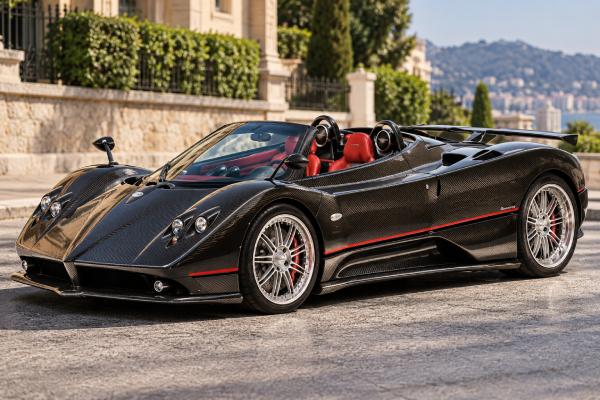
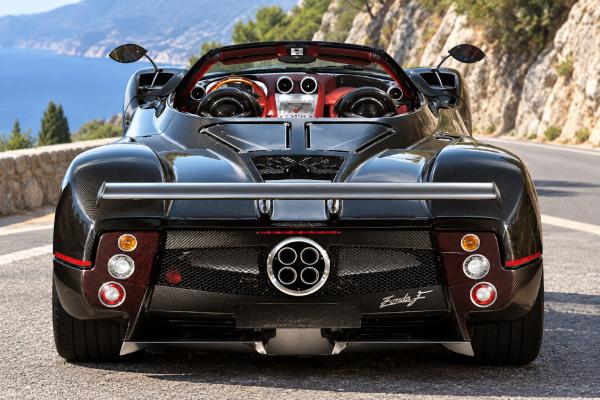
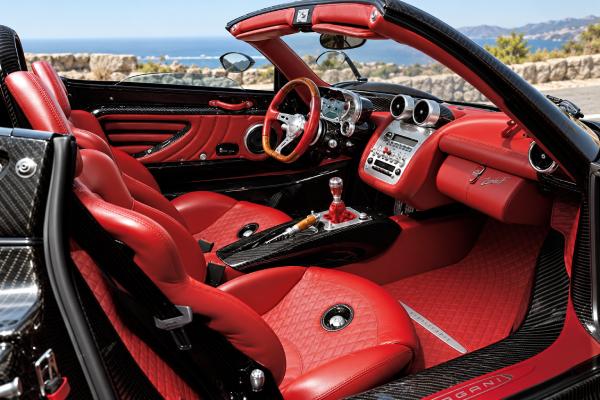
The Pagani Zonda Roadster F is remarkable because opening the roof did not turn the F into a heavier, softer grand tourer. Pagani redesigned the open central structure with high-modulus three-way carbon fabrics, added reinforcement around the sills and fuel-tank area, and made the roll bars structural, yet still published the same 1,230 kg dry weight as the light coupe configuration. The Roadster F was also produced only in 650 hp Clubsport form, with the 7.3-litre naturally aspirated AMG V12, six-speed manual gearbox, carbon-ceramic brakes, and 600 kg of claimed downforce at 300 km/h. A 7:29 Nürburgring lap underscored that the open body retained serious circuit ability. For an owner, however, the roadster brings concerns a coupe does not: the carbon-and-canvas folding roof, seals, rollover structure, open-cabin trim, and evidence of water or weather exposure all deserve inspection. With only 25 examples built, original configuration and factory documentation matter as much as the performance numbers.
Table of Contents
- How Pagani Kept the Roadster F Light and Rigid
- Roadster F Specifications and Technical Data
- Why Every Roadster F Used the Clubsport Specification
- Roof Design, Aero Load, and the 7:29 Nürburgring Lap
- Weather, Roof, Cabin, and Composite Care
- Servicing the Manual V12 and Carbon-Ceramic Hardware
- Buying and Authenticating One of 25 Roadster Fs
How Pagani Kept the Roadster F Light and Rigid
The Roadster F’s defining engineering achievement is structural rather than cosmetic: Pagani removed the fixed roof while preserving the coupe’s published 1,230 kg dry-weight target. The company did this by redesigning load paths in the carbon structure instead of simply adding large amounts of reinforcement underneath.
A closed coupe can use its roof as part of a box that resists bending and torsion. Once that roof disappears, the sills, bulkheads, windscreen area, rear structure, and rollover system must carry more of the load. Pagani specifically identifies reinforcement in the door-sill and fuel-tank areas, structural roll bars, and high-modulus three-way carbon-fibre composites as key changes.
That matters to the way the car steers and rides. If an open structure twists excessively, suspension geometry cannot work from a stable base and the driver may feel shake, delayed response, or rattles over rough surfaces. Pagani’s goal was to keep the Roadster F behaving like an F rather than allowing the body to become a flexible spring in parallel with the suspension.
The roof itself is part of the roadster concept but not the primary structural solution. Pagani describes a folding roof with a carbon-fibre central section and canvas lower portion. It provides weather protection and changes airflow around the cockpit, yet the structural work remains in the safety cell, sill areas, tank zone, and roll bars.
Pagani’s 1,230 kg figure is best read as evidence of the engineering target, not as a promise about what every surviving car will show on scales today. It is a dry-weight specification attached to the factory configuration. The significant point is comparative: Pagani added the material and geometry needed for an open structure yet still published the same 1,230 kg figure associated with the F. A present-day weighing belongs in a chassis report with its test condition stated, not in an argument over the original claim.
Pagani produced 25 Roadster F examples, and later factory material describes the model as a commercial success whose available chassis sold out. That production number is large by Zonda-special-edition standards but still small enough that every car can have meaningful individual history. A Roadster F should therefore be evaluated as a chassis, not as an interchangeable trim level.
Roadster F Specifications and Technical Data
Pagani did not compensate for the missing roof by softening the F’s mechanical specification. The open car’s published baseline is the 650 hp, 780 Nm Clubsport-level V12 together with CCM brakes, while the chassis receives dedicated reinforcement around the sills, tank area, and roll-over structure. That combination—high-output manual drivetrain plus an open body engineered back to F-level seriousness—is the useful way to read the Roadster F data that follows.
| Specification | Roadster F value |
|---|---|
| Engine | Mercedes-Benz AMG 60-degree V12, 48 valves |
| Displacement | 7,291 cc (7.3 litres) |
| Induction | Naturally aspirated |
| Maximum power | 650 hp (478 kW) at 6,200 rpm |
| Maximum torque | 780 Nm (575 lb-ft) at 4,000 rpm |
| Gearbox | Mechanical six-speed plus reverse |
| Clutch | Twin-plate clutch |
| Drive | Rear-wheel drive with self-locking differential |
| Component | Factory specification |
|---|---|
| Intake manifold | Hydroformed aluminium/Avional MHG System |
| Exhaust | Hydroformed Inconel manifold with ceramic coating and titanium silencer |
| Steering | TRW power-assisted rack and pinion |
| Suspension | Independent double A-arm with pull-rod helical springs |
| Dampers | Adjustable Öhlins |
| Suspension arms | Aluminium/magnesium alloy |
| Driver aids | Bosch ABS and traction control |
| Item | Front | Rear |
|---|---|---|
| APP forged wheel | 19 inches | 20 inches |
| Michelin Pilot Sport 2 tyre | 255/35 R19 | 335/30 R20 |
| Brembo carbon-ceramic disc | 380 × 34 mm | 380 × 34 mm |
| Monobloc caliper | Six-piston | Four-piston |
| Measure | Published value | Context |
|---|---|---|
| Length | 4,435 mm (174.6 in) | Factory dimension |
| Width | 2,055 mm (80.9 in) | Factory dimension |
| Height | 1,141 mm (44.9 in) | Factory dimension |
| Wheelbase | 2,730 mm (107.5 in) | Factory dimension |
| Dry weight | 1,230 kg (2,712 lb) | Published dry-weight figure |
| Weight distribution | 46% front / 54% rear | Factory figure |
| Central structure | Roadster-specific carbon-fibre safety cell | Reinforced sills/tank area and structural roll bars |
| Measure | Pagani figure | Context |
|---|---|---|
| 0–100 km/h | 3.6 seconds | Manufacturer claim |
| 0–200 km/h | 9.8 seconds | Manufacturer claim |
| 200–0 km/h | 4.4 seconds | Manufacturer braking claim |
| Maximum lateral acceleration | 1.4 g | Factory figure |
| Top speed | More than 345 km/h | Manufacturer claim |
| Downforce | 600 kg at 300 km/h | About 270 kg front / 330 kg rear |
| Nürburgring lap | About 7:29 | Factory historical account |
Some Pagani historical material lists the Roadster F Nürburgring result more precisely as 7:29.70, while the current model page rounds it to 7:29. Using the rounded factory model-page figure avoids implying a modern standardized record procedure.
Why Every Roadster F Used the Clubsport Specification
The Roadster F was produced only with the 650 hp Clubsport engine specification, according to Pagani’s later historical material. That makes its identity simpler than the coupe’s: there is no standard 602 hp Roadster F baseline that buyers need to separate from a 650 hp version.
Pagani explains that the Clubsport setup had proved more popular, and the roadster therefore used the higher-output V12 from the start. The 650 hp peak arrives at 6,200 rpm, with 780 Nm at 4,000 rpm. The engine remains naturally aspirated, so the increase does not change the F’s fundamental response: the driver still gets a broad, linear build of power tied closely to throttle opening and engine speed.
Carbon-ceramic brakes are also part of the published Roadster F specification. Both axles use 380 × 34 mm self-ventilated discs, with six-piston front and four-piston rear calipers. That is significant because the open car’s equal-weight target was achieved while carrying the high-performance brake package rather than lighter, smaller hardware.
The wheel and tyre package also mirrors the developed F formula: 19-inch front and 20-inch rear forged APP wheels, with 255/35 R19 and 335/30 R20 Michelin Pilot Sport 2 tyres in the original technical listing. Owners should treat those sizes as part of the chassis setup, not simply as styling. A different tyre construction or diameter can affect steering, traction control, ride height, gearing, and aero platform.
What the Roadster F does not do is become an automated sequential car. It keeps the six-speed mechanical manual and twin-plate clutch. That distinction is important when comparing it with later Cinque and Tricolore derivatives. The Roadster F asks the driver to coordinate clutch, lever, throttle, and rear grip directly.
The open body also changes sensory load. Wind, engine sound, tyre noise, and exhaust reach the occupants differently with the roof removed. That can make moderate road speeds feel more intense than the same pace in the coupe. Owners do not need to chase the car’s maximum performance to experience its defining character.
Roof Design, Aero Load, and the 7:29 Nürburgring Lap
The Roadster F’s 7:29 Nürburgring result demonstrates that the roofless structure and aero package worked together at sustained speed. It should be read as engineering evidence for the period, not as a standalone ranking against later cars using different timing conventions.
Removing a roof changes airflow around the windscreen, cabin opening, roll bars, and rear deck. Pagani’s solution had to preserve stability with the roof fitted and with the car open, while still achieving a published 600 kg of downforce at 300 km/h. The roadster’s structural stiffness matters here because aero load only helps if suspension pick-up points remain in predictable relationship to one another.
The folding roof deserves practical respect. It combines a carbon-fibre central portion with a canvas lower section, so inspection should cover both hard and flexible materials. Check carbon surfaces for chips or stress, hinges and latches for correct operation, canvas for shrinkage or abrasion, and sealing surfaces for dirt or compression damage. Confirm how the roof is stored and whether its bag, straps, tools, or associated accessories remain with the car.
Before driving with the roof removed, check that every stowed component is secured as Pagani intended. Loose objects in the cabin can become projectiles, and wind can pull at papers, hats, phones, or soft trim. The Roadster F has more wind protection than a later HP Barchetta, but it is still an open 345+ km/h-capable car.
High-speed inspection should include the visible and hidden aero surfaces. Look at the front splitter, flat floor, diffuser, rear wing and its mounts, wheel-arch liners, and fasteners. A scraped lower panel may be cosmetic; a distorted mounting point can be more significant. Any repaired composite should have a documented method and, ideally, factory involvement.
Ride height and alignment should stay within a known approved setup. Adjustable Öhlins dampers invite experimentation, but a roadster’s aero balance can be sensitive to pitch and rake. Record settings before changes and use corner-weighting and alignment equipment appropriate to the car.
The Nürburgring lap is therefore most useful as a reminder that the Roadster F is an integrated system. The chassis, roofless body, suspension, tyres, brakes, and aero were developed together. Maintaining that relationship is more important than reproducing any single historic number.
Weather, Roof, Cabin, and Composite Care
Roadster ownership adds preservation tasks that a coupe owner can mostly ignore: water entry, roof fit, wind exposure, and greater UV and dust exposure inside the cabin. A dry-looking car still needs inspection for earlier moisture because occasional leaks can leave traces under carpets, behind trim, or around electronics.
Begin with the roof seals and contact surfaces. Look for flattening, tears, dirt tracks, adhesive failure, or areas that appear to have been compressed unevenly. Water-test procedures should follow Pagani guidance; flooding a rare interior with a hose is not a sensible diagnostic shortcut. If there is evidence of leakage, inspect nearby trim, connectors, fasteners, and hidden cavities.
The open cabin’s leather, wood, anodized metal, exposed carbon, and switchgear can age at different rates. Sunlight can dry leather and fade dyes, while aggressive cleaners can stain anodized finishes or alter gloss on carbon clear coat. Use material-specific products approved by Pagani or a specialist familiar with the original surfaces.
Windborne grit also matters. Door tops, seat bolsters, rear deck surfaces, and the leading edges around the cockpit can show abrasion that a coupe avoids. Before polishing, decide whether the mark is superficial contamination, clear-coat wear, or damage to the underlying finish. Over-polishing exposed carbon can produce uneven gloss and reduce originality.
Storage should control humidity and temperature without trapping moisture. Make sure the roof is clean and fully dry before long-term stowage, and avoid folding flexible material sharply in a way that creates permanent creases. If the factory specifies a particular storage shape or location, follow it.
Drainage paths and weather channels should remain clear. Leaves, dust, detailing residue, or old sealant can redirect water into places it was never meant to go. At service, ask the technician to inspect the roadster-specific sealing and drainage areas rather than performing only the coupe checklist.
Finally, document cosmetic work. On a 25-car roadster, a replaced seal, repaired roof panel, retrimmed seat bolster, or refinished exposed-carbon area may matter to future provenance. A photograph and invoice turn a vague concern into a known event.
Servicing the Manual V12 and Carbon-Ceramic Hardware
The Roadster F needs time-based maintenance even when mileage is low. Collector use can preserve visible condition while fluids, tyres, seals, dampers, batteries, and hydraulic components continue to age.
On the Roadster F, build the mechanical service around heat management and the car’s real use pattern. Cooling-system condition, exhaust heat shielding near composite bodywork, clutch hydraulics, transaxle behavior, and brake-fluid history deserve to be reviewed as one operating system before a long tour or fast drive. Parts, fluids, torque values, and intervals still come from current Pagani documentation for the chassis; the roadster-specific task is to connect that factory schedule with evidence of open-air touring, event use, storage, and repeated low-speed maneuvering.
For this roadster, clutch wear can reveal a life spent doing things the odometer barely records. Concours positioning, hotel arrivals, enclosed-trailer loading, and creeping through event queues can demand repeated starts on a twin-plate clutch. Reconstruct those habits from invoices and owner history, then check whether engagement changes as the drivetrain warms. Any chatter, incomplete release, or new transaxle noise should be investigated before the car is asked to repeat another tour.
Tyres require date-code inspection. Deep tread does not make an old Michelin safe at high speed, and a roadster’s structural and aero capability cannot compensate for hardened rubber. Fit current Pagani-approved tyres for driving and preserve original period tyres separately only if they have historical value.
Carbon-ceramic brakes should be measured and inspected by someone familiar with the system. Check discs for impact damage, pads for remaining material, calipers for leaks or seal deterioration, and fluid for age. After track use, inspect wheel bearings, tyre shoulders, brake ducts, fasteners, and heat shielding as part of the same system.
Öhlins dampers can require service with age even at low mileage. Look for leakage, degraded seals, inconsistent damping, damaged adjusters, and play in suspension joints. A roadster that has spent years stationary may benefit from a careful geometry baseline before spirited driving.
Recommissioning should be staged. Inspect the car cold, bring it to operating temperature while watching pressures and warnings, drive gently, then inspect again for leaks, heat effects, or loosened parts. Establishing a known mechanical baseline is more valuable than assuming a pristine exterior means the car is ready for maximum load.
Buying and Authenticating One of 25 Roadster Fs
A Roadster F purchase should prove three things independently: that the chassis is one of the 25 factory roadsters, that its original 650 hp Clubsport/open-body specification is documented, and that all later changes are understood. Rarity does not remove the need for evidence; it makes evidence more important.
Pagani’s Puro program is the strongest starting point for authenticity. The company says it uses more than 400 checks and compares vehicles with its internal history, including component details, serial numbers, photographs, and records. For a roadster, ask that roof hardware, structural roll bars, open-body components, and factory accessories be included in the review.
Build a chronology from order to present. Record build and completion dates, delivery market, registrations, owners, service visits, accident or repair events, factory upgrades, and major transport or event history. Do not force those dates into the 2006–2011 assignment range if the documents show a different registration sequence; preserve the actual evidence.
Inspect the car both closed and open. Check roof fit, latches, seals, canvas, carbon panel condition, windscreen area, roll bars, rear deck, drainage paths, and signs of moisture. Then perform the full mechanical inspection: cold start, clutch, all gears, steering, brakes, suspension, cooling, electronics, tyre dates, underbody, aero, and post-drive leakage.
Composite repair deserves specialist assessment. The central cell, sill reinforcement, tank area, roll-bar interfaces, front and rear steel frames, suspension pick-up points, and body panels should be reviewed separately. A beautifully refinished surface does not prove that structural work underneath was carried out correctly.
Factory evolution is common in the Zonda world. Pagani can restore cars through Rinascimento and reconfigure them through other factory programs. Such work can add meaning and quality, but it should be described accurately. A roadster transformed into a later 760-style commission remains a Pagani with valuable factory provenance, yet it is no longer an untouched reference Roadster F.
For one of 25 open cars, completeness can be unusually tangible. A correctly documented roof assembly, its storage pieces, roadster-only trim, and evidence that the reinforced body has never been casually repaired can distinguish two cars that look similar in auction photography. Later factory transformations may be desirable in their own right, but they change the historical question being answered. Treat sale prices as evidence about individual chassis, not as a ready-made Roadster F index.
The roof and its associated pieces should be treated as an inventory, not merely as trim. Confirm that every supplied panel, flexible section, bag, fastener, tool, and storage item that belongs with the chassis is present and correctly identified. Photograph identifying marks before purchase. On a car produced in such small numbers, sourcing a missing roadster-specific part later may involve factory fabrication rather than normal parts ordering.
A pre-purchase inspection should also distinguish cosmetic evidence of open-top use from signs of structural movement. Door shut lines, latch effort, windscreen surround alignment, seal compression, and roof-panel fit should be compared side to side on level ground. None of those observations alone diagnoses chassis damage, but an unusual combination deserves investigation by Pagani or a composite-structure specialist. The point is to establish why something fits differently, not to condemn normal hand-built variation.
Ask how the car has been transported. Low ride height, exposed carbon, a long rear overhang, and roadster-specific bodywork make loading technique important. Inspect the front splitter, flat floor, jacking and lifting areas, rear diffuser, wheel faces, and underside for transporter or ramp damage. If previous owners used a removable nose-protection system, wheel straps, or custom loading ramps, related invoices and photographs can help explain the condition you see.
A road test should be planned around the car rather than around proving performance. Start with low-speed steering, brake feel, clutch engagement, gearbox action, warning lights, and cabin noises. After fluids are warm, progressively load the engine and chassis only if condition, tyres, weather, and road permit it. With the roof fitted, listen for abnormal movement or air leakage around the interfaces; with it removed, check that the latches and stored pieces remain secure. A second inspection immediately after the drive can reveal seepage, heat-related odors, loose trim, or fresh contact marks that were invisible when cold.
Insurance and storage arrangements deserve attention before the purchase closes. Confirm that the policy covers the agreed value, factory or specialist repair pathways, transit, event use, and any geographical restrictions relevant to the owner. The storage space must also accommodate the roof pieces without bending or abrasion and provide enough clearance to open doors and inspect the car without touching walls or nearby vehicles.
Finally, separate “complete” from “original.” A Roadster F may retain every major component yet include later factory updates, refinished carbon, retrimmed leather, replaced seals, or revised electronics. Those changes are not automatically negative. What matters is that the physical car, the Pagani record, and the invoices tell the same chronology. For a hand-built open Zonda, transparent evolution is more useful than an unsupported claim that nothing has ever changed.
The strongest purchase is the Roadster F whose open-top engineering still tells a coherent story. Its carbon structure, 650 hp V12, manual gearbox, ceramic brakes, roof system, service history, and current condition should all agree with the factory record. When they do, the car remains what Pagani intended: a roadster that gave up the fixed roof without giving up the dynamic seriousness of the F.
References
- Zonda Roadster F | Pagani 2026 (Manufacturer Specifications)
- PAGANI AUTOMOBILI CELEBRATES ITS FIRST 25 YEARS IN THE MIDDLE EAST | Pagani 2023 (Production and Roadster Engineering Context)
- Zonda F | Pagani 2026 (Related Coupe and Powertrain Data)
- Pagani Automobili at the Historic Minardi Day 2025:a weekend celebrating emotions, performance, and passion. | Pagani 2025 (F-Generation Production Context)
- “Pagani Puro”, the program created to certify the authenticity and enhance the value of our exclusive cars over time | Pagani 2021 (Factory Authentication)
- Pagani Rinascimento | Pagani 2017 (Factory Restoration)
Disclaimer
This article is for informational purposes and is not a substitute for professional diagnosis, structural inspection, valuation, or repair. Specifications, torque values, service intervals, roof procedures, equipment, and approved parts can vary by VIN, market, original order, and later factory work; verify every technical decision against the official documentation for the exact chassis. If this guide helps, please share it on Facebook, X/Twitter, owner communities, or specialist forums to support accurate documentation and responsible ownership.