
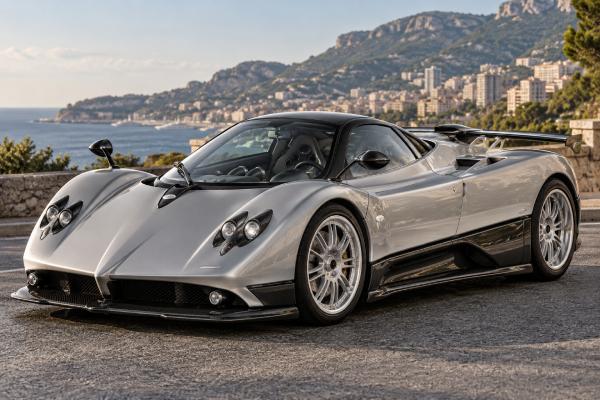
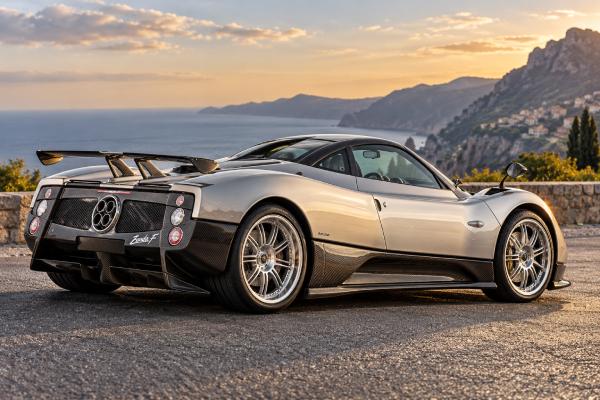
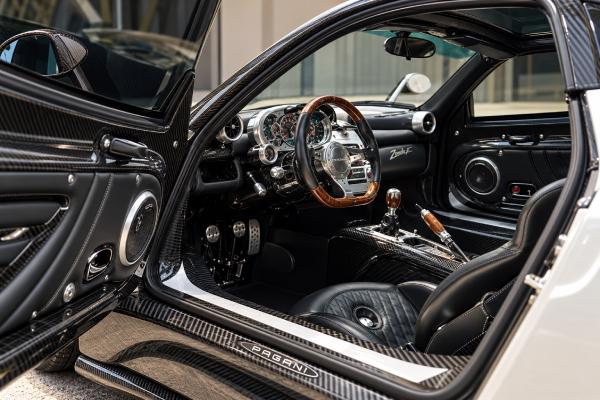
The Pagani Zonda F Clubsport is the 650 hp, 780 Nm high-output version of the manual Zonda F, and its clearest historical marker is a 7:27.82 Nürburgring Nordschleife lap set in 2007. That run was made on the 20.6 km circuit by Marc Basseng in 10°C conditions, using the F’s adjustable suspension, Pirelli road tyres, and high-downforce body. The result matters because it shows what the Clubsport package was intended to do: combine a lightweight carbon structure, naturally aspirated AMG V12, six-speed manual gearbox, strong braking, and serious aero without turning the car into a track-only Zonda R. Yet “Clubsport” still demands chassis-level verification. Pagani’s own Zonda F data describes the 650 hp engine as a special-request Clubsport option and separately lists carbon-ceramic brakes as optional. Cars may therefore differ in original equipment or later factory changes. Buyers should confirm the delivered specification, understand any track history, and inspect consumables and aero hardware as carefully as the engine.
Table of Contents
- Why the 7:27.82 Nürburgring Lap Still Matters
- What “Clubsport” Means in Pagani’s Factory Data
- Zonda F Clubsport Specifications and Technical Data
- Aero Load, Tyres, and Brakes: The High-Speed System
- Using a 650 hp Manual Zonda on Road and Track
- Inspection and Maintenance After Hard Use
- Provenance and Buying Checks for a Clubsport
Why the 7:27.82 Nürburgring Lap Still Matters
The 2007 Nordschleife record is useful because Pagani documented the conditions and the car’s setup philosophy, not merely the lap time. The company states that Marc Basseng completed the 20.6 km, 73-corner course in 7 minutes 27.82 seconds at 7:28 p.m. with an ambient temperature of 10°C.
Pagani framed the attempt as a tribute to Juan Manuel Fangio, whose famous 1957 German Grand Prix comeback at the Nürburgring had taken place 50 years earlier. That connection is unusually appropriate for the Zonda F because the model itself was dedicated to Fangio, Horacio Pagani’s mentor and friend.
The run also shows what “road car” meant in the mid-2000s. The Clubsport was not equipped with the huge electronic toolset of a current hypercar. It relied on adjustable dampers, aerodynamic load, mechanical grip, ABS, traction control, and the driver’s management of a manual gearbox and naturally aspirated engine. Pagani specifically credited the adjustable suspension and Pirelli tyres with helping Basseng find a suitable setup.
The company reported average lateral forces of 1.5 g during the lap. That is a test result from a specific circuit, temperature, tyre, driver, and setup, not a universal road-driving specification. It should not be confused with the 1.4 g figure listed on Pagani’s broader Zonda F specification page or used as a target on public roads.
The lap’s 20.6 km distance is also important when comparing historical Nürburgring times. Modern Nordschleife records can use different start/finish conventions and official procedures. The 7:27.82 figure should be presented in its own period context rather than directly ranked against every later time.
For owners, the most useful lesson is mechanical. A car capable of that sustained load needs more than horsepower. Tyres, wheel condition, brake temperature, fluid health, alignment, damping, aero integrity, and cooling all contribute. A Clubsport that looks correct but has aged tyres, damaged underbody panels, unknown alignment, or old brake fluid no longer represents the car that Pagani tested.
What “Clubsport” Means in Pagani’s Factory Data
Clubsport is best treated as the Zonda F’s higher-output specification, centered on 650 hp at 6,200 rpm and 780 Nm at 4,000 rpm. Pagani labels that engine output “Clubsport-version” and notes that it was optional on special request.
The standard F is listed at 602 hp and 760 Nm, so the 48 hp increase is real and factory documented. Pagani’s 25th-anniversary material also describes the F as 602 hp in standard form and 650 hp in Clubsport form. That makes engine output the strongest simple identifier when discussing the coupe.
Carbon-ceramic brakes require more careful wording. The Zonda F technical page lists standard ventilated steel brakes and then a carbon-ceramic system marked as optional on special request. It does not say that every 650 hp coupe automatically received ceramics. A particular Clubsport may well have them—and the famous record car is associated with the high-performance package—but a buyer should confirm original build data instead of using the label as proof.
The same caution applies to body and aero specification. Pagani attributes 600 kg of downforce at 300 km/h to the Clubsport version, with about 270 kg on the front and 330 kg on the rear. Later owners could alter wings, splitters, ride height, underbody parts, or body panels, and Pagani itself has reconfigured older Zondas through factory programs. Current appearance is not enough to prove original Clubsport aero.
Production terminology can also be misleading. Pagani stated in 2025 that it produced 25 Zonda F coupes and 25 Roadster F cars. That figure covers the F coupe family rather than giving a separate factory total for how many of the 25 coupes left the atelier in 650 hp Clubsport specification. Avoid inventing a Clubsport-only production count unless Pagani documents it for the chassis population.
The practical definition is therefore evidence based: a Zonda F coupe with factory-documented 650 hp Clubsport engine specification, plus whatever brakes, aero, interior, and customer options its build record confirms. That approach is less convenient than a fixed trim checklist, but it is much more accurate for a hand-built Pagani.
Zonda F Clubsport Specifications and Technical Data
“Clubsport” changes the Zonda F specification in specific places rather than creating an unrelated platform. The important factory distinction is the 650 hp, 780 Nm engine calibration; the car still uses the F’s rear-drive, six-speed manual layout and 7,291 cc naturally aspirated AMG V12. The tables therefore separate what defines the higher-output variant from equipment—most notably carbon-ceramic brakes—that Pagani described independently as special-request hardware.
| Specification | Factory value |
|---|---|
| Engine | Mercedes-Benz AMG 60-degree V12, 48 valves |
| Displacement | 7,291 cc (7.3 litres) |
| Induction | Naturally aspirated |
| Maximum power | 650 hp (478 kW) at 6,200 rpm |
| Maximum torque | 780 Nm (575 lb-ft) at 4,000 rpm |
| Gearbox | Mechanical six-speed plus reverse |
| Clutch | Twin-plate clutch |
| Drive | Rear-wheel drive with self-locking differential |
| Component | Pagani specification |
|---|---|
| Central structure | Carbon-fibre safety cell |
| Front and rear frames | Chrome-molybdenum steel spaceframes |
| Bodywork | Carbon-fibre MD System panels |
| Suspension | Independent double A-arm with pull-rod helical springs |
| Dampers | Fully adjustable Öhlins |
| Suspension arms | Aluminium/magnesium alloy |
| Steering | TRW power-assisted rack and pinion |
| Driver aids | Bosch ABS and traction control |
| Item | Front | Rear |
|---|---|---|
| Standard steel brake | 380 × 34 mm, six-piston caliper | 355 × 32 mm, four-piston caliper |
| Optional carbon-ceramic brake | 380 × 34 mm, six-piston caliper | 380 × 34 mm, four-piston caliper |
| Forged APP wheel | 19 inches | 20 inches |
| Factory tyre size | 255/35 R19 | 335/30 R20 |
| Measure | Factory figure | Condition |
|---|---|---|
| Length | 4,435 mm (174.6 in) | Published dimension |
| Width | 2,055 mm (80.9 in) | Published dimension |
| Height | 1,141 mm (44.9 in) | Published dimension |
| Wheelbase | 2,730 mm (107.5 in) | Published dimension |
| Dry weight | 1,230 kg (2,712 lb) | Without Comfort Pack and with CCM brakes |
| Weight distribution | 46% front / 54% rear | Factory figure |
| Measure | Published figure | Context |
|---|---|---|
| 0–100 km/h | 3.6 seconds | Zonda F factory claim |
| 0–200 km/h | 9.8 seconds | Zonda F factory claim |
| 200–0 km/h | 4.4 seconds | Factory braking claim |
| Top speed | More than 345 km/h | Zonda F factory claim |
| Downforce | 600 kg at 300 km/h | Clubsport version |
| Aero balance | About 270 kg front / 330 kg rear | At 300 km/h |
| Nürburgring lap | 7:27.82 | 20.6 km Nordschleife, 2007 |
The dry-weight figure has a specific qualifier and should not be turned into a guaranteed scale weight for every car. Fluids, fuel, comfort equipment, customer options, later modifications, and measurement method all affect an individual example.
Aero Load, Tyres, and Brakes: The High-Speed System
The Clubsport’s 600 kg downforce claim only makes sense when the entire high-speed system is intact. Splitters, underbody panels, rear aero, ride height, suspension settings, tyres, and brakes all determine whether the car can use that load predictably.
Start underneath. Low cars collect evidence of real use on the parts most buyers cannot see in a showroom: leading edges, flat-floor panels, diffuser surfaces, jacking areas, and fasteners. Scraping does not automatically mean serious damage, but cracked carbon, distorted mounts, missing fixings, or repaired panels can alter both strength and airflow. Inspect the car on a lift and compare its current parts with factory documentation.
Ride height and damping matter because the aero platform has to remain controlled. A change that looks minor at parking speed can alter pitch at 250–300 km/h. If adjustable dampers have been rebuilt or settings changed, record the current configuration and return to a known Pagani baseline before experimenting.
Tyres require the same discipline. The Nürburgring release mentions Pirelli P Zero tyres as part of the record run, while Pagani’s broader F specification page lists Michelin Pilot Sport 2 sizes. That is a useful reminder that tyre fitment can vary with period, test, and chassis specification. Do not assume a brand solely from the model name. Confirm what Pagani approves for the exact wheel and current use.
Age is more important than tread depth on collector cars. A Clubsport stored for years may display original-looking tyres with deep tread but poor grip and hardened sidewalls. For driving, fit a current approved tyre; if the removed period tyres have historical importance, preserve them separately rather than treating them as safe consumables.
Brake hardware should be documented just as precisely. Carbon-ceramic discs offer heat capacity and lower unsprung mass, but they can be damaged by impact and are expensive to replace. Steel brakes are a legitimate factory specification, not evidence that a car is incomplete. On either system, inspect disc condition, pad wear, caliper seals, hoses, fluid age, and pedal consistency.
After any high-speed or track event, check the system as a whole rather than focusing on one hot component. Wheel bearings, tyre shoulders, wheel fasteners, brake ducts, suspension joints, underbody panels, heat shielding, and fluid condition all experience sustained load. That is the difference between maintaining a capable track-day car and merely owning one with a famous lap time.
Using a 650 hp Manual Zonda on Road and Track
The Clubsport remains fundamentally analog: a heavy-duty clutch, six-speed manual, naturally aspirated V12, rear-wheel drive, and relatively light mass. Its speed arrives through driver inputs rather than a launch-control sequence, so mechanical sympathy is part of performance.
The 7.3-litre V12 produces peak torque at 4,000 rpm and peak power at 6,200 rpm. That gives the driver a broad, progressive build instead of the instant midrange surge of a modern turbo engine. The benefit is information: throttle position and engine speed tell you more clearly how much rear-tyre demand you are creating.
Clutch use is a major ownership variable. Avoid prolonged slipping on inclines, loading ramps, or stop-start traffic when possible. A car that spends much of its life being maneuvered at events can accumulate significant clutch wear despite low road mileage. Ask for replacement history and inspect engagement both cold and hot.
The exposed manual linkage should select every ratio cleanly. A quick test is not enough; driveline behavior can change with temperature. Warm the car properly, then assess shift quality, clutch release, differential noise, and any vibration under load and on overrun. Do not force a reluctant gear to prove a point during inspection.
On track, build pace in stages. Establish brake feel, coolant and oil-temperature behavior, steering response, and tyre pressure before using full acceleration. If the car has been in long storage, a shakedown session is more valuable than chasing lap time. Vintage or rare carbon parts do not become stronger because the model has a racing reputation.
Traction control and ABS are useful safeguards but do not make the car contemporary in its intervention strategy. Rear grip can still be exceeded quickly, especially on cold tyres or dusty surfaces. Modern drivers accustomed to all-wheel drive, torque vectoring, and fast stability-control correction should recalibrate expectations.
On the road, the Clubsport’s best qualities can be enjoyed far below the performance ceiling. The engine’s response, mechanical shift, steering texture, and low mass are present at legal speeds. Using the car within a sensible margin also reduces the chance that a minor road event becomes an irreplaceable composite-repair project.
Inspection and Maintenance After Hard Use
A Clubsport with genuine track use is not automatically less desirable, but that use must be supported by disciplined inspection and service. Evidence of proper preparation and post-event maintenance is more reassuring than a claim that the car has “never been stressed.”
Before a circuit day, verify fluid age, tyre condition, wheel torque using the official procedure, brake condition, alignment, suspension fasteners, cooling-system health, and underbody security. Check that the battery is secure and that any fire-safety equipment required by the venue is current. Do not add generic track-day torque values or pressures from another Zonda.
Afterward, let the car cool correctly and inspect it again. Look for tyre pickup or shoulder damage, wheel impacts, fresh leaks, brake-pad wear, heat effects around exhaust and wheel wells, loosened aero fasteners, underfloor contact, and changes in pedal or steering feel. Record the event mileage and any work carried out afterward.
A Clubsport that has done circuit work needs a service conversation built around load history, not just elapsed mileage. Ask what temperatures the car saw, whether fluids were changed after events, whether any over-rev or diagnostic entries were recorded, and whether the gearbox, differential, cooling system, and engine were inspected together afterward. The consumables and procedures themselves must follow current Pagani documentation for that chassis; the useful extra information is what the car was asked to do between services.
Storage after track use also matters. Do not put the car away dirty and hot for months. Remove rubber debris and brake dust using surface-safe methods, make sure no fluid leaks developed, and confirm tyre pressures once the tyres return to ambient temperature. If the car will sit, use appropriate battery support and environmental control.
Composite parts need gentle handling. Track debris can chip lacquer or leading edges, but aggressive cosmetic correction can remove original material or create mismatched carbon appearance. Photograph damage before work and retain repair documentation. A small honest mark with a clear history can be easier for a future buyer to understand than an undocumented refinish.
Pagani’s Puro program is useful when history has gaps because it compares the car with factory records and performs more than 400 checks. For older or damaged cars, Rinascimento can restore components using factory drawings, materials, and processes. These programs do not eliminate the need for service records; they strengthen the documentary chain.
Provenance and Buying Checks for a Clubsport
The best Clubsport purchase begins by proving the factory 650 hp specification and then reconstructing how the chassis has lived. Because Pagani did not publish a simple Clubsport-only production count, the safest evidence comes from the company’s own build records and certification programs.
Request a chassis history that identifies original power output, brakes, body finish, interior, wheels, comfort equipment, and major serialized components where recorded. Then compare it with the car. If something differs, ask when it changed and whether the work was performed by Pagani, an authorized facility, or an independent specialist.
Pay special attention to cars that visually resemble later models. Zondas have often returned to the atelier for aero, powertrain, interior, and body changes. Factory evolution can be highly desirable, but it changes what the buyer is acquiring. A converted 760-style car may no longer be a reference example of 2005–2011 Clubsport specification even if it began life that way.
A cold-start-to-hot inspection is essential. Watch for slow cranking, unstable idle, warning messages, smoke, leaks, unusual exhaust noise, cooling irregularities, and weak charging. Drive long enough to evaluate clutch behavior, every gear, steering, brakes, suspension, differential, traction-control and ABS warnings, and temperature stability. Reinspect the underside after the drive.
Track history should be treated as a factual question, not a stigma. Ask for event dates, circuits, transport records, tyre invoices, brake replacement, alignment sheets, damper service, and post-event inspection. A well-maintained car that has exercised its design purpose can be mechanically healthier than a static car with neglected age-related service.
Collision and composite-repair history deserves expert review. Examine the central cell, steel frames, suspension pick-up areas, clamshells, floors, splitters, diffuser, and mounting structures. Require photographs and invoices for any repair. On a car that can generate substantial aero load, the integrity of attachment points matters beyond cosmetics.
Do not price a Clubsport from the badge alone. The 650 hp configuration has to be tied to the car’s factory record, and any claim connecting a chassis to period testing, motorsport personalities, or Nürburgring history needs documentary support of its own. Market evidence is thin enough that an apparently comparable sale may differ materially in specification or history. For this variant, provenance quality can change the meaning of the car before it changes the number attached to it.
A specialist should also review the car’s data trail, not just its invoices. Period diagnostic printouts, clutch measurements if recorded, alignment sheets, damper rebuild reports, tyre dates, and photographs from service or track events can reveal how the car changed over time. When records are incomplete, create a new baseline rather than guessing: document current ride height, alignment, wheel condition, brake measurements, fluid status, tyre specification, and any non-original hardware. That baseline becomes valuable at the next service and protects the next owner from repeating the same uncertainty.
Heat-cycle history is especially relevant on a car that may have seen circuit use. Brake pads and tyres can remain visually acceptable after repeated high-temperature operation while their performance changes substantially. The same principle applies to dampers, flexible lines, and exhaust-area hardware. Any component that has repeatedly operated near its thermal limit deserves inspection on condition, not merely by odometer. If a seller emphasizes a famous track outing, ask what was replaced or measured immediately afterward.
Road legality should also be confirmed separately from mechanical condition. Exhaust parts, lighting, tyres, ride height, noise limits, registration documents, and emissions requirements can vary by market, and later factory or independent changes can affect compliance. A car can be mechanically excellent yet difficult to register in a buyer’s jurisdiction. Resolve those questions before shipping or tax is committed, especially when the car is moving between countries.
Finally, plan for spares and lead times. Components such as unique carbon panels, interior trim, forged wheels, brake hardware, or bespoke exhaust pieces are not ordinary catalog items. A pre-purchase discussion with Pagani or the servicing specialist about parts support, repair strategy, and transport logistics can expose future ownership costs that a conventional inspection misses.
The Clubsport’s appeal is unusually coherent: 650 hp from a naturally aspirated V12, manual control, 1,230 kg published dry weight, serious aero, and a documented Nürburgring achievement. Preserving that coherence is the buyer’s job. When the build record, current hardware, maintenance history, and physical condition agree, the car can be enjoyed as the road-going performance tool Pagani intended rather than merely stored as a number on a collector-car spreadsheet.
References
- Zonda F | Pagani 2026 (Manufacturer Clubsport Specifications)
- Nurburgring Record: 7:27:82 | Pagani 2007 (Manufacturer Lap Record Account)
- Pagani Automobili at the Historic Minardi Day 2025:a weekend celebrating emotions, performance, and passion. | Pagani 2025 (Production and Record Context)
- PAGANI AUTOMOBILI AT THE 8TH HISTORIC MINARDI DAY FOR AN ENTHRALLING WEEKEND OF PASSION AND MOTORSPORTS | Pagani 2024 (Model and Nürburgring Context)
- “Pagani Puro”, the program created to certify the authenticity and enhance the value of our exclusive cars over time | Pagani 2021 (Factory Authentication)
- Pagani Rinascimento | Pagani 2017 (Factory Restoration)
Disclaimer
This article is for informational purposes and is not a substitute for professional diagnosis, inspection, track preparation, or repair. Specifications, torque values, service intervals, procedures, brakes, aero parts, and equipment can vary by VIN, market, original order, and later factory work; verify all technical decisions against official documentation for the exact chassis. If this guide is useful, please share it on Facebook, X/Twitter, owner communities, or specialist forums to support accurate identification and responsible use.