
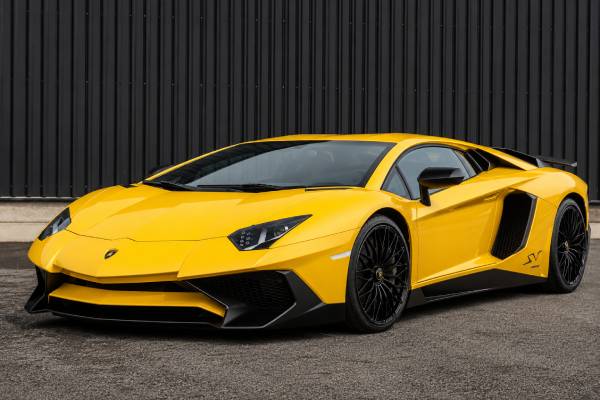
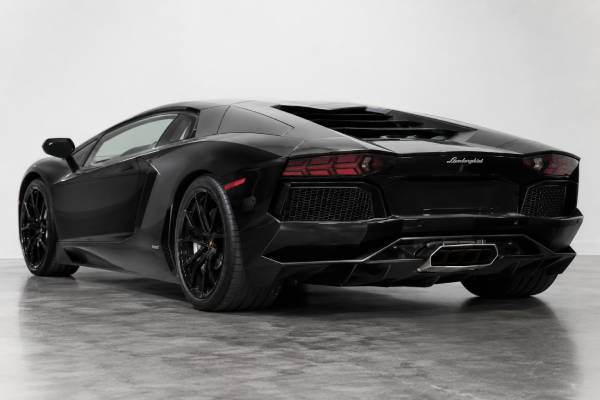
The Lamborghini Aventador LP 720-4 50° Anniversario is the numbered 2013 anniversary version of Lamborghini’s V12 flagship, built to mark 50 years of Automobili Lamborghini. Based on the Aventador LP 700-4 coupe, it kept the carbon-fiber monocoque, all-wheel drive, scissor doors, pushrod suspension, and naturally aspirated L539 6.5-liter V12, but raised output to 720 hp through dedicated engine calibration. It also gained a sharper front end, reworked rear bodywork, improved engine-bay ventilation, and special anniversary trim.
Collectors care because the coupe was a true limited-production Aventador, not just a cosmetic package. Enthusiasts care because it captures the early Aventador character before later rear-wheel steering, active-aero, and SVJ-era electronics changed the model’s feel. Buyers need to treat it as a rare exotic: originality, service history, recall completion, clutch condition, carbon-ceramic brake health, and documentation matter as much as mileage.
Table of Contents
- Why the 50° Anniversario Matters
- L539 V12 Specs and Chassis Data
- Production Numbers, Options, and Identification
- Anniversary Design, Aero, and Cabin Details
- How the LP 720-4 Drives
- Maintenance, Reliability, and Service Risk
- Market Values and Buyer Checks
Why the 50° Anniversario Matters
The LP 720-4 50° Anniversario matters because it is one of the clearest anniversary links between Lamborghini’s historic V12 bloodline and the modern carbon-fiber Aventador era. It celebrated the company’s 1963 founding with more power, numbered production, special paint, and a more aggressive aerodynamic package.
The Aventador itself arrived in 2011 as the successor to the Murciélago and became Lamborghini’s new V12 reference point. It was important for three reasons. First, it introduced a new naturally aspirated V12 engine family, known as L539. Second, it used a carbon-fiber monocoque at the center of the car instead of relying on the older space-frame approach. Third, it pushed Lamborghini’s design language into a more technical, aerospace-inspired shape while keeping classic brand signatures: scissor doors, a mid-mounted V12, dramatic proportions, and all-wheel-drive traction.
The 50° Anniversario arrived at a special moment. Lamborghini had already shown the Aventador’s basic formula was strong: huge naturally aspirated power, brutal launch performance, and visual presence that made the older Murciélago look from another era. The anniversary model did not try to become a track special like the later SuperVeloce. Instead, it made the standard Aventador more exclusive, more visually forceful, and slightly more powerful.
Its place in the model line is simple:
- LP 700-4 coupe: the original Aventador production model.
- LP 720-4 50° Anniversario: the 50th-anniversary numbered special with 720 hp and unique trim.
- LP 750-4 SuperVeloce: the later lighter, more track-focused version.
- Aventador S and SVJ: later evolutions with rear-wheel steering, revised dynamics, and more advanced aero.
- LP 780-4 Ultimae: the final non-hybrid Aventador send-off.
That position gives the LP 720-4 a distinct identity. It is more collectible than an ordinary early LP 700-4, less extreme than an SV, and more “first-generation Aventador” in feel than the later S, SVJ, and Ultimae. For many collectors, that makes it appealing: it has the raw early car’s attitude, but with a factory-built limited-edition story.
The car also arrived before the current hybrid V12 era. Lamborghini’s Revuelto later changed the flagship formula with electrification, electric torque fill, and a dual-clutch transmission. The 50° Anniversario belongs to the last fully naturally aspirated, non-hybrid period of Lamborghini V12 design. That does not automatically make every example a future blue-chip collectible, but it gives the model a strong emotional and historical base.
L539 V12 Specs and Chassis Data
The LP 720-4 50° Anniversario uses the same core Aventador architecture as the LP 700-4, but its L539 V12 was recalibrated to produce 720 hp. The key engineering story is not only the power figure; it is the combination of a high-revving naturally aspirated V12, carbon monocoque, ISR single-clutch gearbox, and permanent all-wheel drive.
| Category | Lamborghini Aventador LP 720-4 50° Anniversario |
|---|---|
| Model code | LB834 Aventador family |
| Engine code | L539 |
| Engine layout | Mid-mounted 60-degree naturally aspirated V12 |
| Displacement | 6,498 cc / 6.5 liters |
| Maximum power | 720 hp / 530 kW at 8,250 rpm |
| Maximum torque | 690 Nm / 509 lb-ft at 5,500 rpm |
| Induction | Naturally aspirated |
| Lubrication | Dry sump |
| Transmission | 7-speed ISR automated manual |
| Drivetrain | Permanent all-wheel drive |
| 0–100 km/h | 2.9 seconds |
| Top speed | 350 km/h / 217 mph |
The L539 is a major part of the car’s appeal. It is not a turbocharged engine and it does not rely on electric assistance. Its character comes from displacement, revs, intake noise, exhaust volume, and throttle response. In normal driving it has enough torque to move the car without effort, but the real drama arrives as the revs climb. The final third of the tachometer is where the engine feels most alive.
The ISR gearbox is also central to the car’s personality. ISR stands for Independent Shifting Rods. It is an automated single-clutch manual, not a modern dual-clutch transmission. Lamborghini used it for speed, weight, packaging, and drama. In Corsa mode, full-throttle upshifts feel violent and theatrical. At parking speed, the same gearbox can feel abrupt compared with a dual-clutch unit. A buyer expecting the smoothness of a modern Porsche PDK or Ferrari DCT will misunderstand the car.
| Item | Specification |
|---|---|
| Structure | Carbon-fiber monocoque with aluminum front and rear frames |
| Suspension | Pushrod suspension with horizontal spring and damper units |
| Front brakes | Carbon-ceramic discs with multi-piston calipers |
| Rear brakes | Carbon-ceramic discs with multi-piston calipers |
| Steering | Hydraulic power steering |
| Front tires | 255-section Pirelli P Zero fitment on 19-inch wheels |
| Rear tires | 335-section Pirelli P Zero fitment on 20-inch wheels |
| Wheelbase | 2,700 mm |
| Length | 4,780 mm |
| Width | 2,030 mm excluding mirrors |
| Height | 1,136 mm |
| Published dry weight | About 1,575 kg |
| Fuel capacity | About 90 liters |
The chassis is stiff, compact, and built around the carbon tub. The aluminum subframes carry crash structures, suspension, and powertrain loads. This is important for inspection: accident damage is not judged like ordinary steel-body damage. Any repair near the tub, suspension pick-up areas, front crash structure, or rear frame must be examined by a Lamborghini specialist.
The hydraulic steering is one of the early Aventador’s best traits. Later cars gained more dynamic systems, but the LP 720-4 keeps a direct, mechanical feel that many drivers prefer. The tradeoff is that it does not have rear-wheel steering, so it feels large at low speed and demands respect on narrow roads.
Production Numbers, Options, and Identification
The LP 720-4 50° Anniversario coupe was a numbered limited series of 100 units worldwide. A later Roadster version added another open-top anniversary run, but the 2013 coupe is the focus for buyers seeking the earliest 50th-anniversary Aventador specification.
The easiest way to understand the car is as a factory limited edition built from the LP 700-4 coupe. It was not a lightweight homologation model, and it was not a one-off Ad Personam build. Its collectability comes from numbered production, distinctive factory equipment, and its place in Lamborghini’s anniversary timeline.
How to identify a genuine car
A proper LP 720-4 50° Anniversario should have more than a seller’s description. A buyer should confirm the identity through factory records, VIN data, service documentation, option codes, and physical details.
Key identifiers include:
- A numbered Forged Composite anniversary badge with the 50° logo.
- LP 720-4 50° Anniversario exterior bodywork, not a standard LP 700-4 with aftermarket carbon parts.
- The 720 hp factory engine calibration, not only an exhaust tune.
- Anniversary-specific interior trim and stitching.
- Correct factory wheels, exterior finish, and two-tone treatment when fitted.
- Lamborghini dealer service records that match the VIN.
- Documentation showing original delivery specification and ownership history.
Giallo Maggio is the signature color and is the most recognizable anniversary finish. It was developed for the edition and uses a bright yellow effect with reflective particles. However, Lamborghini allowed Ad Personam personalization, so not every genuine car must be Giallo Maggio. That matters for valuation. A non-yellow car can still be correct and valuable, but the market usually pays more attention to cars that present as the launch-spec anniversary model.
Factory options that affect desirability
As with many modern Lamborghinis, the options list can strongly influence appeal. Collectors tend to prefer a car that is both highly optioned and coherent. A rare paint choice is not automatically better if it hides the anniversary identity, and heavy personalization can narrow the buyer pool.
Important option and specification areas include:
- Exterior color: Giallo Maggio is the signature choice; special-order colors need documentation.
- Carbon-fiber exterior parts: factory carbon is desirable when original and undamaged.
- Interior trim: semi-aniline leather, Q-Citura stitching, and correct contrast colors matter.
- Wheel finish: black wheels suit the anniversary design and should be inspected for damage or refinishing.
- Transparent engine cover: desirable on many Aventadors, but originality and condition matter.
- Front lifting system: useful and expected by many buyers because the nose is low.
- Parking sensors and rear camera: valuable for real-world use because rear visibility is limited.
- Audio and infotainment: not the main attraction, but working factory systems help preserve value.
Documentation is the difference between a rare car and a difficult car. A complete file should include the original sales invoice or build specification, maintenance invoices, recall completion records, tire replacement history, battery history, paint meter readings, and any warranty or extended-warranty paperwork. For a car this expensive, missing records should affect the price.
Anniversary Design, Aero, and Cabin Details
The 50° Anniversario looks more aggressive because Lamborghini changed the front and rear bodywork for function as well as identity. The redesigned intakes, splitter, rear mesh, and diffuser make the car easier to separate from a regular LP 700-4 at a glance.
The front end uses larger air intakes and a more extended splitter, with small side flaps that help manage airflow. The rear is more heavily altered, with a larger diffuser and broader meshwork to improve ventilation around the engine compartment. Lamborghini described the package as improving aerodynamic efficiency by more than 50 percent compared with the LP 700-4, without hurting drag characteristics. In plain terms, the car was shaped to feel more stable at very high speed while keeping the Aventador’s 350 km/h top-speed claim.
The design was created under Lamborghini Centro Stile during the Filippo Perini era, and it follows the same sharp architectural theme as the base Aventador. The car is wedge-shaped, low, wide, and full of hard creases. The scissor doors are not only theater; they are part of Lamborghini’s V12 flagship identity, linking the Aventador back through Murciélago, Diablo, and Countach.
Exterior details that matter
The anniversary bodywork is easy to damage because it sits low and uses expensive materials. Buyers should inspect:
- The lower front splitter for scrapes, cracks, poor repairs, or mismatched weave.
- Front intake edges for stone impacts.
- Side skirts and lower black panels for curb damage.
- Rear diffuser fins for cracks or heat-related damage.
- Paint match between yellow panels and matte black sections.
- Evidence of full-body paint protection film, especially around the nose and rear arches.
- Panel alignment around the front bumper, doors, engine cover, and rear clamshell.
A resprayed bumper is not unusual on a low exotic, but a repaint should be disclosed, measured, and explained. A repaired crash structure, non-factory carbon part, or poor paint blend is a much bigger concern.
Interior atmosphere
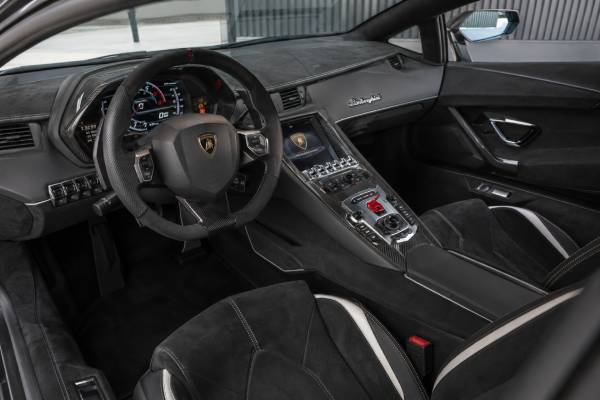
The cabin combines early-2010s Audi-group switch logic with unmistakable Lamborghini drama. The start button sits under a red flip cover. The TFT instrument cluster gives the car a fighter-jet feel. The driving position is low, the windshield is steeply raked, and the view rearward is poor.
The 50° Anniversario interior is more special than a regular LP 700-4 because of its leather, contrast color choices, and Q-Citura stitching. Nero Ade black leather with Terra Emilia brown or Giallo Quercus yellow accents gives the car a clear anniversary identity. The details matter because interior retrimming can reduce collector confidence unless it was factory authorized and fully documented.
The best cabins feel tight, dry, and original. Watch for worn bolsters, loose trim, sticky switches, lifting leather around high-heat areas, scuffed carbon sill panels, and damaged seat backs. Low mileage does not guarantee perfect condition; getting in and out of an Aventador can wear the same areas repeatedly.
How the LP 720-4 Drives
The LP 720-4 drives like an early Aventador with a slightly sharper factory edge: huge noise, strong traction, heavy visual presence, and a gearbox that makes every hard shift feel like an event. It is fast by modern standards, but its real appeal is the way it delivers speed.
The V12 is the center of the experience. At low rpm it feels large and clean, with immediate throttle response. Above the midrange it becomes harder, louder, and more urgent. Near the top of the rev range the car has the old-school naturally aspirated character that turbocharged and hybrid supercars often cannot copy: the sound rises with engine speed, not with boost pressure or artificial enhancement.
Acceleration is brutal because the car combines 720 hp with all-wheel drive. The official 0–100 km/h time of 2.9 seconds still feels serious, especially because the launch is accompanied by mechanical noise, driveline shock, and a cabin full of V12 induction and exhaust sound. The Aventador is not quiet about its speed.
The ISR transmission divides opinion. In Strada mode it can feel clumsy in traffic, especially when creeping, reversing, or shifting at small throttle openings. Sport mode adds more aggression. Corsa mode is the car’s most theatrical setting, with hard, fast shifts that suit the engine’s character. That drama is part of the appeal, but it also means clutch wear depends heavily on use. A car that has spent its life in traffic, valet lines, and low-speed show cruising may have more clutch wear than the odometer suggests.
Steering is reassuringly direct. The hydraulic system gives better texture than many modern electric racks, but the car is wide and the front end is low. On a mountain road, the driver must place it carefully. On a track, it has huge grip but still feels like a large V12 supercar, not a small race car. The all-wheel-drive system gives traction on corner exit, but the Aventador rewards smooth inputs. It is not a car that enjoys careless mid-corner corrections.
Ride quality is firm but not unbearable. The pushrod suspension gives the car strong body control, and the long wheelbase helps stability at speed. Rough urban roads, steep driveways, speed bumps, and tight ramps are the real problems. The front lift system is not a luxury option for many owners; it is a practical tool that can save expensive carbon and paint.
The brakes are extremely powerful when warm and healthy. Carbon-ceramic brakes feel different from conventional iron discs: they can be slightly wooden when cold, then very strong with heat and pressure. On inspection, condition matters more than a casual visual glance. Disc wear, chipping, heat marks, pad thickness, and service records all need specialist review.
As a road car, the LP 720-4 is usable in short bursts but demanding over long days. Cabin noise, low visibility, heat, width, and attention from other people are part of ownership. It is more comfortable than older V12 Lamborghinis, but it is still a dramatic exotic, not a grand tourer.
Maintenance, Reliability, and Service Risk
The LP 720-4 can be dependable when serviced correctly, but ownership risk is high because every major system is expensive. The safest cars are used regularly, maintained annually, kept on proper battery support, and inspected by specialists who understand early Aventadors.
The engine itself is generally strong when maintained, warmed properly, and left unmodified. The larger concerns are the systems around it: cooling, emissions hardware, sensors, battery voltage, gearbox calibration, clutch wear, and heat management. A naturally aspirated V12 may sound simpler than a hybrid powertrain, but that does not make it cheap to own.
Known ownership risk areas
The most important inspection areas are practical, not theoretical:
- ISR clutch wear: Request a clutch wear reading and adaptation report. Low mileage does not guarantee low wear.
- Gearbox behavior: Harsh engagement, warning lights, missed shifts, or poor reverse behavior need diagnosis before purchase.
- Front lift system: Check for leaks, slow operation, uneven lifting, warning messages, and pump noise.
- Cooling system: Inspect radiators, hoses, fans, and evidence of coolant leaks or impact damage.
- Carbon-ceramic brakes: Measure condition correctly; replacement costs are substantial.
- Tires: Replace old tires even if tread looks deep. A V12 AWD supercar should not run on aged rubber.
- Battery and charging system: Weak voltage can trigger confusing electronic faults.
- Exhaust modifications: Non-factory exhausts can affect heat, emissions behavior, warranty history, and resale value.
- Paint and carbon: Look for underside damage, front splitter repairs, mismatched carbon, and poor paintwork.
- Recall completion: Verify VIN-specific campaigns with Lamborghini or an authorized dealer.
Two recall themes are especially relevant to early Aventadors. One involved the fuel/EVAP system on certain 2012–2017 cars, where overfilling and certain conditions could create a fire risk. Another involved 2012–2018 Aventador coupe and roadster models, where engine software could allow stalling under particular low-rpm downshift conditions. A buyer should not assume completion from model year alone. The VIN must be checked.
Service habits that protect value
A collector-grade LP 720-4 should have a clean maintenance rhythm. Annual servicing is expected even when mileage is low. Fluids age. Tires age. Batteries weaken. Seals dry out. A car that sits for years can become more troublesome than one that is driven carefully.
Good ownership practice includes:
- Keeping the car on a correct battery maintainer.
- Warming the engine and drivetrain before hard use.
- Avoiding repeated low-speed clutch slip.
- Replacing tires by age as well as wear.
- Keeping service invoices, not only stamped book entries.
- Avoiding non-reversible modifications.
- Using a Lamborghini specialist for inspections and software work.
- Checking recalls and campaigns by VIN at every ownership transfer.
Restoration is not the right word for most LP 720-4s yet, but correction can be expensive. A neglected car may need tires, clutch work, brake service, suspension repairs, a lift-system repair, paint correction, interior repair, and catch-up servicing at once. That can turn a cheap-looking example into the most expensive car on the market.
Originality is also a value issue. A tasteful aftermarket exhaust may make the car louder, but many collectors prefer factory exhaust, factory calibration, and reversible upgrades. If modified parts are fitted, the original parts should come with the car.
Market Values and Buyer Checks
The LP 720-4 50° Anniversario sits above standard early Aventador coupes but below the strongest later limited models such as SVJ, Ultimae, and the most desirable SV specifications. Its market is thin, so condition and provenance matter more than any simple price guide.
Public transactions are limited because many examples trade privately. Recent market data shows low-volume auction results and asking prices rather than a deep, predictable price curve. In practical terms, many usable examples fall somewhere from the mid-$300,000s to the $500,000-plus range depending on country, mileage, color, history, and specification. Exceptional delivery-mileage or highly original Giallo Maggio cars can sit above ordinary examples. Modified, poorly documented, repainted, or overdue-service cars should trade at a clear discount.
The highest-value cars usually share the same traits:
- Original paint or fully disclosed minor cosmetic work.
- Factory anniversary specification with numbered badge intact.
- Signature Giallo Maggio paint or a documented special-order color.
- Low but believable mileage.
- No accident history.
- Complete Lamborghini service records.
- Recall completion proof.
- Healthy clutch reading.
- Original books, tools, keys, charger, and accessories.
- No irreversible aftermarket modifications.
- Clean ownership history and strong storage conditions.
A buyer should avoid cars that look cheap because they are missing records. The risk is rarely one single failure. It is the combination of unknown clutch wear, old tires, weak battery, overdue annuals, paintwork, carbon damage, and incomplete recall documentation. On an Aventador, these issues can quickly erase any purchase discount.
| Priority | What to check | Why it matters |
|---|---|---|
| Identity | VIN, numbered badge, build specification, factory records | Confirms it is a genuine LP 720-4 50° Anniversario |
| Service history | Annual services, fluids, dealer or specialist invoices | Shows whether the car was maintained or merely stored |
| Clutch and gearbox | Wear reading, adaptation, road-test behavior | ISR repairs and clutch work are major cost drivers |
| Body and carbon | Splitter, diffuser, underbody, panel gaps, paint readings | Crash or carbon repair can harm value heavily |
| Brakes and tires | Disc condition, pad life, tire age and matching fitment | Consumables are expensive and safety-critical |
| Recalls | VIN-specific dealer confirmation | Early Aventadors had important safety campaigns |
| Originality | Exhaust, ECU, wheels, trim, paint, accessories | Collector buyers usually prefer factory-correct cars |
The best purchase strategy is straightforward: buy the best-documented car you can afford, not the cheapest one. A rare Lamborghini with uncertain history is not a bargain unless the price leaves room for specialist correction and future resale stigma.
For long-term collectability, the LP 720-4 has several strengths. It is a numbered anniversary V12 Lamborghini, it uses the naturally aspirated L539 engine, it belongs to the first Aventador generation, and it was produced before hybridization changed the flagship formula. Its weakness is that the Aventador family includes many later special models with higher power, sharper track credentials, or final-edition status. That means the 50° Anniversario’s value depends heavily on how original, rare, attractive, and well documented each example is.
For an enthusiast-owner, the ideal car is not necessarily the lowest-mileage museum piece. A lightly used, fully serviced, original car with fresh tires, completed campaigns, a healthy clutch, and clear records may be the most satisfying choice. It can be driven without the guilt of adding the first meaningful miles, yet still has the factory rarity that separates it from a regular LP 700-4.
References
- Lamborghini Aventador LP720-4 50th Anniversary (2013) – pictures, information & specs 2013 (Manufacturer Press Information Archive) ([NetCarShow.com][1])
- Lamborghini Aventador – Technical Specifications, Pictures, Videos 2011 (Manufacturer Model Page) ([Lamborghini.com][2])
- Milestones | Lamborghini.com 2026 (Manufacturer History) ([Lamborghini.com][3])
- Part 573 Safety Recall Report 18V-391 2018 (Recall Database) ([NHTSA][4])
- Lamborghini Aventador 50th For Sale & Price Guide 2026 (Market Data) ([The Classic Valuer][5])
Disclaimer
This article is for informational purposes only and is not a substitute for professional diagnosis, repair, valuation, or pre-purchase inspection. Specifications, torque values, maintenance intervals, recall status, parts, software, and repair procedures can vary by VIN, market, production date, and equipment. Always verify details against official Lamborghini service documentation and have any Aventador inspected by a qualified Lamborghini specialist before purchase or repair.
If this guide helped, please consider sharing it on Facebook, X/Twitter, or your preferred car community to support our work.