


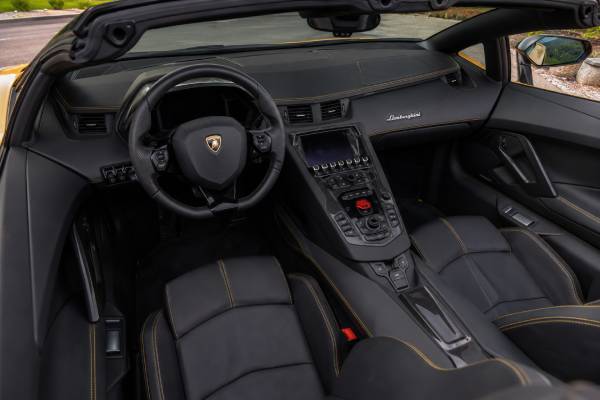
The Lamborghini Aventador LP 700-4 Pirelli Edition Roadster is the open-top version of a special Aventador series created to celebrate Lamborghini’s long-running relationship with Pirelli. Built during the final phase of the original LP 700-4 era, before the Aventador S arrived, it keeps the core LB835 Roadster formula: a carbon-fiber monocoque, removable carbon roof panels, permanent all-wheel drive, pushrod suspension, carbon-ceramic brakes, and the naturally aspirated L539 6.5-liter V12.
Its appeal is simple: it combines the early Aventador’s raw single-clutch character with a factory-recognized Pirelli visual package. For collectors, the key questions are originality, documentation, service history, and whether the Pirelli-specific details remain correct. For drivers, the draw is still the same: open-air V12 sound, scissor-door theater, and one of Lamborghini’s last non-hybrid flagship roadsters.
Table of Contents
- Why the Pirelli Roadster Matters
- L539 V12, Chassis, and Key Specs
- Production, Versions, and Originality Checks
- Design Details and Open-Air Engineering
- How the LP 700-4 Roadster Drives
- Maintenance Risks and Specialist Care
- Market Value and Buying Advice
Why the Pirelli Roadster Matters
The Pirelli Edition Roadster matters because it is not a power upgrade or a track package; it is a factory visual and trim special based on one of Lamborghini’s most important modern V12 platforms. That makes originality more important than lap-time claims.
The Aventador replaced the Murciélago and moved Lamborghini’s flagship line into a more modern engineering era. The original LP 700-4 introduced a carbon-fiber central monocoque, a new-generation 6.5-liter V12, an automated ISR gearbox, and a sharper aerospace-inspired design language. The Roadster added a removable hardtop without turning the car into a soft, compromised convertible.
The Pirelli Edition was announced in late 2014, with deliveries beginning in 2015. It celebrated the relationship between Lamborghini and Pirelli, a partnership that traces back to Lamborghini’s founding era in 1963. Every Aventador already used Pirelli tires, but the Pirelli Edition made that connection visible through its red striping, Pirelli branding, special interior treatment, and factory “Pirelli serie speciale” plaque.
For collectors, the Pirelli Roadster sits in a useful niche. It is more distinctive than a standard LP 700-4 Roadster, less extreme than an SV Roadster, and generally more usable than the later high-value SVJ or Ultimae collector cars. It also belongs to the first Aventador generation, before four-wheel steering, the Aventador S facelift, and later active aero systems changed the car’s feel.
Its reputation today rests on five things:
- Naturally aspirated V12 character: no turbochargers, no hybrid assistance, and a hard-edged high-rpm soundtrack.
- Open-air drama: the removable roof makes the L539 V12 far more present in the cabin.
- Factory special-edition identity: Pirelli colors, logos, interior trim, and plaque are what separate it from a wrapped or modified Roadster.
- Early Aventador rawness: the ISR single-clutch gearbox gives the car a more physical feel than later dual-clutch supercars.
- Long-term collectability: buyers increasingly separate factory-special cars from ordinary used exotics, especially when documentation is strong.
The important limitation is that Lamborghini did not give the Pirelli Edition a different engine tune. It is not quicker than a standard LP 700-4 Roadster in any meaningful factory sense. Its value comes from specification, condition, provenance, and the fact that it preserves the original Aventador formula in a rare and recognizable trim.
L539 V12, Chassis, and Key Specs
The Pirelli Edition Roadster uses the same core mechanical package as the Aventador LP 700-4 Roadster: a 6,498 cc naturally aspirated V12, seven-speed ISR automated manual transmission, and all-wheel drive. The Pirelli package changes the appearance and trim, not the basic performance hardware.
| Item | Specification |
|---|---|
| Model | Lamborghini Aventador LP 700-4 Pirelli Edition Roadster |
| Internal body code | LB835 Roadster |
| Production period covered | 2015–2016 model years |
| Layout | Mid-engine, two-seat, all-wheel-drive roadster |
| Body structure | Carbon-fiber monocoque with aluminum front and rear frames |
| Roof | Two removable carbon-fiber hardtop panels |
| Item | Specification |
|---|---|
| Engine code | L539 |
| Engine type | 60-degree naturally aspirated V12, multi-point injection |
| Displacement | 6,498 cc / 6.5 liters |
| Bore x stroke | 95.0 mm x 76.4 mm |
| Compression ratio | 11.8:1 |
| Output | 700 CV / 515 kW at 8,250 rpm |
| Torque | 690 Nm / 507 lb-ft at 5,500 rpm |
| Lubrication | Dry sump |
| Transmission | 7-speed ISR single-clutch automated manual |
| Clutch | Dry double-plate clutch |
| Drivetrain | Permanent all-wheel drive with Haldex generation IV control |
The “700 hp” label needs one useful clarification. Lamborghini’s LP 700-4 naming refers to 700 CV, which is metric horsepower. In U.S. mechanical horsepower, the figure is often listed around 691 bhp. In normal enthusiast use, the car is still widely described as a 700 hp Aventador because that is how the LP 700-4 identity was marketed.
| Item | Specification |
|---|---|
| Front suspension | Pushrod-actuated suspension with horizontal dampers |
| Rear suspension | Pushrod-actuated suspension with horizontal dampers |
| Steering | Servotronic steering with drive-mode influence |
| Brakes | Carbon-ceramic discs, 400 x 38 mm front and 380 x 38 mm rear |
| Standard LP 700-4 Roadster tire sizes | 255/35 ZR19 front, 335/30 ZR20 rear |
| Pirelli Edition wheel note | Many cars were specified with gloss-black Dione wheels and P Zero tires with red-logo detailing |
| 0–100 km/h | 3.0 seconds |
| Top speed | 350 km/h / 217 mph |
| Item | Specification |
|---|---|
| Wheelbase | 2,700 mm |
| Length | 4,780 mm |
| Width, excluding mirrors | 2,030 mm |
| Height | 1,136 mm |
| Dry weight | 1,625 kg |
| Weight distribution | 43% front / 57% rear |
| Fuel tank | 90 liters |
| Engine oil capacity | 13 liters |
| Engine coolant capacity | 25 liters |
The numbers explain why the car still feels special. The Aventador is wide, low, and heavy by lightweight supercar standards, but the V12 gives it huge presence. The Roadster’s extra structure adds weight over the coupe, yet the performance loss is small in real use. The larger difference is sensory: with the roof off, the engine, intake, exhaust, and ISR shifts dominate the experience.
Production, Versions, and Originality Checks
The Pirelli Edition was offered as both a Coupe and a Roadster, and the Roadster is the more theatrical version because it combines the special livery with open-air V12 sound. The key buying issue is not just whether the car looks like a Pirelli Edition, but whether it was built as one.
Lamborghini publicly described the Pirelli Edition as a special series, but public production totals and the exact Coupe/Roadster split are not as consistently documented as they are for numbered models such as the SVJ 63 or Ultimae Roadster. Some sales listings may claim a specific “one of” number. Treat those claims as starting points, not proof, unless they are supported by factory paperwork, a window sticker, dealer order sheet, Lamborghini build record, or other credible documentation.
How the Pirelli Edition differs
The Pirelli Edition keeps the LP 700-4 powertrain and chassis. Its special identity comes from appearance and trim. The main features to verify are:
- two-tone exterior scheme with alternating matte and gloss finishes
- thin red line along the roof, engine cover, mirrors, and air-intake outlines
- red Pirelli branding placed at the start of the roof-line graphics and on the tires
- black Alcantara interior with red contrast stitching
- red stripe repeated through the cabin and seats
- Lamborghini and Pirelli crests embroidered in red
- leather inserts on the door panels and seat sides
- internal “Pirelli serie speciale” plaque
- Pirelli-related factory tire and wheel presentation, where still present or documented
The Pirelli package is easy to imitate visually, especially with modern vinyl and paint protection film. That is why documentation is central to value. A normal LP 700-4 Roadster with a red stripe, black wheels, and Pirelli badges is not the same thing as a factory Pirelli Edition.
Factory colors and configuration
The Pirelli Edition’s strongest visual feature is the contrast between gloss and matte surfaces. Period descriptions group the scheme into two broad approaches: black upper sections with gloss body colors, or gloss-black upper sections with matte body colors. Known color names associated with the package include shades such as Giallo Spica, Rosso Mars, Bianco Isis, Nero Aldebaran, Grigio Liqueo, Grigio Ater, Bianco Canopus, Nero Nemesis, Grigio Adamas, and Grigio Titans.
For a buyer, the exact factory combination matters. A color-change wrap may protect the paint, but it also hides the original presentation. A repaint can be acceptable after damage repair only if disclosed, documented, and priced correctly. A special-edition Lamborghini should not require the buyer to guess what it was when it left Sant’Agata.
Documents that matter
Ask for documents before falling in love with the specification. The best Pirelli Roadsters usually have a complete chain of evidence:
- original window sticker or market-equivalent sales document
- Lamborghini dealer build sheet or order record
- service invoices from authorized Lamborghini dealers or recognized specialists
- recall and campaign completion records by VIN
- ownership history with dates and mileage
- paintwork readings and accident repair documentation
- original books, keys, battery tender, roof-panel bags, tool kit, and accessories
- clear photos of the Pirelli plaque, embroidery, exterior striping, and wheel/tire details
Mileage alone is not enough. A low-mile car that has sat for years with old tires, weak batteries, overdue fluids, and no campaign records can be a worse ownership risk than a properly serviced higher-mile example.
Design Details and Open-Air Engineering
The Pirelli Edition works because it adds visual identity without diluting the Aventador’s shape. The red line is small, but on the wedge-shaped Roadster it draws attention to the roof, air intakes, mirrors, and engine cover, which are already some of the car’s most dramatic surfaces.
The LP 700-4 Roadster is not a soft-top convertible. It uses two removable carbon-fiber roof panels that can be stored in the front luggage compartment. Each panel is light enough for one person to handle, but careful handling matters because chips, latch wear, broken storage bags, and scratched clearcoat are common ownership annoyances on exotic removable-roof cars.
The body structure is the main reason the Roadster feels more solid than older open exotics. The carbon-fiber monocoque carries the central load, while aluminum subframes support the suspension and crash structures. Lamborghini reinforced the Roadster around the upper body and rear pillars to account for the open roof. The result is not coupe-identical stiffness, but it avoids the loose, shuddering feel found in many older supercar convertibles.
The engine cover and rear bodywork are also part of the Roadster identity. The car has large rear buttresses and a movable rear window that lets the driver choose between more cabin isolation and more V12 sound. In daily driving, that rear glass matters more than most spec-sheet features. With the roof off and rear window down, the car becomes loud, hot, and mechanical. With the rear window raised, the cabin is still dramatic but more usable on long drives.
The Aventador’s design also serves cooling. The L539 V12 sits close behind the occupants, and the Roadster body has to manage engine heat, brake heat, and cabin comfort. Side air intakes, rear vents, variable air inlets, and the movable spoiler all help the car remain stable and cool at speed. This is why accident repairs, poorly fitted aftermarket body panels, blocked vents, or non-factory exhaust changes can create more than cosmetic problems.
Inside, the cockpit is pure early-2010s Lamborghini: fighter-jet start button cover, broad center tunnel, TFT instrument cluster, and drive modes for Strada, Sport, and Corsa. The Pirelli Edition’s black Alcantara and red details suit the car better than many louder custom interiors because they connect the cabin to the exterior stripe instead of turning the cabin into a separate design idea.
The scissor doors remain part of the theater, but they also require inspection. Door struts, hinges, alignment, paint rub points, and weather seals should all be checked. A door that drops, creaks, binds, or sits proud can point to simple strut aging, but it can also suggest previous body repair.
How the LP 700-4 Roadster Drives
The Aventador LP 700-4 Roadster feels fast, physical, and slightly old-school by modern supercar standards. Its speed is still serious, but its personality comes from the V12 and ISR gearbox more than from perfect smoothness.
The engine is the center of the car. Below midrange, the L539 is tractable enough for city driving, but it does not feel like a turbocharged engine with instant low-rpm punch. It builds force as the revs rise, then becomes harder, sharper, and more metallic near the top end. The last few thousand rpm are the reason people still chase these cars.
The ISR transmission is more divisive. It is a single-clutch automated manual, not a modern dual-clutch gearbox. In Strada, it can feel clunky at low speed if the driver expects luxury-car smoothness. In Sport and Corsa, it shifts more aggressively and can deliver the dramatic head-nod that became part of the early Aventador experience. Some buyers love that violence. Others prefer the polish of newer dual-clutch supercars. A test drive should settle that question quickly.
The all-wheel-drive system gives the car traction that suits its power and tire width. It can still feel rear-biased in character, but it is not a delicate, lightweight rear-drive machine. It prefers commitment, space, and clean inputs. On a narrow road, the width is always present. On a faster road, the car feels more at home because the steering, chassis, and aero begin to make sense.
Drive modes change the car’s behavior noticeably:
- Strada: best for traffic, parking, wet roads, and rough streets.
- Sport: louder, sharper, and more playful, with more emotional shift behavior.
- Corsa: the most aggressive setting, better suited to fast open roads or track use than city driving.
The brakes are powerful, but carbon-ceramic systems feel different from ordinary iron brakes. They can be less grabby when cold and more impressive as speed and temperature rise. Brake feel, pedal travel, and vibration during a test drive tell you a lot about condition. Replacement costs are high enough that brake inspection should never be casual.
The Roadster’s ride depends heavily on tires, tire age, wheel size, alignment, and suspension condition. Fresh high-quality Pirelli tires make the car feel far more settled than aged low-mile originals. Old tires can make an Aventador tramline, ride harshly, and lose wet grip even when tread depth looks acceptable.
Usability is better than the shape suggests, but still exotic. Visibility is limited to the rear, the nose is low, the turning circle is large, and parking requires patience. A front lift system, where fitted, is a major practical option. Cabin heat, engine noise, and attention from traffic are part of every drive. This is not a quiet luxury roadster. It is a V12 event.
Maintenance Risks and Specialist Care
The Pirelli Edition Roadster is not a normal used convertible with expensive badges; it is a carbon-structure V12 Lamborghini with costly consumables and specialist-only inspection needs. The best cars are not necessarily the lowest-mile cars, but the ones maintained by people who understand how Aventadors age.
Main ownership risks
The ISR gearbox and clutch should be high on the inspection list. The system can be durable when properly used, but clutch wear varies sharply with traffic use, reversing on slopes, repeated low-speed maneuvering, launch-style driving, and poor adaptation. A specialist should read clutch data, check shift quality, inspect for leaks, and confirm software/adaptation status.
The carbon-ceramic brakes also need careful review. Do not judge them only by how shiny the discs look. Inspect for chips, cracks, heat damage, uneven wear, pad condition, and disc measurements using the correct procedure. A car advertised as “low mileage” can still have expensive brake wear if it has seen repeated hard use.
The front lift system, if equipped, is another common cost area. Check that it raises and lowers evenly, does not sag, and does not leave warning lights. Hydraulic leaks, tired actuators, weak pumps, or damaged lift hardware can turn a convenience option into a repair bill.
Battery health is critical. Aventadors dislike weak voltage. A marginal battery can trigger warning lights, module faults, transmission complaints, infotainment glitches, and starting issues. Cars that sit need correct battery maintenance, not occasional jump-starts.
The Roadster roof deserves its own inspection. Confirm that both panels are present, undamaged, correctly finished, and supplied with proper storage bags. Check latches, seals, wind noise, water leaks, alignment, and the condition of the front trunk storage area.
Recalls and campaigns
VIN-level recall checks are mandatory. Aventadors from this era were affected by safety campaigns in several markets, including an EVAP-related recall that involved fuel tank overfilling, carbon canister saturation, purge valve issues, warning lights, fuel smell, and potential fire risk under particular conditions. Some cars may also have required engine-management updates related to stalling behavior.
Do not assume a campaign was completed because the car has dealer service stamps. Ask for proof. A Lamborghini dealer can check open campaigns by VIN, and that check should happen before purchase, not after delivery.
Service pattern to expect
Low annual mileage does not remove the need for time-based service. Fluids, seals, tires, batteries, hydraulic components, and rubber parts age even when the odometer barely moves. A strong service file should show regular annual or mileage-based maintenance, brake fluid changes, tire replacement by age, recall completion, and prompt repair of warning lights.
Common inspection points include:
- engine oil leaks around covers, lines, and dry-sump plumbing
- coolant leaks, radiator damage, and fan operation
- transmission behavior, clutch wear, and actuator health
- front lift operation and hydraulic leaks
- suspension bushings, dampers, ball joints, and alignment
- carbon-ceramic brake disc and pad condition
- tire date codes, matching tire specification, and even wear
- underbody scrapes, diffuser damage, and front splitter damage
- scissor-door alignment, struts, and latch condition
- roof-panel seals, latches, storage bags, and finish
- diagnostic scan for stored and pending faults
- evidence of aftermarket tune, exhaust, flame map, or non-factory wiring
Aftermarket exhausts are common, but they reduce buyer confidence if they are loud, poorly installed, emissions-noncompliant, or paired with engine tuning. The Aventador already runs hot and dramatic. Extra flames may look exciting online but can create heat, warranty, legality, and resale problems.
Parts availability is generally better than with older classic Lamborghinis, but prices are high and some trim-specific parts can be hard to source. Pirelli Edition interior pieces, plaques, special embroidery, roof finishes, and livery details are not items you want to chase casually after purchase.
Market Value and Buying Advice
The Pirelli Edition Roadster usually trades on a premium over an ordinary LP 700-4 Roadster when it is genuine, complete, and well documented. The premium becomes fragile when the car has unclear paperwork, accident history, heavy modification, missing Pirelli details, or neglected service.
In the current collector market, early Aventador Roadsters sit below the most collectible Aventador variants such as SV, SVJ, and Ultimae models, but they are no longer simply depreciating used exotics. They are naturally aspirated V12 Lamborghinis from before the brand’s full hybrid era, and that matters. The Pirelli Edition adds a recognizable factory story without moving the car into ultra-limited numbered-edition territory.
Asking prices vary widely. Standard LP 700-4 Roadsters often appear in the mid-$300,000 to mid-$400,000 range depending on year, mileage, color, options, and condition. Verified Pirelli Edition Roadsters can ask more, especially with very low miles, desirable colors, complete factory equipment, and authorized-dealer history. Very high asking prices should be judged against real transactions, not just rarity language.
What raises value
The strongest cars usually have the following:
- confirmed factory Pirelli Edition specification
- original paint or high-quality documented paintwork
- complete Pirelli exterior and interior details
- low but believable mileage with consistent service records
- unmodified exhaust, engine software, and bodywork
- clean accident history and strong paint-meter results
- fresh, correct tires rather than old “original” tires used for driving
- completed recalls and campaigns
- original books, keys, tender, roof bags, tools, and accessories
- desirable factory options such as front lift, transparent engine cover, carbon engine bay trim, Sensonum audio, and correct Pirelli/Dione wheel presentation
What should lower value
Walk carefully around cars with:
- missing Pirelli plaque, embroidery, or factory records
- stripe or livery that looks added after delivery
- aftermarket exhaust with tune or flame behavior
- non-factory body kits, SV-style conversions, or repaint without documentation
- aged tires being presented as a positive
- warning lights explained away as “just a battery”
- incomplete service history
- unknown clutch wear data
- carbon-ceramic brake wear close to replacement
- roof panel damage, missing roof bags, or water leaks
- underbody damage from speed bumps or transport mistakes
A modified car can still be enjoyable, but it should be priced as a modified car. For a special-edition Lamborghini, originality is not just a preference; it is part of the asset.
Pre-purchase inspection checklist
A proper PPI should be done by a Lamborghini dealer or a specialist with Aventador diagnostic access. The inspection should include:
- Confirm the VIN, build specification, and Pirelli Edition status.
- Scan all control modules and record stored and pending faults.
- Read clutch wear, gearbox adaptations, and relevant driveline data.
- Confirm recall and campaign completion by VIN.
- Inspect carbon-ceramic brakes using the correct method.
- Check tire date codes, sizes, brand, and wear pattern.
- Inspect front lift function and hydraulic condition.
- Measure paint and inspect carbon, aluminum panels, and underbody.
- Check roof-panel condition, seals, latches, and storage accessories.
- Road test the car from cold and hot, including low-speed shifting, braking, steering, and lift operation.
The best buying strategy is to pay more for the right car and negotiate only after inspection. A cheap Aventador can become expensive quickly, and a cheap special-edition Aventador with missing proof may never become the collectible car the seller claims it is.
For an enthusiast who wants the raw early Aventador experience, the Pirelli Edition Roadster is one of the more characterful choices. For a collector, it is worth buying only when its factory identity is clear. The car’s long-term appeal depends on preserving what makes it different: the Pirelli connection, the open V12 body, the original trim, and the unfiltered LP 700-4 driving feel.
References
- Lamborghini Aventador Pirelli Edition – Pictures, Videos 2026 (Manufacturer)
- Lamborghini Aventador Roadster – Pictures, Videos 2026 (Manufacturer)
- Lamborghini Aventador: Four Things You Should Know 2021 (Manufacturer)
- Part 573 Safety Recall Report 17V-073 2017 (Recall Database)
- Lamborghini Aventador LP700-4 Roadster Market 2026 (Market Data)
Disclaimer
This article is for informational purposes only and is not a substitute for professional diagnosis, repair, valuation, or inspection. Specifications, torque values, service intervals, software updates, recall status, and repair procedures can vary by VIN, market, equipment, and production date. Always verify details against official Lamborghini service documentation and have any car inspected by a qualified Lamborghini specialist before purchase or repair.
If this guide helped, please consider sharing it on Facebook, X/Twitter, or your preferred enthusiast community to support our work.