

The Lamborghini Aventador S is the mid-cycle evolution of Lamborghini’s V12 flagship, sold as the LP 740-4 S coupe from 2017 and as the S Roadster from 2018, with production running into 2021 before the Ultimae closed the Aventador era. It kept the naturally aspirated L539 6.5-liter V12, raised output to 740 CV, and added the systems that made the Aventador feel sharper and more modern: four-wheel steering, revised aero, magneto-rheological pushrod suspension, updated drive modes, and the EGO custom mode. For buyers and collectors, the Aventador S matters because it is neither the earliest Aventador nor the most extreme SVJ. It is the usable, full-production sweet spot: dramatic, still raw, but much better tied down than the LP 700-4. It also represents one of the final non-hybrid, naturally aspirated V12 Lamborghinis.
Table of Contents
- Aventador S Place in V12 History
- L539 V12, Chassis, and Core Specs
- Coupe, Roadster, Options, and Identification
- Aero, Steering, and Lamborghini Character
- How the Aventador S Drives
- Maintenance Risks and Ownership Reality
- Market Values and Buyer Checks
Aventador S Place in V12 History
The Aventador S is best understood as the Aventador that fixed much of the early car’s behavior without removing its drama. It replaced the original LP 700-4 as the standard V12 flagship and sat below the later SVJ and Ultimae in the model family.
Lamborghini introduced the first Aventador in 2011 as the Murciélago’s successor. It brought an all-new carbon-fiber monocoque, a new in-house V12, ISR single-clutch automated transmission, pushrod suspension, all-wheel drive, and the kind of scissor-door silhouette expected from a top-tier Sant’Agata V12. The early LP 700-4 was fast, theatrical, and visually shocking, but it was also wide, heavy-feeling at low speeds, and prone to understeer when driven hard.
The Aventador S arrived as the answer to those complaints. It was not a clean-sheet car. It kept the Aventador’s carbon tub, mid-mounted L539 V12, seven-speed ISR gearbox, and all-wheel-drive layout. The important change was how the car managed its size and mass. Lamborghini added rear-wheel steering, recalibrated the suspension, revised the aerodynamics, updated the electronics, and raised engine output from 700 CV to 740 CV.
The “S” badge also gave the Aventador a link to older Lamborghini V12 models such as the Miura S, Islero S, and Countach S. In Lamborghini language, S usually means a more developed, sharper, and more desirable evolution rather than a completely different model.
The Aventador S matters today for four reasons:
- It is one of the final regular-production, naturally aspirated Lamborghini V12 models before hybridization.
- It has the improved driving systems that make it easier to use than the original LP 700-4.
- It offers a less extreme ownership profile than an SVJ, while still carrying the full V12 flagship identity.
- It sits in a collectible window between older raw V12 Lamborghinis and newer hybrid supercars.
The coupe is the purer driver’s version, with slightly lower weight and better structural feel. The Roadster adds open-air theater and often commands stronger asking prices, especially in high-spec Ad Personam colors. Neither is rare in the way a numbered SVJ, SV, or Ultimae is rare, but good examples with clear history, low mileage, original paint, desirable colors, and complete Lamborghini service records are already being treated as serious modern collectibles.
L539 V12, Chassis, and Core Specs
The Aventador S is built around the L539 6.5-liter naturally aspirated V12, a carbon-fiber monocoque, all-wheel drive, and a seven-speed ISR automated manual gearbox. The key upgrade over the LP 700-4 is not only 40 extra CV, but the way the chassis systems help the car use that power.
| Item | Specification |
|---|---|
| Model | Lamborghini Aventador LP 740-4 S |
| Internal/model code | LB834 Aventador family |
| Production years covered | 2017–2021 coupe; 2018–2021 Roadster |
| Engine | L539 naturally aspirated 60-degree V12 |
| Displacement | 6,498 cc |
| Induction | Naturally aspirated |
| Fuel system | Multi-point injection |
| Maximum power | 740 CV / 544 kW at 8,400 rpm |
| Maximum torque | 690 Nm at 5,500 rpm |
| Transmission | 7-speed ISR single-clutch automated manual |
| Drivetrain | All-wheel drive with rear mechanical self-locking differential |
| Chassis | Carbon-fiber monocoque with aluminum front and rear frames |
| Suspension | Pushrod suspension with magneto-rheological adaptive dampers |
| Steering | Lamborghini Dynamic Steering with rear-wheel steering |
| Brakes | Carbon-ceramic discs, 400 mm front and 380 mm rear |
| Wheels | 20-inch front, 21-inch rear |
| Typical tire sizes | 255/30 ZR20 front, 355/25 ZR21 rear |
| Wheelbase | 2,700 mm |
| Length | 4,797 mm |
| Width excluding mirrors | 2,030 mm |
| Height | 1,136 mm |
| Fuel tank | 85 liters |
| Version | 0–100 km/h | Top speed | Dry weight |
|---|---|---|---|
| Aventador S Coupe | 2.9 seconds | 350 km/h / 217 mph | 1,575 kg |
| Aventador S Roadster | 3.0 seconds | 350 km/h / 217 mph | 1,625 kg |
The L539 engine is the heart of the car’s appeal. It is a large-displacement V12 with no turbochargers and no electric assistance. That matters because its response is directly tied to throttle opening and engine speed. At low rpm it feels strong but not lazy; above the midrange it becomes sharper, harder-edged, and increasingly loud as it runs toward its 8,400 rpm power peak.
The ISR gearbox is part of the Aventador’s character, but buyers need to understand it. It is not a dual-clutch transmission. It is a robotized single-clutch gearbox designed for low weight, compact packaging, and violent full-throttle shifts. In Strada mode it can feel abrupt compared with a modern dual-clutch gearbox. In Corsa mode, the shift shock becomes part of the car’s personality.
The chassis is equally important. The carbon-fiber monocoque gives the Aventador S strong torsional rigidity, while aluminum subframes carry the suspension and crash structures. The pushrod suspension layout, unusual in road cars but common in race-car packaging, places the springs and dampers inboard and helps Lamborghini manage both aerodynamics and body control.
Coupe, Roadster, Options, and Identification
The Aventador S came in coupe and Roadster forms, with the Roadster adding removable carbon-fiber roof panels and more open-air sound. Lamborghini has not published a simple standalone production total for the Aventador S, so buyers should focus on condition, specification, documentation, and originality rather than chasing unverified build numbers.
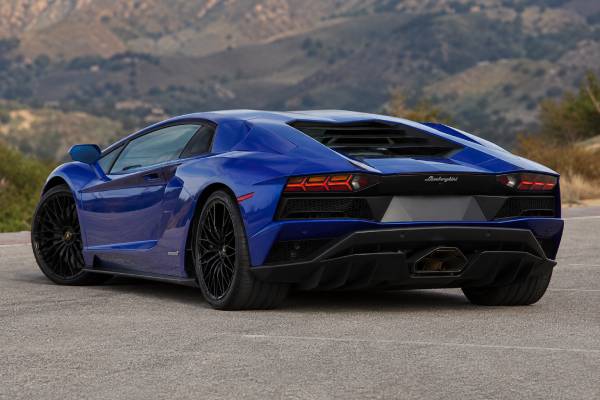
The coupe is identified by its fixed roof, sharply vented rear deck, central triple-exit exhaust outlet, revised front splitter, side intakes, active rear wing, and S-specific aerodynamic detailing. The Roadster keeps the same 740 CV powertrain but uses two removable roof panels that can be stored in the front luggage area. It is heavier and fractionally slower to 100 km/h, but the driving experience feels more theatrical because the V12 sound reaches the cabin more directly.
| Version | Main appeal | Buyer notes |
|---|---|---|
| LP 740-4 S Coupe | Sharper structure, lower weight, cleaner driver focus | Best choice for buyers who value handling precision and long-term originality |
| LP 740-4 S Roadster | Open-air V12 sound and stronger visual drama | Often more expensive; inspect roof panels, seals, storage condition, and wind-noise issues |
Factory options and personalization matter heavily on Aventador S values. Lamborghini’s Ad Personam program allowed buyers to choose special paint, contrast stitching, interior leather and Alcantara combinations, carbon trim, wheel finishes, and unusual color pairings. A striking factory specification can lift desirability, but only when it is documented and tasteful enough for the market.
Common high-value options and specification details include:
- Front lifting system, which is essential for steep driveways and urban use.
- Exterior carbon-fiber packages for the splitter, side details, diffuser, engine bay, and mirrors.
- Transparent or carbon engine-cover details, depending on body style and market.
- Sensonum premium audio, more relevant to road use than track use.
- Dione, Dianthus, or other factory wheel designs, depending on model year and market.
- Sport seats or comfort seats, depending on intended use.
- Contrast stitching, embroidered Lamborghini shields, and special interior color layouts.
- Full paint-protection film if installed carefully and documented.
- Factory matte paint, which can be desirable but needs more careful inspection.
Authenticity matters because many Aventadors have been modified. Exhaust systems, lowering kits, aftermarket wheels, carbon add-ons, and ECU tunes are common. Some modifications improve sound or appearance, but they can reduce collector appeal if the original parts are missing. For a long-term keeper, the safest car is usually a factory-correct example with its original wheels, original exhaust, documented options, two keys, books, service invoices, battery charger, roof tools for Roadsters, and a clean paint-meter inspection.
Aventador S identification should also include VIN and market checks. U.S., European, Middle Eastern, and Asian-market cars can differ in lighting, emissions equipment, speedometer display, radio/navigation setup, warranty history, and compliance paperwork. Imported cars are not automatically bad, but they need stronger documentation.
Aero, Steering, and Lamborghini Character
The Aventador S looks similar to the original Aventador at a glance, but its important changes are functional. The revised nose, diffuser, active rear wing, cooling paths, rear-wheel steering, and LDVA control logic make it more stable and more responsive than the LP 700-4.
The front end is one of the easiest S identifiers. Lamborghini reshaped the bumper and splitter to increase front downforce and reduce the early Aventador’s tendency to feel light or reluctant at the nose. The rear diffuser is more aggressive, and the central triple-exit exhaust gives the S a distinct rear signature. The active rear wing adjusts to suit speed and driving conditions, balancing drag and downforce.
The most important engineering feature is four-wheel steering. At low and medium speeds, the rear wheels can steer opposite the front wheels, making the car feel shorter and more agile than its 2,700 mm wheelbase suggests. At higher speeds, the rear wheels steer with the fronts, improving stability and making lane changes and fast sweepers feel more settled.
LDVA, Lamborghini Dinamica Veicolo Attiva, is the car’s control brain. It coordinates powertrain, steering, suspension, all-wheel drive, and stability-control behavior. The Aventador S gives the driver Strada, Sport, Corsa, and EGO modes:
- Strada is the calmest setting and softens the gearbox, dampers, and throttle response for normal roads.
- Sport loosens the car’s attitude and gives a more rear-biased, playful feel.
- Corsa sharpens shift speed, throttle, damping, and stability settings for track-style driving.
- EGO lets the driver mix settings rather than accepting a full preset.
The design still delivers the classic Lamborghini signals: scissor doors, a low wedge profile, huge side intakes, Y-shaped lighting graphics, hexagonal details, and an exposed mechanical feeling around the engine bay. It is not subtle, and it was never meant to be. The Aventador S is a car where engineering and theater are closely linked.
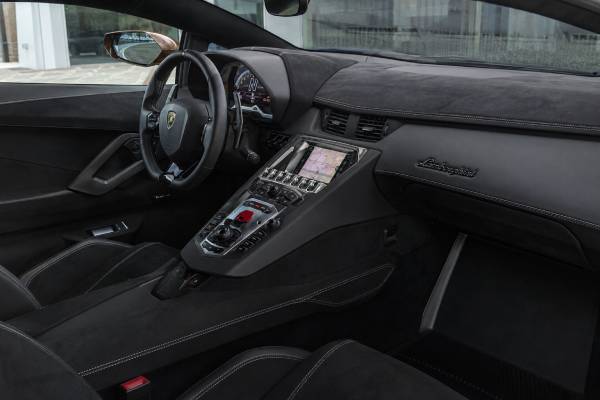
Inside, the Aventador S feels more like a cockpit than a luxury GT. The driver sits low, the windshield is steeply raked, the center console is high, and the start button hides under a red fighter-jet-style cover. Visibility is better forward than rearward, and the car’s width is always obvious. The TFT digital instrument display and updated infotainment make it more modern than earlier Lamborghinis, but this is still a focused supercar rather than a daily luxury coupe.
The sound is central to the car’s character. The V12 sits behind the occupants and breathes through a short, dramatic exhaust path. At low load, it has a mechanical growl. Under full throttle, it becomes hard, metallic, and high-pitched in a way turbocharged cars cannot fully copy. That sound is one reason collectors continue to treat the Aventador S as important even though newer supercars are quicker.
How the Aventador S Drives
The Aventador S feels large, loud, and physical, but it is much more cooperative than the original Aventador. The rear-wheel steering and revised chassis tuning make the car turn in more cleanly, while the V12 gives it instant response and a sense of occasion at any speed.
Acceleration is brutal, but not in the silent, seamless way of an electric car or the smooth way of a modern dual-clutch turbo supercar. The Aventador S builds drama as rpm rises. The engine’s best work happens when it is allowed to rev, and the last third of the tachometer is where the car feels most alive. The 740 CV output is more than enough to overwhelm short roads, so the most satisfying driving often comes from clean throttle use, careful braking, and letting the V12 climb through second and third gear rather than chasing maximum speed.
The ISR gearbox defines much of the experience. Driven gently, it can feel clunky if the driver treats it like a torque-converter automatic. It rewards a small lift during low-speed shifts and feels more natural when driven with intent. Under hard acceleration, especially in Corsa, the shift action is fast and aggressive, with a clear interruption and impact between gears. Some drivers love this because it gives the car a raw mechanical edge. Others prefer the smoothness of a dual-clutch Huracán or Ferrari. A test drive is essential.
The steering is quicker and more useful than in the LP 700-4. At parking speeds, the car is still wide and low, but rear-wheel steering helps reduce the sense of awkwardness. On mountain roads, the nose responds better than buyers may expect from a big V12 all-wheel-drive car. It still needs respect. The Aventador S has massive rear tires and strong traction, but it is not light. Bad pavement, cold tires, and sudden throttle inputs can make it feel nervous.
The brakes are powerful and durable when healthy. Carbon-ceramic brakes need temperature to feel their best, and pedal feel can seem different from steel brakes at low speed. On track, condition matters more than mileage. A low-mileage car that has done repeated hot laps may have more brake and tire wear than a higher-mileage road car.
Ride quality is firm but not punishing by exotic-car standards. Strada mode is usable for highway driving, and the car can cover distance if the roads are smooth. City use is more demanding. The nose lift is close to essential, the turning radius still requires planning, rear visibility is limited, and parking garages can become stressful because of the width.
The Roadster changes the mood more than the raw numbers suggest. It is slightly heavier, but the open roof brings the intake and exhaust note closer. For owners who drive mainly on scenic roads and weekends, that may be worth more than the coupe’s extra stiffness. For buyers who care about precision, long-term collectability, and the cleanest driving feel, the coupe is usually the better choice.
Maintenance Risks and Ownership Reality
The Aventador S is not fragile when maintained properly, but it is an exotic V12 Lamborghini with expensive consumables, specialist labor, and many electronic and hydraulic systems. The best ownership experience comes from buying the right car, not from trying to fix a neglected one cheaply.
The L539 V12 is generally respected as a strong engine, but it must be serviced by people who know the platform. Oil service, coolant condition, ignition components, intake hardware, exhaust heat management, and software updates all matter. Heat is a recurring theme. The Aventador engine bay runs hot, and cars used in traffic, hot climates, or heavy stop-start driving need careful inspection of hoses, wiring, seals, and surrounding components.
The ISR transmission is a major inspection point. Clutch wear depends heavily on driving style. Repeated low-speed maneuvering, hill starts, reverse maneuvers, and creeping in traffic can shorten clutch life. A Lamborghini diagnostic scan should report clutch wear data and gearbox faults. Do not rely only on how the car feels during a short test drive.
Carbon-ceramic brakes are another major cost driver. Discs can last a long time on road-driven cars, but replacement costs are high. Inspect disc surface condition, thickness, pad life, and signs of track abuse. Brake squeal alone is not proof of a problem, but cracks, heavy chipping, or uneven wear need specialist evaluation.
Important Aventador S inspection areas include:
- Clutch wear percentage and gearbox adaptation data.
- Suspension lift operation, hydraulic leaks, and warning lights.
- Magneto-rheological damper condition and suspension fault codes.
- Carbon-ceramic brake disc and pad condition.
- Tire brand, age, sizes, and tread depth.
- Wheel damage, especially on inner barrels and center-lock hardware where fitted.
- Cooling system leaks, coolant smell, and fan operation.
- Oil leaks around engine, gearbox, and differential areas.
- Exhaust heat shielding and signs of heat damage.
- Battery health and history of tender use.
- Infotainment, camera, display, and switchgear function.
- Paint depth, panel alignment, front splitter damage, and underbody scrapes.
- Roadster roof panel fit, seals, latch condition, and storage bags.
Tires deserve special attention. The Aventador S uses large, expensive high-performance tires, and old tires can ruin the way the car drives. Even if tread depth looks acceptable, check date codes. A six-figure supercar on aged or mismatched tires is a warning sign that the owner may have economized elsewhere.
Battery care is also more important than many buyers expect. Low voltage can trigger warning lights and strange electronic behavior. A properly kept Aventador should live on a battery maintainer when parked for long periods. A history of repeated dead batteries can lead to avoidable diagnostic headaches.
Service history should be complete, not vague. “Just serviced” means little without invoices. A strong file should show dates, mileage, authorized Lamborghini or recognized specialist names, fluids, brake work, tires, software updates, recalls or campaigns, and any warranty repairs. For newer examples, confirm remaining warranty or extended warranty eligibility where applicable.
Avoid cars with unclear accident history, missing underbody panels, poor paint blending, non-factory carbon of uncertain origin, aggressive tunes, or missing original parts. An Aventador S can tolerate tasteful reversible upgrades, but collector-grade cars should be easy to return to factory condition.
Market Values and Buyer Checks
The Aventador S market rewards originality, color, mileage, condition, and documentation more than model year alone. Coupes usually sit below Roadsters, while exceptional colors, Ad Personam interiors, very low mileage, and fully documented ownership can push a car far above average market guides.
Recent market data places standard Aventador S coupes well above ordinary used-supercar territory, with Roadsters carrying a clear premium. Public auction averages can understate the best private-sale cars because low-mileage, desirable-color examples often trade through dealers or private networks. At the same time, optimistic asking prices do not always equal sale prices. Treat market guides as a starting point, then adjust for specification and condition.
Value drivers include:
- Original paint and no accident history.
- Low mileage, but only when supported by regular maintenance.
- Desirable factory colors such as Verde, Arancio, Giallo, Blu, Viola, or special Ad Personam shades.
- Tasteful interior contrast and carbon-fiber options.
- Factory front lift and desirable wheel specification.
- Complete Lamborghini service records.
- Original exhaust, wheels, books, tools, roof bags for Roadsters, and battery tender.
- Clean title, clear import history, and no finance or insurance complications.
- Warranty or Lamborghini extended-warranty eligibility.
- Recent tires, fresh service, and strong diagnostic report.
Cars to be cautious with include:
- High-option cars with missing build documentation.
- Modified cars without original parts.
- Cars advertised as “no stories” but showing paintwork on multiple panels.
- Low-mileage cars with long service gaps.
- Cars stored without battery care.
- Roadsters with roof fitment issues or water-entry signs.
- Cars with repeated warning lights blamed on “just a sensor.”
- Examples with worn carbon brakes but priced like collector cars.
A proper buying process should be structured. First, confirm the VIN, market, model year, and factory specification. Second, review service invoices and ownership history before traveling. Third, arrange a pre-purchase inspection with a Lamborghini dealer or a specialist who has Aventador diagnostic equipment. Fourth, inspect paint, carbon, underbody, wheels, brakes, tires, suspension lift, clutch data, and fault history. Fifth, price the car after the inspection, not before.
| Priority | What to check | Why it matters |
|---|---|---|
| Documentation | Build spec, service invoices, ownership history, recall/campaign status | Protects value and prevents hidden-cost surprises |
| Powertrain | Clutch data, gearbox faults, oil leaks, cooling system, diagnostic scan | Major repairs are expensive and specialist-dependent |
| Chassis | Paint depth, underbody, suspension lift, damper codes, wheel damage | Accident or curb damage can sharply reduce value |
| Consumables | Tires, brake discs, brake pads, fluids, battery | Deferred consumables can add large immediate costs |
| Originality | Factory exhaust, wheels, carbon trim, interior parts, reversible modifications | Original cars are easier to sell and usually more collectible |
For long-term collectability, the Aventador S has a strong case. It is not the rarest Aventador, but it is a key version: the improved standard model, the first series-production Lamborghini with four-wheel steering, and one of the last pure naturally aspirated V12 flagships before the hybrid Revuelto era. The safest buy is not the cheapest car. It is the car with the best combination of factory specification, condition, documented care, and mechanical inspection results.
References
- Lamborghini Aventador S | Lamborghini.com 2026 (Manufacturer Specifications)
- Lamborghini Aventador S Roadster | Lamborghini.com 2026 (Manufacturer Specifications)
- End of an Era with the Last Lamborghini Aventador 2022 (Manufacturer Publication)
- Recall Campaign | Lamborghini.com 2026 (Recall Database)
- Lamborghini Aventador LP740-4 S Market – CLASSIC.COM 2026 (Market Data)
Disclaimer
This article is for informational purposes only and is not a substitute for professional diagnosis, repair, inspection, or valuation. Specifications, torque values, service intervals, software updates, recall status, and repair procedures can vary by VIN, market, model year, equipment, and service history. Always verify details against official Lamborghini service documentation and have any car inspected by a qualified Lamborghini dealer or specialist before purchase or repair.
If you found this guide useful, please share it on Facebook, X/Twitter, or your favorite car community to support our work.