


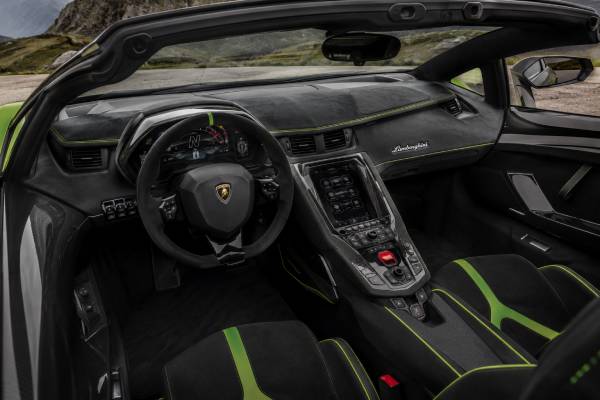
The Lamborghini Aventador SVJ 63 Roadster is the rarest open-top expression of the Aventador SVJ formula: a 6.5-liter L539 naturally aspirated V12, 770 CV, all-wheel drive, active aerodynamics, carbon-fiber structure, and a numbered 63-unit production run created through Lamborghini Centro Stile and Ad Personam. It sits near the end of Lamborghini’s non-hybrid V12 era, after the Aventador S and before the electrified Revuelto replaced the Aventador line. For collectors, the SVJ 63 Roadster matters because it combines the most aggressive Aventador chassis package with genuine factory rarity. For drivers, it matters because it keeps the roof-off drama without losing the SVJ’s active aero, rear-wheel steering, pushrod suspension, and ISR gearbox character. The result is not just a louder Aventador Roadster. It is one of the most collectible final-generation, naturally aspirated Lamborghini V12 road cars.
Table of Contents
- Why the SVJ 63 Roadster Matters
- L539 V12 Specs and Chassis Data
- SVJ 63 Production, Options, and Identification
- Active Aero, Carbon Roof, and Signature Details
- How the SVJ 63 Roadster Drives
- Maintenance Risks and Specialist Care
- Market Value and Buying Checklist
Why the SVJ 63 Roadster Matters
The SVJ 63 Roadster is important because it joins three things Lamborghini rarely combines in one model: a flagship V12 roadster, track-focused SVJ hardware, and a numbered 63-car special edition. It is not a separate mechanical model from the Aventador SVJ Roadster, but its production limit, factory design themes, and anniversary symbolism make it far more collectible than a normal SVJ Roadster.
The Aventador itself arrived for the 2012 model year as the successor to the Murciélago. It introduced Lamborghini’s carbon-fiber monocoque production strategy for the flagship V12 line and replaced the long-running Bizzarrini-derived V12 family with the new L539 engine. Over its long life, the Aventador evolved through the LP700-4, LP720-4 50th Anniversario, LP750-4 Superveloce, Aventador S, SVJ, Ultimae, and several ultra-limited derivatives.
The SVJ sits at the sharp end of that family. “SV” stands for Super Veloce, while “J” refers to Jota, Lamborghini’s traditional marker for more extreme, track-focused development. The Aventador SVJ coupe gained attention for its Nürburgring production-car lap record, and the Roadster carried the same core idea into an open-top body.
The SVJ 63 Roadster was unveiled in 2019 as a more exclusive version of the SVJ Roadster. Lamborghini used the number 63 to reference its founding year, 1963. Only 63 were built, compared with 800 standard SVJ Roadsters. That alone changes the buying logic. A standard SVJ Roadster is rare by normal standards; the SVJ 63 Roadster is rare even inside the Lamborghini collector world.
Its significance comes from several overlapping factors:
- It is one of the final naturally aspirated Lamborghini V12 roadsters before hybridization.
- It uses the most aggressive Aventador aero package, ALA 2.0.
- It keeps the open-air removable hardtop layout rather than a soft top.
- It is a factory-numbered limited edition, not an aftermarket specification.
- It belongs to the late Aventador era, when Lamborghini had refined steering, suspension, electronics, and aero far beyond the original LP700-4.
For many collectors, the strongest appeal is timing. The Aventador SVJ 63 Roadster arrived just before the end of the pure internal-combustion V12 flagship era. The Revuelto that followed is faster and more advanced, but it is a plug-in hybrid. The SVJ 63 Roadster represents the old Lamborghini flagship formula in its most theatrical form: a large naturally aspirated V12 mounted behind the driver, no hybrid assist, a single-clutch automated gearbox, scissor doors, and a removable roof.
That also explains why it has a different personality from the later Aventador Ultimae Roadster. The Ultimae is the final Aventador and is cleaner in design, but the SVJ 63 is more extreme, more aero-led, and more visually aggressive. Buyers choosing between them are usually choosing between final-edition purity and SVJ drama.
L539 V12 Specs and Chassis Data
The key specification is simple: a 6,498 cc naturally aspirated L539 V12 making 770 CV at 8,500 rpm and driving all four wheels through a 7-speed ISR automated manual. The SVJ Roadster’s performance figures are still severe today: 0–100 km/h in about 2.9 seconds, 0–200 km/h in about 8.8 seconds, and a top speed above 350 km/h.
| Category | Specification |
|---|---|
| Model | Lamborghini Aventador SVJ 63 Roadster |
| Platform code | LB835 Aventador Roadster family |
| Production years | 2019–2020 for the SVJ 63 Roadster launch period |
| Engine code | L539 |
| Engine layout | Mid-mounted 60-degree V12 |
| Displacement | 6,498 cc |
| Induction | Naturally aspirated |
| Maximum power | 770 CV / 566 kW at 8,500 rpm |
| Maximum torque | 720 Nm / 531 lb-ft at 6,750 rpm |
| Transmission | 7-speed ISR automated manual |
| Drivetrain | Electronically controlled all-wheel drive |
| Body structure | Carbon-fiber monocoque with aluminum subframes |
| Roof | Two-piece removable carbon-fiber hardtop |
The L539 V12 is central to the car’s value. It is not turbocharged, not hybrid-assisted, and not tuned for quiet smoothness. It makes its power high in the rev range, where the SVJ feels more like a race-bred engine than a large luxury-car V12. The short-stroke character, dry-sump lubrication, high rpm limit, and intake/exhaust tuning are a major part of why the SVJ remains desirable even as newer hybrid supercars outperform it on paper.
The ISR gearbox is also important. ISR means Independent Shifting Rods. It is a single-clutch automated manual, not a dual-clutch transmission. In slow traffic, it can feel abrupt compared with modern dual-clutch units. At full load in Corsa mode, it gives the Aventador its violent shift character. That old-school behavior is now part of the car’s identity.
| Area | Detail |
|---|---|
| 0–100 km/h | About 2.9 seconds |
| 0–200 km/h | About 8.8 seconds |
| Top speed | Over 350 km/h |
| 100–0 km/h braking | About 31 meters |
| Front brakes | Carbon-ceramic discs with fixed multi-piston calipers |
| Rear brakes | Carbon-ceramic discs with fixed multi-piston calipers |
| Suspension | Pushrod layout with magneto-rheological adaptive dampers |
| Steering systems | Lamborghini Dynamic Steering and Lamborghini Rear-wheel Steering |
| Aerodynamics | ALA 2.0 active aerodynamic system with aero-vectoring |
| Drive modes | Strada, Sport, Corsa, and Ego |
Dimensions and weight vary slightly by source, market specification, equipment, and measurement method. For buying purposes, the most important point is that the Roadster carries more mass and structural reinforcement than the coupe, but Lamborghini tuned the SVJ Roadster so it keeps the same core active systems and the same engine output.
SVJ 63 Production, Options, and Identification
The SVJ 63 Roadster is a 63-unit limited edition within the 800-unit Aventador SVJ Roadster run. The model’s collectability depends heavily on correct factory identity, original specification, documentation, and whether the car still presents as a genuine SVJ 63 rather than a modified or cosmetically altered SVJ Roadster.
The standard Aventador SVJ Roadster was limited to 800 units worldwide. The SVJ 63 Roadster was the rarer numbered derivative. Lamborghini’s Centro Stile and Ad Personam teams created eight design expressions for the SVJ 63 Roadster, using specific exterior and interior combinations, visible carbon-fiber elements, contrasting accents, and dedicated trim.
Factory identification matters because the market treats an original SVJ 63 differently from a standard SVJ Roadster with similar colors or aftermarket graphics. A proper car should have supporting Lamborghini documentation, correct plaque details, matching VIN records, original option data, and a factory specification that aligns with the SVJ 63 program.
Important identity points include:
- numbered SVJ 63 production status
- factory Ad Personam specification
- visible carbon-fiber exterior areas, depending on configuration
- SVJ 63-specific design treatment
- dedicated interior color and trim combinations
- special plaque or numbering details
- original Lamborghini dealer or factory paperwork
- service records showing authorized Lamborghini maintenance
Factory options also affect desirability. On this type of car, buyers care less about ordinary convenience equipment and more about specification cohesion. A dramatic Ad Personam car with a desirable color story, visible carbon, forged center-lock wheels, a documented build, and low mileage will usually attract more collector attention than a higher-mileage car with a less distinctive configuration.
Commonly valued equipment and specification features include:
- exposed carbon-fiber exterior package elements
- center-lock forged wheels
- carbon-fiber interior trim
- Alcantara-heavy cabin treatment
- contrast stitching and SVJ embroidery
- Sensonum audio
- Lamborghini telemetry
- front lifting system
- rear-view camera and parking sensors
- electric and heated seats, depending on buyer preference
- paint protection film if installed cleanly and documented
There is a tradeoff between originality and usability. Some owners prefer cars with paint protection film because carbon-fiber lips, side skirts, and lower body panels are vulnerable to stone chips. Collectors, however, should confirm that the film was applied without cutting into paint or carbon surfaces. Poorly installed or aged film can become a liability.
Market-specific equipment can also matter. U.S., European, Middle Eastern, and Asian-market cars may differ in lighting, emissions equipment, registration documents, speedometer markings, and service history. Importing an SVJ 63 Roadster across regions can add complexity. Before buying a car outside its original market, confirm compliance, taxes, title status, recall completion, and whether a local Lamborghini dealer will support the car without restrictions.
The best examples are not simply the lowest-mile cars. A delivery-mileage car may still need recommissioning if it has sat too long. A carefully used car with annual servicing, fresh tires, completed recalls, clean paintwork, and no stories can be a better ownership proposition than a static collector car that has not been exercised.
Active Aero, Carbon Roof, and Signature Details
The SVJ 63 Roadster looks extreme because its design is shaped by cooling, downforce, and air management rather than decoration alone. The large intakes, extended side skirts, high-mounted exhaust outlets, front aero channels, rear wing, and engine cover are part of the SVJ’s function-first identity.
The most important engineering feature is ALA 2.0, Lamborghini’s active aerodynamic system. ALA stands for Aerodinamica Lamborghini Attiva. In simple terms, the system uses active flaps to change the car’s airflow depending on driving conditions. It can reduce drag in a straight line or increase downforce when cornering and braking. It can also manage airflow from side to side, a function often described as aero-vectoring.
This matters because the Aventador is large, wide, and powerful. Mechanical grip alone is not enough to make a 770 CV roadster feel controlled at high speed. The SVJ package uses active aero, rear-wheel steering, adaptive suspension, all-wheel drive, and dedicated tires as one system.
The removable roof is another defining feature. The Aventador Roadster does not use a folding fabric roof. Instead, it has two removable carbon-fiber roof panels that attach above the cabin and store under the front hood. The SVJ Roadster’s roof panels are made using high-pressure RTM carbon-fiber technology. The arrangement keeps the car visually close to a coupe when installed, while preserving a very clean open-air profile when removed.
The tradeoff is practicality. Removing and storing the panels takes more effort than pressing a button in a convertible. With the panels stored in the front compartment, cargo space becomes very limited. Buyers who expect grand-touring convenience may find the system awkward. Enthusiasts usually accept it because it keeps the Aventador Roadster’s roof structure light, rigid, and visually special.
The cabin is pure late Aventador. It has a low seating position, a broad center tunnel, fighter-jet-style controls, a start button under a red flip cover, large shift paddles, and heavy use of carbon fiber, leather, and Alcantara. The SVJ 63 Roadster adds more visual theater through special colorways and trim details.
Several design elements are worth checking closely on inspection:
- front splitter and lower carbon surfaces for scraping
- side skirts for chips and underside damage
- rear diffuser for heat marks or impact damage
- carbon roof panels for edge wear, cracks, and latch condition
- engine cover alignment and hinge condition
- rear wing mounts and clearcoat condition
- headlight lenses and front-end paint protection film
- cabin Alcantara wear on bolsters, steering wheel, and sills
The exhaust layout gives the SVJ a harder voice than earlier Aventadors. The high-mounted outlets shorten the visual distance between engine and exhaust exit, and the sound is part of the car’s appeal. With the rear window open and the roof off, the Roadster becomes much more intense than the coupe in normal driving. That is good for emotion, but it also means heat, noise, and attention are always part of the experience.
How the SVJ 63 Roadster Drives
The SVJ 63 Roadster drives like a raw, high-speed V12 Lamborghini with modern control systems layered on top. It is not as smooth or effortless as a modern dual-clutch hybrid supercar, but that is exactly why many owners want it.
The engine dominates the experience. At low rpm, the L539 V12 feels muscular but not lazy. As the revs climb, it becomes sharper, louder, and more urgent. Peak power arrives high at 8,500 rpm, so the car rewards drivers who let it rev. The throttle response is immediate because there are no turbochargers to wake up and no electric torque fill smoothing the delivery.
The ISR gearbox is the most divisive part of the drive. In Strada, it can shift more gently, but it still feels like a single-clutch automated manual. In Sport and Corsa, shifts are far more aggressive. Driven hard, the interruption and impact of each gear change become part of the theater. Driven lazily in traffic, the same gearbox can feel clumsy. Buyers coming from a Huracán, Ferrari 488, McLaren, or Porsche 911 Turbo should try an Aventador before assuming they will like it.
The steering is much better than early Aventadors. Lamborghini Dynamic Steering changes ratio and response based on mode and speed, while rear-wheel steering helps the car rotate at lower speeds and feel more stable at high speeds. The result is still a very wide car, but it no longer feels as reluctant to change direction as the earliest Aventador models.
The suspension is firm, especially on poor surfaces. Magneto-rheological dampers help, but the SVJ is a track-focused Aventador, not a relaxed roadster. The front lift system is essential in real use because the nose and splitter sit low. Buyers should treat the lift system as a practical requirement, not a luxury feature.
Braking performance is immense when the carbon-ceramic system is in good condition. On the road, pedal feel can be firm and slightly cold at low speeds, but the system has the capacity expected of a 350 km/h car. On track, brake temperature, pad condition, tire age, and fluid freshness become critical. A car used for hard events needs a more serious inspection than a cars-and-coffee example.
The drive modes change the personality clearly:
| Mode | Best use | Character |
|---|---|---|
| Strada | City, cruising, rough roads | Softest throttle, calmer shifts, more stability intervention |
| Sport | Fast road driving | More dramatic power delivery, louder behavior, livelier chassis feel |
| Corsa | Track or very focused driving | Fastest responses, hardest shifts, maximum performance calibration |
| Ego | Personal setup | Driver-selected mix of engine, gearbox, steering, suspension, and stability settings |
Usability is better than the shape suggests, but only within supercar limits. Visibility to the rear is limited. The car is very wide. The doors attract attention everywhere. Cabin storage is small. The roof panels reduce front cargo space when removed. The turning circle and low nose require planning in tight urban areas.
On a mountain road, the SVJ Roadster feels more alive than a normal Aventador Roadster because the front end is sharper, the rear-steer helps rotation, and the aero package gives confidence at speed. On a highway, it feels stable and brutally fast, but tire roar and engine noise are always present. On track, it can be very capable, but it is still a large, expensive, heavy V12 roadster with costly consumables. Many owners prefer occasional high-performance road use rather than repeated circuit work.
Maintenance Risks and Specialist Care
The SVJ 63 Roadster is not a normal used exotic; it is a limited-production carbon-fiber V12 Lamborghini that needs factory-level diagnostics, correct parts, and specialists who understand Aventador systems. A cheap inspection or incomplete service history is a serious risk.
The L539 V12 is generally strong when maintained correctly, but neglect is expensive. Oil service, fluids, plugs, belts, filters, cooling-system checks, and software updates should be documented. Cars that sit for long periods can develop battery, tire, seal, and fuel-related issues even if mileage is low. A collector car still needs regular exercise and maintenance.
The ISR transmission and clutch need careful evaluation. Clutch wear depends heavily on driving style, traffic use, launch use, reversing on inclines, and low-speed maneuvering. A diagnostic scan can usually show clutch wear data and stored faults. A low-mile car with heavy city use may have more clutch wear than a higher-mile car used mostly on open roads.
Carbon-ceramic brakes are another major cost area. They can last a long time in road use, but track heat, gravel damage, impact marks, and incorrect wheel handling can shorten their life. Inspect discs for chips, cracks, surface condition, and measured wear. Pads, brake fluid, and caliper condition should also be checked.
The most important ownership areas include:
- battery health and use of a correct maintainer
- ISR clutch wear and gearbox adaptation values
- hydraulic front lift operation
- magneto-rheological damper function
- rear-wheel steering fault history
- all-wheel-drive system operation
- carbon-ceramic disc and pad condition
- tire age, tire type, and matching fitment
- ALA flap operation and stored aero faults
- cooling system leaks or fan faults
- exhaust valve operation
- infotainment, cameras, parking sensors, and control modules
- roof panel latches, seals, storage bags, and alignment
- paint, carbon-fiber clearcoat, and underside scrape damage
Tires deserve special attention. The SVJ package was developed around high-performance Pirelli tires, and tire age changes the way the car behaves. Old tires may look fine but provide less grip, poorer braking, and less predictable breakaway. On a 770 CV all-wheel-drive Lamborghini, tires are a safety item as much as a maintenance item.
Recall completion should be verified by VIN. Certain 2020 Aventador SVJ Coupe and Roadster cars were affected by recalls involving the internal door handle mechanism and front suspension arm anchor bolt/frame-thread issue. A buyer should not rely on seller statements alone. Confirm recall status through an authorized Lamborghini dealer or official database.
Paint and carbon repairs require caution. The SVJ’s exposed carbon, lower aero pieces, rear wing, roof panels, and engine-cover areas can be expensive to repair correctly. A small scrape on a painted bumper is one thing. Damage to structural carbon, exposed-weave carbon, or factory matte finishes is much more serious. Refinished carbon may be acceptable if documented and done by a top specialist, but it will affect collector confidence.
A proper pre-purchase inspection should include:
- VIN and factory specification verification.
- Diagnostic scan with Lamborghini-compatible equipment.
- Clutch wear and gearbox adaptation check.
- Lift, rear-steer, damper, AWD, and ALA system test.
- Paint-depth readings and carbon-fiber inspection.
- Underside inspection on a lift, including splitter and diffuser.
- Brake disc, pad, and tire condition report.
- Roof panel fit, latch, seal, and storage check.
- Service history review by date, mileage, and dealer.
- Recall and warranty-extension status confirmation.
For ownership, the safest approach is to budget like an Aventador owner, not like a normal sports-car owner. Annual service, insurance, tires, battery care, paint protection, transport, storage, and specialist diagnostics all cost real money. The purchase price is only one part of the risk.
Market Value and Buying Checklist
The SVJ 63 Roadster sits above the standard SVJ Roadster in collector desirability because production is capped at 63 units and the car has factory special-edition identity. As of mid-2026, public asking prices and auction results for SVJ Roadsters vary widely, while SVJ 63 Roadsters usually trade at a premium when the specification, mileage, and documentation are strong.
Pricing is thin because few cars come to market. A standard Aventador SVJ Roadster may appear more often, but the SVJ 63 Roadster is a much smaller pool. Public market data can be misleading because one low-mile, perfect-spec car and one modified, higher-mile, imported car are not truly comparable. Private sales may also sit above or below public auction results depending on urgency, region, tax structure, and buyer confidence.
Value is driven by:
- confirmed SVJ 63 identity
- mileage and usage pattern
- original factory specification
- number plaque and documentation
- Ad Personam colorway desirability
- exposed carbon condition
- service history from authorized dealers or recognized specialists
- recall completion
- accident-free history
- paint originality
- roof panel condition
- ownership history
- market region and import status
- presence of books, keys, tools, charger, roof bags, and accessories
The best cars have a complete story. The file should show original order or build information, delivery documents, service invoices, recall records, warranty paperwork, paint protection details, and any ownership transfer history. A car with missing documents can still be genuine, but it will be harder to sell to a serious collector.
Avoid cars with vague “full service history” claims that do not include invoices. Also be careful with cars that have been wrapped, color-changed, tuned, fitted with aftermarket exhausts, or modified with non-factory carbon parts. Some modifications may improve sound or looks, but they usually narrow the buyer pool for a numbered limited edition.
A strong buyer checklist should include these questions:
| Area | What to confirm |
|---|---|
| Identity | VIN, SVJ 63 status, numbering, factory build specification, and plaque details |
| Documents | Original books, service invoices, warranty records, recall completion, and import papers if relevant |
| Condition | Paint originality, carbon-fiber condition, underside scrape damage, roof panel fit, and interior wear |
| Mechanical | Diagnostic scan, clutch wear, lift system, rear steering, ALA operation, brakes, tires, and cooling system |
| Market fit | Color desirability, mileage, ownership history, taxes, registration, and resale audience |
The safest examples to buy are original, documented, lightly used, and recently serviced. The riskiest are cars with missing history, unclear import status, heavy cosmetic changes, old tires, incomplete recall records, unresolved warning lights, damaged carbon, or sellers who resist a specialist inspection.
Long-term collectability looks strong because the SVJ 63 Roadster has the ingredients collectors usually want: final-era naturally aspirated V12 power, open body style, limited production, factory numbering, aggressive engineering, and clear separation from standard models. That does not make it immune to market cycles. High-end Lamborghini values can move with interest rates, global liquidity, regional tax rules, and the broader collector-car market. But among Aventador variants, the SVJ 63 Roadster is one of the cars most likely to remain desirable because its appeal is not based only on speed. It is based on rarity, drama, and the end of a mechanical era.
References
- Lamborghini Aventador SVJ Roadster | Lamborghini.com 2020 (Manufacturer Model History)
- Meet Aventador SVJ Roadster 2019 (Manufacturer News)
- SVJ 63 Roadster and EVO GT Celebration Unveiled 2019 (Manufacturer News)
- Vehicle Detail Search – 2020 LAMBORGHINI AVENTADOR SVJ ROADSTER | NHTSA 2020 (Recall Database)
- Lamborghini Aventador LP770-4 SVJ Roadster Market 2026 (Market Data)
Disclaimer
This article is for informational purposes only and is not a substitute for professional diagnosis, repair, valuation, or pre-purchase inspection. Specifications, torque values, service intervals, fluids, procedures, recall applicability, and equipment can vary by VIN, market, model year, and factory configuration. Always verify details against official Lamborghini service documentation and consult an authorized Lamborghini dealer or qualified specialist before buying, servicing, or repairing an Aventador SVJ 63 Roadster.
If this guide helped you, please share it on Facebook, X/Twitter, or your favorite car community to support our work.