
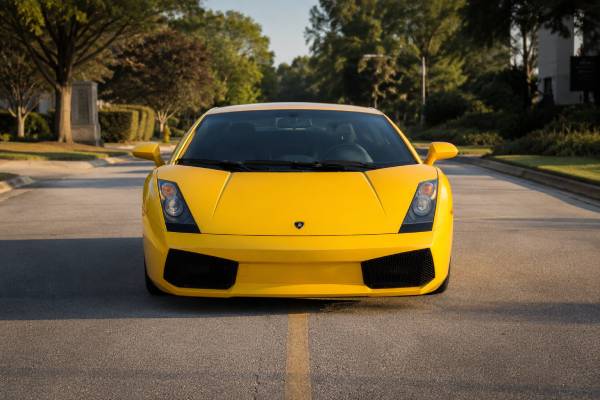
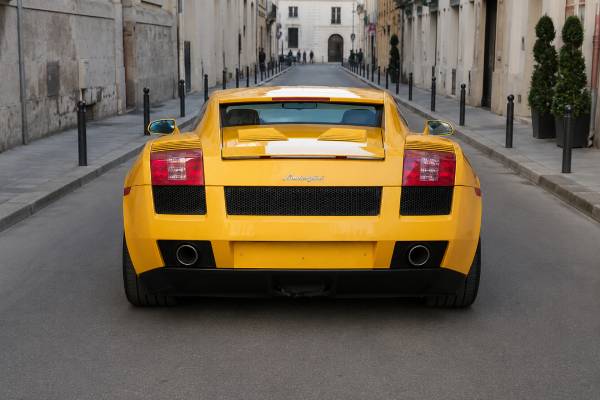
The 2003–2005 Lamborghini Gallardo Coupé is the original 5.0-liter V10 version of the L140 platform, built before the 2006 power and gearing update. It matters because it turned Lamborghini from a low-volume exotic maker into a more stable modern supercar brand under Audi ownership. With a naturally aspirated 90-degree V10, all-wheel drive, aluminum-intensive construction, and a choice of six-speed gated manual or E-gear automated manual transmission, the first Gallardo gave buyers a smaller, sharper companion to the V12 Murciélago. Today, early 500 hp cars attract two very different audiences: drivers who want the rawest pre-facelift Gallardo experience, and collectors watching clean manual examples become harder to replace. The best cars are not simply the lowest-mileage ones; they are the cars with original specification, careful servicing, clutch documentation, recall completion, and no hidden accident history.
Table of Contents
- Why the First Gallardo Still Matters
- 5.0 V10 Specifications and Chassis Data
- Early Production, Options, and Identification
- Design, Engineering, and Sensory Details
- How the 500 hp Gallardo Drives
- Maintenance Risks and Ownership Reality
- Market Values and Buying Checks
Why the First Gallardo Still Matters
The first Gallardo matters because it was Lamborghini’s first true modern volume supercar. It kept the brand’s drama but added the engineering discipline, build quality, and daily usability that buyers expected after Audi took control.
The L140 project had deep roots. Lamborghini had long considered a smaller car below the V12 flagship line, from the Urraco, Silhouette, and Jalpa to later concept ideas. The Gallardo finally turned that idea into a production car that could sit beside the Murciélago without feeling like a budget model. It was still a low, wide, mid-engine Lamborghini, but it was more compact, easier to see out of, easier to place on the road, and less intimidating to use than the V12 cars.
Launched in 2003, the Gallardo arrived at a critical time. Lamborghini needed more than occasional poster cars; it needed a repeatable product that could sell in meaningful numbers, support dealer networks, and build trust with owners. The Gallardo did that. It brought a new V10 engine, standard all-wheel drive, a rigid aluminum structural layout, and enough comfort to make weekend trips realistic.
The 2003–2005 Coupé is the earliest and purest version. Later Gallardos gained power, revised gearing, sharper software, 5.2-liter engines, lighter special editions, and rear-wheel-drive variants. Those cars are faster and often easier to drive quickly. The early 500 hp Coupé, however, has a cleaner first-series character: simple front and rear styling, the original engine calibration, early cabin details, and the strongest link to the model’s launch identity.
Its historical importance comes from several points:
- It was Lamborghini’s first production V10 road car.
- It was the brand’s first smaller mid-engine model after a long gap following the Jalpa.
- It became the foundation for later Gallardo Spyders, Superleggeras, LP560-4 models, Balboni editions, and Squadra Corse variants.
- It helped establish the formula later refined by the Huracán.
- It made Lamborghini ownership more realistic without making the car feel ordinary.
For collectors, the early Coupé is not rare in the same way as a Diablo SE30 or Murciélago SV, but it is becoming more clearly segmented. Gated manual cars, low-mileage original examples, unusual colors, and cars with complete Lamborghini or respected specialist history sit apart from neglected E-gear cars with deferred maintenance. The market is learning to separate “cheap Gallardo” from “good early Gallardo.”
5.0 V10 Specifications and Chassis Data
The 2003–2005 Gallardo Coupé uses a 4,961 cc naturally aspirated V10 rated at 500 hp, paired with all-wheel drive and either a six-speed manual or E-gear automated manual. The numbers remain serious today, but the car’s appeal comes from the way the engine, chassis, size, and sound work together.
| Category | Specification |
|---|---|
| Platform code | L140 |
| Body style | Two-door, two-seat coupé |
| Engine | 5.0-liter naturally aspirated V10, 90-degree layout |
| Displacement | 4,961 cc |
| Valvetrain | DOHC, four valves per cylinder |
| Output | 500 hp at 7,800 rpm |
| Torque | 510 Nm at 4,500 rpm |
| Induction | Naturally aspirated |
| Lubrication | Dry-sump system |
| Transmission | Six-speed manual or six-speed E-gear automated manual |
| Drivetrain | Rear-biased permanent all-wheel drive |
| Chassis | Aluminum structural chassis with aluminum body panels |
| Suspension | Double wishbones front and rear |
| Steering | Power-assisted rack and pinion |
| Brakes | Ventilated steel discs, 365 mm front and 335 mm rear |
| Wheels and tires | 19-inch wheels; 235/35 ZR19 front and 295/30 ZR19 rear tires |
| Measure | Figure |
|---|---|
| Length | 4,300 mm |
| Width | 1,900 mm |
| Height | 1,165 mm |
| Wheelbase | 2,560 mm |
| Dry weight | About 1,430 kg |
| Fuel capacity | About 90 liters |
| 0–100 km/h | About 4.2 seconds |
| 0–200 km/h | About 14.5 seconds |
| Top speed | About 309 km/h |
The engine is the centerpiece. It is not turbocharged, not hybrid-assisted, and not softened by modern sound filters. It needs revs, but it does not feel empty at low speed because the 5.0-liter displacement and 510 Nm torque peak give it real midrange force. Above the middle of the tachometer, it changes character and becomes harder, sharper, and more metallic.
The early six-speed manual is the collector transmission. Its open-gate shift gives the car a mechanical ritual that later dual-clutch supercars cannot copy. The E-gear is quicker than a relaxed manual shift when driven correctly, but it is a single-clutch automated manual, not a modern dual-clutch gearbox. It can be jerky at parking speed, expensive when abused, and highly dependent on clutch condition and calibration.
The all-wheel-drive system gives the Gallardo more security than many rear-drive supercars of its period. It does not make the car dull. The torque split and mid-engine weight distribution still make it feel rear-led, especially when the tires are warm and the road opens up.
Early Production, Options, and Identification
The easiest way to identify the 2003–2005 car is to look for the original 500 hp specification before the 2006 update. These early cars have the first-series body details, the original engine output, and either the gated six-speed manual or early E-gear system.
The Gallardo was produced from 2003 to 2013, but this guide focuses only on the original Coupé before the later 520 hp update. Lamborghini introduced revisions for the 2006 model year, including more power, shorter gearing, revised suspension tuning, steering changes, and exhaust updates. Those later pre-LP cars are closely related, but they are not the same ownership or collector proposition.
For a buyer, year and registration can be misleading because market delivery dates vary. A car may be built in one year, registered in another, and advertised using whichever date sounds most attractive. The important checks are the VIN, factory build record, engine specification, gearbox type, options, and service history.
Key early-version identifiers
Look for these points when checking a 2003–2005 Coupé:
- 5.0-liter V10 rated at 500 hp, not the later 520 hp tune.
- Original pre-facelift front and rear body design.
- Six-speed gated manual or six-speed E-gear.
- Fixed-roof Coupé body, not Spyder.
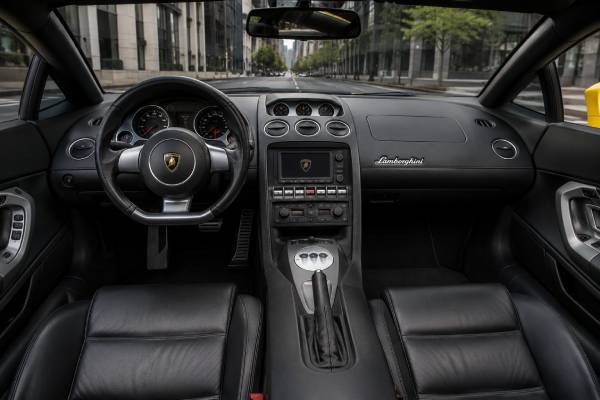
- Early interior switchgear and trim layout.
- VIN and build information matching the claimed production period.
- Service records showing the car has been maintained as a Lamborghini, not treated like a normal used car.
Options and market equipment varied, but common desirable features include the front axle lift system, navigation or multimedia equipment, upgraded leather trim, contrast stitching, branding details, special paint, and specific wheel designs. The lift system is useful because the Gallardo’s front overhang and low nose are vulnerable to ramps and driveway entries. However, it also adds components that must be inspected.
The most important “option” for long-term value is the manual gearbox. Early E-gear cars are still real Gallardos and can be enjoyable, especially when properly set up, but the gated manual has become the emotional and collectible choice. A manual car with original paint, low ownership count, factory books, tools, clear options, and a thick service file is a different asset from a high-mileage E-gear car with missing records.
Documentation that matters
A strong early Gallardo file should include:
- Original books, manuals, and service booklet.
- VIN-matched invoices from Lamborghini dealers or known specialists.
- Clutch wear readings for E-gear cars.
- Recall completion evidence, especially for steering-system work where applicable.
- Paint meter readings or body inspection notes.
- Tire dates and brake measurements.
- Records for fluids, spark plugs, belts, cooling work, and suspension repairs.
- Proof of factory options and original color combination.
Originality matters, but not every modification has the same effect. A reversible exhaust may appeal to some drivers if the factory system is included. Poorly fitted body kits, non-factory wheels, ECU tunes with no documentation, cheap carbon trim, lowered suspension, and missing original parts usually reduce buyer confidence.
Design, Engineering, and Sensory Details
The early Gallardo works because it combines simple geometric Lamborghini design with compact proportions and functional cooling needs. It looks dramatic, but most of its shapes serve packaging, airflow, visibility, or stance.
The design was shaped during the early Audi era, when Lamborghini wanted a car that looked unmistakably Italian but could be built with more consistency than older models. The Gallardo kept the wedge-like theme, sharp edges, low roofline, and wide rear haunches expected from the brand. It avoided the scissor doors of the V12 cars, which helped separate it from the Murciélago and made it easier to live with.
The body is compact by modern supercar standards. At 4,300 mm long, it is shorter than many current performance coupés, but the 1,900 mm width gives it real road presence. The short nose, cab-forward stance, and large side intakes make the car read as mid-engine immediately.
Packaging and cooling
The V10 sits behind the cabin and ahead of the rear axle line. The dry-sump lubrication system helps engine placement and oil control under high lateral load. Large side intakes feed the powertrain area, while the rear bodywork vents heat from the engine bay. Cooling condition is important on any used example because heat cycles age hoses, plastics, wiring insulation, and engine-bay hardware.
Aerodynamics are more subtle than on later Superleggera or LP570 models. The early Coupé does not rely on huge wings or aggressive splitters. It uses a clean body, flat surfaces, careful underbody management, and speed-dependent stability rather than obvious track-day add-ons.
Cabin and controls
Inside, the first Gallardo is much more usable than older Lamborghinis. The driving position is low but not absurd. The windshield is broad enough to make road placement manageable, and the cabin is better assembled than the brand’s 1990s cars. Some Audi-era switchgear is obvious, but that is part of the car’s identity: it is a Lamborghini with more reliable controls and a less fragile interior environment.
The manual gearbox gives the cabin its most important tactile feature. The metal gate, exposed shift pattern, and clutch pedal make every low-speed drive feel deliberate. E-gear cars replace that ritual with paddles and automated clutch actuation. They still have a dramatic engine and chassis, but the emotional tone changes.
The sensory character is central to the car. The early V10 has a hard-edged induction note, a metallic exhaust voice, and a rising intensity that modern turbocharged cars often lack. At low speed it can feel mechanical and slightly heavy. At high rpm it feels alive, precise, and urgent.
How the 500 hp Gallardo Drives
The early Gallardo drives like a compact, naturally aspirated, all-wheel-drive supercar from the analog-to-digital transition period. It is fast, secure, noisy, physical, and much less filtered than later dual-clutch Lamborghinis.
At low speeds, the car feels wide but not unmanageable. The steering has real weight, the seating position is low, and the nose is short enough to judge once the driver is used to it. Rear visibility is limited, and parking requires care, especially in cars without a camera. The front lift, when fitted and working, makes daily use much easier.
The engine is tractable in town, but it does not enjoy lazy treatment in the way a large turbocharged engine might. It wants proper oil temperature, deliberate throttle inputs, and space to rev. Cold starts, short trips, and repeated stop-start use are not ideal for the car or the clutch.
On an open road, the 5.0 V10 becomes the main event. The throttle response is crisp, and the engine builds power in a clean, linear way. The early car does not have the later 520 hp tune or shorter gearing, so it can feel slightly longer-legged than the updated models. That is not a flaw for every driver. It gives the car a more classic supercar rhythm: choose the gear, let the engine climb, and enjoy the sound.
Manual versus E-gear driving feel
A manual Gallardo is slower on paper than a perfectly driven paddle-shift car, but it is usually more satisfying at normal road speeds. The shift requires patience and precision. A rushed change can feel clumsy, while a clean shift through the gate is one of the main reasons these cars are now prized.
E-gear suits drivers who want the period paddle-shift experience, but it needs understanding. It is not smooth like a modern dual-clutch system. It uses a clutch, and that clutch wears. Creeping in traffic, reversing uphill, and repeated low-speed maneuvering can shorten clutch life. When calibrated and driven with mechanical sympathy, E-gear can be enjoyable. When neglected, it becomes one of the car’s largest cost risks.
Ride, grip, and braking
The ride is firm but not unbearable. Tire condition has a major effect on comfort, steering feel, and stability. Old tires with plenty of tread can make the car feel nervous, noisy, or vague. Correct high-performance tires in the proper sizes transform the car.
The all-wheel-drive system gives strong traction out of corners, especially compared with rear-drive supercars of the same era. The balance is stable and confidence-inspiring, but the car is not immune to poor inputs. It still has a mid-engine layout, wide rear tires, and enough speed to punish overconfidence.
The steel brakes are strong for road use when fresh. Track use is different. Heat, pad choice, fluid age, and disc condition matter. A car advertised as “never tracked” can still have tired brakes from road abuse, while a carefully maintained track-driven car may be mechanically healthier than a neglected garage queen.
Maintenance Risks and Ownership Reality
A good early Gallardo can be robust by exotic-car standards, but it is still a mid-engine Lamborghini with expensive parts, tight packaging, and age-related needs. The cheapest car to buy is often the most expensive car to own.
The engine itself has a strong reputation when serviced correctly, warmed properly, and kept away from poor modifications. The risk usually comes from neglect around the engine rather than the basic V10 design: old fluids, ignored leaks, tired coils, brittle hoses, weak batteries, poor storage, corroded fasteners, and heat-damaged wiring.
Maintenance should be planned around condition, time, and use, not just mileage. Many Gallardos cover few miles per year, which means rubber, fluids, tires, batteries, and seals age before the odometer suggests trouble. A 12,000-mile car with long gaps in servicing can be a worse buy than a 35,000-mile car with annual specialist attention.
Common inspection areas
Before purchase, a specialist should check:
- Clutch wear, especially on E-gear cars.
- E-gear pump operation, actuator health, and calibration.
- Manual clutch bite point, synchro feel, and gearbox noise.
- Engine oil leaks, coolant leaks, and dry-sump system condition.
- Radiators, coolant hoses, and signs of overheating.
- Coil packs, misfire history, and warning lights.
- Suspension arms, dampers, bushings, and alignment.
- Brake disc thickness, pad condition, calipers, and fluid age.
- Front lift function and hydraulic leaks if fitted.
- Power steering lines and recall completion.
- Tire brand, size, wear pattern, and date codes.
- Battery health and charging-system behavior.
- Sticky interior switches, worn leather, and broken trim.
- Underside damage from speed bumps, jacking errors, or road strikes.
The steering-system recall is especially important in affected markets. The issue involved high-pressure power steering pipes that could leak near hot areas, creating a fire risk. Any car in the affected range should have documented completion or be checked by a Lamborghini dealer or qualified specialist.
Clutch costs are a major ownership divider. Manual clutches can last well with skilled use, but hard launches and poor technique shorten life. E-gear clutch life varies even more because traffic use, calibration, and driver behavior matter. A clutch wear reading is not optional on an E-gear purchase; it is part of the value calculation.
Restoration and originality tradeoffs
The Gallardo is modern enough that “restoration” often means recommissioning rather than full rebuilding. Still, neglected examples can need a long list of work: tires, brakes, clutch, fluids, suspension, sticky controls, paint correction, undertray repairs, wheel refurbishment, and electrical diagnosis.
Originality is increasingly important. Factory paint, original panels, correct wheels, original exhaust parts, complete tools, books, and records all help value. Sensible maintenance upgrades can be acceptable, but irreversible cosmetic changes usually hurt the car. Buyers should also be careful with cars that have been wrapped for years, as wraps can hide paint mismatch, stone damage, or previous repairs.
Market Values and Buying Checks
The early Gallardo market has split into driver-grade E-gear cars, strong-condition E-gear cars, and increasingly collectible gated manual cars. Condition, history, gearbox, mileage, color, and originality can move values more than model year alone.
As of the current market, early base Gallardos often trade from the high five figures into the low six figures in the United States, with exceptional manual cars reaching much higher. Public market trackers place ordinary base-model values around the lower six-figure area, while insurer valuation tools and auction results show that condition and gearbox can create large spreads. Manual cars with low miles, rare colors, and complete provenance can command a major premium over comparable E-gear examples.
A cheap Gallardo is tempting because the entry price can overlap with newer sports cars. That comparison is misleading. A Gallardo has exotic-car parts pricing, specialist labor, and failure modes that can erase a bargain quickly. The right question is not “Can I afford the purchase price?” It is “Can I afford to bring this exact car to a known-good baseline?”
| Priority | Why it matters | What to look for |
|---|---|---|
| Service history | Shows whether the car was maintained by time and condition | Annual records, major services, fluids, plugs, clutch data |
| Gearbox condition | Manual and E-gear cars have different risks and values | Clean shifts, clutch reading, no actuator faults |
| Originality | Collector confidence depends on factory-correct specification | Original paint, wheels, exhaust parts, books, tools |
| Accident history | Aluminum structure and exotic body repairs are costly | Paint readings, panel fit, underside inspection, repair invoices |
| Deferred maintenance | Small skipped items become expensive when grouped | Tires, brakes, suspension, battery, cooling, lift system |
| Recall status | Safety and future resale depend on completed campaigns | Dealer confirmation and paperwork |
The best examples to seek are original, unmodified Coupés with complete records, known ownership, clean paintwork, healthy brakes and tires, and no stories around the title or structure. A manual car in a strong color with low-to-moderate mileage and full documentation is the safest collector choice. A well-maintained E-gear car can be a better driver value, provided the clutch and transmission system are documented.
Be cautious with cars that show any of these signs:
- Missing service history or vague seller claims.
- Recent clutch replacement with no invoice.
- Warning lights dismissed as “just a sensor.”
- Heavy aftermarket exhaust with no original parts.
- Cheap tires or mismatched tire brands.
- Fresh paint on multiple panels with no explanation.
- Low price justified by “minor” E-gear issues.
- Long-term storage without recommissioning records.
- Interior wear that does not match the mileage.
- Underside scraping, cracked undertrays, or damaged jacking points.
Long-term collectability looks strongest for gated manual Coupés, launch-era colors, very original cars, and examples with clear provenance. E-gear cars will remain desirable when properly maintained, but they are less likely to see the same collector premium unless mileage, condition, color, or history is exceptional.
For an enthusiast, the 2003–2005 Gallardo Coupé still offers something rare: a usable modern Lamborghini with a naturally aspirated V10, compact dimensions, hydraulic-era feel, and a real sense of occasion. For a buyer, the lesson is simple. Buy the best documented car you can afford, pay for a specialist inspection, and keep enough budget aside to service it properly after purchase.
References
- Celebrating The Lamborghini Gallardo 2023 (Manufacturer History)
- Milestones | Lamborghini.com 2026 (Manufacturer History)
- 12V-430 4 Pages 2012 (Recall Database)
- Gas Mileage of 2004 Lamborghini Gallardo 2026 (Official Fuel Economy Data)
- 2004 Lamborghini Gallardo Base | Hagerty Valuation Tool® 2026 (Valuation Guide)
Disclaimer
This article is for informational purposes only and is not a substitute for professional diagnosis, repair advice, or a pre-purchase inspection by a qualified Lamborghini specialist. Specifications, torque values, service intervals, recall applicability, and procedures can vary by VIN, market, production date, equipment, and later service updates. Always verify details against the official service documentation for the exact vehicle.
If this guide helped you, please share it on Facebook, X/Twitter, or your favorite car community to support our work.