
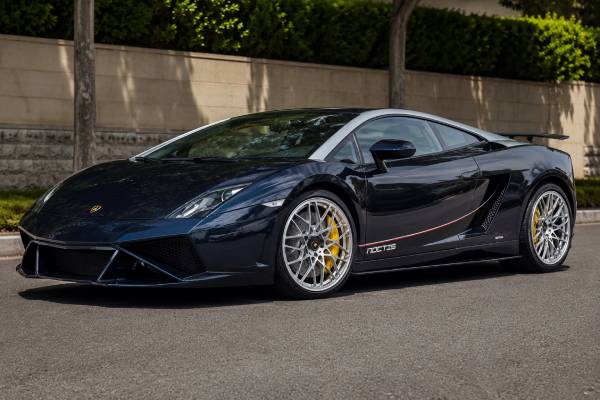

The Lamborghini Gallardo LP 560-4 Noctis is a rare late-run Gallardo built around the sharper 5.2-liter V10, all-wheel drive, and a dramatic two-tone appearance package aimed at Hong Kong and Chinese-market buyers. It is not the lightest, most track-focused, or most famous Gallardo, but it matters because it sits at a sweet point in the model’s story: near the end of production, after the major LP 560-4 mechanical update, and before the Huracán replaced Lamborghini’s best-selling V10 supercar.
For buyers, the Noctis is attractive because it combines familiar LP 560-4 hardware with limited-edition identity. For owners, the key is documentation. A standard Gallardo with similar colors is not the same thing as a Noctis. The car’s value depends heavily on original specification, service records, clutch condition, paint authenticity, and proof that the limited-edition equipment belongs to the VIN.
Table of Contents
- Why the Noctis Matters
- V10 Drivetrain and Core Specs
- Production, Identity, and Options
- Design, Engineering, and Special Details
- Road Feel, Sound, and Performance
- Maintenance Risks and Ownership Reality
- Values, Inspection, and Buying Advice
Why the Noctis Matters
The Noctis is best understood as a rare appearance-led edition of the facelifted Gallardo LP 560-4, not as a separate performance model. Its appeal comes from scarcity, regional-market character, and the proven mechanical package underneath.
The Gallardo itself changed Lamborghini more than almost any other modern model. Launched for the 2004 model year, it gave the brand a smaller V10 companion to its V12 flagship and helped Lamborghini move from occasional exotic-car maker to serious modern supercar manufacturer. The L140 platform ran for a decade, and by the time the LP 560-4 arrived in 2008, the Gallardo had matured into a faster, cleaner, sharper car.
The LP 560-4 update was more than a facelift. It brought a 5.2-liter direct-injection V10, revised styling, quicker e-gear shift logic, improved performance, and a more polished cabin experience. The name tells the basic formula: “LP” means longitudinal rear engine placement, “560” refers to output in metric horsepower, and “4” means four driven wheels.
The Noctis appeared in the final stretch of Gallardo production, generally associated with 2012–2013 and the Hong Kong/Chinese market. It is commonly described as a 20-car special edition, though buyers should treat the exact number as something to verify through Lamborghini documentation rather than relying only on registry entries or seller claims.
Its significance is different from a Superleggera or Squadra Corse. A Superleggera is valued for weight reduction and track-focused hardware. A Noctis is valued for rarity, color treatment, regional provenance, and late-production LP 560-4 drivability. That makes it appealing to collectors who want an unusual Gallardo without accepting the harsher ride, greater carbon-body repair risk, or higher pricing of the LP 570-4 special models.
Today, the Noctis sits in a niche collector position. It is rare enough to deserve special attention, but not widely traded enough to have a simple public price guide. The best examples are original, low-mileage cars with factory paperwork, correct paint and trim, complete service records, and no heavy aftermarket modifications.
V10 Drivetrain and Core Specs
The LP 560-4 Noctis uses the same essential mechanical foundation as the late Gallardo LP 560-4: a naturally aspirated 5.2-liter V10, all-wheel drive, an aluminum spaceframe, and high-performance two-seat coupé packaging. That makes it much more than a cosmetic collectible.
| Area | Specification |
|---|---|
| Platform | Lamborghini Gallardo L140 |
| Body style | Two-door, two-seat coupé |
| Engine | 5.2-liter naturally aspirated V10 |
| Displacement | 5,204 cc |
| Engine family/code reference | CEH-related 5.2 FSI V10 identification is commonly used in parts and catalog contexts; verify by VIN and market documentation |
| Valvetrain | DOHC, 40 valves |
| Fuel system | Direct injection |
| Compression ratio | 12.5:1 |
| Output | 560 hp / 560 PS at 8,000 rpm, depending on market wording |
| Torque | 540 Nm / 398 lb-ft at 6,500 rpm |
| Lubrication | Dry sump |
| Transmission | 6-speed e-gear automated manual on documented Noctis examples; 6-speed manual existed on the wider LP 560-4 range |
| Drivetrain | All-wheel drive with rear limited-slip differential and electronic front axle control support |
| Chassis | Structural aluminum spaceframe |
| Suspension | Double wishbones front and rear |
| Steering | Hydraulic power-assisted rack and pinion |
| Standard brake format | Large ventilated steel discs; carbon-ceramic brakes were option-dependent on the wider Gallardo range |
| Front tires | 235/35 ZR19 |
| Rear tires | 295/30 ZR19 |
| Measure | Figure |
|---|---|
| Wheelbase | 2,560 mm |
| Length | 4,345 mm |
| Width | 1,900 mm |
| Height | 1,165 mm |
| Listed dry/nominal weight | About 1,500 kg, depending on equipment and measurement standard |
| Fuel capacity | About 90 liters / 24 US gallons |
| 0–100 km/h | About 3.7 seconds |
| 0–200 km/h | About 11.8 seconds |
| Top speed | About 325 km/h / 202 mph |
The engine is the star. Unlike today’s turbocharged performance cars, the LP 560-4 makes its pace through displacement, revs, throttle response, and gearing. Peak power arrives at 8,000 rpm, so the car rewards drivers who let the V10 work high in the tachometer. The dry-sump oiling system also reflects the Gallardo’s purpose: it helps control oil supply under hard cornering and allows lower engine packaging than a conventional wet-sump layout.
The all-wheel-drive system gives the LP 560-4 a different character from rear-drive Gallardos such as the LP 550-2 Valentino Balboni. It is less playful at low speeds but more secure under hard launch, poor road surfaces, and fast exits from bends. For many owners, that security is exactly the point.
Production, Identity, and Options
A real Noctis needs paperwork more than folklore. Because the edition’s visual ingredients can be imitated, the safest way to confirm one is through the VIN, factory build data, original sales documents, and Lamborghini dealer or heritage records.
The wider Gallardo family was built from 2003 to 2013, with total production reaching just over 14,000 cars. That was huge by Lamborghini standards at the time, but individual late special editions were far rarer. The Noctis is usually described as a small Hong Kong/Chinese-market edition based on the LP 560-4 coupé and commonly reported as limited to 20 cars.
Known Noctis descriptions center on two-tone dark paint schemes. The most often mentioned exterior themes are dark blue/silver and dark grey/silver combinations, with Blu Fontus and Grigio Lynx appearing in registry and enthusiast references. Interiors are usually described around black leather, Alcantara, and contrast details, though exact trim should be checked against the car’s factory data rather than assumed from online descriptions.
What separates a Noctis from a normal LP 560-4
The important identifiers are the combination of edition status, original two-tone specification, regional-market provenance, and late LP 560-4 equipment. A repaint, wrap, or aftermarket two-tone scheme does not create a Noctis.
A careful buyer should ask for:
- The VIN and original market of delivery.
- Factory option printout or Lamborghini dealer confirmation.
- Original paint codes and trim codes.
- Early registration documents showing market history.
- Service invoices from recognized Lamborghini dealers or specialists.
- Photos showing the car before any repaint, wrap, or accident repair.
- Confirmation of whether wheels, suspension, exhaust, brakes, and interior trim are original.
The broader LP 560-4 range offered both coupé and Spyder body styles, with manual and e-gear transmissions available depending on market and specification. The Noctis, however, is generally documented around the coupé and e-gear setup. That matters for collectors because a seller may use “Noctis” loosely to describe colors rather than a verified factory edition.
Options also influence desirability. Front lift, rear camera, navigation, carbon interior trim, transparent engine cover, upgraded audio, special stitching, and carbon-ceramic brakes can all affect value, but originality matters more than quantity. A modestly optioned but properly documented Noctis is usually more compelling than a heavily modified car with uncertain identity.
Design, Engineering, and Special Details
The Noctis works because the late Gallardo shape already had strong visual tension, and the two-tone treatment makes it look more special without changing the basic body. It is a subtle limited edition by Lamborghini standards, but still dramatic next to normal sports cars.
The LP 560-4 facelift introduced sharper front and rear surfacing than the early Gallardo. The nose gained more angular intakes and a more aggressive lower treatment, while the rear became wider-looking and more horizontal. Lamborghini’s own design language at the time used triangles, trapezoids, and hard-cut volumes, tying the Gallardo visually to the Murciélago LP 640 and the Reventón era.
The Noctis color treatment plays well with that geometry. Dark paint lowers the visual mass of the car, while silver or contrasting upper accents highlight the roofline and shoulders. On a Gallardo, that matters because the body is compact but wide. The two-tone finish makes the car appear flatter, longer, and more technical.
The structure underneath is not decorative. The aluminum spaceframe gives the car stiffness without the cost and repair complexity of a full carbon tub. Aluminum and thermoplastic outer panels help control weight. The mid-mounted V10 sits behind the cabin under a short rear deck, with cooling, intake, and exhaust paths tightly packaged around the engine bay.
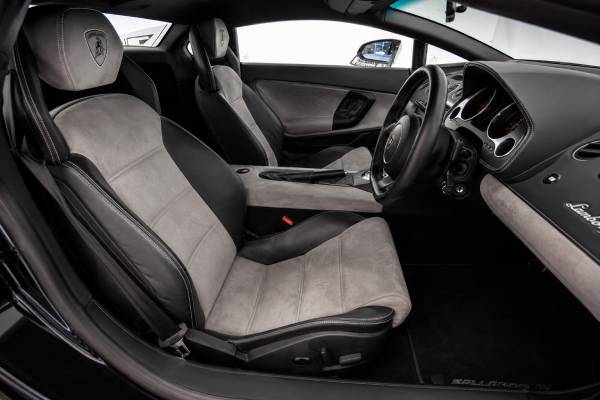
The cockpit is pure late-2000s Lamborghini: low seating, broad center tunnel, Audi-era switchgear, and an upright instrument binnacle. Compared with older Lamborghinis, the Gallardo is much easier to operate. Compared with a modern Huracán, it still feels mechanical and compact. The driving position is low, the nose is difficult to see, and rear visibility is limited, but the control layout is logical once the driver is familiar with it.
The sound is a major part of the design experience. The 5.2 V10 has a harder, sharper note than the earlier 5.0-liter Gallardo engine. It does not need artificial enhancement to feel theatrical. Intake noise builds with revs, the exhaust tightens into a metallic howl, and e-gear upshifts add a mechanical punctuation that suits the car’s character.
Road Feel, Sound, and Performance
The LP 560-4 Noctis feels fast in a direct, naturally aspirated way: instant throttle response, a rising V10 soundtrack, and strong traction rather than turbocharged torque shock. It is still quick by modern standards, but its greatest strength is the way it delivers speed.
From low rpm, the engine is clean rather than explosive. The real drama starts as the tachometer climbs. Above the midrange, the V10 becomes sharper, louder, and more urgent, pulling hard toward 8,000 rpm. That makes the car more involving than many newer forced-induction cars, because the driver gets rewarded for gear choice and rev control.
The e-gear transmission defines much of the experience. It is not a modern dual-clutch gearbox. At low speed, it can feel abrupt if the driver treats it like a torque-converter automatic. Driven correctly, with a slight lift during normal upshifts and firmer throttle in sportier modes, it feels much better. Corsa mode sharpens the shifts and suits hard driving, but it is not the best choice for city traffic or clutch life.
Steering is one of the LP 560-4’s best qualities. The hydraulic rack has weight and road feel that many modern electric systems lack. The front end is precise, and the car feels planted at speed. The all-wheel-drive system gives secure traction, especially when exiting corners, though it also means the car is less eager to rotate than a rear-drive Gallardo.
Ride quality depends heavily on tires, suspension condition, and wheel setup. On fresh premium tires and healthy dampers, the car is firm but usable. Old tires, damaged wheels, tired suspension bushings, or poor alignment can make it tramline, crash over bumps, or feel nervous. A Gallardo that drives badly is often telling you about deferred maintenance rather than an inherent flaw.
Braking is strong, but condition matters. Steel brakes are robust and more affordable to service. Carbon-ceramic brakes, when fitted, reduce fade and unsprung mass but are expensive if discs are worn, chipped, or heat-damaged. Buyers should not judge carbon-ceramic brakes only by pad thickness; disc condition and measured wear are critical.
In normal use, the Noctis is surprisingly manageable for a supercar of its era. It has usable air conditioning, reasonable ergonomics, a front luggage compartment, and strong stability at highway speed. It is not quiet, soft, or easy to park, but it can be driven regularly if maintained properly and treated with mechanical sympathy.
Maintenance Risks and Ownership Reality
The LP 560-4 is one of the more usable older exotic cars, but it is still an exotic with expensive parts, specialist labor, and age-related risk. The safest cars are not always the lowest-mileage cars; they are the cars with consistent maintenance and correct storage.
The 5.2 V10 is generally strong when serviced properly. It needs clean oil, correct warm-up, healthy cooling, good fuel, and attention to leaks or misfires before they become costly. Long idle periods, weak batteries, poor aftermarket tuning, neglected fluids, and cheap replacement parts can create problems that a pre-purchase inspection will often reveal.
Common inspection areas
- E-gear clutch wear: Ask for a proper clutch wear reading, engagement data, and an assessment from a technician who understands Gallardo e-gear behavior. A car that creeps, shudders, smells of clutch, or shifts harshly in normal mode may need adjustment or hardware.
- E-gear hydraulics: Pumps, accumulators, actuators, sensors, and wiring can cause shift faults. Intermittent faults should not be dismissed as “normal Lamborghini character.”
- Cooling system: Check front radiators, hoses, water pump history, thermostat behavior, coolant leaks, and fan operation. Stone damage at the front of the car is common.
- Oil leaks: Inspect dry-sump lines, cam covers, seals, and undertrays. A clean underside is good, but fresh cleaning before sale can hide leaks.
- Suspension and lift system: If fitted with front lift or adjustable suspension, check for leaks, warning lights, uneven operation, and tired dampers.
- Brakes: Measure disc condition, pad life, caliper condition, and brake-fluid service history. Carbon-ceramic replacement costs can change the economics of a purchase.
- Tires: Old tires ruin the car. Date codes matter as much as tread depth on a high-speed supercar.
- Electrical systems: Battery health is critical. Low voltage can cause confusing faults in modules, e-gear systems, alarm systems, and infotainment.
- Recall and software history: The 2011–2014 Gallardo recall involving ECU software and warning-lamp behavior should be checked by VIN.
Service planning should be annual, not mileage-only. Many Gallardos cover low mileage, but fluids age, tires harden, batteries weaken, seals dry, and rubber parts deteriorate. A car that has traveled only a few hundred miles in several years may still need a major catch-up service.
Originality is also part of maintenance. Exhaust systems, tunes, lowered suspension, wheel spacers, and cosmetic carbon parts are common on Gallardos. Some upgrades are reversible and harmless; others reduce collector appeal or create emissions, heat, clutch, or drivability issues. On a Noctis, modifications carry extra risk because the limited-edition value depends on factory-correct presentation.
Values, Inspection, and Buying Advice
Buy the best-documented Noctis you can find, not simply the cheapest Gallardo with similar paint. The edition’s rarity only adds value when the car’s identity, condition, and history are clear.
Public market data for standard LP 560-4 coupés is much easier to find than data for Noctis cars. In the 2026 market, normal LP 560-4 coupés often sit broadly in the low-six-figure to mid-six-figure range in US-dollar terms depending on mileage, transmission, condition, history, and specification. Exceptional late cars, rare factory options, and very low mileage can push higher. Cars with stories, heavy modifications, accident history, weak records, or looming clutch and brake costs trade lower.
The Noctis should command a premium only when the car proves what it is. A seller asking limited-edition money should be able to provide limited-edition evidence. Without that, price it as a normal LP 560-4 with an attractive specification.
| Value factor | Why it matters |
|---|---|
| Factory documentation | Confirms the car is a genuine Noctis rather than a lookalike |
| Original paint and trim | Two-tone identity is central to the edition |
| Low but usable mileage | Supports collectability while reducing storage-related concern |
| Dealer or specialist service history | Shows proper care of e-gear, fluids, brakes, and software |
| Clutch and brake condition | Large upcoming costs can erase a price advantage |
| Accident-free structure | Aluminum chassis and panel repairs must be judged carefully |
| Unmodified specification | Collectors generally favor original cars, especially limited editions |
| Regional provenance | Hong Kong/Chinese-market history supports the Noctis story |
Pre-purchase inspection priorities
A proper inspection should include a cold start, road test, diagnostic scan, lift inspection, paint-depth readings, clutch data, brake measurements, tire date checks, and verification of all VIN tags and labels. The inspector should know Gallardos specifically. A general performance-car inspection is not enough.
Avoid cars with vague stories. “Limited edition,” “special order,” and “one of a few” are not proof. Also be careful with cars that have missing undertrays, aftermarket exhaust tuning without records, warning lights blamed on batteries, inconsistent paint readings, or service gaps after import.
The best Noctis is a car that still looks, drives, and documents like a factory late-run LP 560-4 special edition. It should start cleanly, shift predictably, track straight, cool properly, stop without vibration, and show no unexplained warning lights. It should also come with enough paperwork that the next buyer will not have to repeat the identity debate.
Long-term collectability looks favorable but selective. The Gallardo is no longer just a used exotic; it is now the car that built modern Lamborghini volume and preserved the naturally aspirated V10 formula before hybridization and heavy software control changed the supercar landscape. The Noctis adds rarity to that story. Still, rarity alone is not magic. Condition, authenticity, and maintenance discipline will decide which cars become true collector pieces.
References
- Lamborghini Gallardo LP 560-4 Coupé – Technical Specifications, Pictures 2026 (Manufacturer Model Page)
- Recall Campaign | Lamborghini.com 2026 (Recall Database)
- Part 573 Safety Recall Report 18V-833 2018 (Recall Report)
- Lamborghini Gallardo LP560-4 – Specs & Performance – LamboCars 2012 (Technical Specification Reference)
- ECR – Lamborghini Gallardo LP 560-4 Noctis list 2026 (Registry Reference)
Disclaimer
This article is for informational purposes only and is not a substitute for professional diagnosis, inspection, repair, valuation, or legal advice. Specifications, torque values, service intervals, software campaigns, procedures, and equipment can vary by VIN, market, model year, and factory options. Always verify details against official Lamborghini service documentation, dealer records, and a qualified Lamborghini specialist before buying, servicing, or repairing a vehicle.
If this guide helped, please share it on Facebook, X/Twitter, or your favorite enthusiast community to support our work.