
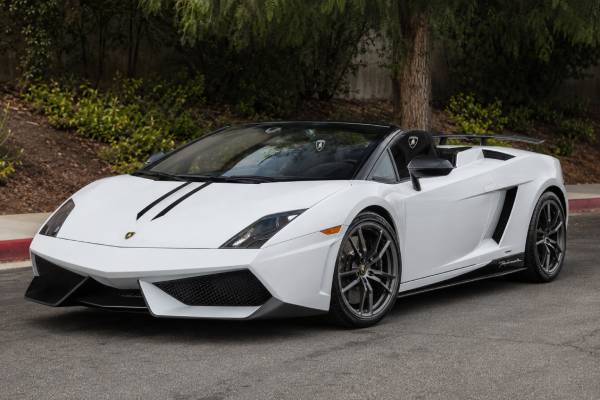
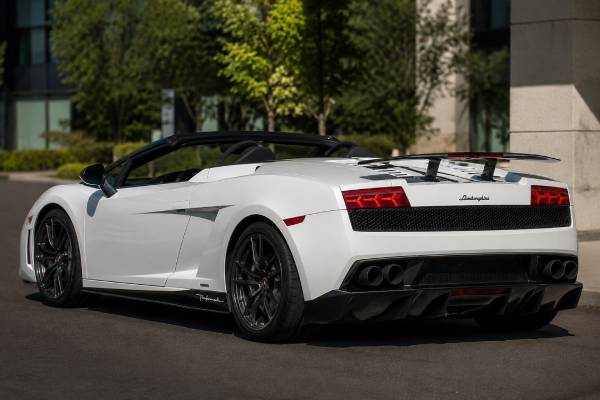
The Lamborghini Gallardo LP 570-4 Spyder Performante is the open-air, lightweight, high-output version of the late Gallardo line. It takes the harder-edged formula of the LP 570-4 Superleggera and adds a folding fabric roof, more sound, and a slightly more dramatic road presence. For buyers and collectors, it matters because it sits near the end of the original Gallardo era: naturally aspirated V10 power, compact proportions, all-wheel-drive security, and a rawer single-clutch transmission feel than later dual-clutch Lamborghinis.
This is not simply a louder Gallardo Spyder with more carbon trim. The Performante has a specific role in the model family. It is lighter, sharper, rarer, and more focused than the regular LP 560-4 Spyder, yet still usable enough for road driving. The best cars today are judged by originality, mileage, factory specification, service records, roof condition, clutch health, and whether the costly lightweight and carbon-ceramic parts are intact.
Table of Contents
- Why the Spyder Performante Still Matters
- Key Specs and Mechanical Layout
- Versions, Options, and Identification Points
- Design, Engineering, and Signature Details
- Road and Track Driving Character
- Maintenance Risks and Owner Care
- Market Values and Buying Checklist
Why the Spyder Performante Still Matters
The LP 570-4 Spyder Performante is important because it captures the final, most focused open-top version of the Gallardo formula. It combines the Superleggera’s lightweight intent with the drama of a soft-top V10 Lamborghini, making it one of the most desirable non-race Gallardo variants.
The Gallardo itself changed Lamborghini. Launched for the 2004 model year and built through 2013, the L140 Gallardo became the brand’s volume supercar and proved that Lamborghini could build something exotic, fast, and repeatable in larger numbers. It sat below the Murciélago and later the Aventador, but it was not a lesser car in character. It was smaller, easier to place on the road, and more approachable for real driving.
The LP 570-4 Spyder Performante arrived late in the model cycle. By then, Lamborghini had already updated the Gallardo from the early 5.0-liter V10 to the later 5.2-liter direct-injection V10 and had introduced the LP naming system. “LP” stands for longitudinal rear placement, “570” refers to metric horsepower, and “4” points to all-wheel drive.
The Performante’s job was clear: give buyers a lighter, sharper, more emotional Gallardo Spyder without turning it into a track-only special. It followed the same general idea as the LP 570-4 Superleggera coupe, but the open body changed the experience. With the roof down, the intake note, metallic V10 howl, exhaust crackle, and single-clutch gearshifts are more exposed. That sensory side is a large part of the car’s appeal.
The car also matters because it sits at a dividing line. Later Lamborghini V10 models, especially the Huracán, became faster, more polished, and easier to drive thanks to dual-clutch gearboxes, more advanced electronics, and stronger structures. The Gallardo Performante feels older in the best and worst ways: more mechanical, more abrupt, more compact, and more demanding of sympathy.
Collectors care about it for several reasons:
- It belongs to the final generation of Gallardo models.
- It uses the high-output 5.2-liter naturally aspirated V10.
- It has factory lightweight parts and a more focused chassis setup.
- It is rarer than a regular LP 560-4 Spyder.
- It offers open-air sound without losing the all-wheel-drive character of the LP 570-4 line.
- It represents a bridge between analog-feeling Lamborghinis and the more digital Huracán era.
Exact production totals for the Spyder Performante are often discussed but not always supported by factory documentation in public listings. Treat any quoted low-production number as useful context, not proof. For buying and valuation, a verified build record, original window sticker, factory certificate, and consistent VIN-specific documentation matter more than a seller’s rarity claim.
Key Specs and Mechanical Layout
The LP 570-4 Spyder Performante is built around a 5.2-liter naturally aspirated V10, all-wheel drive, and a lightweight open body. Its headline figures remain serious today: 570 metric horsepower, 0–100 km/h in about 3.9 seconds, and a top speed around 324 km/h.
| Category | Specification |
|---|---|
| Platform | L140 Gallardo |
| Production era covered | 2011–2013 |
| Engine code | CEH-family 5.2-liter V10 |
| Engine layout | Mid-mounted, longitudinal, naturally aspirated V10 |
| Displacement | 5,204 cc |
| Fuel system | Direct gasoline injection |
| Power | 570 PS at 8,000 rpm |
| Torque | 540 Nm at 6,500 rpm |
| Transmission | 6-speed e-gear automated manual in most factory examples |
| Drivetrain | Permanent all-wheel drive with rear-biased character |
| Body style | 2-door, 2-seat soft-top Spyder |
| Dry weight | About 1,485 kg |
| 0–100 km/h | About 3.9 seconds |
| Top speed | About 324 km/h |
The engine is the centerpiece. Unlike turbocharged modern performance engines, the Gallardo’s V10 makes its drama through revs, throttle response, and sound. Peak power arrives high in the rev range, so the car rewards drivers who let the engine climb. The torque figure is strong, but this is not a lazy low-rpm engine. It feels most alive from the midrange to the redline.
The “4” in LP 570-4 matters in daily use. The all-wheel-drive system gives the Performante a planted feel, especially when the tires are warm and the road surface is uneven. It does not make the car harmless, but it does give it a different character from rear-wheel-drive Gallardo variants. The car prefers clean inputs: brake in a straight line, settle the chassis, then feed in throttle as the front and rear axles load up.
The transmission is a major part of the ownership experience. The e-gear unit is not a torque-converter automatic and not a modern dual-clutch gearbox. It is a single-clutch automated manual. That means it uses an automated clutch and shift mechanism to operate a conventional manual-style gearbox. When driven gently, it can feel clumsy compared with later dual-clutch cars. When driven with intent, especially with a small throttle lift during upshifts, it feels more natural and more mechanical.
The chassis uses an aluminum spaceframe with double-wishbone suspension. Carbon-fiber and lightweight components help offset the added weight of the roof system and open-body structure. Carbon-ceramic brakes were a key part of the high-performance specification on many examples, and they are one of the most important inspection points because replacement costs are substantial.
Versions, Options, and Identification Points
The key distinction is simple: the Spyder Performante is the lightweight, high-output Gallardo Spyder, not a standard LP 560-4 Spyder with cosmetic additions. Buyers should verify the exact model, factory equipment, and any Edizione Tecnica features through VIN-specific documentation before paying a premium.
The LP 570-4 family included several important models. The Superleggera was the lightweight coupe. The Spyder Performante translated that idea into an open-top car. Later Edizione Tecnica versions added a more defined final-edition flavor with visual contrast details and desirable standard or bundled equipment.
| Version | Role in the range | Buyer relevance |
|---|---|---|
| LP 560-4 Spyder | Standard facelift all-wheel-drive open Gallardo | Less focused, usually cheaper, more common |
| LP 570-4 Superleggera | Lightweight coupe | Sharper and more track-biased, but no open-roof experience |
| LP 570-4 Spyder Performante | Lightweight open-top performance model | Best mix of noise, rarity, and usability for many collectors |
| LP 570-4 Spyder Performante Edizione Tecnica | Final-era enhanced specification | Often more desirable when original and well documented |
Factory and dealer documentation matters because many Gallardos have been modified. Wheels, stripes, wings, exhausts, carbon trim, steering wheels, and even transmission configurations can be changed after delivery. A car should be judged by what it was built as, not only by how it looks today.
Useful identification and authenticity checks include:
- Confirm the VIN decodes as the correct LP 570-4 Spyder Performante.
- Check the original window sticker, build sheet, or Lamborghini dealer documentation.
- Verify whether the car left the factory with e-gear, carbon-ceramic brakes, front axle lift, camera, navigation, carbon interior trim, and specific wheel design.
- Inspect the carbon rear wing, diffuser, side skirts, mirror trim, and interior carbon for factory finish and correct fit.
- Check whether stripes, contrast panels, painted wheels, and caliper colors match the original order.
- Confirm roof color, upholstery, stitching, and seat type against factory records.
- Treat manual-converted cars as modified unless factory documentation proves otherwise.
Common desirable equipment includes the front lift system, carbon packages, sport seats, carbon-ceramic brakes, forged wheels, rear-view camera, navigation, Alcantara interior trim, and well-chosen exterior colors. None of these replaces condition, but they can influence value when two cars are otherwise similar.
For collectors, originality is often worth more than added parts. A loud aftermarket exhaust may make the car more exciting on a short drive, but it can hurt value if the original exhaust is missing. The same applies to wheel changes, lowered suspension, non-factory wraps, aftermarket carbon, and ECU tuning. Reversible upgrades are easier to accept when the original parts come with the car.
The Edizione Tecnica name deserves care. It is not just a sticker package in the eyes of the market, but sellers sometimes use the term loosely. A true Edizione Tecnica should be confirmed through build records, not assumed from contrast stripes or a wing.
Design, Engineering, and Signature Details
The Spyder Performante looks dramatic because its design serves a clear purpose: reduce weight, sharpen the airflow, and make the open Gallardo feel more special. Its wedge profile, exposed rear mass, fixed wing, carbon details, and low roofline give it more presence than the standard Spyder.
The Gallardo shape is compact by modern supercar standards. It is wide and low, but not huge. That makes the car easier to place on narrow roads than newer Lamborghinis, and it helps explain why enthusiasts still like driving it. The Performante version adds aggression without losing the clean Gallardo outline.
The soft-top is central to the car’s identity. Lamborghini did not try to make it a folding hardtop. The fabric roof keeps the profile lower and lighter, and it preserves the classic open supercar feel. With the roof down, the rear deck and buttress area make the car look broader, while the sound from the V10 becomes a major part of the experience.
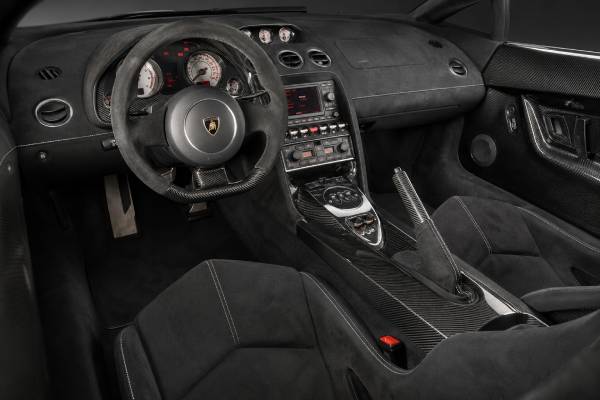
Lightweight engineering appears throughout the car. Depending on specification, examples may include carbon-fiber exterior parts, carbon interior trim, lightweight seats, Alcantara instead of heavier leather in key areas, and forged wheels. The point was not only to remove mass but also to make the car feel more alert.
The engine placement shapes everything. A longitudinal V10 sits behind the cabin, so the driver feels the car rotating from behind the seats. Cooling intakes, rear vents, and exhaust routing are not decoration. They manage heat from a tightly packaged, high-revving engine in a compact body.
The exhaust note is one of the car’s defining traits. The CEH-family 5.2-liter V10 has a harder, sharper sound than the early 5.0-liter Gallardo engine. It is smooth at light throttle, metallic as the revs rise, and genuinely theatrical near the top end. In a Spyder, those sounds reach the cabin with little filtering.
The cockpit is also part of the late-Gallardo charm. It is not as screen-heavy as modern cars. The driver faces a compact instrument layout, physical controls, paddle shifters, and a low windscreen. Some switchgear reminds you of the Audi-era parts-bin relationship, but the driving position, sound, and view over the front fenders keep the car feeling unmistakably Lamborghini.
Compared with the Huracán that followed, the Spyder Performante feels narrower in focus and older in execution. The Huracán is faster and more polished. The Gallardo is more abrupt, more mechanical, and more transparent about its age. That difference is exactly why many buyers now seek late Gallardos: they feel like supercars that still ask the driver to adapt.
Road and Track Driving Character
The Spyder Performante is fast, but its real appeal is how it delivers speed. It feels compact, noisy, high-revving, and physical, with all-wheel-drive traction and a single-clutch gearbox that rewards timing rather than casual inputs.
At low speed, the car can feel more demanding than its numbers suggest. The e-gear clutch needs sympathy, especially when parking, reversing, creeping in traffic, or climbing steep driveways. A good driver treats it like a manual gearbox being operated by hydraulics: avoid unnecessary slip, avoid holding it on the throttle on hills, and do not let it crawl for long periods.
Once moving, the car becomes more natural. Throttle response is immediate, and the engine’s character builds with rpm. It does not have the shove of a modern turbocharged engine at low revs, but it feels cleaner and more exciting as it climbs. The best acceleration comes when the V10 is kept in its upper range.
The e-gear shift quality depends heavily on mode, throttle position, and driver behavior. In relaxed use, it can pause and nod the car forward during shifts. In harder driving, especially with a small lift or committed throttle, it feels sharper and more purposeful. Corsa mode makes the shifts faster and more aggressive, but it also increases wear if used carelessly.
The steering is one of the Gallardo’s strongest points. It has real weight, a compact front-end feel, and better road texture than many newer electric-assist systems. The front axle feels secure, but the car is still rear-biased in attitude. Enter a corner too quickly and it can push wide; use clean braking and throttle timing and it becomes stable, fast, and confidence-inspiring.
Ride quality is firm but not unbearable. The Performante’s lightweight and performance focus mean it is not as relaxed as a regular Spyder, especially on poor roads or old tires. Tire choice has a major effect. Fresh, correct high-performance tires make the car feel alive and predictable. Old, hardened tires make it nervous, noisy, and less trustworthy.
The brakes are powerful, especially with carbon-ceramic discs in good condition. On the road they can feel slightly wooden when cold, but they offer strong resistance to fade when warm. On track, brake condition and tire temperature matter more than the brochure numbers. A car with aged fluid, old tires, or chipped ceramic discs should not be pushed hard until inspected.
Visibility is better than many expect for a Lamborghini, but not ordinary. The nose is low, the car is wide, and rear visibility changes with the roof position. Parking sensors and a rear camera are useful. The front lift system is also valuable because the nose and underbody are vulnerable on ramps, curbs, and uneven roads.
As a road car, the Spyder Performante is at its best on open, flowing routes where it can breathe. It is not ideal for heavy commuting, tight city traffic, or short cold starts. It wants temperature, space, and a driver who enjoys the process.
Maintenance Risks and Owner Care
The Gallardo LP 570-4 Spyder Performante can be reliable for an exotic, but it is not cheap to own. The largest risks are clutch wear, e-gear hydraulic faults, roof-system issues, carbon-ceramic brake costs, old tires, deferred annual servicing, and accident or modification history.
A specialist inspection is essential before purchase. This is not a car where a clean exterior and low mileage are enough. Low-use examples can still need expensive work because fluids age, seals dry out, tires expire, batteries weaken, and hydraulic systems dislike sitting.
Important ownership areas include:
- E-gear clutch and hydraulics: Clutch wear should be read with proper diagnostic equipment. Ask for current clutch wear data, not a vague seller estimate. Inspect the actuator, pump behavior, accumulator, hydraulic lines, and shift quality.
- Engine health: The 5.2-liter V10 is strong when serviced, but oil leaks, coil or ignition issues, sensor faults, intake leaks, heat damage, and neglected fluids can become costly.
- Cooling system: Front radiators and condensers can collect debris and suffer stone damage. Poor cooling performance should be investigated before it becomes an overheating problem.
- Carbon-ceramic brakes: Inspect rotor condition, minimum weight, chips, cracks, pad life, and caliper condition. Cosmetic shine is not enough.
- Roof mechanism: Check full operation from cold and warm conditions. Inspect fabric, rear window, seals, cables, motors, microswitches, drains, and hydraulic behavior.
- Front lift system: Look for leaks, slow operation, warning lights, uneven lift, and signs of underbody impact.
- Suspension and steering: Ball joints, bushings, dampers, wheel bearings, alignment, and tire wear reveal how the car has been driven.
- Electrical system: Weak batteries can trigger strange warning lights. Confirm modules, warning lamps, immobilizer behavior, and charging health.
- Interior aging: Sticky buttons, worn Alcantara, loose trim, seat bolster wear, and damaged carbon are common inspection items.
The 2011–2014 Gallardo range was also subject to a U.S. safety recall related to ECU software that could fail to retain trouble codes after key-off, preventing warning lamps from appearing on restart. A buyer should confirm by VIN whether any applicable recall or campaign has been completed.
Service intervals vary by market and documentation, but annual service is the safe ownership baseline for a car like this. Time matters as much as mileage. A 2,000-mile car that skipped several years of service is not automatically better than a 12,000-mile car with consistent specialist records.
Ask for invoices, not just stamps. A strong file should show fluids, filters, brake fluid, gearbox and differential service where due, clutch readings, tires by date code, battery replacements, roof repairs if any, software updates, and recall completion. For a collector-grade car, the original books, tools, keys, tire inflator, window sticker, sales invoice, and factory accessories all help.
Restoration is not the right word for most Performantes yet, but recommissioning can be expensive. A neglected car may need tires, fluids, clutch work, roof service, battery, brakes, sticky-button refinishing, paint correction, undertray repairs, and suspension refresh before it feels right. That cost can erase any discount on the purchase price.
Originality versus upgrades is a real tradeoff. A sports exhaust, aftermarket wheels, manual conversion, or suspension change may suit one owner, but collectors usually prefer factory-correct cars. If a modified car interests you, value it as a modified example and make sure the original parts are included.
Market Values and Buying Checklist
The Spyder Performante sits above ordinary Gallardo Spyders in the market because it has rarity, performance, lightweight parts, and late-model appeal. As of mid-2026, normal usable examples tend to trade far below the most publicized outliers, while exceptional low-mile, rare-color, or special-spec cars can command a strong premium.
The market is thin, so single sales can distort expectations. A modified car with higher mileage may sit near the lower end of the range, while a very low-mile final-year or Edizione Tecnica car with strong colors and complete documentation can reach much higher. Manual-converted cars are their own category and should not be used as direct evidence for factory e-gear values unless the buyer specifically wants that conversion.
A practical value framework looks like this:
| Example type | Typical market position | Main risk |
|---|---|---|
| Higher-mile or modified driver | Lower price band for the model | Deferred service, clutch wear, missing original parts |
| Clean, serviced driver | Most sensible ownership choice | Still needs careful roof, brake, and e-gear inspection |
| Low-mile original car | Premium collectible band | Age-related recommissioning despite low mileage |
| Edizione Tecnica or rare color | Higher premium when verified | Seller overpricing without complete documentation |
| Manual-converted car | Specialist niche | Quality of conversion and future collector acceptance |
The best cars are not always the lowest-mile cars. A low-mile example that sat for years may need more money than a regularly exercised car with careful service. For driving, the sweet spot is often a clean, original, well-maintained car with enough mileage to prove it works but not so much that interior wear, clutch wear, and suspension fatigue dominate the inspection.
Value drivers include:
- Verified LP 570-4 Spyder Performante identity.
- Factory originality and matching documentation.
- Desirable color and interior combination.
- Edizione Tecnica status, if proven.
- Low but believable mileage.
- Complete service history from Lamborghini dealers or respected specialists.
- Healthy e-gear clutch reading and smooth operation.
- Excellent carbon-ceramic brake condition.
- Fully working roof and front lift.
- No accident history, paint mismatch, or structural repair.
- Original wheels, exhaust, carbon parts, books, tools, and keys.
Avoid cars with unexplained warning lights, missing service history, poor roof operation, clutch readings that do not match driving feel, cheap tire brands, damaged carbon, undisclosed paintwork, weak batteries, and sellers who cannot provide documentation. Also be careful with cars that have been heavily wrapped, tracked without records, or repeatedly listed across dealers with changing stories.
A pre-purchase inspection should include:
- VIN and build verification.
- Paint-depth readings and body-panel inspection.
- Undercarriage and front splitter check.
- Diagnostic scan with e-gear clutch data.
- Roof operation test.
- Front lift test.
- Brake rotor, pad, and tire inspection.
- Cooling-system and leak check.
- Road test from cold start to full operating temperature.
- Review of invoices, recalls, ownership history, and original equipment.
For long-term collectability, the Performante has a strong case. It is the lightweight open Gallardo, it has the high-output naturally aspirated V10, and it belongs to the last chapter of the model that made Lamborghini a modern supercar manufacturer. It will not appeal to every buyer because the e-gear gearbox feels dated beside newer dual-clutch cars. But for collectors who want noise, compact size, rarity, and a more mechanical Lamborghini feel, that dated quality is part of the charm.
References
- Lamborghini Gallardo LP 570-4 Spyder performante – Technical Specifications, Pictures 2026 (Manufacturer Specification Page)
- Huracán Surpasses Gallardo: New Production Record 2019 (Manufacturer Production Record)
- Independent Operator 2026 (Manufacturer Service Information)
- Part 573 Safety Recall Report 18V-833 2018 (Recall Database)
- Lamborghini Gallardo LP570-4 Spyder Performante Market – CLASSIC.COM 2026 (Market Data)
Disclaimer
This article is for informational purposes only and is not a substitute for professional diagnosis, repair, valuation, or inspection. Specifications, torque values, service intervals, software campaigns, parts, and procedures can vary by VIN, market, model year, and equipment. Always verify details against the official Lamborghini service documentation and have any purchase or repair assessed by a qualified Lamborghini specialist.
If this guide helped you, please consider sharing it on Facebook, X/Twitter, or your preferred car community to support our work.