
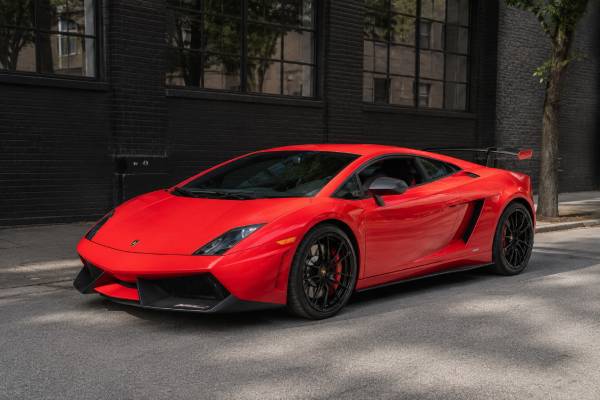
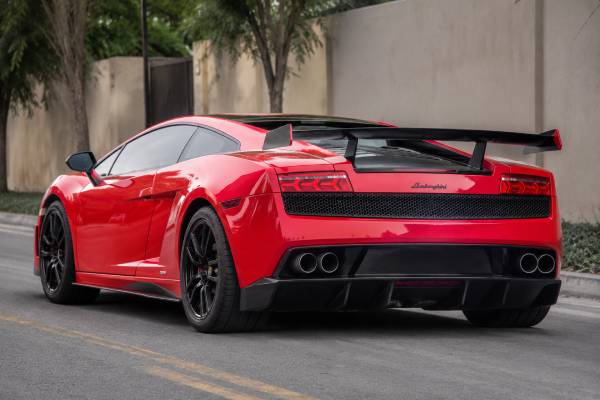
The Lamborghini Gallardo LP 570-4 Super Trofeo Stradale is the road-legal Gallardo that sits closest to Lamborghini’s one-make racing program. It takes the late L140-generation Gallardo, adds the 570 PS 5.2-litre V10, e-gear all-wheel-drive hardware, carbon-fiber weight saving, a huge race-style rear wing, and the visual attitude of the Gallardo Super Trofeo race car. Only 150 were planned, which makes it far rarer than the standard LP 560-4 and more specialized than the LP 570-4 Superleggera.
For buyers, the appeal is clear: it is limited, loud, naturally aspirated, and tied to Lamborghini motorsport. For owners, the reality is equally clear: condition, documentation, clutch health, carbon-ceramic brake condition, originality, and accident history matter more than ordinary used-car mileage. The best examples feel raw without being unusable, but tired or modified cars can become expensive very quickly.
Table of Contents
- Why the Super Trofeo Stradale Matters
- CEH V10, Chassis, and Key Specs
- Production, Options, and Authenticity Checks
- Race-Derived Design and Engineering Details
- What It Feels Like to Drive
- Maintenance Risks and Specialist Care
- Market Values and Buying Strategy
Why the Super Trofeo Stradale Matters
The Super Trofeo Stradale matters because it is not just another Gallardo special edition; it is the street version most directly tied to Lamborghini’s Super Trofeo racing identity. It arrived near the end of the Gallardo’s life, when Lamborghini already knew the model had become one of its most successful cars.
The Gallardo itself launched in 2003 and changed Lamborghini’s scale. Before it, Lamborghini production was small, dramatic, and often financially fragile. Under Audi ownership, the Gallardo brought a new level of repeatable build quality, a compact V10 layout, everyday usability, and global dealer support. It did not replace the V12 flagship idea; it created a second Lamborghini product line that could sell in much larger numbers.
The LP 570-4 Super Trofeo Stradale appeared at the 2011 Frankfurt Motor Show and belonged to the final, sharper phase of the L140 platform. Its name explains the basic layout:
- LP means longitudinale posteriore, referring to the longitudinal rear-mid-mounted engine.
- 570 refers to the factory power rating in metric horsepower, commonly presented as 570 hp in model naming.
- 4 means all-wheel drive.
- Super Trofeo Stradale means a road car inspired by the Super Trofeo racing series.
This car sits above the standard LP 560-4 and alongside the LP 570-4 Superleggera in the late Gallardo range. The Superleggera is the cleaner lightweight road car. The Super Trofeo Stradale is more extroverted, more race-themed, and more collectible because of its production cap and its direct visual connection to the racing car.
Its timing also helps its reputation today. By 2011, supercars were moving quickly toward dual-clutch transmissions, active systems, turbocharging, hybrid boost, and heavier electronic control. The Super Trofeo Stradale still uses a naturally aspirated V10, hydraulic steering, a single-clutch automated manual gearbox, and a body shape that feels compact by modern supercar standards. That mix gives it a mechanical edge that many newer cars smooth away.
Collectors pay attention for four main reasons. First, production was limited to 150 numbered units. Second, it uses the late 5.2-litre Gallardo drivetrain in one of its most focused factory road-car forms. Third, its design is instantly identifiable because of the wing, carbon hood, quick-release hood details, and Rosso Mars launch color. Fourth, it represents the end-of-era Gallardo before the Huracán changed the V10 Lamborghini formula.
It is not the rarest modern Lamborghini, and it is not the most powerful. Its appeal is more specific: it is a usable, road-legal, naturally aspirated, motorsport-styled V10 Lamborghini from the closing chapter of the Gallardo story.
CEH V10, Chassis, and Key Specs
The core specification is simple: a 5.2-litre naturally aspirated V10, six-speed e-gear transmission, all-wheel drive, carbon-fiber weight saving, and a dry weight of 1,340 kg. That gives the Super Trofeo Stradale the same basic performance character as the LP 570-4 Superleggera, but with a stronger race-car visual package.
Core technical specifications
| Category | Specification |
|---|---|
| Platform | L140 Gallardo |
| Engine code / layout | CEH 5.2-litre V10, rear-mid-mounted longitudinally |
| Displacement | 5,204 cc |
| Induction | Naturally aspirated |
| Valvetrain | DOHC, four valves per cylinder |
| Output | 570 PS at 8,000 rpm, commonly marketed as 570 hp |
| Torque | 540 Nm at 6,500 rpm |
| Transmission | Six-speed e-gear automated manual |
| Drivetrain | Permanent all-wheel drive |
| Body style | Two-door coupe |
| Dry weight | 1,340 kg |
| 0–100 km/h | 3.4 seconds |
| Top speed | 320 km/h |
The V10 is the center of the car’s character. It is not boosted, softened, or torque-filled like a modern turbo engine. It wants revs. Peak power arrives high in the tachometer, and peak torque is also high, so the car feels best when driven with commitment. Around town it can behave, but the engine’s real personality appears above the middle of the rev range.
The e-gear transmission is a single-clutch automated manual, not a modern dual-clutch gearbox. That difference matters. A dual-clutch shifts with near-continuous torque. E-gear interrupts power during the shift, then re-engages the clutch. In gentle driving, that can feel jerky if the driver treats it like a torque-converter automatic. It works best when the driver slightly eases the throttle during low-speed shifts and uses firmer throttle inputs when driving quickly.
Dimensions, tires, and hardware
| Area | Detail |
|---|---|
| Chassis construction | Aluminum spaceframe with aluminum and carbon-fiber body components |
| Suspension | Double wishbones front and rear |
| Steering | Hydraulic power-assisted steering |
| Wheels | 19-inch lightweight forged wheels |
| Tires | Pirelli P Zero Corsa, commonly 235/35 ZR19 front and 295/30 ZR19 rear |
| Brakes | High-performance braking system; carbon-ceramic brakes available on request |
| Wheelbase | 2,560 mm |
| Length | About 4,387 mm |
| Width | About 1,900 mm |
| Height | About 1,166 mm |
The dry-weight number deserves careful reading. Dry weight does not include all operating fluids, so a real road-ready car weighs more. Still, the figure is useful because Lamborghini used it to show the car’s weight saving versus the standard LP 560-4. The key point is not the exact scale weight; it is the combination of a lighter body package, a high-revving V10, sticky tires, and a more aggressive aerodynamic setup.
The all-wheel-drive system gives the car traction out of slower corners and makes it easier to deploy power than a rear-drive special in poor conditions. It also means the car is not as playful as a rear-drive Gallardo. The Super Trofeo Stradale’s mission is stability, speed, and drama, not smoky oversteer.
Production, Options, and Authenticity Checks
The most important production fact is the planned run of 150 numbered cars. Because the model is rare and often visually copied, buyers should verify the numbered plaque, factory specification, VIN, service records, and original equipment before paying a limited-edition premium.
The Super Trofeo Stradale was introduced in 2011 and is commonly tied to the 2012 model year in many records. It belongs to the final Gallardo period that ended in 2013, when the last Gallardo left production. That is why model-year descriptions can vary by market, registration date, and listing source. For buying purposes, the exact VIN and factory documentation matter more than the casual model-year label in an advertisement.
How it differs from nearby Gallardo versions
The Super Trofeo Stradale is easiest to understand by comparing it with related late Gallardo models:
| Model | Main character | Collector note |
|---|---|---|
| LP 560-4 | Standard late all-wheel-drive Gallardo with 5.2-litre V10 | More common, easier to find, less focused |
| LP 570-4 Superleggera | Lightweight, sharper road car with 570 PS V10 | Important performance base for the Super Trofeo Stradale |
| LP 570-4 Spyder Performante | Open-top lightweight LP 570-4 | More emotional open-air car, less track-themed in body style |
| LP 570-4 Super Trofeo Stradale | Road-going Super Trofeo-inspired limited coupe | 150-unit rarity, wing and carbon details are central to value |
| LP 570-4 Squadra Corse | Later race-inspired Gallardo special | Related in spirit, but a separate model and usually treated separately by collectors |
The launch color was Rosso Mars, a bright red chosen to connect the car with Italian racing color tradition. Grigio Telesto and Bianco Monocerus were also available. The black rear wing, black hood treatment, dark air intakes, high-gloss black wheels, and red-black interior theme made the launch specification especially recognizable.
Known factory and dealer-level desirability points include:
- Numbered limited-edition plaque.
- Original Rosso Mars paint, especially with matching factory interior details.
- Original carbon-fiber rear wing and engine hood.
- Correct lightweight forged wheels.
- Alcantara interior with carbon-fiber trim.
- Factory documentation, service book, invoices, and option printout.
- Any original accessories, books, keys, battery maintainer, tool kit, and tire-inflation equipment.
- Evidence of authorized Lamborghini servicing.
Some cars were ordered with more track-focused equipment, while others were specified with more comfort features. Depending on market and car, options could include a front lifting system, navigation, Bluetooth, anti-theft equipment, carbon-ceramic brakes, and racing-style equipment such as a roll cage, harnesses, or fire extinguisher. These details affect value only when they are original, documented, and complete.
The main authenticity risk is not a fake VIN; it is a normal Gallardo or Superleggera modified to look like a Super Trofeo Stradale. The wing, wrap, wheels, carbon trim, and interior details can be added later. A serious buyer should confirm the exact model variant through Lamborghini documentation or a specialist who can read the VIN, build data, and option history correctly.
Avoid assuming that rare means untouched. Some cars have been tracked, wrapped, stored poorly, modified, or repaired after cosmetic damage. A limited Gallardo with paintwork is not automatically bad, but undisclosed accident repair, non-original carbon parts, missing documentation, or incorrect interior trim should reduce the price.
Race-Derived Design and Engineering Details
The Super Trofeo Stradale looks the way it does because Lamborghini wanted a road car that visibly shared DNA with the Gallardo Super Trofeo race car. The wing, removable-style engine hood, carbon fiber, and cabin materials are not small trim changes; they define the model.
The rear wing is the most obvious feature. It is large, high, and deliberately theatrical. Lamborghini stated that in its best aerodynamic setting it could deliver three times the aerodynamic load of the standard Gallardo LP 560-4 setup. That does not mean three times the total grip in every corner. It means the aero package creates far more stabilizing downforce than the standard road car, especially at higher speeds.
The removable engine hood with quick-release-style hardware is another direct race-car cue. On a normal road car, an engine cover is mostly a styling and service panel. On the Super Trofeo Stradale, it is part of the race-derived theatre. It tells the owner every time they look at the car that this is a limited, competition-themed Gallardo, not a luxury-spec LP 560-4 with a body kit.
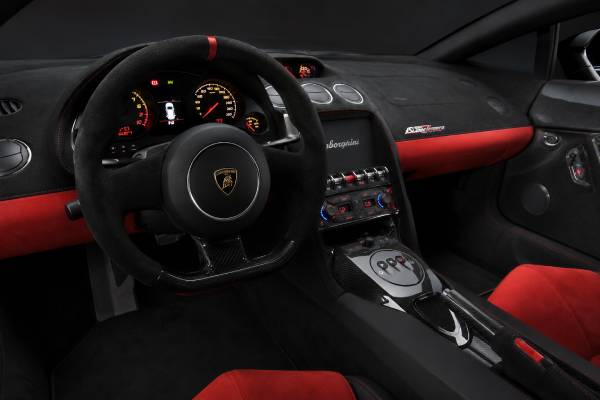
Carbon fiber is used for weight saving and identity. The rear wing and engine hood are the headline pieces, while the cabin uses carbon and Alcantara to reduce shine, reduce visual softness, and increase the race-car feel. The interior is not stripped like a pure racing car, but it is much more purposeful than a leather-heavy Gallardo ordered for city use.
The cockpit is still recognizably Gallardo. The driving position is low, the windshield is shallow, the dashboard is angular, and the cabin feels narrow compared with many modern supercars. The controls are simple by current standards. That simplicity has aged well for many owners because there are fewer screens and fewer drive-mode layers between the driver and the mechanical car.
The sound is a major part of the engineering appeal. The 5.2-litre V10 has a sharper, harder voice than many V8 supercars and a more urgent note than a large V12. The intake and exhaust character change as the revs rise. At low rpm it sounds mechanical and busy. At high rpm it becomes bright, metallic, and unmistakably Lamborghini.
The design also shows how far the Gallardo evolved from the original 2003 car. The early Gallardo was cleaner and less aggressive. The LP 560-4 refresh sharpened the front and rear styling. The LP 570-4 cars added weight-saving and performance intent. The Super Trofeo Stradale pushed that final form into a harder, more motorsport-led shape.
One important detail for buyers: the car’s dramatic parts are expensive to repair or replace. Carbon panels, special interior pieces, and correct wing hardware are not ordinary Gallardo trim. Damage hidden under a wrap, poor repainting around carbon edges, or incorrect replacement parts can affect both value and future usability.
What It Feels Like to Drive
The Super Trofeo Stradale feels fast, loud, compact, and more physical than modern dual-clutch supercars. It is not difficult in the way an old Countach is difficult, but it demands more driver timing than a newer Huracán or any modern turbocharged performance car.
At low speed, the first thing most drivers notice is the e-gear transmission. It is not smooth unless the driver cooperates with it. In automatic mode, it can feel clumsy. In manual paddle mode, it becomes more satisfying because the driver controls the rhythm. A small throttle lift during gentle shifts helps. Under harder acceleration, the shifts feel more dramatic and more appropriate to the car.
The V10 rewards revs. Below the middle of the tachometer it has enough torque for normal driving, but it does not feel lazy or overboosted. Push it harder and the engine wakes up in a way that makes the car feel more special with each thousand rpm. The throttle response is direct, and the high-rpm pull is the reason many owners still prefer this era to newer turbocharged alternatives.
The steering is one of the Gallardo’s strengths. Hydraulic assistance gives more natural weighting than many later electric systems. It is not delicate like a lightweight classic sports car, but it tells the driver enough about front grip and road surface to make the car engaging. The front end feels planted, and the all-wheel-drive system helps the driver use power early on corner exit.
The chassis balance is secure rather than loose. On fast roads, the Super Trofeo Stradale feels stable and confident. The large wing adds high-speed presence, but tires, alignment, and ride height still make a huge difference. Old P Zero Corsa tires can make the car feel nervous, noisy, or harsh. Fresh, correct tires transform it.
Ride quality depends heavily on road surface and tire age. This is a focused Gallardo, so it is firm. It can handle normal road use, but it does not glide over broken pavement. The low nose also means the front lifting system, if fitted, is more than a convenience. It helps protect the front end from driveways, speed bumps, and ramps.
Braking performance is strong when the system is healthy. Cars with carbon-ceramic brakes need a proper inspection of disc condition, not just a quick visual glance. Carbon-ceramic discs can last a long time in road use, but track work, overheating, edge damage, or improper pad use can make replacement painfully expensive.
Visibility is typical late Gallardo: decent forward, limited rearward, and not ideal over the shoulder. The wing adds drama in the mirrors but does not make the car easier to place. In traffic, the car feels wide and low. On a mountain road or track, it shrinks around the driver because the controls are direct and the body is compact by modern supercar standards.
The best use case is occasional road driving, events, mountain routes, and carefully chosen track days. It can do city driving, but that is not where it shines. It is happiest when the engine is hot, the tires are warm, the road is open, and the driver treats the gearbox like a manual system with paddles rather than a smooth automatic.
Maintenance Risks and Specialist Care
The Super Trofeo Stradale can be dependable for an exotic, but only when serviced correctly and used often enough to stay healthy. The costly cars are the ones that look clean, have low mileage, but hide clutch wear, stale fluids, old tires, weak batteries, missed campaigns, or poor repair history.
Major areas to inspect
| Area | What to check | Why it matters |
|---|---|---|
| E-gear clutch | Clutch wear reading, engagement quality, service calibration | A worn clutch or poor setup can turn into a major bill |
| E-gear hydraulics | Pump operation, actuator leaks, pressure behavior | Shift problems are often hydraulic or calibration related |
| Engine | Leaks, misfires, service records, high-rpm behavior, fault history | The V10 is strong, but neglect is expensive |
| Cooling system | Radiators, hoses, fans, debris in front openings | Low cars collect road debris and heat management matters |
| Brakes | Disc condition, pad type, heat marks, service invoices | Carbon-ceramic replacement can reshape the purchase economics |
| Suspension | Dampers, bushings, ball joints, front lift system | Age and low ride height create wear and leak risks |
| Body and carbon | Wing mounts, hood, panel gaps, paint edges, underside damage | Correct carbon parts are valuable and costly |
| Electrical system | Battery condition, modules, warning lights, recall status | Weak voltage can create misleading faults |
E-gear condition is one of the biggest buying factors. A seller may say “the clutch is fine,” but a buyer needs a diagnostic clutch-wear report and a road test by someone who knows how a healthy Gallardo e-gear should behave. Jerky engagement, slipping, delayed reverse selection, warning lights, pump overactivity, or harsh low-speed behavior can all point to expensive work.
The engine is generally respected, but it still needs exotic-car care. Annual servicing is wise even when mileage is low. Oil, brake fluid, coolant, gearbox fluid, front differential fluid, and Haldex or all-wheel-drive-related service items should be handled according to the correct service schedule for the VIN and market. A car driven only a few hundred miles in several years may need more recommissioning than its odometer suggests.
Carbon-ceramic brakes require special attention. A casual visual inspection is not enough. The discs should be assessed for surface condition, chips, heat damage, thickness or mass where applicable, and matching pad compound. A bargain car needing carbon brake work may not be a bargain.
Tires are another simple but important item. Many collector Gallardos wear low-mileage tires that are too old to trust. Correct-size high-performance tires are not cheap, and the car’s behavior depends on them. Tire date codes should be checked before any serious drive.
The front lift system, if fitted, is highly desirable but adds another inspection point. Check that it rises evenly, holds pressure, and does not leak. Also inspect the underside of the front bumper, splitter area, side skirts, jacking points, and rear diffuser for scraping.
Interior condition matters more than buyers sometimes expect. Alcantara can shine or flatten with use. Carbon trim can crack or delaminate. Sticky switches, worn bolsters, missing trim, and poor aftermarket audio or alarm work hurt the feel of a limited car.
The 2018 U.S. recall covering certain 2011–2014 Gallardo Coupe and Spyder vehicles is especially relevant for American-market cars. It involved engine ECU software that could erase trouble codes after key-off, preventing warning lamps from alerting the driver later. A buyer should run a VIN check with Lamborghini or the official recall database and confirm that all open campaigns and service actions are complete.
The safest approach is to use a Lamborghini dealer or a recognized independent specialist for a pre-purchase inspection. A normal performance-car shop may miss model-specific issues, especially e-gear data, carbon-ceramic brake condition, factory option verification, and limited-edition authenticity.
Market Values and Buying Strategy
The Super Trofeo Stradale sits in a thin, specialist market where condition and authenticity matter more than book value. Public market trackers place the benchmark around the high-$100,000 range, but the best low-mileage, original, fully documented cars can sit above average data because there are so few clean examples.
Do not treat one auction result as the whole market. A modified car with patchy history, old tires, and no recent service is not comparable to a numbered, original Rosso Mars car with full Lamborghini history, clean paint readings, factory options, and fresh mechanical work. The sample size is small enough that each sale needs context.
What drives value
The strongest value factors are:
- Original limited-edition specification.
- Verified numbered car status.
- Low but believable mileage.
- Complete service history from Lamborghini or a respected specialist.
- Original paint or well-documented high-quality paintwork.
- Correct carbon-fiber parts and interior trim.
- Desirable color, especially Rosso Mars.
- Healthy e-gear clutch reading.
- Fresh major service and current tires.
- No accident history or fully documented professional repair.
- Complete books, keys, tools, accessories, and factory records.
The weakest value factors are:
- Missing documentation.
- Unverified limited-edition claims.
- Aftermarket wing, wrap, wheels, or interior changes.
- Poor e-gear behavior.
- Unknown clutch wear.
- Carbon-ceramic brake wear with no inspection record.
- Long storage without recommissioning.
- Sticky interior controls and worn Alcantara.
- Underside damage from low-speed impacts.
- Inconsistent paint readings or unclear accident repair.
A good buying strategy starts before the inspection. Ask the seller for the VIN, service invoices, option documentation, ownership history, recent diagnostic report, clutch-wear data, tire date codes, brake condition records, and clear photos of the underside, carbon panels, interior, and numbered plaque. A seller of a serious collector-grade car should not struggle to provide those basics.
During inspection, focus on originality first, then mechanical condition, then cosmetics. A resprayed bumper from stone chips is not a major problem if documented. A non-original carbon hood, poorly repaired wing mount, or unknown e-gear fault is a much bigger issue. For this model, the special parts are the value.
Choose the car that has been used lightly but serviced consistently. Ultra-low mileage can be attractive, but storage can create stale fluids, flat-spotted tires, weak batteries, sticky seals, and surprise leaks once the car is driven again. A slightly higher-mileage car with careful use and full records may be better than a garage queen that needs recommissioning.
Long-term collectability looks strong because the ingredients are right: limited production, natural aspiration, late Gallardo status, motorsport connection, dramatic design, and a clear place in Lamborghini history. The biggest risk is not that enthusiasts forget the car. The risk is buying the wrong example at the right-looking price.
For most buyers, the best Super Trofeo Stradale is original, documented, recently serviced, correctly tired, clean underneath, and inspected by a Lamborghini specialist. Pay more for that car. It will usually be cheaper than trying to turn a compromised example into a collector-grade one later.
References
- Video from Lamborghini at Frankfurt Motor Show 2011: The Lamborghini Gallardo LP 570-4 Super Trofeo Stradale – the Most Extreme Gallardo Ever in Looks and Performance. 2011 (Manufacturer Release)
- Heritage | Lamborghini.com 2026 (Motorsport Heritage)
- End of Production for the Lamborghini Gallardo 2013 (Manufacturer Newsroom)
- Part 573 Safety Recall Report 18V-833 2018 (Recall Report)
- Lamborghini Gallardo LP570-4 Super Trofeo Stradale Market – CLASSIC.COM 2026 (Market Data)
Disclaimer
This article is for informational purposes only and is not a substitute for professional diagnosis, inspection, repair, valuation, or legal advice. Specifications, torque values, service intervals, recall status, and repair procedures can vary by VIN, market, model year, equipment, and later updates. Always verify details against official Lamborghini service documentation and have any vehicle inspected by a qualified Lamborghini specialist before purchase or repair.
If this guide helped you, please share it on Facebook, X/Twitter, or your favorite automotive community to support our work.