

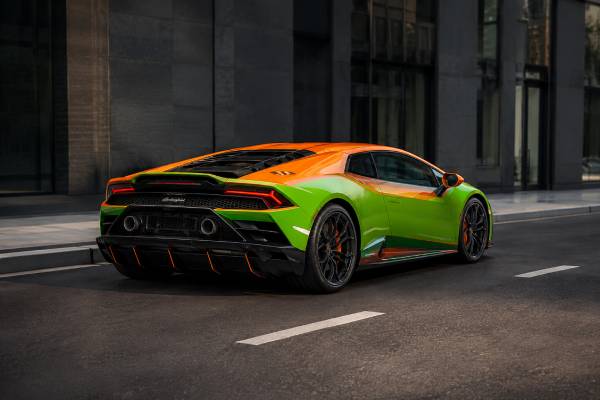
The Lamborghini Huracán EVO GT Celebration is not a separate performance model; it is a rare motorsport-themed special edition based on the Huracán EVO LP 640-4 coupe. Its importance comes from what it celebrates: Lamborghini’s back-to-back GTD-class victories at the 24 Hours of Daytona and 12 Hours of Sebring in 2018 and 2019. Limited to 36 cars, the GT Celebration links the road-going EVO to the Huracán GT3 EVO at the moment Lamborghini’s customer-racing program became a serious endurance-racing force.
For buyers, the appeal is simple: it gives the already excellent 640 hp all-wheel-drive EVO a far stronger story, a more collectible build count, and a recognizable factory livery. For owners, it remains a modern exotic with real maintenance demands, sensitive carbon-ceramic brakes, expensive tires, complex electronics, and value tied closely to documentation, originality, mileage, and condition.
Table of Contents
- What the GT Celebration Really Is
- V10 Specs and Chassis Data
- Build Run, Options, and Identification
- Race Livery, Design, and EVO Technology
- Road and Track Character
- Ownership, Maintenance, and Common Risk Points
- Market Values and Buying Checklist
What the GT Celebration Really Is
The Huracán EVO GT Celebration is best understood as a factory-built tribute edition, not a power upgrade. It uses the standard all-wheel-drive Huracán EVO mechanical package but adds limited-production identity, motorsport graphics, and a direct link to Lamborghini Squadra Corse’s endurance-racing success.
Lamborghini unveiled the GT Celebration during Monterey Car Week in August 2019, alongside the Aventador SVJ 63 Roadster. That setting matters because Monterey is not only a supercar showcase; it is a collector stage. Lamborghini used it to position the GT Celebration as a car for buyers who cared about rarity and racing context as much as raw performance.
The edition celebrates four major wins by Huracán GT3 EVO race cars: the 24 Hours of Daytona and 12 Hours of Sebring in both 2018 and 2019. The number 36 was chosen because Daytona’s 24 hours plus Sebring’s 12 hours equals the “36 Hours of Florida.” That makes the production number more than a marketing figure; it is part of the car’s story.
Mechanically, the GT Celebration belongs to the LB724 Huracán EVO family. The EVO arrived as the facelifted, more intelligent development of the original Huracán LP 610-4. It brought the 640 CV naturally aspirated V10 from the Performante, revised aerodynamics, rear-wheel steering, torque vectoring, magnetorheological dampers, and Lamborghini Dinamica Veicolo Integrata, usually shortened to LDVI. LDVI is the EVO’s central driving-dynamics brain. It coordinates steering, dampers, all-wheel drive, traction control, and drive modes to make the car feel more predictive and less reactive.
For collectors, the GT Celebration sits in an interesting position. It is rarer than most Huracán EVOs, more usable than the later STO, and more visually tied to Lamborghini motorsport than a typical Ad Personam build. It is not as mechanically distinct as a Performante or STO, so its value depends heavily on factory originality and paperwork. The best examples feel like documented factory collectibles; weaker examples feel like ordinary EVOs with a rare paint package.
V10 Specs and Chassis Data
The useful technical takeaway is simple: the GT Celebration performs like a Huracán EVO LP 640-4 coupe. That means a naturally aspirated 5.2-liter V10, a seven-speed dual-clutch transmission, all-wheel drive, all-wheel steering, and factory supercar pace without hybrid assistance or turbocharging.
| Category | Specification |
|---|---|
| Base model | Huracán EVO LP 640-4 coupe |
| Platform / model family | LB724 Huracán EVO |
| Engine | 5,204 cc naturally aspirated 90-degree V10 |
| Induction | Naturally aspirated |
| Fuel system | Direct and multi-point fuel injection |
| Maximum power | 640 CV / 470 kW at 8,000 rpm |
| Maximum torque | 600 Nm at 6,500 rpm |
| Transmission | 7-speed Lamborghini Doppia Frizione dual-clutch automatic |
| Drivetrain | Electronically controlled all-wheel drive |
| 0–100 km/h | 2.9 seconds |
| Top speed | Over 325 km/h / over 202 mph |
| Dry weight | About 1,422 kg |
| Fuel tank | 80 liters / about 21.1 US gallons |
The engine is the heart of the car’s appeal. It is the later, higher-output version of Lamborghini’s V10, shared in character with the Huracán Performante rather than the earlier LP 610-4. It revs hard, makes peak power near the top of the tachometer, and rewards a driver who lets it breathe. In an era when most rivals use turbochargers or hybrid torque-fill, the EVO’s naturally aspirated delivery is a major part of its long-term enthusiast appeal.
The chassis uses a hybrid structure of aluminum and carbon-fiber elements, with aluminum and composite exterior panels. Suspension is by double wishbones at each corner, supported by magnetorheological dampers. These dampers change their firmness electronically and quickly, giving the EVO a wide spread between road comfort and high-speed control.
| Area | Detail |
|---|---|
| Suspension | Double wishbones with magnetorheological dampers |
| Steering | Electromechanical steering with Lamborghini Dynamic Steering |
| Rear steering | Electromechanical rear-wheel steering |
| Front brakes | Carbon-ceramic discs, 380 x 38 mm, 6-piston calipers |
| Rear brakes | Carbon-ceramic discs, 356 x 32 mm, 4-piston calipers |
| Standard wheel size | 20-inch EVO fitment, specification-dependent |
| Wheelbase | 2,620 mm |
| Length | About 4,520 mm |
| Width without mirrors | About 1,933 mm |
| Height | About 1,165 mm |
A key buying point is that the GT Celebration’s specialness does not make its service parts unique in the way a bespoke engine or body would. Underneath, it remains an EVO. That helps long-term usability. The risk is different: damage to livery-specific paintwork, decals, forged-composite trim, carbon panels, or GT Celebration details can be far harder to correct than routine mechanical wear.
Build Run, Options, and Identification
The GT Celebration’s value starts with its 36-car production limit, but the right car must prove it is one of those factory cars. A buyer should treat paperwork, specification records, paint documentation, window sticker, service history, and Lamborghini dealer verification as core parts of the purchase, not nice extras.
The factory theme is tied to the Huracán GT3 EVO. The launch car used Verde Egeria with Arancio Aten accents, echoing the GRT Grasser Racing Team livery. Lamborghini also connected the edition to Paul Miller Racing, another key team in the Daytona and Sebring story. The “11” graphics on the hood and doors, the Squadra Corse shield, and the Italian and American flag details are not random decoration. They explain why this EVO exists.
Most examples seen publicly are titled as 2020 model-year cars, even though the edition was unveiled in 2019. That is normal for a late-2019 announcement and early customer delivery cycle. The article’s 2019–2019 year range is best read as the announcement and limited-edition creation period rather than the registration year of every car.
Important identification points include:
- Factory GT Celebration package shown on the build sheet or window sticker.
- Correct motorsport livery, not an aftermarket wrap copying the launch car.
- Exterior number and graphic placement consistent with the factory theme.
- Lamborghini Squadra Corse roof or exterior identifiers where fitted.
- Original paint and decal records, especially on Verde and Arancio cars.
- Matching VIN, warranty history, service records, and dealer-supplied specification.
- Original wheels, brake calipers, forged-composite trim, and interior trim.
- Owner’s books, keys, battery maintainer, car cover, and delivery accessories.
Factory options still matter because the GT Celebration package did not erase normal EVO specification choices. Commonly desirable equipment includes the front axle lift system, sport seats, forged-composite interior or engine-bay trim, transparent engine bonnet, Sensonum audio, contrast stitching, colored seat belts, carbon-ceramic brakes, telemetry, and parking-camera equipment.
A plain but original car is usually better than a modified one with more visual drama. Aftermarket exhausts, tunes, suspension changes, wheel changes, wrap work, and non-factory paint correction can all reduce collector confidence. Some modifications are reversible, but a rare factory edition should not be valued like a normal used Huracán. Originality is part of the asset.
Race Livery, Design, and EVO Technology
The GT Celebration looks dramatic because its design has a job: it turns a road EVO into a visible reminder of Lamborghini’s GT3 program. The best details are not the loudest ones; they are the ones that connect the car to Daytona, Sebring, Squadra Corse, and the Huracán GT3 EVO.
The underlying Huracán EVO design already had sharper aerodynamics than the original LP 610-4. The front bumper uses new airflow channels and Y-shaped Lamborghini themes. The rear adopts high-mounted exhaust outlets and a more aggressive diffuser treatment that recalls Lamborghini’s track-focused models. The EVO also has a rear spoiler shape that improves airflow and stability without turning the car into a fixed-wing track special.
The GT Celebration adds a motorsport overlay. The two-tone livery, contrast accents, door and hood numbers, and roof details make the car feel closer to a race paddock than a typical exotic-car showroom. That is why condition matters so much. A repaired bumper, repainted hood, replaced decal, or poorly matched stripe can weaken the car’s strongest feature.
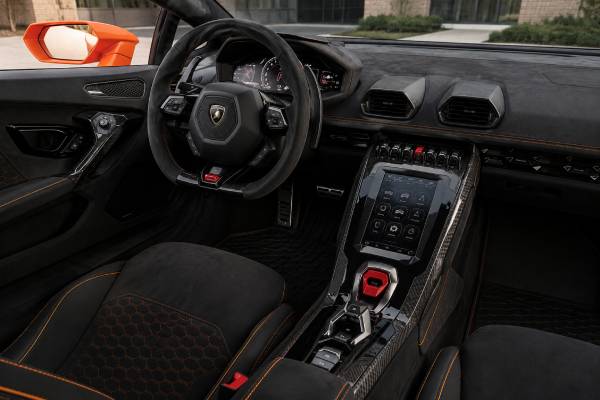
Inside, the EVO is more modern than the early Huracán. The central 8.4-inch touchscreen controls infotainment, some vehicle functions, climate features, and connectivity. Lamborghini offered leather, Alcantara, and Carbon Skin finishes, plus extensive Ad Personam personalization. In a GT Celebration, the best interiors usually support the exterior theme without feeling randomly specified.
The most important engineering feature is LDVI. It reads driver input, selected drive mode, road behavior, and vehicle motion, then coordinates systems that used to feel more separate. In simple terms, the EVO tries to prepare the car for what the driver is about to do, not merely react after the car has already moved.
The main systems working together are:
- Rear-wheel steering for low-speed agility and high-speed stability.
- Torque vectoring for cleaner corner exit behavior.
- Electronically controlled all-wheel drive for traction and balance.
- Magnetorheological dampers for changing road and track conditions.
- Lamborghini Dynamic Steering for variable steering response.
- ANIMA drive modes that alter the car’s personality.
The sound is also part of the engineering. The high-mounted exhaust outlets and naturally aspirated V10 create a sharper, more mechanical experience than most turbocharged rivals. At low rpm the car can behave, but the upper half of the rev range is where it becomes memorable.
Road and Track Character
The GT Celebration drives like a Huracán EVO LP 640-4: brutally quick, secure, loud, and easier to exploit than its shape suggests. It is not as raw as an STO and not as aero-focused as a Performante, but it is one of the most complete road-biased V10 Lamborghinis.
Acceleration is immediate once the engine is awake, but it does not feel like a turbocharged car that throws torque at the driver from low rpm. The V10 builds with speed and intensity. That makes the car more engaging because the last 2,000 rpm matter. The dual-clutch gearbox shifts quickly in automatic mode and becomes far more dramatic when the driver uses the paddles near redline.
In Strada mode, the EVO can be surprisingly usable. The gearbox softens, the dampers relax, and the all-wheel-drive system gives confidence in poor weather or imperfect road conditions. The front axle lift, when fitted, is close to essential for real-world use because the nose is low and expensive.
Sport mode makes the car louder and more playful, though still controlled by the all-wheel-drive system. Corsa is the serious mode. It sharpens throttle response, shifts, stability control, and suspension behavior for fast road or track use. On a circuit, the EVO feels stable under braking and traction-rich on exit. It does not have the final lightness or feedback of the rear-drive STO, but it covers ground with huge speed and fewer demands on the driver.
Steering feel is accurate rather than old-school delicate. The rear-steering system can make the car feel shorter than it is in tight corners, then calmer at speed. Some drivers need time to trust it because the rear axle subtly helps rotate the car.
The brakes are extremely strong, but carbon-ceramic systems should not be judged like ordinary steel brakes. Cold feel can be different, light squeal is not always a defect, and track use can consume pads, tires, and brake life quickly. A pre-purchase inspection should measure wear properly rather than relying on visual guesses.
The GT Celebration’s usability has limits. Rear visibility is modest, the cabin is low, tire noise can be high, and parking requires care. Still, compared with older Lamborghinis, the EVO is friendly. It starts easily, cools well when maintained, and can handle normal driving better than its livery suggests.
Ownership, Maintenance, and Common Risk Points
The Huracán EVO GT Celebration is generally a robust modern Lamborghini when kept stock and serviced correctly, but cheap ownership is not part of the deal. The major risks are deferred maintenance, accident repair, carbon-ceramic brake wear, tire age, battery neglect, electronic faults, and poor-quality modifications.
Annual servicing is the baseline. Many markets and dealer schedules treat the Huracán as a 12-month or roughly 9,000-mile / 15,000-km service car, whichever comes first. Low mileage does not remove the need for service because fluids age, brake fluid absorbs moisture, batteries weaken, tires harden, and software updates may be missed.
A sensible ownership routine includes:
- Annual oil and filter service using the correct approved oil.
- Brake-fluid replacement on schedule, especially before track use.
- Coolant, gearbox, differential, and all-wheel-drive system checks at the correct intervals.
- Battery maintainer use whenever the car sits.
- Tire replacement based on age, heat cycles, and tread condition.
- Regular inspection of underbody panels, cooling ducts, and front splitter.
- Software and campaign checks through an authorized Lamborghini dealer.
- Full diagnostic scan before and after purchase.
The engine is not known for needing constant rebuild attention in stock road use, but it is still a high-output, dry-sump, high-rpm V10. Warm-up discipline matters. Hard throttle before oil temperature is stable is poor practice. Repeated short trips, old oil, and long storage without proper maintenance are not ideal.
The dual-clutch transmission is far easier to live with than older automated single-clutch Lamborghini gearboxes. There is no Gallardo-style clutch-wear anxiety in normal use, but service history still matters. Rough engagement, warning lights, fluid leaks, overheating messages, or delayed gear selection deserve specialist attention.
Carbon-ceramic brakes are a major cost driver. Pads, discs, sensors, and calipers should be inspected by someone who understands Lamborghini CCB systems. Track use can accelerate wear even when mileage is low. A car with 3,000 miles and several track days may have more brake and tire stress than a carefully driven 12,000-mile road car.
Tires are another hidden value marker. Old tires can look fine and still be unsafe on a 200-mph car. Check date codes, brand, specification, tread depth, shoulder wear, puncture repairs, and whether all four tires match in type and age. Uneven wear can also point to alignment issues, hard track use, or suspension damage.
Electronics should be checked carefully. The EVO has more infotainment, connectivity, control modules, sensors, and drive-mode integration than early Huracáns. Warning lights, intermittent parking-camera faults, lift-system issues, battery-voltage problems, or drive-mode errors can become time-consuming if diagnosis is poor.
For the GT Celebration specifically, cosmetic repair quality is a major concern. Inspect:
- Front bumper underside and splitter for scraping.
- Paint match across hood, bumper, doors, and rear quarters.
- Decal edges, lifting, bubbling, replacement, or clearcoat issues.
- Roof graphics and Squadra Corse details.
- Forged-composite trim for cracks or cloudy finish.
- Transparent engine cover fit and finish where fitted.
- Wheel rash, refinishing, and correct factory wheel type.
- Seat bolsters, Alcantara wear, and colored belt condition.
Avoid cars with missing records, tuned ECUs, non-factory exhaust work without original parts, suspiciously fresh paint, or accident entries that are not supported by repair invoices and photographs. A rare EVO should be easy to explain on paper. When the story is messy, the price should reflect that.
Market Values and Buying Checklist
The GT Celebration trades above ordinary Huracán EVO coupes when the car is original, documented, and low-mileage, but it should not be priced like a mechanically unique homologation special. Its strongest value drivers are rarity, factory livery, motorsport story, condition, mileage, specification, and proof that it is a real GT Celebration.
As of mid-2026, ordinary Huracán EVO coupes commonly appear in the broad $250,000 to $340,000 range depending on year, mileage, condition, and specification, with higher asking prices for exceptional cars. Public GT Celebration listings have tended to sit above normal EVO money, often around the low-to-high $300,000s when mileage is low and the car presents correctly. Very low-mileage, highly optioned, launch-livery cars can ask more, but asking price is not the same as a completed sale.
The buyer should separate three markets:
| Car type | Value behavior |
|---|---|
| Ordinary Huracán EVO coupe | Valued mainly on mileage, options, color, condition, and service history |
| GT Celebration with full records | Earns a rarity premium because the factory story is provable |
| GT Celebration with damage, missing records, or modifications | Premium narrows quickly because collectors pay for originality |
The most desirable cars usually have low but usable mileage, original paint, intact factory graphics, no accident history, full Lamborghini dealer records, clear ownership history, original accessories, and a build specification that matches the motorsport theme. The launch-style Verde Egeria and Arancio Aten look is especially recognizable, but condition should outrank color preference.
A strong pre-purchase inspection should include:
- Confirm the VIN and factory GT Celebration specification through Lamborghini documentation.
- Review the window sticker, build sheet, service invoices, warranty records, and campaign history.
- Inspect paint depth and repair evidence on every panel.
- Check livery authenticity, decal condition, and any replaced exterior pieces.
- Perform a full diagnostic scan with Lamborghini-capable equipment.
- Measure carbon-ceramic brake condition and pad life.
- Inspect tires for age, correct specification, and track-related wear.
- Check front lift operation, suspension behavior, and steering-system faults.
- Verify gearbox behavior during cold start, normal driving, and manual shifts.
- Inspect underbody panels, radiators, cooling ducts, and front-end scrape damage.
The safest cars to buy are not always the lowest-mileage examples. A 300-mile car that sat for years without annual service can need expensive recommissioning. A 5,000-mile car with perfect records, fresh tires, recent fluids, no paintwork, and a clean inspection may be the better ownership choice.
Long-term collectability looks positive but measured. The GT Celebration has rarity, a factory motorsport story, the final-era naturally aspirated V10, and a visual identity that sets it apart. Against that, it shares its mechanical package with the regular EVO and was created through specification and livery rather than major engineering changes. It should appeal most to buyers who want a collectible Huracán they can still drive, not to those seeking the most extreme track model.
For an owner-investor, the best strategy is simple: keep it original, maintain it on time, keep every document, avoid irreversible modifications, protect the paint and decals, and drive it enough to keep the car healthy. A GT Celebration with a clean story will always be easier to sell than one that needs explanations.
References
- SVJ 63 Roadster and EVO GT Celebration Unveiled 2019 (Manufacturer Publication)
- Lamborghini Huracán EVO | Lamborghini.com 2019 (Manufacturer Specifications)
- Check for Recalls: Vehicle, Car Seat, Tire, Equipment | NHTSA 2026 (Recall Database)
- Lamborghini Huracán EVO Market – CLASSIC.COM 2026 (Market Data)
Disclaimer
This article is for informational purposes only and is not a substitute for professional diagnosis, repair, appraisal, or inspection. Specifications, torque values, service intervals, software campaigns, recalls, and procedures can vary by VIN, market, equipment, and production date. Always verify details against official Lamborghini service documentation and have any purchase or repair assessed by a qualified Lamborghini specialist.
If this guide helped you, please share it on Facebook, X/Twitter, or your favorite car community to support our work.