


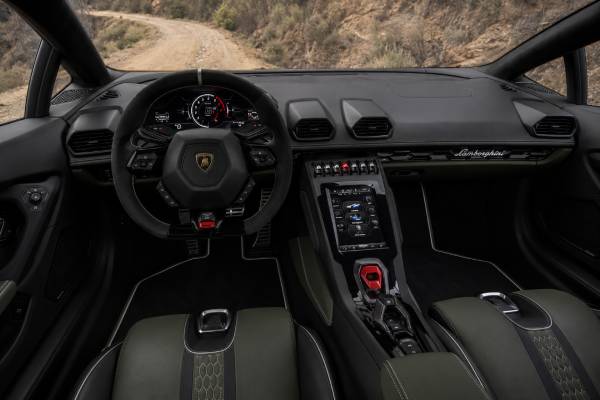
The Lamborghini Huracán Sterrato is the wild final twist in the naturally aspirated V10 Huracán story: a mid-engine supercar raised, widened, protected, and tuned for loose surfaces without losing the noise, response, and theater that made the Huracán famous. It is not an SUV, not a rally car, and not a normal Huracán with tougher tires. It is a limited-production, all-wheel-drive V10 coupe built to make gravel roads, broken pavement, winter passes, and dusty trails feel like part of the supercar experience rather than places to avoid. For buyers, the Sterrato matters because it combines rarity, usability, and end-of-era emotion. For enthusiasts, it matters because Lamborghini turned a familiar platform into something genuinely strange: a 610 hp V10 exotic with 162 mm of ground clearance, custom all-terrain tires, Rally mode, and a roof-mounted air intake.
Table of Contents
- Why the Sterrato Matters
- V10 Specs, Chassis, and Performance Data
- Production Numbers, Options, and Identification
- All-Terrain Design and Engineering Details
- How the Sterrato Drives on Road and Dirt
- Ownership Maintenance and Known Risk Areas
- Market Values, Inspection, and Buying Advice
Why the Sterrato Matters
The Sterrato matters because it closed the Huracán era with the most playful and unconventional version of the car. Instead of chasing the lowest lap time, Lamborghini used the V10 platform to build a supercar that could slide, breathe, and survive where a normal low-slung exotic would feel nervous.
Lamborghini revealed the production Huracán Sterrato in late 2022 after developing the idea from an earlier concept first shown in 2019. Production was planned at 1,499 units, with deliveries taking place through 2023 and 2024. The article title covers the 2024 model-year Sterrato, but the car’s real-world build and delivery window overlaps both years.
The Sterrato sits near the end of the Huracán family tree. Earlier Huracán variants served clear roles: the LP610-4 as the original all-wheel-drive V10 coupe, the Performante as the Nürburgring-focused aero car, the EVO as the technology update, the STO as the road-legal track weapon, and the Tecnica as the cleaner rear-drive road-and-track bridge. The Sterrato did something different. It kept the basic mid-engine Huracán ingredients, then changed the car’s stance, tire strategy, suspension travel, underbody protection, aero logic, and electronic calibration for low-grip surfaces.
That made it historically important for three reasons.
First, it became one of the final naturally aspirated Lamborghini V10 road cars before the company moved into the hybrid Temerario era. Second, it proved that supercar collectability does not always require maximum power, carbon wings, and track records. Third, it showed how much personality was still left in the Huracán platform after a decade of development.
The LB724 label is useful as an internal-style identifier in listings, data systems, and enthusiast discussions, but buyers should rely on the VIN, factory build record, window sticker, service file, and Lamborghini dealer documentation for exact car identification. On a limited car with heavy personalization, the paperwork is as important as the badge.
V10 Specs, Chassis, and Performance Data
The Sterrato uses a 5,204 cc naturally aspirated V10 with 610 CV, all-wheel drive, and a 7-speed dual-clutch gearbox. Its performance numbers are slightly lower than track-focused Huracáns, but the tradeoff is deliberate: more ground clearance, more wheel travel, tougher tires, and better control on loose surfaces.
| Category | Specification |
|---|---|
| Engine | 5.2-liter naturally aspirated V10 |
| Displacement | 5,204 cm³ |
| Bore x stroke | 84.5 x 92.8 mm |
| Compression ratio | 12.7:1 |
| Maximum power | 610 CV / 449 kW at 8,000 rpm |
| Maximum torque | 560 Nm at 6,500 rpm |
| Transmission | 7-speed Lamborghini Doppia Frizione dual-clutch automatic |
| Drivetrain | Electronically controlled all-wheel drive with rear mechanical self-locking differential |
| 0–100 km/h | 3.4 seconds |
| 0–200 km/h | 9.8 seconds |
| Top speed | 260 km/h |
| Fuel economy | 15 mpg combined EPA; 14.9 l/100 km WLTP |
| CO₂ emissions | 337 g/km WLTP |
The V10 is the center of the car’s appeal. It is not turbocharged, not hybrid-assisted, and not tuned to mask its character. The engine needs revs, rewards throttle precision, and gives the Sterrato a hard-edged sound that separates it from most modern performance cars. The 610 CV output is lower than the 640 CV used in some Huracán EVO, STO, and Tecnica variants, but the Sterrato is not trying to be the fastest Huracán in a straight line or on slick tires. Its calibration favors response, control, and traction when the surface is dirty or loose.
| Area | Specification |
|---|---|
| Chassis | Hybrid aluminum and carbon-fiber structure |
| Body | Aluminum and synthetic material |
| Length | 4,525 mm |
| Width excluding mirrors | 1,956 mm |
| Width including mirrors | 2,236 mm |
| Height | 1,248 mm |
| Wheelbase | 2,629 mm |
| Maximum ground clearance | 162 mm |
| Front wheels and tires | 8.5J x 19 ET27 wheels; 235/40 R19 Bridgestone Dueler AT002 tires |
| Rear wheels and tires | 11J x 19 ET40 wheels; 285/40 R19 Bridgestone Dueler AT002 tires |
| Suspension | Magneto-rheological adaptive dampers |
| Steering | Electro-mechanical power steering |
| Front brakes | Carbon-ceramic, 380 mm diameter, 38 mm thickness |
| Rear brakes | Carbon-ceramic, 356 mm diameter, 32 mm thickness |
The important numbers are not only power and speed. The ground clearance, tire sidewall, track width, suspension travel, and brake hardware define the car’s real personality. The Sterrato is taller than a normal Huracán, but it still has a short wheelbase, a mid-engine layout, fast steering, and a broad rear tire. That mix is why it feels exotic rather than like a lifted sports coupe.
Production Numbers, Options, and Identification
The Sterrato was limited to 1,499 units, and that production cap is central to its value. Condition and documentation still matter more than the build number alone, but a properly documented Sterrato has a stronger collector case than a normal-production Huracán EVO.
There was no factory roadster version. The Sterrato was sold as a coupe, with the V10, all-wheel drive, 7-speed LDF gearbox, raised chassis, and model-specific all-terrain equipment forming the core package. Buyers could personalize the car heavily, so two Sterratos can look and feel very different even when the mechanical base is the same.
Factory identity points
A genuine Sterrato should show the model-specific combination of raised ride height, widened tracks, 19-inch all-terrain wheel-and-tire package, protective body elements, roof air intake, Sterrato interior details, Rally mode, and factory documentation. The quick visual cues are obvious, but buyers should never rely only on appearance because wheels, decals, skid-style trim, and exterior accessories can be copied.
The strongest identification trail includes:
- VIN matched to Lamborghini dealer records.
- Original window sticker or market-equivalent specification sheet.
- Factory order record showing Sterrato specification and options.
- Service history from an authorized Lamborghini dealer or recognized specialist.
- Ownership file with delivery paperwork, invoices, software/update records, and accessory receipts.
- Clear title history with no accident, flood, salvage, or major paintwork concerns.
- Photos from new or early ownership showing original configuration.
Options and personalization
The Sterrato was highly customizable through Lamborghini’s standard option list and Ad Personam program. The official brochure describes standard, optional, and Ad Personam paint choices, with Ad Personam opening the door to more than 300 exterior color options. Lamborghini also offered a wide range of interior leathers, Alcantara finishes, contrast stitching, trim choices, caliper colors, wheel finishes, and exterior graphic treatments.
Options that tend to matter to buyers include:
- Distinctive exterior color or factory livery.
- Verde Sterrato interior accents and embroidered Sterrato details.
- Carbon-fiber exterior and interior trim.
- Front auxiliary lights where legal and properly homologated for the market.
- Roof basket, ski and snowboard rack, winter tires, and all-terrain accessories.
- High-value Ad Personam colors or documented one-off combinations.
- Lamborghini telemetry, connected services, and infotainment features where equipped and market-supported.
- Protective film applied early by a high-quality installer.
A rare color can help value, but only when the rest of the car is right. A loud specification with repainting, missing paperwork, heavy gravel damage, or unresolved service questions is less attractive than a cleaner, better-documented example in a more common color.
Market and country differences
Equipment and compliance details vary by market. Lighting, connected services, accessory legality, emissions labeling, warning labels, and infotainment functions can differ between North America, Europe, the Middle East, and other regions. A car imported from another market may still be desirable, but the buyer should verify registration compliance, warranty status, recall eligibility, odometer units, lighting configuration, and whether all connected functions work in the destination country.
All-Terrain Design and Engineering Details
The Sterrato works because Lamborghini changed the parts that matter for rough surfaces rather than simply raising the ride height. The body protection, dust management, tires, suspension travel, drive modes, and driver display all support the same goal: make a supercar feel confident when the road surface stops being perfect.
The stance is the first giveaway. Compared with the Huracán EVO 4WD, the Sterrato’s ride height rises by 44 mm, while the track increases by 30 mm at the front and 34 mm at the rear. This gives the car more clearance and a more planted look. It also changes the visual balance of the Huracán shape. The cabin remains low and forward, the rear haunches stay wide, and the car still looks mid-engine, but the tires and protective cladding give it a much more purposeful edge.
The wheel arches, underbody aluminum protection, reinforced sills, mudguards, front and rear protection elements, and redesigned rear diffuser are not decorative in the usual supercar sense. They help limit stone chipping, dust buildup, and damage from rougher roads. The Sterrato can still be damaged if abused; it is not a rock crawler. But it gives the driver more freedom on roads that would be stressful in a Performante or STO.
Dust management is one of the cleverest changes. The roof-mounted air intake helps feed the V10 cleaner air in dusty conditions. Lamborghini also closed or revised certain side air-intake paths to reduce dust entering the engine filter area. That matters because a high-revving V10 running behind a car-shaped dust cloud needs clean intake air to stay healthy.
Inside, the Sterrato keeps the Huracán’s dramatic cockpit but adds a more adventure-focused interface. The human-machine interface can show information such as pitch, roll, compass heading, geographic coordinates, and steering angle. Those features are not necessary for normal commuting, but they reinforce the Sterrato’s mission and give the cabin a different identity from the STO’s track-focused environment.
The tire package is just as important as the bodywork. The custom Bridgestone Dueler AT002 tires are built to handle both road speed and loose surfaces. Their run-flat capability allows continued driving for a limited distance after a puncture, which is useful given the car’s purpose. The tire sidewall, tread pattern, and compound change the whole feel of the car compared with a low-profile track tire.
How the Sterrato Drives on Road and Dirt
The Sterrato feels special because it gives the driver permission to use a Lamborghini with less fear of imperfect surfaces. It is slower at the top end than the fastest Huracáns, but it is often more enjoyable at real speeds because the tire, suspension, and electronics make the car feel alive earlier.
On asphalt, the V10 dominates the experience. Throttle response is immediate, the engine note hardens as the revs rise, and the dual-clutch gearbox shifts quickly without making the car feel numb. The 0–100 km/h time of 3.4 seconds is more than enough for any public road. The top speed of 260 km/h is lower than a normal Huracán, mainly because of the tire, ride-height, and aerodynamic compromises, but that limit fits the car’s purpose.
The steering is fast and accurate, though the all-terrain tires soften the first bite compared with a track tire. That is not a flaw. It makes the car easier to read on poor roads and less nervous over broken surfaces. The taller tire sidewall also improves ride comfort, which is one reason the Sterrato can feel more usable than a lower, sharper Huracán on real roads.
Drive modes and Rally mode
The ANIMA drive-mode selector gives the Sterrato its most important electronic difference. Strada remains the road-friendly setting, Sport allows more playful behavior, and Rally mode is added for low-grip surfaces. Rally mode does not turn the car into a competition rally machine. Instead, it changes how the stability control, torque distribution, throttle response, and chassis systems allow slip and recover grip.
On gravel, the Sterrato rewards smooth inputs. The rear can rotate, the all-wheel-drive system helps pull the car straight, and the V10 gives the driver precise control through the throttle. The car’s balance is still mid-engine, so reckless steering or braking on loose surfaces can punish the driver quickly. The difference is that the Sterrato gives more warning, more compliance, and more usable traction than a standard Huracán would.
Brakes, grip, and real-world pace
The carbon-ceramic brakes are powerful, but buyers should understand that brake feel can vary with temperature, pad condition, and road grit. On pavement, the system feels strong and serious. On dusty roads, the limit is more often tire grip than brake capacity. The tires are the main filter between the driver and the surface, and their condition matters enormously.
The Sterrato is best understood as a fast-road and loose-surface experience car, not a desert racing tool. It is happiest on mountain roads, broken rural pavement, dry gravel, snow-adjacent resort roads with the right tires, and curated off-road experiences. It can handle more than a normal supercar, but it still has expensive bodywork, carbon-ceramic brakes, low approach angles by SUV standards, and a very costly V10 behind the seats.
Ownership Maintenance and Known Risk Areas
The Sterrato is likely to be durable when serviced correctly, but it is still an exotic V10 Lamborghini with expensive consumables and model-specific hardware. The main ownership risk is not ordinary unreliability; it is damage, deferred service, poor documentation, worn tires, brake cost, and off-road use that exceeds what the car was designed to tolerate.
The V10 itself has a strong reputation when maintained by competent Lamborghini technicians. Buyers should still check for oil leaks, coolant leaks, abnormal valvetrain noise, ignition faults, engine mounts, exhaust rattles, sensor errors, and any history of over-rev, overheating, or non-approved tuning. A Sterrato with an engine tune, aftermarket exhaust, removed catalysts, or emissions-related modifications may be harder to warranty, inspect, or sell.
The LDF dual-clutch gearbox is generally much easier to live with than older single-clutch Lamborghini transmissions, but it is not maintenance-free. A pre-purchase inspection should include diagnostic scans, clutch and gearbox adaptation checks where available, leak inspection, shift-quality assessment, and confirmation that software updates are current.
Areas to inspect carefully
A Sterrato inspection should focus on the parts most affected by its mission:
- Tires: Check age, tread depth, sidewall damage, puncture repairs, matching specification, and correct run-flat fitment.
- Wheels: Inspect inner barrels for bends or cracks from potholes, rocks, or hard gravel use.
- Carbon-ceramic brakes: Measure disc wear, inspect edges and faces, check pad thickness, and look for chips or heat damage.
- Underbody protection: Look for deep gouges, bent panels, missing fasteners, scraped shields, and signs of impact.
- Suspension: Check dampers, control arms, bushings, alignment, ride-height consistency, and any lift or warning-light faults.
- Cooling and intakes: Inspect radiators, ducts, filters, intake tract, and grille areas for dirt, stones, and debris.
- Paint and film: Review the nose, sills, arches, doors, rear quarters, roof intake area, and lower body for gravel rash.
- Electronics: Scan all modules and test infotainment, camera systems, drive modes, steering-wheel controls, and connected features.
- Interior: Check Alcantara wear, seat bolsters, switchgear, mats, and signs of water or dust intrusion.
A car that has actually been used on gravel is not automatically bad. The issue is whether it was cleaned, serviced, protected, and inspected afterward. Light, honest use with records can be acceptable. Hidden impact damage, cheap repainting, mismatched tires, ignored warning lights, or missing underbody fasteners should make a buyer cautious.
Service planning
Owners should follow the official service schedule for their VIN and market, not generic online intervals. Annual service, brake-fluid service, tire replacement by age and condition, coolant checks, and regular diagnostic scans matter even on low-mile cars. Low mileage does not prevent battery problems, seal aging, tire flat-spotting, or stale fluids.
Battery health is especially important because modern Lamborghinis depend heavily on control modules. Cars that sit unused should be kept on the correct maintainer. A weak battery can trigger misleading faults and make inspection harder.
Warranty and extended-warranty coverage are valuable. Because the Sterrato is a limited model, factory-backed coverage and dealer service history may support resale value as much as they reduce risk. For collectors, originality matters. Reversible accessories are less concerning than ECU tuning, suspension alterations, non-standard wheels, aftermarket body parts, or undocumented paintwork.
Market Values, Inspection, and Buying Advice
The Sterrato is positioned as a modern collectible because it combines limited production, final-era V10 appeal, and a distinctive concept that no normal Huracán duplicates. The best cars are low-mile, original, well-optioned, fully documented examples with clean paint, correct tires, and no evidence of careless off-road abuse.
Current public market tracking shows the Sterrato generally sitting in the low-to-mid $300,000 range in the U.S., with individual results moving above or below that depending on mileage, specification, color, timing, auction setting, and condition. Some lower-mile auction sales have landed around the high-$200,000 to low-$300,000 range, while strong dealer listings and standout specifications can ask more. The practical takeaway is simple: do not price the car by mileage alone. A 500-mile car with poor storage, flat-spotted tires, dead battery history, and paint issues can be less appealing than a 2,000-mile car with perfect records and careful use.
| Value factor | Why it matters |
|---|---|
| Documentation | Confirms authenticity, options, service, recalls, ownership, and original specification. |
| Mileage | Lower mileage helps, but only when storage, service, and condition support it. |
| Color and Ad Personam specification | Rare factory colors and tasteful unique builds can widen buyer interest. |
| Paint condition | Gravel rash, repainting, and poor film installation can reduce confidence. |
| Tire and wheel condition | Correct Bridgestone fitment, healthy sidewalls, and undamaged wheels matter on this model. |
| Brake condition | Carbon-ceramic replacement costs are high, so measured wear is important. |
| Factory accessories | Documented original accessories can add appeal if legal and complete. |
| Modification history | ECU tunes, exhaust changes, suspension changes, and non-factory wheels can reduce collector value. |
Best examples to seek
The safest purchase is a car with one or two careful owners, full Lamborghini dealer service, original paint, correct tires, clean diagnostic scans, no accident history, and a complete option file. A car with factory protective film, documented accessories, and a desirable color is even better.
Collectors should prioritize originality. Enthusiast drivers can accept more mileage if the price reflects it and the car passes inspection. The Sterrato was designed to be driven, so a properly used car should not be dismissed automatically. The key question is whether the use was within the car’s design envelope.
Examples to avoid
Avoid cars with unexplained warning lights, mismatched tires, cheap aftermarket wheels, heavy underbody impact marks, incomplete ownership history, missing service records, suspiciously fresh paint on lower panels, or a title history that does not match the seller’s story. Also be cautious with imported cars unless the compliance trail, market equipment, warranty position, and recall status are clear.
A proper pre-purchase inspection should include:
- Confirm VIN, model identity, options, and market specification through Lamborghini records.
- Scan all control modules and save the diagnostic report.
- Inspect tires, wheels, brakes, suspension, steering, underbody, cooling areas, and intake paths.
- Measure paint depth and inspect lower panels under strong light.
- Review service invoices, warranty status, recalls, accessories, and ownership history.
- Perform a road test that checks cold start, shift quality, steering behavior, brake feel, drive modes, and warning messages.
Long-term collectability looks strong because the Sterrato has a clear story. It is limited, naturally aspirated, visually distinct, and tied to the end of the V10 Huracán line. Its risk is that novelty can fade if the market cools or if rough-use examples begin to look tired. The best cars will likely be those that preserve the original concept without pretending they were never meant to be enjoyed.
References
- Huracán Sterrato | Lamborghini.com 2024 (Official Specifications)
- Lamborghini presents the new Huracán Sterrato 2022 (Manufacturer Publication)
- Huracán Sterrato presented at the Lamborghini Lounge Doha 2022 (Manufacturer Publication)
- HURACAN STERRATO_DIGITAL_BROCHURE_EN_2024 2024 (Official Brochure)
- 2024 Lamborghini Huracán Sterrato Market – CLASSIC.COM 2026 (Market Data)
Disclaimer
This article is for informational purposes only and is not a substitute for professional diagnosis, inspection, repair, or valuation. Specifications, torque values, service intervals, software campaigns, market equipment, and procedures can vary by VIN, market, production date, and installed options. Always verify details against official Lamborghini service documentation and have any purchase inspected by a qualified Lamborghini dealer or specialist.
If this guide helped you, please share it on Facebook, X/Twitter, or your favorite enthusiast community to support our work.