

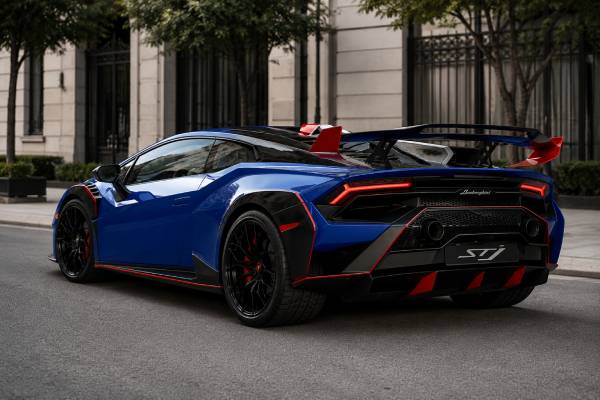
The Lamborghini Huracán STJ is the final, rarest, and most track-focused road-going expression of Lamborghini’s naturally aspirated V10 Huracán. Built in only ten units for 2024, it takes the already extreme Huracán STO and adds a sharper aero package, motorsport-style adjustable dampers, dedicated Bridgestone Potenza Race tires, and numbered collector details. Its purpose is simple: close the Huracán era with the most focused V10 road car Lamborghini could build before the brand moved its junior supercar line toward hybrid power.
For collectors, the STJ matters because scarcity, factory provenance, and end-of-era status all meet in one car. For drivers, it matters because it keeps the classic Lamborghini formula alive: a high-revving 5.2-liter V10, rear-wheel drive, dramatic aero, and a chassis tuned more for circuit precision than daily softness. It is not the easiest Huracán to buy, use, or maintain, but it is one of the most significant.
Table of Contents
- Why the STJ Marks the Last V10 Huracán
- V10 Specs, Chassis, and Performance Data
- Ten-Unit Production, Identification, and Options
- Aero, Suspension, and Special Engineering
- Driving Character on Road and Track
- Maintenance, Reliability, and Ownership Risks
- Market Value, Inspection, and Buying Guide
Why the STJ Marks the Last V10 Huracán
The Huracán STJ is Lamborghini’s farewell to the naturally aspirated V10 supercar in road-going limited-series form. It is not a normal run-out trim; it is a ten-car collector edition based on the Huracán STO and developed as the last celebration of the engine that defined Lamborghini’s entry supercar line for a decade.
The Huracán family arrived for the 2014 model year as the Gallardo’s replacement. It kept the mid-engine V10 layout but moved Lamborghini’s smaller supercar into a more modern era with a stiffer aluminum-and-carbon structure, dual-clutch transmission, digital controls, and a broader range of personalities. Over time the line stretched from all-wheel-drive road cars to rear-drive variants, Spyders, the Performante, the EVO, the Tecnica, the rally-inspired Sterrato, and the race-bred STO.
The STJ sits at the sharpest end of that family. Its name tells you what Lamborghini wanted it to represent. “ST” refers to Super Trofeo, Lamborghini’s one-make racing series, while “J” refers to Jota, a name linked to FIA Appendix J and several of Lamborghini’s most track-focused special models. In plain terms, the badge signals a road car shaped by competition thinking.
The STJ also arrived at a turning point. Lamborghini was preparing the Huracán replacement with hybrid assistance and a new engine concept, ending the line of naturally aspirated V10 junior supercars that began with the Gallardo and matured through the Huracán. That makes the STJ important beyond its lap-time improvement. It is a closing chapter for a specific sound, throttle feel, and mechanical identity.
For enthusiasts, the STJ matters because it represents the purest version of a familiar formula: no turbochargers, no hybrid boost, no all-wheel-drive safety net, and no comfort-led softening. For collectors, it matters because ten units worldwide place it in a different rarity class from the STO, Performante, Tecnica, and Sterrato. Its value will depend less on mileage alone and more on documentation, allocation history, factory specification, and whether the car remains complete with all STJ-specific parts and plates.
The STJ is best understood as a factory-built final punctuation mark. It is not the fastest Lamborghini ever made, and it is not the most powerful Huracán derivative by a dramatic margin. Its importance comes from focus, timing, and scarcity.
V10 Specs, Chassis, and Performance Data
The STJ uses the STO’s 5.2-liter naturally aspirated V10, seven-speed LDF dual-clutch gearbox, and rear-wheel-drive layout, then adds more focused aero and mechanical chassis hardware. Lamborghini quotes 640 CV, which is 470 kW and often shown in buyer guides as roughly 640 hp, although metric horsepower and SAE horsepower are not identical.
| Item | Specification |
|---|---|
| Model | Lamborghini Huracán STJ |
| Production year | 2024 |
| Production volume | 10 units worldwide |
| Body style | Two-seat coupe |
| Engine | 5,204 cc naturally aspirated V10 |
| Maximum output | 640 CV / 470 kW at 8,000 rpm |
| Maximum torque | 565 Nm |
| Transmission | 7-speed LDF dual-clutch automatic |
| Drivetrain | Rear-wheel drive |
| Wheels | 20-inch single-nut wheels |
| Tires | Bridgestone Potenza Race, STJ-specific high-grip compound |
| Suspension upgrade | Four-way adjustable racing-derived dampers replacing active components |
| Aero upgrade | Carbon-fiber front flicks and rear wing angle increased by 3 degrees |
| Aero gain | About 10 percent more aerodynamic load than Huracán STO |
| Factory lap claim | More than one second quicker than the STO at Nardò’s handling track |
The important point is not raw power. The STJ does not use a new engine tune to create its identity. Instead, Lamborghini focused on the parts that let the car use its power more precisely: downforce, tire grip, damper control, and chassis adjustability.
The V10 is mounted behind the cabin and ahead of the rear axle. It breathes naturally, revs hard, and delivers its personality through response rather than turbocharged torque. In a modern supercar world full of hybrid torque fill and boosted engines, that makes the STJ feel unusually direct. The engine’s output is controlled by Lamborghini’s LDF dual-clutch gearbox, which gives fast shifts and repeatable track performance without the clutch-management demands of older automated-manual Lamborghinis.
Because the STJ is based on the STO, the wider technical context matters. The STO already used extensive carbon-fiber bodywork, a racing-inspired “cofango” front structure combining hood and fenders, fixed-ratio steering, rear-wheel drive, carbon-ceramic braking hardware, and track-focused drive modes. The STJ builds on that with a more adjustable suspension package and a more assertive aero balance.
The result is a car aimed at serious drivers rather than spec-sheet bragging. A buyer comparing it with a standard EVO or Tecnica should see the STJ less as a faster highway car and more as a road-legal circuit tool. It rewards setup, tire condition, road surface, and driver commitment more than a more forgiving all-wheel-drive Huracán.
Ten-Unit Production, Identification, and Options
The STJ’s biggest collector fact is its ten-unit global production run. That tiny number changes the buying process because authenticity, allocation paperwork, original specification, and STJ-specific components matter as much as condition.
Lamborghini gave the STJ two official exterior configurations designed by Centro Stile. One uses Grigio Telesto bodywork with a Nero Noctis roof and Rosso Mars and Bianco Isi detailing. The other uses Blu Eliadi bodywork with a Nero Noctis roof and the same red and white detail language. Both were intended to make the STJ recognizable without turning it into a purely decorative edition.
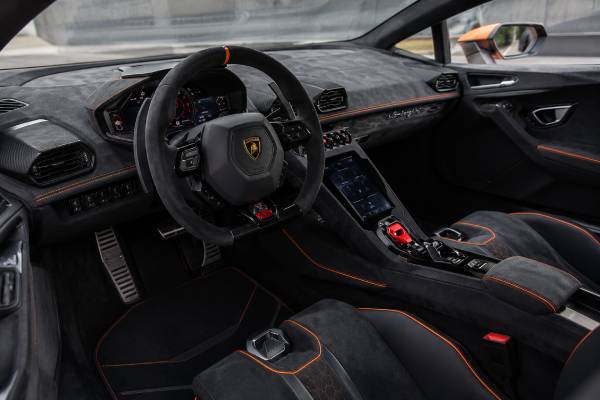
Inside, the STJ follows the STO’s track-minded cabin approach. Expect Alcantara, lightweight trim, strong visual links to the racing program, and a cockpit that puts function ahead of grand-touring luxury. The STJ also includes a numbered carbon-fiber plate marked “1 of 10,” and Lamborghini offered the possibility of a customized passenger-side plate according to the customer’s instructions.
For identification, a serious buyer should look for several layers of proof:
- Factory documentation showing the car as a Huracán STJ, not a modified STO.
- The numbered carbon-fiber STJ identification plate.
- The correct livery configuration and factory paint/interior records.
- The STJ-specific aerodynamic appendages on the cofango.
- The four-way adjustable racing-derived dampers.
- The correct 20-inch single-nut wheel and tire specification.
- Dealer delivery paperwork, service records, books, tools, accessories, and any factory correspondence.
- Matching VIN, warranty, and market paperwork that aligns with the car’s country of delivery.
This is especially important because the Huracán platform has a large aftermarket. STO-style aero parts, race-style dampers, forged wheels, wraps, and custom interiors can make an ordinary car look more special than it is. An STJ should not be evaluated by appearance alone. It needs a paper trail.
The STJ appears to have been offered only as a coupe, which makes sense given its STO base and track mission. There is no meaningful Spider equivalent in the same factory STJ program. The car’s value comes from being the final V10 Huracán special, not from open-top usability or broad personalization.
Owners should be careful with reversible changes. Paint protection film, track alignment documentation, and factory-approved service work are sensible. Non-original wheels, exhaust changes, software tunes, removed catalysts, aftermarket suspension parts, or repainted aero pieces can harm collector confidence unless every original component is preserved and the work is fully reversible.
Aero, Suspension, and Special Engineering
The STJ is technically special because Lamborghini concentrated on the parts that affect grip, balance, and driver precision. It is a more focused STO, not a cosmetic farewell edition with badges alone.
The front-end changes are centered on the cofango, the STO’s large carbon-fiber front assembly that combines the hood and fenders. On the STJ, Lamborghini added two carbon-fiber aerodynamic flicks. These small-looking parts matter because they control airflow at the front corners and help the car create more useful load over the front axle.
At the rear, Lamborghini increased the rear wing angle by 3 degrees compared with the STO. That sounds minor, but wing angle is a powerful tuning tool. More angle usually means more downforce and more drag, but Lamborghini’s goal was not simply maximum rear load. The STJ needed a balanced aero package so the front and rear axles worked together at speed. The official result is about 10 percent more aerodynamic load while maintaining balance.
The suspension change is even more important for drivers. The STJ replaces the standard active components with four-way adjustable racing-derived shock absorbers. “Four-way” means the dampers can be adjusted for compression and rebound at both high and low shaft speeds. In simpler terms, the setup can separate how the car reacts to slow body movement, such as pitch and roll, from how it deals with fast impacts, curbs, and rough surfaces.
That gives an experienced driver or technician more control over the car’s behavior. On a smooth circuit, the setup can be tightened for sharper response and better platform control. On a bumpier road or track, it can be adjusted to keep the tires in contact with the surface rather than making the car nervous. Lamborghini also noted that the damper choice allows lower spring stiffness while maintaining strong dynamic control, which is useful because grip depends on the tire staying loaded consistently.
The tires complete the package. The STJ uses special Bridgestone Potenza Race tires developed with a dedicated high-grip compound. A track-biased tire is not just a grip number; it changes warm-up behavior, steering response, braking consistency, and wet-weather caution. On a car this rare, tire age and correct fitment also become part of originality.
The emotional engineering remains the V10. No hybrid system fills torque gaps. No turbocharger changes the sound. The STJ’s character comes from a free-breathing engine, sharp throttle response, and a rising intake-and-exhaust note that gets more intense as revs build. That is a major reason collectors see the car as the end of an era rather than just another limited Huracán.
Driving Character on Road and Track
The STJ should feel sharper, more adjustable, and more tire-sensitive than a normal Huracán, even though its engine output is familiar from the STO. Its performance advantage comes from grip, aero balance, and suspension control rather than a dramatic power increase.
On track, the car’s strengths should be most obvious in braking zones, high-speed direction changes, and corner exits where rear-wheel-drive traction matters. The added aero load helps at speed, while the adjustable dampers let a specialist tune the car for a specific circuit. The dedicated Potenza Race tires should give the front axle more bite and the rear axle more stability when warm.
The V10’s delivery is a major part of the experience. The engine does not punch forward with the low-rpm shove of a turbocharged rival. Instead, it builds speed with a clean, linear pull and rewards the driver for using the upper rev range. That makes throttle placement more intuitive in fast corners because the driver can add power progressively rather than managing a sudden boost surge.
The dual-clutch gearbox suits this mission. It shifts quickly, keeps the engine in its power band, and reduces the distraction of manual clutch operation. In the most aggressive driving modes, it should feel immediate and mechanical enough for track work, though it will never have the old-school involvement of a manual gearbox. The tradeoff is repeatability.
On the road, the STJ is likely demanding. The STO base is already firm, loud, low, and visually dramatic. The STJ’s more focused tire and damper package makes tire temperature, road surface, and setup more important. On a smooth mountain road, that can feel magical: fast steering, strong front-end response, a high-revving engine, and a sense that the car is keyed into the surface. On cold tires, broken pavement, or heavy rain, the same traits demand restraint.
Owners should also be realistic about usability. The Huracán cabin is compact, visibility is shaped by supercar proportions, and the STO-based bodywork is not built around subtlety. The low nose, wide track, carbon aero, and center-lock wheels all make routine urban use more deliberate. A front lift system, if fitted or market-available, is valuable, but it does not make the car casual.
The STJ’s ideal use case is not daily commuting. It is occasional road driving, curated events, factory-backed concours-style displays, and careful track use with professional support. A buyer who wants the easiest Huracán to drive should look elsewhere. A buyer who wants the most focused and rare final V10 Huracán has the right target.
Maintenance, Reliability, and Ownership Risks
The STJ should be treated like a collector-grade track-focused Lamborghini, not like a normal used performance car. The V10 and LDF gearbox are proven by modern exotic standards, but rarity, carbon parts, tire sensitivity, and specialist setup make ownership expensive and detail-heavy.
The engine itself has a strong reputation when serviced correctly. The naturally aspirated 5.2-liter V10 avoids turbocharger heat and hybrid battery complexity, but it still needs correct fluids, careful warm-up, clean intake paths, healthy ignition components, and dealer-level diagnostics. Cars that sit unused for long periods can suffer from battery issues, stale fuel, sticky controls, aged tires, and electronic faults caused by low voltage.
The transmission is a dual-clutch unit, so buyers should check shift behavior, software status, fluid-service history, and any fault codes. It should shift cleanly at low speed and under load. Harshness, warning lights, delayed engagement, or inconsistent behavior deserves specialist attention before purchase.
The STJ-specific suspension needs extra care. Four-way adjustable dampers are only an advantage when set up properly. A poorly adjusted car can feel worse than a standard STO. Owners should document baseline settings, alignment, corner weights if performed, and any track setup changes. A future buyer will want to know whether the car has been tuned by a knowledgeable Lamborghini specialist or randomly adjusted.
Carbon-ceramic brakes need inspection beyond pad thickness. Check disc condition, edge damage, heat marks, surface condition, caliper health, and brake cooling ducts. Track use can accelerate wear, and carbon-ceramic replacement costs are high. A low-mile car with repeated circuit sessions may have more brake and tire stress than a higher-mile car used gently on roads.
Key ownership checks include:
- Battery health and use of the correct maintainer.
- Annual service records from an authorized Lamborghini dealer or respected specialist.
- Brake disc, pad, tire, and wheel condition.
- Center-lock wheel service procedure and correct torque documentation.
- Damper condition, adjustment records, and alignment sheets.
- Carbon-fiber aero damage under the nose, around the cofango, and near the rear diffuser.
- Software updates, fault-code scans, and recall checks by VIN.
- Evidence of track use, including tire heat cycles and brake temperature history where available.
Body damage is a major risk. The STJ’s carbon aero parts are rare, expensive, and potentially difficult to replace quickly. Even minor underbody scrapes can matter if they affect original carbon components. Accident repair should be examined by a Lamborghini body specialist, not a general luxury-car shop.
Warranty and extended-warranty coverage also matter. Lamborghini’s warranty terms and extension programs vary by country, and the STJ’s limited-production status makes official network history even more valuable. A car serviced outside the official network may still be mechanically sound, but it can lose buyer confidence unless the specialist is well known and the records are complete.
Market Value, Inspection, and Buying Guide
The STJ’s market is too thin for ordinary price-guide thinking. With only ten cars worldwide, each sale will depend on allocation history, color configuration, mileage, tax location, provenance, and whether the seller can prove the car remains complete and original.
A normal Huracán value discussion starts with year, mileage, condition, and options. An STJ discussion starts with authenticity. The buyer should confirm the car is one of the ten factory STJs before discussing price. After that, the most important value factors are originality, documentation, condition of STJ-specific parts, and whether the car has been used on track.
Compared with the STO, the STJ should command a serious rarity premium. The STO is special but not ultra-limited in the same way. The STJ is closer to a factory collectible: a final-edition car with a defined build count and a direct link to the end of the V10 Huracán line. That does not mean every asking price is justified. It means comparable sales will be scarce, private, and sometimes opaque.
A strong STJ candidate should have:
- Confirmed factory STJ identity.
- Complete delivery documentation.
- Original paint or fully documented paint condition.
- Correct Centro Stile livery.
- Numbered carbon-fiber plate and any customer-specific plate.
- Unmodified engine, exhaust, ECU, suspension hardware, and aero.
- Original wheels and correct tire specification.
- Full dealer service history.
- Clean accident and title history.
- Current recall status checked by VIN.
- All books, keys, tools, covers, chargers, and accessories supplied at delivery.
Cars to approach carefully include examples with unexplained repainting, missing plates, heavy track use without records, aftermarket exhaust or ECU work, damaged carbon aero, incomplete service history, or vague seller claims about allocation. A rare Lamborghini with poor documentation can be harder to resell than a more common car with perfect records.
Inspection should happen in layers. First, verify identity and paperwork. Second, inspect the body, carbon aero, wheels, tires, brakes, and suspension. Third, run a full diagnostic scan. Fourth, confirm service, recall, and warranty status with the official network. Finally, review whether all original parts and accessories are present.
For long-term collectability, the STJ has strong ingredients: final naturally aspirated V10 status, ten-unit production, factory motorsport influence, STO base, and clear visual identification. The main risks are illiquidity and condition sensitivity. Because so few exist, selling one may require the right buyer at the right time. But for a serious Lamborghini collector who wants the last and rarest V10 Huracán road car, the STJ is one of the defining modern choices.
References
- Lamborghini Huracán STJ: “The Last Dance” 2024
- Lamborghini Huracán STO | Lamborghini.com 2024
- Lamborghini 634 will have a new hybrid twin-turbo v8 engine 2024
- Warranty Extension | Lamborghini.com 2026
- Recall Campaign | Lamborghini.com 2026
Disclaimer
This article is for informational purposes only and is not a substitute for professional diagnosis, repair, valuation, or pre-purchase inspection. Specifications, torque values, service intervals, procedures, software status, recall status, and equipment can vary by VIN, market, production date, and individual configuration. Always verify details against official Lamborghini service documentation and consult a qualified Lamborghini dealer or specialist before buying, servicing, modifying, or tracking the vehicle.
If this guide helped you, please share it on Facebook, X/Twitter, or your favorite car community to support our work.