
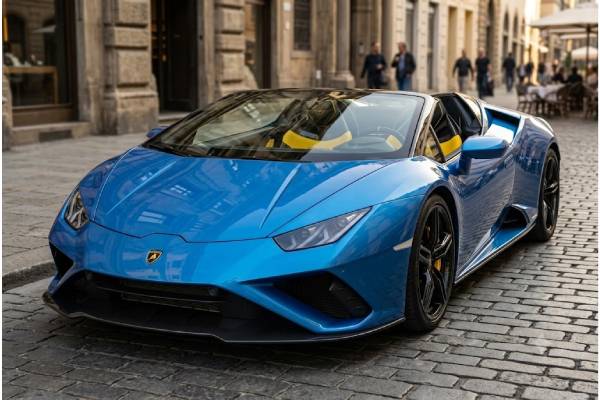
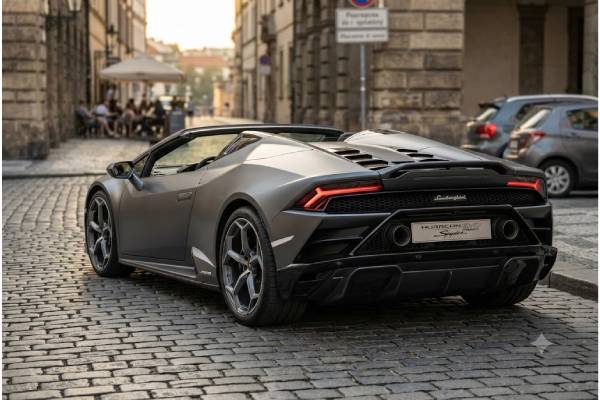
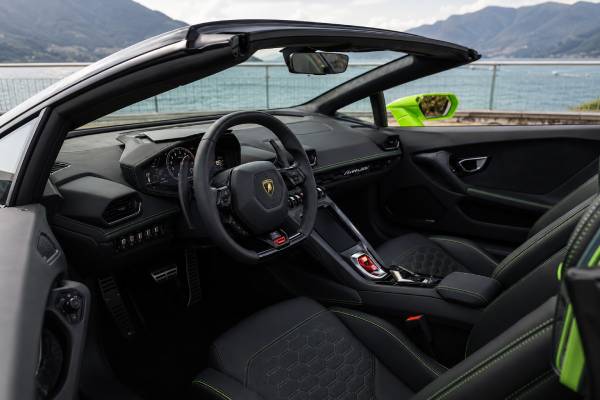
The Lamborghini Huracán EVO RWD Spyder is the open-top, rear-wheel-drive version of Lamborghini’s last naturally aspirated V10 era. It takes the familiar Huracán EVO formula and removes the front-driven hardware, trading all-weather traction for a more direct, playful, driver-led character. With 610 hp from a 5.2-liter V10, a 7-speed dual-clutch gearbox, and a fabric roof that folds away in seconds, it sits between everyday-usable exotic and old-school sensory machine.
For buyers, the EVO RWD Spyder is not just “the cheaper Huracán Spyder.” It is a specific choice: lighter in feel than the AWD EVO Spyder, less track-focused than the STO, and more emotional than many turbocharged or hybrid rivals. The best examples combine original paint, clean service records, desirable options, low but usable mileage, and verified recall completion.
Table of Contents
- Why This Rear-Drive V10 Spyder Matters
- LB724 Specifications and Performance Data
- Variants, Options, and Factory Identification
- Design and Engineering That Shape Its Character
- How the EVO RWD Spyder Drives
- Maintenance, Reliability, and Ownership Risk
- Market Values and Buyer Inspection Guide
Why This Rear-Drive V10 Spyder Matters
The Huracán EVO RWD Spyder matters because it combines three things Lamborghini will not repeat in the same way: a naturally aspirated V10, rear-wheel drive, and open-air road use. It is one of the clearest expressions of the Huracán line before Lamborghini moved its entry supercar into the hybrid V8 era.
The Huracán itself replaced the Gallardo and became Lamborghini’s volume supercar. The EVO update refined the original Huracán with sharper aerodynamics, improved interior technology, better chassis electronics, and a more mature design. The RWD Spyder arrived in 2020 as the convertible version of the EVO RWD coupe, replacing the earlier LP 580-2 Spyder.
Its role in the range was clear. The AWD EVO Spyder was the faster, more planted version. The STO was the road-legal track special. The Tecnica later blended STO influence with road usability. The EVO RWD Spyder was the emotional road car: less about chasing the quickest launch and more about throttle response, steering, sound, and balance.
The car’s appeal today comes from that exact positioning. It still looks modern, has a usable cabin, and offers dealer-supported ownership, but it also gives the driver a level of mechanical drama that newer electrified supercars often smooth out. The 5.2-liter V10 revs to 8,000 rpm, responds instantly, and puts its power through the rear tires without the security blanket of front-axle drive.
Collectors also pay attention because the Huracán ended a long Lamborghini V10 chapter that began with the Gallardo. The EVO RWD Spyder is not rare in the hand-built-classic sense, but clean, factory-original, well-optioned cars are already separating from average examples. The long-term interest is strongest for cars with verified Lamborghini dealer history, special Ad Personam colors, desirable carbon options, lift systems, and no accident or paintwork story.
In short, the LB724-era EVO RWD Spyder is important because it is not the fastest Huracán. It is the Huracán for people who want the engine, the sound, the shape, and the rear-drive feeling without turning every drive into a track session.
LB724 Specifications and Performance Data
The essential specification is simple: 5.2-liter naturally aspirated V10, 610 hp, rear-wheel drive, and a 7-speed Lamborghini dual-clutch transmission. The useful details matter because small differences between RWD, AWD, coupe, and Spyder versions affect value, maintenance, and driving feel.
| Item | Lamborghini Huracán EVO RWD Spyder |
|---|---|
| Engine | 90-degree naturally aspirated V10 |
| Displacement | 5,204 cc / 5.2 liters |
| Injection | Dual injection: direct and multi-point |
| Bore x stroke | 84.5 mm x 92.8 mm |
| Compression ratio | 12.7:1 |
| Power | 610 CV / 449 kW / about 602 hp at 8,000 rpm |
| Torque | 560 Nm / 413 lb-ft at 6,500 rpm |
| Lubrication | Dry sump |
| Transmission | 7-speed LDF dual-clutch automatic |
| Drive layout | Mid-engine, rear-wheel drive |
The V10 is the main event. Unlike a turbocharged engine, it does not rely on boost to create drama. It builds torque cleanly, sharpens as the revs rise, and saves its hardest character for the upper half of the tachometer. The dual-injection system helps emissions, response, and high-load fueling, while the dry-sump lubrication system supports the low engine placement and high lateral loads expected from a supercar.
| Item | Specification |
|---|---|
| Chassis | Hybrid aluminum and carbon-fiber structure |
| Body | Aluminum and composite exterior panels with fabric soft top |
| Suspension | Independent double wishbones |
| Steering | Electromechanical power steering; variable-ratio LDS optional |
| Standard brakes | Ventilated and cross-drilled steel discs |
| Brake calipers | 8-piston front, 4-piston rear |
| Standard wheels | 19-inch front and rear |
| Standard tires | 245/35 ZR19 front, 305/35 ZR19 rear |
| Wheelbase | 2,620 mm / 103.15 in |
| Length | 4,520 mm / 177.95 in |
| Width excluding mirrors | 1,933 mm / 76.10 in |
| Height | 1,180 mm / 46.46 in |
| Dry weight | 1,509 kg / 3,326 lb |
| Weight distribution | 40 percent front / 60 percent rear |
| Fuel capacity | 83 liters / about 21.9 US gal |
| Front trunk capacity | 100 liters |
| Measure | Figure |
|---|---|
| 0–100 km/h | 3.5 seconds |
| 0–200 km/h | 9.6 seconds |
| Top speed | 324 km/h / about 201 mph |
| 100–0 km/h braking | 32.2 meters |
| WLTP combined consumption | 13.9 l/100 km |
| WLTP CO2 emissions | 335 g/km |
The figures show why this car is best judged by feel, not only by acceleration. Many AWD supercars launch harder, and the AWD EVO Spyder is quicker to 100 km/h. The RWD Spyder’s value is in how it reaches speed: less front-axle drag, more rear-biased motion, and a clearer sense of what the tires are doing.
Variants, Options, and Factory Identification
The EVO RWD Spyder is easiest to identify by its rear-wheel-drive body details, open roof, 610 hp tune, and two-wheel-drive chassis setup. Buyers should still confirm the VIN, build sheet, options, recalls, and original delivery market before treating any car as a correct, factory-original example.
The main related Huracán versions are:
- Huracán EVO RWD Coupe: same core rear-drive idea, lighter and slightly quicker than the Spyder.
- Huracán EVO Spyder AWD: 640 CV, all-wheel drive, faster launches, and a more secure high-speed personality.
- Huracán STO: rear-wheel drive but far more track-focused, with more carbon bodywork and stronger circuit intent.
- Huracán Tecnica: later road-and-track bridge model with sharper aero and a 640 CV RWD tune.
- Huracán Sterrato: lifted, all-terrain-themed final-series Huracán with a very different buyer profile.
Factory options affect both usability and value. The front axle lift is one of the most important real-world options because the car’s low nose is vulnerable on ramps, driveways, speed humps, and transport trucks. Magnetorheological dampers are also desirable because they widen the comfort range without removing the car’s aggressive feel.
Strong buyer options usually include:
- Front axle lift system.
- Magnetorheological dampers.
- Carbon-ceramic brakes, when condition is excellent.
- 20-inch wheels, especially desirable factory designs.
- Carbon-fiber sport seats or upgraded comfort seats, depending on buyer preference.
- Exterior carbon packages.
- Interior carbon trim.
- Alcantara, leather, or Carbon Skin upholstery.
- Apple CarPlay and infotainment upgrades.
- Parking sensors, reversing camera, and useful visibility aids.
- Transparent engine cover where equipped or market-appropriate.
- Ad Personam paint and special interior stitching.
Color matters more than it does on normal used cars. Bright Lamborghini colors such as Verde Mantis, Arancio Borealis, Giallo Inti, Blu Cepheus, and strong Ad Personam shades can command a premium when paired with tasteful interiors. Neutral cars in black, white, silver, and gray may sell more easily to conservative buyers but need the right options to stand out.
Authenticity checks should include the original window sticker or factory build sheet, service booklet entries, dealer invoices, paint-meter readings, and inspection of option codes. A wrapped car is not automatically a problem, but the paint beneath the wrap must be inspected carefully. A car with aftermarket exhaust, lowering, wheels, or ECU tuning may sound appealing, but those changes can reduce value, complicate warranty discussions, and hide harder use.
Design and Engineering That Shape Its Character
The EVO RWD Spyder looks different because Lamborghini tuned the shape for a rear-drive car rather than simply removing front driveshafts from the AWD model. Its sharper front intake treatment, revised splitter, and unique rear diffuser help separate it visually and aerodynamically from the AWD EVO Spyder.
The front end has a more open, aggressive face than the earlier LP 580-2 Spyder. Lamborghini used a wide front intake theme rather than the stronger Y-shaped front graphic of some AWD EVO versions. At the rear, the black diffuser and bumper treatment give the RWD model a cleaner, more mechanical look. These are not just styling details; they help signal the car’s more playful chassis tuning.
The roof is a high-quality soft top rather than a folding hardtop. It opens or closes in about 17 seconds and can operate at low urban speeds. That matters because the car feels very different roof-down. With the rear glass lowered, the cabin becomes a controlled sound chamber for the V10. With the roof up, it is quieter and more usable than the dramatic shape suggests.
The mid-engine layout gives the car its short-nose, cab-forward stance. The engine sits immediately behind the cockpit, which keeps the driver close to the sound, heat, and vibration of the powertrain. The dry-sump V10 also helps the engine sit low, supporting a lower center of gravity.
P-TCS, Lamborghini’s Performance Traction Control System, is one of the key RWD features. Instead of cutting torque harshly as soon as rear slip appears, it is designed to manage torque more progressively. In normal language, that means the car can allow controlled movement without instantly killing the fun. Strada, Sport, and Corsa modes change the tolerance, response, and shift behavior.
The cabin mixes theater with useful function. The red starter cover, paddle shifters, low seating position, 8.4-inch central touchscreen, and driver-focused controls create the expected Lamborghini mood. The ergonomics are not as calm as a Porsche 911 Turbo, but the Huracán is easier to live with than its dramatic exterior suggests.
The most distinctive feature remains the sound. The V10 uses revs, intake noise, and exhaust pitch instead of turbo whistle or electric torque fill. That gives the EVO RWD Spyder its emotional edge. It sounds mechanical at low speed, metallic in the middle, and urgent near redline. Roof down, that becomes the car’s defining luxury.
How the EVO RWD Spyder Drives
The EVO RWD Spyder drives like a modern Lamborghini with a more honest rear axle. It is fast, stable, and electronically protected, but it feels less filtered than the AWD EVO and rewards smoother steering, throttle, and brake inputs.
In Strada mode, the car is surprisingly manageable. The dual-clutch gearbox shifts smoothly, throttle response is calmer, and the suspension is tolerable on good roads. It is still wide, low, loud, and attention-grabbing, so “daily usable” should not be confused with ordinary. Visibility forward is decent for a mid-engine supercar, but rear and rear-three-quarter vision require care.
Sport mode is where the car’s personality opens up. The exhaust becomes more present, the gearbox holds gears longer, and the rear-drive calibration allows more movement. The car feels alive on corner exit because the rear tires are doing the work without the front axle pulling the nose straight. This is the mode many owners use on mountain roads, open country roads, and short spirited drives.
Corsa mode is sharper and more disciplined. It suits smooth pavement and track use, but it can feel too rigid or busy on rough public roads. The gearbox becomes more aggressive, the throttle more immediate, and the stability systems more performance-focused. The car is still not an STO, but it is far from a soft boulevard Spyder.
The steering is quick and accurate. Cars with Lamborghini Dynamic Steering can feel more variable as speed and mode change, so buyers should test-drive both if they are sensitive to steering feel. Standard electromechanical steering is not old-school heavy, but the front end is responsive and the car places accurately.
Braking depends heavily on equipment and condition. Steel brakes are strong and cheaper to maintain. Carbon-ceramic brakes resist fade better and look right on a high-spec Lamborghini, but replacement cost is serious. On any version, pedal feel should be firm, straight-line braking should be stable, and vibration should not be dismissed as “normal supercar behavior.”
Tires transform the car. Old Pirelli P Zero tires with plenty of tread can still be poor if the rubber has aged or heat-cycled out. A fresh, correct tire set gives the rear axle the grip and predictability the chassis needs. Mismatched tires, cheap replacements, or wrong sizes are warning signs.
The EVO RWD Spyder is not the quickest way to go fast in a Huracán. It is the most theatrical road-focused way to enjoy the 610 hp tune with the sky open and the rear tires involved.
Maintenance, Reliability, and Ownership Risk
A good EVO RWD Spyder can be reliable by exotic-car standards, but ownership risk comes from deferred service, accident history, carbon-ceramic brake wear, roof system faults, tire age, lift-system problems, and electronic campaigns. The right pre-purchase inspection is worth far more than a cheap asking price.
The 5.2-liter V10 has a strong reputation when serviced correctly and left close to factory specification. It is not a fragile engine, but it is expensive when neglected. Oil services, correct fluids, diagnostic scans, cooling-system checks, and documented annual maintenance matter. Cars that sit for long periods still need time-based service because fluids age, seals dry, batteries weaken, and tires flat-spot.
Important inspection areas include:
- Engine: listen for abnormal timing, accessory, or misfire noises after cold start and at full operating temperature.
- Gearbox: check smooth low-speed takeoff, clean paddle shifts, no warning lights, and no hesitation in reverse.
- Cooling system: inspect radiators, hoses, fan operation, coolant condition, and evidence of front debris damage.
- Brakes: measure disc condition, pad life, caliper finish, and brake-fluid service history.
- Suspension: check dampers, bushings, ball joints, front lift operation, and uneven tire wear.
- Roof system: confirm smooth opening and closing, no hydraulic noise, no warning messages, and no water leaks.
- Electronics: scan all modules, not just the engine ECU.
- Battery: verify condition because weak batteries can trigger confusing warning messages.
- Body underside: inspect the front splitter, undertrays, jacking points, diffuser, and wheel liners.
- Paint and structure: measure panels and inspect seams, bolts, brackets, and bumper alignment.
Annual servicing is normal even for low-mileage cars. A car driven 1,000 miles per year but serviced every three years is not better than a car driven regularly and maintained properly. Lamborghini dealer stamps help resale, but detailed specialist invoices are also valuable if the work is correct and traceable.
The LDF dual-clutch transmission is generally robust, but abuse shows up through rough engagement, warning lights, overheating history, or poor shift quality. Launch-control use is less visible than a manual clutch record, so buyers should judge the whole car: tire wear, brake wear, service gaps, cosmetic damage, and owner behavior.
Carbon-ceramic brakes deserve special attention. They can last a long time on road cars, but track use, stone damage, and improper cleaning can shorten life. Replacement discs and pads are costly enough to change the economics of a purchase. A bargain car needing carbon-ceramic brake work may not be a bargain at all.
Recalls and service campaigns should be checked by VIN with a Lamborghini dealer or official recall database. Relevant Huracán-era campaigns include software-related rear camera issues on some cars and a 2024 EVO Spyder front frame bracket recall for a limited population. Completion records should be in the dealer system, not just verbally promised.
Aftermarket modifications are a major risk area. Exhausts, tunes, lowering springs, spacers, aftermarket wheels, and altered emissions equipment can reduce reliability and resale confidence. Some changes are reversible, but buyers should price them honestly. The safest purchase is usually a stock car with factory options, clean diagnostics, and complete records.
Market Values and Buyer Inspection Guide
The EVO RWD Spyder sits in the modern collectible zone: used enough to have depreciated from new, new enough to remain serviceable, and special enough to attract buyers who missed the final naturally aspirated V10 ordering window. Market data in early 2026 places average benchmark values around the high-$200,000 range, with real cars varying widely by mileage, specification, condition, and color.
Typical market positioning looks like this:
| Factor | Effect on value |
|---|---|
| Low mileage with annual service | Strong positive |
| Front lift and desirable factory options | Strong positive |
| Ad Personam or high-demand color | Positive when tastefully specified |
| Original paint and no accident history | Major positive |
| Carbon-ceramic brakes in excellent condition | Positive, but only if wear is documented |
| Missed services or weak records | Negative |
| Aftermarket tune or exhaust | Often negative for collector-grade buyers |
| Wrap with unverified paint underneath | Inspection risk |
| Prior accident, repaint, or structural repair | Major negative |
A sensible search range is not just “cheapest to most expensive.” Lower-mileage, highly optioned cars with clean paint and dealer records can justify a premium. Higher-mileage cars can also be good buys if they have been serviced yearly, driven responsibly, and priced correctly. The weakest value is usually a low-mileage car with gaps, weak batteries, old tires, and no evidence of proper annual care.
Pre-purchase inspection priorities
Use this order before negotiating:
- Confirm VIN, model, year, title status, and original delivery market.
- Request the window sticker, build sheet, service booklet, and dealer service printout.
- Check open recalls and campaign completion by VIN.
- Perform a full diagnostic scan of all control modules.
- Measure paint thickness and inspect for prior repair.
- Inspect the underside, front lift, splitter, diffuser, wheels, and suspension.
- Measure brake disc and pad condition, especially on carbon-ceramic cars.
- Check tire brand, date codes, sizes, and wear pattern.
- Operate the roof repeatedly and inspect seals for leaks.
- Road-test from cold start through full operating temperature.
Cars to seek are original, unmodified examples with consistent service, fresh tires, no warning lights, no sticky interior damage, excellent roof function, and options that support real use. Cars to avoid are those with unexplained paintwork, missing records, tuned ECUs, cheap tires, unresolved warning lights, or sellers who resist a specialist inspection.
Long-term collectability is likely strongest for cars that represent the EVO RWD Spyder cleanly: vivid factory colors, desirable factory carbon, front lift, strong documentation, and no stories. The model may not become rare overnight, but it has the right ingredients for lasting enthusiast demand: final-era V10 sound, open roof, rear-wheel-drive balance, and a clear identity within the Huracán family.
References
- Huracán EVO RWD Spyder: open-air celebration 2020 (Manufacturer News Release)
- Lamborghini Huracán EVO RWD SPYDER | Lamborghini Montreal 2024 (Technical Specifications)
- Part 573 Safety Recall Report 21V-466 2021 (Recall Database)
- Part 573 Safety Recall Report 24V-701 2024 (Recall Database)
- Lamborghini Huracán Evo RWD Spyder Market – CLASSIC.COM 2026 (Market Data)
Disclaimer
This article is for informational purposes only and is not a substitute for professional diagnosis, repair, inspection, valuation, or legal advice. Specifications, torque values, service intervals, software campaigns, recall applicability, and procedures can vary by VIN, market, production date, and equipment. Always verify details against official Lamborghini service documentation and have any car inspected by a qualified Lamborghini dealer or specialist before purchase.
If this guide helped you, please consider sharing it on Facebook, X/Twitter, or with other Lamborghini enthusiasts to support our work.