
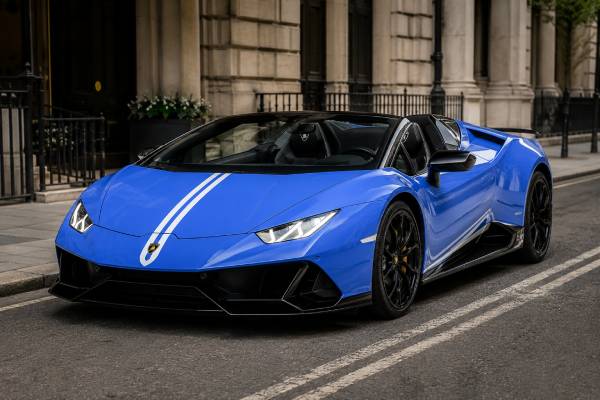
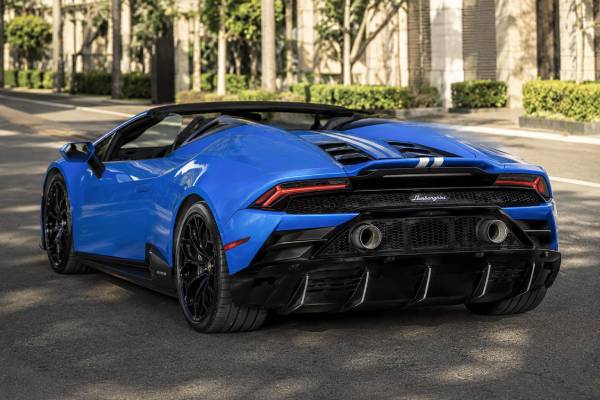
The Lamborghini Huracán EVO Spyder 60th Anniversary Edition is a highly specific collector version of Lamborghini’s open-top, all-wheel-drive V10 supercar. It matters because it combines the most complete road-focused Huracán EVO hardware with a factory anniversary specification limited to 60 units. That gives it two forms of appeal: the easy-to-understand thrill of a 640 hp naturally aspirated V10 behind the seats, and the longer-term collector pull of a documented special edition built near the end of Lamborghini’s pure V10 era.
This is not the lightest Huracán, the most track-focused Huracán, or the most radical-looking Huracán. Its strength is balance. It has the full EVO dynamic package, four-wheel drive, four-wheel steering, a fast-folding soft top, and the special trim details that mark Lamborghini’s 60th year. For buyers, the key is simple: provenance and condition matter as much as mileage, because the car’s value rests heavily on factory originality.
Table of Contents
- Why This Anniversary Spyder Matters
- V10 Specifications and Core Hardware
- Limited Build, Options, and Authenticity
- Design, Aero, and Open-Top Engineering
- How the EVO Spyder Drives
- Maintenance Risk and Ownership Reality
- Market Values and Buyer Checks
Why This Anniversary Spyder Matters
The Huracán EVO Spyder 60th Anniversary Edition matters because it is a factory-limited version of one of Lamborghini’s last naturally aspirated V10 convertibles. It sits at the point where modern electronics, old-school engine character, and collectible scarcity all meet.
The Huracán line replaced the Gallardo and became Lamborghini’s core V10 model family. By the time the EVO arrived, Lamborghini had already refined the formula through the original LP 610-4, rear-wheel-drive LP 580-2, Performante, and Spyder versions. The EVO was not a clean-sheet car, but it was a major evolution. It brought the 640 CV engine tune associated with the Performante into a more usable road car and paired it with Lamborghini Integrated Vehicle Dynamics, rear-wheel steering, all-wheel drive, and revised aerodynamics.
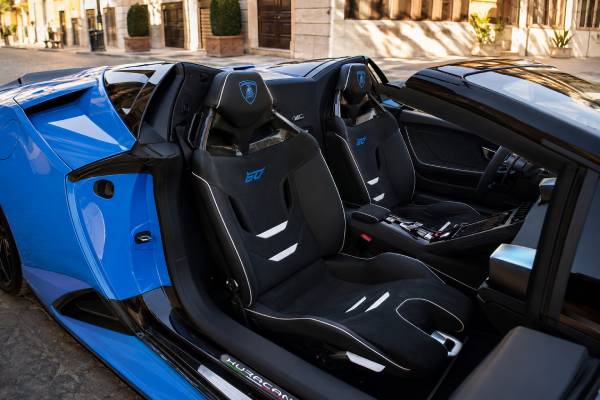
The 60th Anniversary Edition was announced in 2023 as part of a three-model celebration covering the Huracán STO, Huracán Tecnica, and Huracán EVO Spyder. Each special edition was limited to 60 units, with two dedicated color configurations and anniversary details. For the EVO Spyder, that meant the same core mechanical package as the standard all-wheel-drive EVO Spyder, but with limited-edition visual identity, a carbon-fiber “1 of 60” plate, and 60th-anniversary branding on the doors and seats.
Its historical position is important. Lamborghini’s next-generation V10 successor moved toward electrification, while the Huracán represented the final long-running chapter of the naturally aspirated 5.2-liter V10 as a central Lamborghini product. The 60th Anniversary Edition therefore has a clearer collector story than a normal EVO Spyder. It is not rare by accident; it was built and numbered as a celebration piece.
For enthusiasts, the appeal is emotional. The car gives roof-down access to one of the best modern production V10 soundtracks. For collectors, the appeal is documentation. A normal Huracán can be valued mainly by mileage, color, condition, and service history. A 60th Anniversary Edition also needs proof that the car is a real factory anniversary car, not a standard EVO Spyder with aftermarket graphics or cosmetic changes.
The car’s reputation today is strongest among buyers who want a usable Lamborghini with limited-series credibility. It is less extreme than an STO and less focused than a Tecnica, but it is also more theatrical in daily driving because of the open roof, all-wheel-drive traction, and full EVO chassis technology.
V10 Specifications and Core Hardware
The exact car covered here is the all-wheel-drive Huracán EVO Spyder with Lamborghini’s 5.2-liter naturally aspirated V10, 640 CV, and 7-speed LDF dual-clutch transmission. The 60th Anniversary Edition is primarily a limited factory specification, not a separate engine or chassis tune.
| Category | Specification |
|---|---|
| Model | Lamborghini Huracán EVO Spyder 60th Anniversary Edition |
| Internal / platform identifier | LB724 |
| Production year covered | 2023 |
| Engine | 5.2-liter naturally aspirated V10 |
| Displacement | 5,204 cc |
| Power | 640 CV / 470 kW at 8,000 rpm |
| Torque | 600 Nm / 443 lb-ft at 6,500 rpm |
| Transmission | 7-speed Lamborghini Doppia Frizione dual-clutch automatic |
| Drivetrain | Electronically controlled all-wheel drive |
| 0–100 km/h | 3.1 seconds |
| 0–200 km/h | About 9.3 seconds |
| Top speed | 325 km/h / 202 mph |
The engine is the heart of the car. It uses no turbochargers and no hybrid assistance, so throttle response is immediate and mechanical. Power builds with revs rather than arriving as a low-rpm surge. That is a major part of the EVO Spyder’s appeal. It feels alive at part throttle, then becomes much more intense above the midrange as the intake and exhaust note sharpen.
The LDF gearbox is central to the driving character. In easy driving, it can shift cleanly and quickly without making the car difficult to use in traffic. In Sport and Corsa modes, the same transmission becomes far more aggressive, holding gears longer and making manual paddle shifts feel much more urgent.
| Area | Specification or feature |
|---|---|
| Body style | Two-seat soft-top Spyder |
| Structure | Aluminum and carbon-fiber hybrid chassis architecture |
| Suspension | Double-wishbone layout with magnetorheological dampers |
| Steering | Electronic power steering with Lamborghini Dynamic Steering |
| Rear steering | Lamborghini All-Wheel Steering |
| Brakes | Carbon-ceramic brake system |
| Front tires | 245/30 ZR20 |
| Rear tires | 305/30 ZR20 |
| Dry weight | About 1,542 kg |
| Wheelbase | 2,620 mm |
| Fuel economy, U.S. EPA | 15 mpg combined, 13 city, 18 highway for 2023 Huracán Spyder AWD |
The all-wheel-drive system is a practical advantage, not just a performance headline. A 640 hp open-top mid-engine car needs traction management, especially on cold tires or uneven roads. The EVO’s system constantly changes torque distribution based on drive mode, steering, throttle, and available grip.
The rear-steering system gives the car two personalities. At low speeds it helps the car rotate more easily, which makes tight roads and parking less intimidating. At higher speeds it adds stability, making the short-wheelbase Huracán feel calmer than its dimensions suggest.
Limited Build, Options, and Authenticity
The 60th Anniversary Edition is valuable because it is a genuine factory limited edition, not just an option bundle. The most important buyer task is proving that the exact car was built as one of the 60 EVO Spyder anniversary cars.
Lamborghini created the 60th Anniversary Huracán editions with dedicated liveries and special details. Each model received two configuration themes. For the EVO Spyder, the best-known anniversary treatments include combinations such as Blu Le Mans with Bianco Isi detailing, or Verde Viper with Bianco Isi elements, depending on market and order configuration. Interior themes typically used Nero Ade leather and Alcantara with contrast stitching and piping, plus 60th-anniversary seat embroidery.
The main factory identifiers to verify are:
- The carbon-fiber “1 of 60” plate.
- The 60th-anniversary logo painted on the doors.
- 60th-anniversary embroidery on the seats.
- Factory build sheet or Lamborghini dealer documentation.
- Original window sticker or market-specific order sheet.
- Consistent paint, trim, stitching, wheel, and livery details.
- VIN and option-code confirmation through an authorized Lamborghini dealer.
Factory options still matter because Lamborghini buyers often personalize cars heavily. Some features improve usability and resale appeal, while others are more taste-dependent.
Desirable equipment often includes:
- Front lift system for steep ramps and driveways.
- Magnetorheological suspension if not already bundled in the market specification.
- Rear-view camera and parking sensors.
- Smartphone interface and navigation.
- Premium sound, where the buyer values touring use.
- High-quality carbon interior trim.
- Forged or lightweight wheel designs in factory finish.
- Transparent protective film installed cleanly and reversibly.
The anniversary package should not be confused with the Huracán STO 60th Anniversary or Huracán Tecnica 60th Anniversary. Those cars have different drivetrain layouts, body hardware, and driving intent. The EVO Spyder 60th Anniversary is the open-top all-wheel-drive celebratory model. That makes it more usable and more grand-touring friendly than the STO, but less track-special in character.
Market-specific equipment can also change the car. U.S., European, U.K., Middle Eastern, and Asian-market cars may differ in lighting rules, emissions labels, speedometer display, documentation, warranty terms, and registration history. A collector-grade example should have paperwork that matches the market where it was originally delivered.
Avoid cars where the seller cannot separate factory anniversary content from later cosmetic additions. A replica-style wrap, painted door logo, or aftermarket trim does not create a true 60th Anniversary Edition. For a normal enthusiast buyer this may be a cosmetic issue; for a collector it is a value issue.
Design, Aero, and Open-Top Engineering
The EVO Spyder’s design works because it keeps the Huracán’s wedge-shaped aggression while making the roof-down experience central to the car. The anniversary edition adds visual rarity, but the basic shape is already one of Lamborghini’s cleanest modern designs.
The EVO facelift sharpened the original Huracán with new aerodynamic details. The front splitter, reshaped air channels, rear diffuser, and rear spoiler were designed to improve downforce and stability compared with the earlier Huracán. Lamborghini also moved the rear design closer to the Performante look, with higher-set exhaust outlets and a more technical rear treatment.
The Spyder’s soft top is one of its defining engineering features. It gives the car a different feel from the coupe without turning it into a relaxed cruiser. The top folds electrically and allows the driver to choose between full theater and better weather protection. With the roof down, the V10 dominates the experience. With the roof up, the car still feels like a serious supercar, although wind and tire noise remain part of the package.
The cockpit is built around Lamborghini’s low, angular design language. The central touchscreen controls infotainment and vehicle functions, while the driver sits low and close to the front axle line. Visibility is better forward than many people expect, but rear three-quarter visibility is limited, especially with the roof up.
What makes the anniversary design different
The 60th Anniversary Edition does not rely on new body panels. Its identity comes from factory color, livery, plaques, seat embroidery, and trim details. That is good for long-term durability because the limited-edition value is not tied to fragile special mechanical parts, but it also means originality is easy to disturb.
The most important design-related ownership rule is simple: preserve factory finish. Repainting anniversary markings, changing wheels, replacing interior trim, or removing original livery elements can make the car less desirable. Protective film is usually acceptable if it is high-quality and documented, but permanent cosmetic changes should be treated carefully.
Sound and sensory character
The sound is a major reason to buy this car. Turbocharged supercars can be faster in the real world, but few match the drama of a high-revving Lamborghini V10 with the roof open. The intake note hardens as revs climb, the exhaust becomes sharper, and the shift behavior changes dramatically with drive mode.
That sensory quality is part of the car’s engineering value. The EVO Spyder is not just a specification sheet; it is a final-era naturally aspirated Lamborghini that lets the driver hear and feel the engine without a roof filtering the experience.
How the EVO Spyder Drives
The EVO Spyder drives like a modern Lamborghini that wants to be used, not stored. It is fast enough to feel extreme, but its all-wheel drive, rear steering, and adaptive systems make it more approachable than its 640 hp output suggests.
In Strada mode, the car is surprisingly manageable. The gearbox shifts early, the dampers soften, and the steering feels less nervous. It still rides firmly, and low ground clearance means the driver must respect driveways and road crowns, but it does not feel like a track car pretending to be street legal.
Sport mode is the emotional setting. The drivetrain becomes louder and more playful, the gearbox holds lower gears, and the all-wheel-drive system allows a more energetic corner-exit feel. This is where the EVO Spyder often feels most special on public roads. It is dramatic without demanding racetrack speeds.
Corsa mode is sharper and more serious. It reduces softness in the controls and prioritizes lap-style precision. On a smooth road or circuit it gives the most direct response, but on rough streets it can feel less natural than Sport because the car becomes more rigid and immediate.
Acceleration is violent by normal standards but cleanly delivered. The naturally aspirated V10 does not give the sudden low-rpm shove of a turbocharged engine. Instead, it builds speed in a rising, linear rush. The reward is that the driver can meter power with confidence, especially with the traction advantage of all-wheel drive.
The steering is quick, and the rear-steering system makes the car feel shorter than expected. Some purists prefer simpler hydraulic systems, but the EVO’s setup fits the car’s purpose. It is alert, precise, and confidence-building when the tires are warm.
Ride quality depends heavily on tires, road surface, and wheel condition. On smooth pavement, the magnetorheological dampers give enough compliance for weekend touring. On broken city roads, the car still feels wide, low, and expensive. The front lift system is valuable because carbon splitters, underbody panels, and low front edges are costly to repair.
The brakes are extremely strong, but carbon-ceramic systems need correct inspection. On the road they can last a long time, especially if the car is not tracked. Heavy track use, poor bedding, or damage from wheel cleaning chemicals can change the ownership picture quickly.
The open-top experience is the main reason to choose the Spyder over a coupe. There is more weight and a little less structural purity, but the trade is worthwhile for many buyers. With the roof down, the driver gets closer to the V10’s sound and the car feels more event-like at legal speeds.
Maintenance Risk and Ownership Reality
The Huracán EVO Spyder is generally robust for an exotic supercar, but it is still a complex Lamborghini with expensive consumables and specialist service needs. The safest ownership path is documented annual maintenance, careful inspection, and no shortcuts on tires, brakes, fluids, or electronics.
The V10 itself has a strong reputation when maintained correctly. It uses dry-sump lubrication, revs high, and produces serious heat, so service history matters. A low-mileage car that sat unused for long periods is not automatically better than a regularly driven car serviced on time.
Key maintenance areas include:
- Annual service records from Lamborghini or a recognized specialist.
- Correct engine oil, filters, brake fluid, and coolant maintenance.
- Gearbox service history and smooth clutch engagement.
- Clean radiator and condenser areas, especially behind front openings.
- No warning lights or stored drivetrain faults.
- No overheating history or repeated low-voltage problems.
- Fresh tires in correct sizes and matching specification.
- Brake disc condition, pad life, and carbon-ceramic surface inspection.
- Roof operation, seals, drains, and alignment.
- Front lift function, if fitted.
- Battery health and correct charging habits.
Carbon-ceramic brakes deserve special attention. They can last a long time in gentle road use, but replacement costs are high. Do not judge them only by mileage. Look for chips, cracks, uneven surfaces, strange pedal feel, vibration, or evidence of repeated heavy track use.
Tires are another real cost. A car with old, flat-spotted, mismatched, or low-tread tires will not drive properly. High-performance tires age even when tread remains. For a 640 hp mid-engine Lamborghini, tire date codes are an inspection item, not a minor detail.
The Spyder roof must be checked slowly and repeatedly. Watch the movement, listen for strain, inspect the seals, and look for water marks behind seats, under carpets, and near trim edges. A convertible exotic can hide expensive problems if it has been stored outside, washed carelessly, or repaired after body damage.
Electronics are part of modern Lamborghini ownership. The touchscreen, drive modes, sensors, parking aids, camera systems, lift system, and control modules should all be tested. A weak battery can create confusing warning messages, but that should never be used as an excuse to ignore stored fault codes.
For U.S.-market cars, recall and campaign status should be checked by VIN. Some Huracán recall campaigns involve software or lighting compliance rather than engine durability, but unresolved campaigns still matter for safety, legality, and resale. A Lamborghini dealer can confirm open actions and completed repairs.
Common buying risks
The biggest risk is not usually engine failure. It is buying a car with hidden accident repair, undocumented modifications, incomplete anniversary proof, neglected consumables, or poor cosmetic correction.
Be cautious with:
- Cars missing original books, keys, tools, charger, or factory documents.
- Repainted panels with unclear reasons.
- Non-factory wheels or lowered suspension.
- Exhaust modifications that may affect emissions or warranty.
- Worn interior bolsters inconsistent with stated mileage.
- Sticky trim, damaged carbon, or poorly repaired leather and Alcantara.
- Heavy paint correction that thins clear coat.
- Track use presented as “spirited weekend driving.”
- Imported cars without full market-compliance paperwork.
The right inspection should include diagnostic scan, paint-depth readings, underbody check, suspension check, brake inspection, roof inspection, and a road test by someone familiar with Huracán behavior.
Market Values and Buyer Checks
The 60th Anniversary EVO Spyder should be valued above a normal Huracán EVO Spyder only when its factory identity and condition are clear. The premium is strongest on low-mileage, unmodified, fully documented cars in original anniversary specification.
The broader Huracán EVO Spyder market has moved into a mature used-supercar phase, but limited final-era V10 cars remain more resilient than ordinary high-mileage examples. Standard EVO Spyders often trade according to mileage, condition, options, and warranty status. Anniversary cars add scarcity, color desirability, and provenance.
As a practical 2026 guide, normal EVO Spyder values usually sit below the strongest limited-edition asking prices, while 60th Anniversary examples can command a meaningful premium when mileage is low and the car is complete. Asking prices are not the same as sale prices. Sellers may price anniversary cars ambitiously because there are few direct comparisons.
The best examples to seek are:
- Original factory 60th Anniversary cars with dealer confirmation.
- Low but realistic mileage, not delivery-mile cars with no exercise.
- Complete books, tools, keys, window sticker, and build documentation.
- No accident history and clean paint-depth readings.
- Original wheels, interior trim, livery details, and plaques.
- Current service, fresh tires, and no deferred maintenance.
- Clear ownership chain and market-correct registration paperwork.
- Factory warranty or extended warranty where still available.
Examples to avoid include cars with uncertain identity, missing plaques, modified exhausts without original parts, wrap-covered paint with unknown condition underneath, open recalls, weak roof operation, or unexplained panel paint.
A buyer should inspect the car in this order:
- Confirm VIN, build record, and factory anniversary status through Lamborghini documentation.
- Check the exterior identity: door logos, livery, paint color, wheels, and “1 of 60” plate.
- Inspect the body for accident repair, paint mismatch, underbody damage, and splitter wear.
- Scan all modules and verify that no major faults are stored or recently cleared.
- Check service history, annual maintenance, brake condition, tire age, and roof operation.
- Drive the car from cold and confirm clean shifting, stable temperatures, straight braking, and correct drive-mode behavior.
- Confirm original accessories, manuals, charger, spare items, and warranty or campaign status.
Long-term collectability is strongest because of the car’s timing. It celebrates Lamborghini’s 60th anniversary, it belongs to the final pure V10 Huracán era, and it has a fixed production story. It is unlikely to become the most valuable Huracán variant because the STO, Sterrato, and final ultra-limited models have stronger niche identities. But as an open-top, all-wheel-drive, limited factory anniversary car, it has a durable collector case.
The smart buyer should not chase the cheapest car. In this segment, the discount on a questionable example can disappear quickly through tires, brakes, service, paint correction, roof repair, or missing documentation. The best value is usually the most complete car with the clearest story.
References
- Lamborghini Huracán EVO Spyder | Lamborghini.com 2023 (Manufacturer Specifications)
- Three Limited Editions for the 60th Anniversary 2023 (Manufacturer News)
- Huracán (R)evolution: a story of technology and innovation 2024 (Manufacturer Technical History)
- Gas Mileage of 2023 Lamborghini Huracan 2023 (EPA Fuel Economy)
- Part 573 Safety Recall Report 23V-826 2023 (Recall Database)
Disclaimer
This article is for informational purposes only and is not a substitute for professional diagnosis, repair, valuation, or pre-purchase inspection. Specifications, torque values, service intervals, recall status, software updates, and procedures can vary by VIN, market, equipment, and production date. Always verify details against official Lamborghini service documentation and have any car inspected by a qualified Lamborghini dealer or marque specialist.
If this guide helped you, please share it on Facebook, X/Twitter, or your favorite automotive community to support our work.