
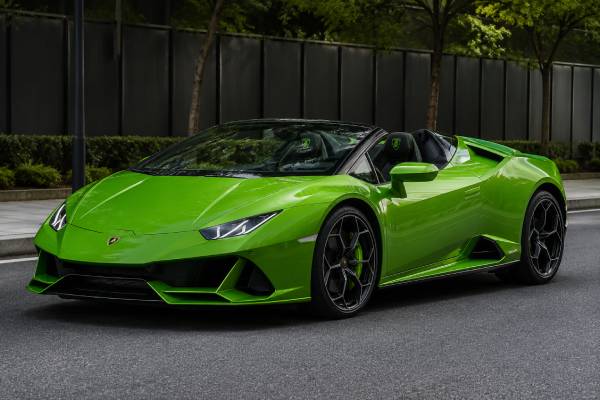
The Lamborghini Huracán EVO Spyder is the open-air version of the final full-power, all-wheel-drive Huracán EVO formula: a naturally aspirated 5.2-liter V10, 640 CV, seven-speed dual-clutch gearbox, all-wheel drive, rear-wheel steering, active chassis control, and a soft top that turns the engine into the main event. It is not the rarest Huracán, but it is one of the most complete road versions because it blends the Performante-derived engine character with daily usability and the theater of a convertible.
For buyers, the EVO Spyder matters because it sits near the end of Lamborghini’s non-hybrid V10 era. For owners, it is a highly technical exotic that rewards proper service records, careful inspection, and factory-correct specification. For enthusiasts, it is a reminder that speed is only part of the appeal: the sound, throttle response, roof mechanism, aero work, and chassis electronics are what make it memorable.
Table of Contents
- Why the EVO Spyder Matters
- V10, AWD Chassis, and Specs
- Variants, Options, and Identification
- Aero, Roof, Cockpit, and Special Systems
- How the EVO Spyder Drives
- Service, Weak Points, and Ownership Risk
- Values, Inspection, and Buying Priorities
Why the EVO Spyder Matters
The Huracán EVO Spyder matters because it combines the late-generation Huracán’s best road technology with the drama of an open roof. It is a modern Lamborghini that still feels mechanical where it counts: the engine is naturally aspirated, the revs build cleanly, and the sound is not filtered through turbochargers or hybrid boost.
Lamborghini introduced the EVO Spyder in 2019 as the open-top companion to the Huracán EVO coupe. It replaced the earlier Huracán Spyder formula with a more powerful engine, revised aero, rear-wheel steering, torque vectoring, updated infotainment, and Lamborghini Dinamica Veicolo Integrata, usually shortened to LDVI. LDVI is the central vehicle-dynamics brain that reads driver inputs and road data, then coordinates the suspension, steering, all-wheel-drive system, torque vectoring, and stability systems.
The EVO Spyder’s place in Lamborghini history is stronger than its production numbers alone suggest. It is not a numbered limited edition like some special-series exotics, and it does not have the extreme track focus of the STO. Its appeal is different. It is the full-fat, all-wheel-drive, road-biased Huracán in convertible form, built during the last years before Lamborghini’s V10 successor moved into the hybrid era.
The model also bridges two personalities. Below about 4,000 rpm, it can work as a surprisingly usable exotic with a quick gearbox, good traction, and enough comfort for ordinary roads. Above that point, the V10 becomes the center of the car. It pulls harder, sharpens its tone, and gives the driver the kind of naturally aspirated response that is becoming rare in new supercars.
For collectors and buyers, the key point is simple: the EVO Spyder is desirable when it has the right history. A well-specified, low-mileage, accident-free car with annual Lamborghini service, completed recalls, original paint, desirable colors, and sensible options will always be easier to buy, own, and resell than a cheaper car with gaps in its story.
V10, AWD Chassis, and Specs
The EVO Spyder’s headline specification is its 5,204 cc naturally aspirated V10 producing 640 CV at 8,000 rpm. The number is important, but the character matters more: this engine makes its power through revs, airflow, and response rather than turbo boost.
The V10 sits behind the cabin and drives all four wheels through Lamborghini’s seven-speed dual-clutch transmission, known as LDF. In this version, the engine tune is closely linked to the Huracán Performante family, with a sharper intake and exhaust character than the earlier LP610-4 Spyder. The result is a car that feels more urgent at the top end while still being tractable in traffic.
| Item | Specification |
|---|---|
| Production era covered | 2019–2024 |
| Body style | Two-seat Spyder with electrohydraulic soft top |
| Engine | 5.2-liter naturally aspirated Lamborghini V10 |
| Displacement | 5,204 cc |
| Maximum power | 640 CV / 470 kW at 8,000 rpm |
| Maximum torque | 600 Nm at 6,500 rpm |
| Transmission | Seven-speed Lamborghini dual-clutch automatic |
| Drivetrain | Electronically controlled all-wheel drive |
| 0–100 km/h | 3.1 seconds |
| 0–200 km/h | 9.3 seconds |
| Top speed | 325 km/h / 202 mph |
| 100–0 km/h braking | 32.2 meters |
| Dry weight | 1,542 kg |
| WLTP combined consumption | 14.9 L/100 km |
| WLTP CO2 emissions | 338 g/km |
The chassis uses a lightweight aluminum and carbon-fiber hybrid structure, with added reinforcement for the open body. That extra structure is why the Spyder weighs more than the coupe, but the car still feels very stiff for a convertible. Lamborghini’s goal was not to create a relaxed boulevard version. It was to keep the EVO’s speed, response, and aero balance while allowing roof-down driving.
The suspension layout uses double-wishbone architecture, described by Lamborghini as overlapping quadrilaterals. Magnetorheological dampers change their behavior quickly by altering the fluid response inside the damper. In simple terms, the car can soften or firm its suspension far faster than a traditional fixed damper setup.
The steering system is electric power steering supported by Lamborghini Dynamic Steering. This variable-ratio setup changes how quickly the front wheels respond based on speed and drive mode. The rear-wheel steering system then adds another layer: at lower speeds it helps the car rotate, while at higher speeds it improves stability.
| System | What it does |
|---|---|
| LDVI | Coordinates drivetrain, suspension, steering, torque vectoring, and stability logic |
| All-wheel drive | Distributes torque electronically for traction and corner-exit stability |
| Rear-wheel steering | Improves agility at low speeds and stability at high speeds |
| Magnetorheological dampers | Adjust damping response rapidly according to road, mode, and driver input |
| Carbon-ceramic brakes | Provide high heat tolerance and long life when used correctly |
| 20-inch wheels | Often paired with Pirelli P Zero tires in factory specification |
The US fuel-economy picture is predictable for a 5.2-liter V10 supercar. EPA figures for late Huracán Spyder models are around 13 mpg city, 18 mpg highway, and 15 mpg combined on premium gasoline. That matters less for fuel cost than for range planning, emissions registration, and buyers comparing cars across markets.
Variants, Options, and Identification
The EVO Spyder should be identified carefully because the Huracán range includes several visually similar versions with different drivetrains, power outputs, and values. The car covered here is the all-wheel-drive EVO Spyder with the 640 CV V10, not the later EVO RWD Spyder with 610 CV.
The main roadgoing Huracán EVO-era models include the EVO coupe, EVO Spyder, EVO RWD, EVO RWD Spyder, STO, Tecnica, and Sterrato. These share the broad Huracán platform, but they do not appeal to the same buyer. The EVO Spyder is the open-air, all-wheel-drive grand performance model. The EVO RWD Spyder is more playful and rear-drive. The STO is track-focused. The Tecnica is a rear-drive road-and-track blend. The Sterrato is the lifted, rally-inspired outlier.
For a buyer, this means the badge is only the starting point. The VIN, build sheet, original window sticker, service records, and dealer history matter more than a listing title.
Important factory and personalization options
The most valuable EVO Spyders are usually the ones with desirable factory options and tasteful personalization. Lamborghini’s Ad Personam program allowed broad paint, trim, stitching, leather, Alcantara, carbon, and color combinations, so two cars from the same model year can feel very different.
Options and features worth checking include:
- Front axle lift, which is highly desirable for driveways, speed bumps, and city use.
- Exterior carbon-fiber packages, especially when factory-installed and documented.
- Interior carbon, Carbon Skin®, Alcantara, contrast stitching, and branded trim details.
- Sport exhaust or market-specific exhaust equipment where applicable.
- 20-inch factory wheel designs, including Aesir wheels on many EVO Spyder builds.
- Parking sensors, reversing camera, navigation, Apple CarPlay, telemetry, and upgraded audio.
- Transparent engine cover or other visible engine-bay options, depending on market and build.
- Full paint-protection film, but only when it was installed cleanly and has not hidden paintwork.
Factory-correct specification is especially important because poorly chosen aftermarket parts can hurt value. Wheels, suspension changes, exhaust modifications, ECU tuning, and non-factory carbon parts should all be treated as inspection items. Some owners prefer modifications, but the safest collector-grade car is usually the one that can be returned to original form with documentation.
How to separate an EVO Spyder from nearby models
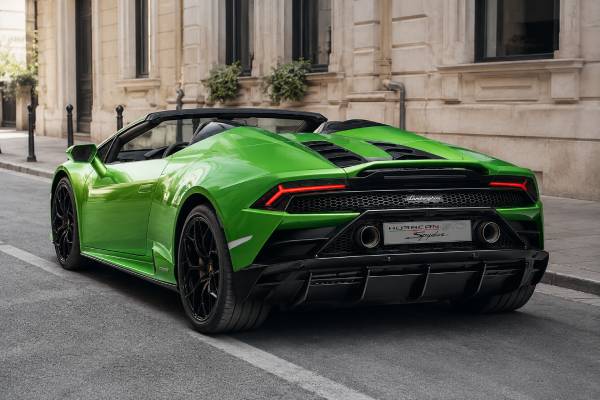
A real EVO Spyder has the updated EVO front and rear styling, high-mounted exhaust outlets, active chassis systems, the 8.4-inch center touchscreen, and the 640 CV all-wheel-drive powertrain. A RWD Spyder has different front and rear aero treatment and lower output. A Performante Spyder is older, more track-flavored, and uses different aero and design cues. A Tecnica is not a Spyder in this same form.
The best verification path is simple:
- Confirm the VIN and model description through Lamborghini dealer records.
- Match the build sheet to the car’s paint, interior, wheels, brakes, roof, and options.
- Check that the service history follows time-based intervals, not only mileage.
- Confirm open campaigns and recalls through a Lamborghini dealer or official recall lookup.
- Inspect paint depth, panel fit, underbody condition, front splitter, wheels, and carbon trim.
On a car this expensive, “looks right” is not enough. Documentation is part of the vehicle.
Aero, Roof, Cockpit, and Special Systems
The EVO Spyder’s design is functional first: the bodywork manages air, cooling, downforce, and roof-down turbulence. It looks dramatic because it has to solve real problems around a mid-engine V10, open cockpit, high speed, and heat control.
The front splitter creates a double airway beneath the car, while revised front openings and side intakes help feed cooling systems and shape airflow. At the rear, the suspended spoiler, high exhaust outlets, diffuser, and underbody work help the EVO generate more aero load than the earlier Huracán Spyder. Lamborghini described the aero improvement over the previous Huracán generation as a major step, not a mild restyle.
The soft top is one of the car’s defining features. It is electrohydraulic, lightweight, and able to open or close in about 17 seconds at speeds up to 50 km/h. When the roof folds away, two rear fins rise behind the seats and continue the body line toward the rear. The design is not just decorative; the shape helps manage airflow around the occupants.
The rear window is especially useful. Closed, it acts like a wind blocker. Open, it lets more of the intake and exhaust sound into the cabin. This small detail changes the whole character of the car. With the roof up and rear window closed, the EVO Spyder can feel refined enough for a long drive. With the roof down and rear window open, the V10 becomes much more present.
LDVI and the predictive chassis
LDVI is the technology that separates the EVO from earlier Huracán models. Instead of treating the engine, transmission, steering, damping, all-wheel drive, and stability control as separate systems, LDVI coordinates them through a central logic. It uses driver inputs, selected drive mode, steering angle, throttle, brake pressure, gear selection, and sensor data to prepare the car’s response.
That is why the EVO Spyder can feel smaller than it is on a twisty road. Rear-wheel steering helps rotation, torque vectoring helps power delivery, and the dampers adapt to road condition and driver demand. The driver still feels the car’s weight and width, but the systems reduce the effort needed to place it accurately.
Interior and usability details
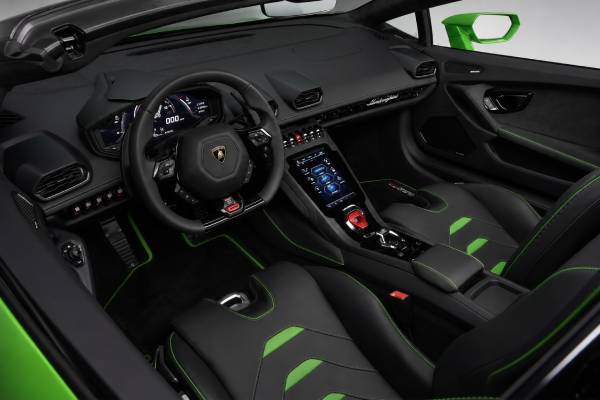
The cabin moved the Huracán into a more digital phase. The 8.4-inch touchscreen controls many vehicle and entertainment functions, including climate, infotainment, and LDVI information. This makes the center console cleaner, but it also means buyers should test every screen function carefully.
The driving position is low, the windscreen is shallow, and rear visibility is limited with the roof up. That is normal for a mid-engine Spyder, but it makes cameras, sensors, and careful mirror setup more valuable. Cabin materials can be excellent, especially on cars with leather, Alcantara, Carbon Skin®, and contrast stitching, but condition varies with use. Bolster wear, sticky switchgear, scratched carbon, worn steering-wheel trim, and damaged seat piping all affect value.
How the EVO Spyder Drives
The EVO Spyder drives like a fast, secure, open-air supercar rather than a raw track special. Its defining traits are instant throttle response, huge traction, sharp steering, a hard-edged V10 sound, and enough compliance to make road use realistic.
In Strada, the car is calmer than its shape suggests. The gearbox shifts smoothly, the dampers relax, the all-wheel-drive system gives secure traction, and the exhaust is more restrained. It is still low, wide, loud, and expensive to run, but it does not punish the driver the way older supercars often did.
Sport mode changes the mood. The gearbox gets more aggressive, the exhaust opens up, and the car feels more playful. The rear-wheel steering and torque-vectoring systems help the car rotate, but the all-wheel-drive layout keeps it from feeling nervous. This is the mode many owners use on mountain roads because it gives drama without demanding track-level commitment.
Corsa is the most focused setting. It sharpens the drivetrain and stability logic for hard driving, especially on smooth roads or circuits. The EVO Spyder is capable on track, but it is not the Huracán variant best suited for repeated hard lapping. Heat, tires, brake wear, and the extra weight of the open body all matter. Owners who want regular track work may prefer an STO, Tecnica, or coupe.
The engine is the highlight in every mode. Below midrange, it is clean and immediate. Above 6,000 rpm, it becomes urgent, metallic, and unmistakably Lamborghini. The lack of turbochargers makes the throttle easy to meter, especially on corner exit. The engine does not need artificial drama; it builds naturally and rewards revs.
The steering is quick and light compared with older hydraulic systems. Some drivers love the agility. Others may find the variable ratio and rear steering slightly synthetic at first. The key is to drive with smooth hands. Overdriving the front end can make the car feel busy, while measured inputs reveal how much grip and rotation the chassis can create.
Ride quality depends heavily on tires, wheel condition, road surface, and mode. On good roads, the magnetorheological dampers give the car real usability. On broken pavement, the short sidewalls and stiff structure remind you that this is a supercar. Tire temperature also matters. Cold performance tires reduce grip and steering feel, especially in cool or wet weather.
The brakes are powerful and durable when treated correctly. Carbon-ceramic brakes prefer heat and clean use, but they are expensive if damaged, chipped, overheated, or measured near replacement limits. Low mileage does not automatically mean good brakes; inspection should include disc condition, pad thickness, surface damage, and service records.
Service, Weak Points, and Ownership Risk
The EVO Spyder is generally strong by exotic-car standards, but ownership risk comes from deferred maintenance, accident repairs, electronics, consumables, and poor documentation. A cheap EVO Spyder can become expensive quickly if it needs brakes, tires, roof work, suspension parts, paint correction, or dealer diagnostic time.
The V10 itself has a good reputation when serviced correctly. It is not a fragile showpiece that must be rebuilt at low mileage. The risks are more practical: old fluids, weak batteries, overheated components, ignored warning lights, damaged radiators, low-quality aftermarket tuning, and cars stored for long periods without proper maintenance.
Time-based service matters. Many EVO Spyders cover very low annual mileage, but brake fluid, coolant, oil, filters, rubber components, batteries, tires, and seals still age. A service book with long gaps is a red flag even if the odometer is low.
Common inspection areas
Before buying, ask a Lamborghini specialist or authorized dealer to inspect these areas:
- Engine oil leaks, coolant leaks, radiator condition, and evidence of overheating.
- DCT shift quality, fault codes, clutch data, and launch-control history where available.
- Front lift operation, hydraulic leaks, and uneven suspension behavior.
- Magnetorheological damper condition and warning lights.
- Carbon-ceramic brake discs, pads, calipers, and brake-fluid age.
- Tire date codes, tire brand and specification, uneven wear, and wheel damage.
- Soft-top operation, alignment, seals, drains, hydraulic behavior, and wind noise.
- Infotainment functions, cameras, parking sensors, Apple CarPlay, and instrument display.
- Battery health, charging history, and stored low-voltage faults.
- Underbody scrapes, front splitter damage, diffuser damage, and jacking-point condition.
- Paint thickness, panel gaps, overspray, PPF edges, and previous accident repair.
The soft top deserves special attention. It should open and close smoothly, latch correctly, sit evenly, and seal well. Any hesitation, noise, warning message, water leak, or uneven movement should be investigated before purchase.
Recalls and campaigns
Late Huracán models have been subject to recall and campaign activity, including a 2024 recall involving certain Huracán EVO Spyder vehicles and a front frame bracket installed incorrectly. The affected population was small, but the issue is important because it relates to crash protection. Buyers should verify every VIN through Lamborghini’s official recall system or an authorized dealer rather than assuming a car is clear.
The broader Huracán family has also had recalls or campaigns involving items such as lighting compliance, rearview camera behavior, and other market-specific issues. This does not make the EVO Spyder unreliable, but it reinforces the need for dealer records. A complete campaign history is part of the car’s value.
Cost drivers owners should respect
The largest ownership costs are usually not the annual oil service. They are the big-ticket items that appear when a car has been neglected or poorly inspected.
The expensive areas include:
- Carbon-ceramic brake replacement.
- Tires, alignment, and wheel repair.
- Front lift and suspension components.
- Soft-top diagnosis and repair.
- Dealer diagnostic time for electrical faults.
- Paint, carbon trim, and underbody repairs.
- DCT service, fault tracing, or abuse-related wear.
- Correcting poor aftermarket modifications.
A well-maintained EVO Spyder is not cheap to run, but it is manageable for an exotic. A neglected one can erase any purchase discount quickly.
Values, Inspection, and Buying Priorities
The best EVO Spyder to buy is the most documented, original, well-optioned, and properly serviced example you can afford. Mileage matters, but condition, specification, paint history, service continuity, and recall completion matter more.
The EVO Spyder entered the US market with a suggested retail price around the high-$200,000 range before taxes and options. Many cars were optioned far beyond base price. On the modern used market, values vary widely by year, mileage, color, specification, condition, location, warranty status, and seller quality. Public market data has placed many EVO Spyders around the high-$200,000 range, while very low-mile, high-spec, late-production examples can be advertised far higher.
Do not read one market average as the value of every car. A 2019 or 2020 car with miles, repaint, weak options, and incomplete records is not comparable with a 2024 car in a rare Ad Personam color with front lift, carbon options, factory warranty coverage, full dealer history, and low mileage.
What drives value
The strongest cars usually have:
- Original paint or fully documented paintwork.
- Clean history with no structural damage.
- Complete Lamborghini dealer or specialist service records.
- Verified recall and campaign completion.
- Desirable factory colors and interior combinations.
- Front lift, carbon packages, quality interior trim, and strong wheel specification.
- Low but believable mileage with evidence of regular use and maintenance.
- Factory books, keys, battery tender, tools, manuals, window sticker, and build sheet.
- No questionable tuning, exhaust, suspension, or cosmetic modifications.
- Good tire dates and healthy carbon-ceramic brake measurements.
The weakest cars usually show the opposite: vague history, missing records, repeated auction appearances, mismatched tires, aftermarket wheels with no originals, warning lights, cheap paint protection, worn interiors, roof issues, or unexplained paintwork.
Pre-purchase checklist
Use this as a serious buyer’s checklist, not a casual used-car list.
| Area | What to confirm |
|---|---|
| Identity | VIN, build sheet, model variant, market version, and original options |
| History | Ownership chain, accident records, paintwork, title status, and import/export history |
| Service | Annual maintenance, fluids, brake service, battery replacement, and dealer campaigns |
| Diagnostics | Stored faults, DCT data, suspension faults, infotainment errors, and low-voltage history |
| Body | Paint depth, panel alignment, carbon damage, splitter scrapes, and underbody condition |
| Roof | Smooth operation, sealing, latch function, drains, hydraulic behavior, and rear-window function |
| Consumables | Tires, carbon-ceramic brakes, pads, alignment, wheels, and battery health |
| Originality | Factory wheels, exhaust, software, suspension, trim, and retained original parts |
A specialist inspection is not optional at this level. Even a beautiful car can hide expensive problems. The inspection should include a lift check, diagnostic scan, paint-meter readings, road test, roof-cycle test, brake measurements, tire-date check, and review of service invoices.
Which examples to seek
The safest buy is a factory-original car with front lift, desirable colors, complete records, low-to-moderate mileage, clean paint readings, fresh tires, healthy brakes, and no open campaigns. A car that has been driven a little and serviced every year can be better than an ultra-low-mile car that has sat unused and skipped time-based maintenance.
The examples to avoid are the ones with stories. “Minor damage” can be serious on a carbon-and-aluminum exotic. “Needs nothing” means little without invoices. “Recently serviced” should include dates, mileage, dealer or shop names, and itemized work. “Wrapped since new” should still be paint-metered. “Tastefully modified” should be treated as a value question, not an upgrade by default.
Long-term collectability looks favorable, but not because the EVO Spyder is extremely rare. It should remain desirable because it represents the mature, open-top, naturally aspirated V10 Lamborghini formula before electrification changed the segment. The best cars will be those that preserve that formula with clean history and factory-correct presentation.
References
- Lamborghini Huracán EVO Spyder | Lamborghini.com 2019 (Manufacturer Specifications)
- Automobili Lamborghini unveils Huracán EVO Spyder at Geneva Motor Show 2019: breath−taking performance and presence 2019 (Manufacturer Press Release)
- Gas Mileage of 2024 Lamborghini Huracan 2024 (EPA Fuel Economy)
- Part 573 Safety Recall Report 24V-701 2024 (Recall Database)
- Lamborghini Huracán Evo Spyder Market – CLASSIC.COM 2026 (Market Data)
Disclaimer
This article is for informational purposes only and is not a substitute for professional diagnosis, repair, inspection, valuation, or legal advice. Specifications, torque values, service intervals, recall applicability, inspection procedures, and repair methods can vary by VIN, model year, market, equipment, and factory campaign status. Always verify details against official Lamborghini service documentation, a Lamborghini dealer, and a qualified specialist before buying, servicing, modifying, or repairing any vehicle.
If this guide helped you, please share it on Facebook, X/Twitter, or your favorite car community to support our work.