
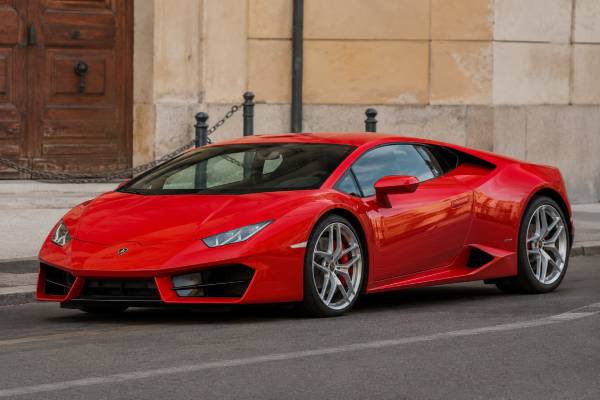
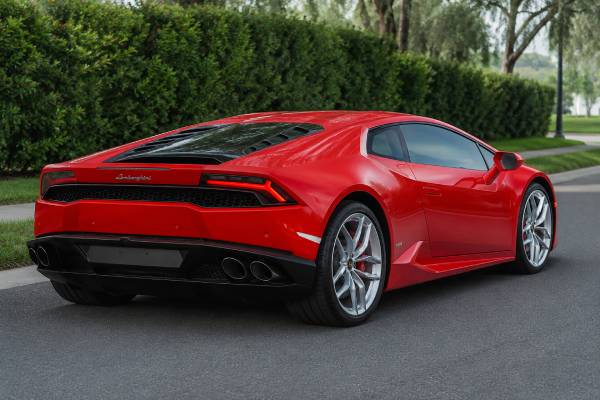
The Lamborghini Huracán LP 580-2 Coupé is the rear-wheel-drive Huracán that many drivers wanted from the start. It keeps the naturally aspirated 5.2-liter V10, the dramatic wedge shape, and the modern dual-clutch gearbox, but removes the front drive hardware and retunes the car around feel rather than maximum launch traction. That makes it less numerically aggressive than an LP 610-4, yet more playful, lighter at the nose, and more transparent in the way it moves.
Built for the 2016–2019 model years before the Huracán EVO era took over, the LP 580-2 sits in an important place in Lamborghini history. It is not the rarest Huracán, nor the fastest, but it is one of the clearest expressions of the car’s character: a mid-engine V10 supercar with rear-drive balance, sharp styling, and enough usability to be driven often.
Table of Contents
- Why the LP 580-2 Matters
- V10 Specs, Chassis, and Performance Data
- Versions, Options, and Authenticity Details
- Design, Engineering, and RWD Character
- What It Feels Like to Drive
- Maintenance, Reliability, and Ownership Risks
- Market Values and Buying Checklist
Why the LP 580-2 Matters
The Huracán LP 580-2 matters because it turns the early Huracán from an all-weather all-wheel-drive supercar into a more traditional driver’s Lamborghini. It is the lighter, rear-driven version of the first-generation Huracán Coupé, built for buyers who wanted more steering clarity, more throttle adjustability, and a stronger connection to Lamborghini’s rear-drive past.
The Huracán itself replaced the Gallardo, Lamborghini’s best-selling model at the time, and brought a much more modern platform. The LP 610-4 launched first with all-wheel drive, a 610 PS V10, carbon-ceramic brakes, and a digital cockpit. It was fast, secure, and easier to drive quickly than older Lamborghinis. The LP 580-2 arrived as the purist counterpoint. Its name tells the story: “580” for metric horsepower and “2” for two driven wheels.
Lamborghini positioned the LP 580-2 as a different personality, not simply a cheaper Huracán. It lost 30 PS compared with the LP 610-4, but it also shed weight, gained unique suspension and steering calibration, and received different front and rear styling. The goal was not to beat the all-wheel-drive car from a stoplight. The goal was to make the driver feel more involved.
For collectors and buyers, this distinction matters. Many early Huracáns were bought as image cars, optioned heavily, and driven sparingly. The LP 580-2 appeals to a different group: owners who value rear-drive dynamics and the sound of a naturally aspirated V10 before turbocharging and hybrid assistance became unavoidable. In that sense, it has become more interesting with age.
The production window also gives it a clear historical boundary. The LP 580-2 Coupé belongs to the pre-EVO Huracán generation, offered before the 2019 Huracán EVO brought a larger redesign, more power, and more advanced vehicle-dynamics software. Later rear-drive Huracáns, such as the EVO RWD and Tecnica, are quicker and more developed, but the LP 580-2 is simpler in feel and closer to the original Huracán formula.
It also sits in a lineage that includes the Gallardo LP 550-2 Valentino Balboni and the rear-wheel-drive versions of older V12 Lamborghinis. That does not make every LP 580-2 a blue-chip collectible, but it gives the car a clear enthusiast identity. Among early Huracáns, the LP 580-2 Coupé is the one that most rewards a driver who cares about balance, steering, sound, and throttle control.
V10 Specs, Chassis, and Performance Data
The LP 580-2 uses Lamborghini’s 5.2-liter naturally aspirated V10, tuned to 580 PS and 540 Nm, mounted longitudinally behind the cabin and driving only the rear wheels. The result is a mid-engine supercar with a dry weight of about 1,389 kg, a 40:60 front-to-rear weight balance, and factory performance figures of 0–100 km/h in 3.4 seconds and 320 km/h at the top end.
| Item | Specification |
|---|---|
| Model years covered | 2016–2019 |
| Body style | 2-door Coupé |
| Layout | Rear mid-engine, rear-wheel drive |
| Engine | 5.2-liter 90-degree V10 |
| Displacement | 5,204 cc |
| Induction | Naturally aspirated |
| Fuel system | Direct injection plus multi-point injection |
| Maximum power | 580 PS / 572 hp / 426 kW at 8,000 rpm |
| Maximum torque | 540 Nm / 398 lb-ft at 6,500 rpm |
| Transmission | 7-speed Lamborghini Doppia Frizione dual-clutch automatic |
| Dry weight | About 1,389 kg / 3,062 lb |
| Weight distribution | About 40 percent front, 60 percent rear |
| 0–100 km/h | 3.4 seconds |
| 0–200 km/h | 10.1 seconds |
| Top speed | 320 km/h / 198 mph |
The engine is closely related to the V10 used across the Huracán and second-generation Audi R8 family, but Lamborghini’s calibration gives it a distinct sound and response. It has a high 8,000 rpm power peak, strong mid-range torque, and a hard-edged top-end note that defines the car. The dual-injection system helps both response and emissions, while cylinder deactivation can shut down one bank under light load to reduce fuel use.
The gearbox is the LDF dual-clutch unit. It is the only transmission offered; there is no manual LP 580-2. In automatic mode it can behave smoothly enough for traffic, but in Sport and Corsa it shifts with more urgency and more drama. Launch control is available, although repeated launch use should always be considered when inspecting a used example.
| Area | Specification |
|---|---|
| Length | 4,459 mm / 175.6 in |
| Width | 1,924 mm / 75.7 in, excluding mirrors |
| Height | 1,165 mm / 45.9 in |
| Wheelbase | 2,620 mm / 103.1 in |
| Standard wheels | 19-inch Kari wheels |
| Common tire sizing | 245/35 ZR19 front, 305/35 ZR19 rear |
| Suspension | Double wishbones front and rear |
| Steering | Electromechanical power steering; Lamborghini Dynamic Steering optional |
| Brakes | Steel brakes standard; carbon-ceramic brakes available on many cars depending on market and optioning |
| Fuel capacity | About 80 liters / 21.1 US gallons |
A key mechanical difference from the LP 610-4 is braking specification. The all-wheel-drive LP 610-4 commonly emphasized carbon-ceramic brakes, while the LP 580-2 was launched with steel brakes as part of its lighter, more road-focused package. Many buyers still sought optional upgrades, and used cars vary widely, so brake type should be checked on the actual vehicle.
Fuel economy is not a purchase driver here, but it matters for range and ownership planning. In U.S. EPA-style data for the 2WD Huracán, expect about 17 mpg combined, with 14 mpg city and 21 mpg highway. European combined figures around 11.9 l/100 km were quoted under period test rules. Real-world use can be much worse if the car is driven as intended.
Versions, Options, and Authenticity Details
The LP 580-2 Coupé is the fixed-roof rear-drive version of the early Huracán, while the LP 580-2 Spyder is its open-top counterpart. For buyers, the Coupé is usually the cleaner driver’s choice because it is lighter, stiffer, and more focused, while the Spyder trades some sharpness for open-air V10 theater.
The Coupé ran alongside the all-wheel-drive LP 610-4 and later the Performante. It was not a numbered limited edition, and Lamborghini did not treat it as a separate coachbuilt special. That means value is driven less by rarity claims and more by specification, condition, mileage, documentation, and originality.
How the LP 580-2 differs from the LP 610-4
The major difference is the drivetrain. The LP 610-4 sends power to all four wheels and produces 610 PS. The LP 580-2 sends power only to the rear wheels and makes 580 PS. That change affects the whole car. Lamborghini recalibrated the suspension, steering, and stability control to suit rear-wheel drive, changed the aerodynamic balance, and gave the car unique visual details.
The LP 580-2 also received:
- Distinct front bumper treatment with larger, more angular air intakes.
- Revised rear styling and diffuser treatment.
- Rear-brake cooling changes.
- Standard 19-inch Kari wheels at launch.
- Pirelli P Zero tires developed for the rear-drive setup.
- A lighter, more nose-responsive feel compared with the all-wheel-drive car.
- Steel brakes as the standard setup in many markets.
The rear-drive car is not simply a de-contented Huracán. It has its own character. That is why clean LP 580-2 Coupés often attract buyers who specifically want this version, not just the least expensive Huracán.
Options that matter on used cars
Lamborghini’s option list can strongly affect both desirability and ownership cost. On an LP 580-2, the most useful and value-relevant equipment usually includes front axle lift, parking sensors and rear camera, upgraded trim, desirable wheels, sport exhaust, transparent engine bonnet, and good interior specification.
Important options and features to verify include:
- Front lift system: highly desirable because the Huracán’s nose is low and front splitter damage is common.
- Magneto-rheological suspension: useful for combining road comfort with tighter body control.
- Lamborghini Dynamic Steering: divisive; some like the quick response, while others prefer the standard steering’s consistency.
- Carbon-ceramic brakes: desirable to some buyers, expensive to replace, and not automatically better for normal road use.
- Sport exhaust: adds sound and market appeal, but confirm it is factory or a quality documented upgrade.
- Glass engine cover: desirable visually, especially on collector-grade examples.
- Ad Personam colors and trim: can lift value when tasteful and documented.
- Branding package, contrast stitching, full leather, Alcantara, and Q-Citura: interior details that influence presentation.
Factory records, window stickers, order sheets, and dealer build summaries are very useful. On a modern Lamborghini, originality is not just about matching mechanical numbers; it is about proving the car’s delivered specification, service history, accident status, paint condition, and option content.
Identification and documentation
A serious buyer should confirm that the VIN, build data, registration year, and model description all match the car being offered. Some listings blur distinctions between LP 580-2, LP 610-4, Spyder, EVO RWD, and modified cars. A correct LP 580-2 Coupé should be rear-wheel drive, pre-EVO in appearance, and fitted with the 580 PS engine tune.
Useful documents include:
- Original sales invoice or window sticker.
- Lamborghini dealer service invoices.
- Annual service records.
- Recall and campaign completion records.
- Paint protection film records, if fitted.
- Tire purchase dates and specifications.
- Brake condition reports.
- Pre-purchase inspection from a Lamborghini specialist.
- Any warranty or certified pre-owned paperwork.
Avoid cars where the seller relies on vague phrases such as “fully loaded” or “dealer maintained” without supporting paperwork. These cars are complex, expensive, and easy to misrepresent through incomplete listings.
Design, Engineering, and RWD Character
The LP 580-2 looks like a Huracán, but its design details are tuned to signal a different purpose. The front and rear treatments are sharper and more aggressive than the LP 610-4, while the rear-wheel-drive layout gives the car a lighter front-end feel and a stronger sense of rotation.
The Huracán’s design came from Lamborghini’s modern angular language: low nose, hard creases, hexagonal themes, slim lighting, and a cabin pushed forward over a compact mid-engine body. It is less visually wild than some V12 Lamborghinis, but it is still unmistakably exotic in scale and stance. The LP 580-2’s reshaped front air intakes help separate it from the all-wheel-drive model, and the rear treatment gives it a slightly more focused look.
The body structure uses a hybrid aluminum and carbon-fiber chassis architecture. This was central to the Huracán’s step forward over the Gallardo. It improved stiffness, helped reduce weight, and gave Lamborghini a more modern base for electronic systems, crash structure, and cabin quality.
The V10 as the emotional center
The engine is the reason many people still care about this car. A naturally aspirated V10 with an 8,000 rpm power peak feels very different from a turbocharged engine. It does not deliver one sudden wall of torque; it builds, sharpens, and becomes more intense as revs rise. That rising character is part of the drama.
The exhaust note is also central to the LP 580-2. At low rpm it can be surprisingly civil. Under load it becomes metallic, urgent, and unmistakably Lamborghini. In a market now shaped by turbochargers, particulate filters, hybrid systems, and sound regulations, the early Huracán’s V10 feels increasingly special.
The engine’s cylinder deactivation system is a practical engineering detail rather than an emotional one. Under light load, one cylinder bank can shut down temporarily. The driver usually does not notice it, and the system switches back quickly when more throttle is requested. In ownership, however, it reinforces why software health, battery condition, and proper diagnostics matter.
Chassis tuning for rear-wheel drive
Removing the front drive hardware changes the Huracán’s behavior. The LP 580-2 feels lighter at the nose, more willing to turn, and more dependent on rear tire condition. It is not an old-school widowmaker; stability control remains sophisticated. But the balance is more adjustable, especially in Sport mode, where the electronics allow more movement.
The suspension uses double wishbones at both ends. Spring, anti-roll bar, and damper tuning were adapted for the rear-drive car. The stability-control strategy also differs from the all-wheel-drive model, giving the car a more playful character while still preserving a safety net.
This is where tire choice matters. The LP 580-2 was developed around specific Pirelli P Zero fitments, and worn, aged, or incorrect tires can make the car feel nervous or dull. A rear-drive mid-engine supercar with old rear tires is not a bargain; it is a risk.
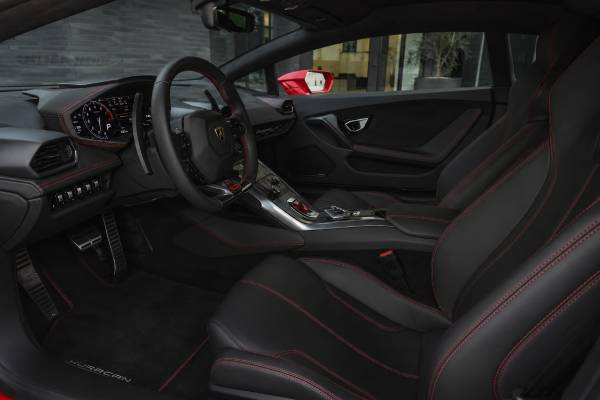
The cockpit is more modern than traditional Lamborghini interiors. The digital instrument cluster, fighter-jet-style start button cover, low seating position, and high center console all create theater. Visibility is decent forward but limited rearward. Parking aids are not luxuries on this car; they help protect expensive paint, wheels, and carbon or painted lower trim.
What It Feels Like to Drive
The LP 580-2 feels faster than its numbers because the engine, gearbox, sound, and rear-drive balance make every input vivid. It is not as brutally easy to launch as an all-wheel-drive Huracán, but it is more engaging when the road bends and the driver starts managing weight transfer.
In Strada mode, the car can be surprisingly usable. The dual-clutch gearbox shifts smoothly, the throttle is manageable, and the ride is acceptable by supercar standards, especially on cars with adaptive dampers. It is still wide, low, loud, and attention-grabbing, but it can handle short city trips or highway miles without the constant strain of an older exotic.
Sport mode is where the LP 580-2’s personality comes alive. The throttle sharpens, the gearbox holds gears longer, the exhaust becomes more vocal, and the stability-control calibration lets the rear axle participate more. This is the mode many owners use on mountain roads because it adds excitement without fully removing the electronic safety net.
Corsa is more serious. Gearshifts become sharper, the car expects cleaner inputs, and the systems prioritize speed and control. On track, the LP 580-2 is rewarding, but it is not as forgiving as an all-wheel-drive Huracán when the driver is greedy with throttle on corner exit. It rewards smooth hands, patient throttle application, and properly warmed tires.
Acceleration and braking
The 0–100 km/h time of 3.4 seconds is still very quick, but modern performance cars have made that number look less shocking than it once did. The difference is delivery. The LP 580-2 does not feel like an electric or turbocharged car punching forward in one silent shove. It builds speed with revs, noise, gear changes, and increasing intensity.
Steel brakes can feel excellent on the road and are less financially terrifying than carbon-ceramic rotors. Carbon-ceramic brakes, when fitted, reduce unsprung mass and resist fade well, but replacement costs are substantial. Either setup needs careful inspection. Pedal feel should be firm and consistent, with no vibration, pulling, warning lights, or uneven wear.
Steering, ride, and cornering balance
The steering is quick and accurate, but feel depends on specification. Cars with standard steering can feel more linear. Cars with Lamborghini Dynamic Steering can feel more eager and variable, which some drivers enjoy and others find less natural. A test drive on familiar roads is the best way to decide.
The front axle is the major dynamic advantage over the LP 610-4. Without the hardware and behavior of all-wheel drive, the LP 580-2 turns with less sense of mass ahead of the driver. The rear axle then becomes part of the conversation. On good tires, this gives the car a satisfying arc through corners. On poor tires or cold roads, it demands respect.
Ride quality depends on wheels, tires, dampers, road surface, and tire age. The car is stiff, but not crude. Long highway drives are possible, and the cabin is better finished than older Lamborghinis. Road noise and engine noise remain part of the experience. Anyone expecting grand-tourer calm is shopping in the wrong category.
The LP 580-2 is best on open roads with clean sightlines, smooth surfaces, and enough space to use the engine. It can commute, but that is not where it shines. Its best moments come when the V10 is above the mid-range, the gearbox is responding quickly, and the rear axle feels loaded but alive.
Maintenance, Reliability, and Ownership Risks
The LP 580-2 is generally robust for an exotic, but it is still a Lamborghini with expensive consumables, complex electronics, and very low tolerance for neglected maintenance. The safest cars are those with annual specialist servicing, fresh tires, clean diagnostic scans, and documented repairs rather than vague ownership stories.
The V10 itself has a strong reputation when serviced correctly. It is not known as a fragile engine, but age, heat, infrequent use, poor battery health, deferred fluid changes, and hard track use can create expensive problems. A car that has covered regular mileage with proper service records can be safer than a very low-mileage car that sat for long periods.
Annual servicing is the baseline. Many Lamborghini service schedules revolve around yearly or mileage-based checks, with oil and filter changes, inspections, brake checks, fluid checks, diagnostics, and age-related replacements. Exact requirements vary by market, model year, and VIN, so the official service documentation matters more than generic internet schedules.
Common inspection areas
A pre-purchase inspection should focus on the exact car, not just the model’s general reputation. The following areas deserve close attention:
- Engine leaks and heat damage: inspect around cam covers, oil lines, coolant areas, and the engine bay trim.
- Gearbox behavior: check for smooth low-speed engagement, clean shifts, and no warning lights.
- Clutch data and launch use: the dual-clutch unit is not like an old single-clutch E-gear, but abuse still matters.
- Cooling system: inspect radiators and condensers for stone damage and debris blockage.
- Suspension: check dampers, bushings, lift-system function, and uneven ride height.
- Front lift system: confirm it raises and lowers correctly without leaks or warning messages.
- Brakes: measure rotor and pad condition; carbon-ceramic replacement costs can change the economics of a car.
- Tires: check age, brand, model, size, tread depth, and heat cycling, not just remaining tread.
- Wheels: look for cracks, bends, curb rash, and poor refinishing.
- Electronics: scan all modules, including infotainment, instrument cluster, parking systems, and stability-control systems.
- Battery condition: weak batteries can trigger misleading fault codes and drivability issues.
Body, paint, and accident risk
Accident history is one of the biggest value risks. A Huracán can look clean in photos while hiding repaired front splitter damage, underbody scrapes, wheel impacts, paintwork, or structural repair. The car’s low ride height makes the front underside especially vulnerable.
Paint protection film is common and often beneficial, but it can hide paint edges, old stone chips, or poor repairs. Inspect panel gaps, paint depth, bumper mounting points, headlight fit, undertray condition, and wheel-arch liners. A clean Carfax-style report is useful but not enough. Specialist inspection and paint-meter readings are more important.
Recalls and campaigns
Several Huracán recall and campaign items affect parts of the broader 2015–2024 range, including headlight-related compliance recalls. For the 2016–2019 LP 580-2, a buyer should verify by VIN that all applicable recalls and service campaigns have been completed. Do not rely only on a seller’s statement. A Lamborghini dealer or official recall lookup can confirm the current status.
The best ownership approach is preventive. Replace aging tires before they become a problem. Keep the battery healthy. Clean radiators. Service the car annually. Store it on a maintainer. Warm the engine properly before high-rpm use. Avoid cheap aftermarket modifications unless they are reversible, documented, and from reputable suppliers.
Market Values and Buying Checklist
The LP 580-2 Coupé has moved from “entry Huracán” toward “enthusiast-spec early Huracán.” As of 2026, ordinary used examples often sit around the high-$100,000 to low-$200,000 range in the U.S. market, while lower-mileage, highly optioned, clean-title cars can ask more. In the U.K., good examples commonly sit around the low-to-mid £100,000s, with late, low-mileage, strong-spec cars higher.
Those ranges move with mileage, color, options, region, condition, and dealer quality. Asking prices are not sale prices, and modified cars can distort public listings. Still, the LP 580-2 has held up well because it offers the naturally aspirated V10, rear-wheel drive, and modern Lamborghini usability in one package.
What raises value
The strongest cars usually combine the right history, the right specification, and the right condition. A high-mileage but perfectly maintained car may be a better driver purchase than a low-mileage car with gaps, but collector-minded buyers still pay more for mileage, originality, and presentation.
Value-positive factors include:
- Clean title and no accident history.
- Complete Lamborghini dealer or recognized specialist service history.
- Low-to-moderate mileage with regular use.
- Desirable colors such as Verde Mantis, Arancio Borealis, Rosso Mars, Grigio Lynx, Bianco Icarus, Nero Noctis, and special Ad Personam shades.
- Front lift system.
- Good interior trim and stitching choices.
- Glass engine cover or attractive exterior carbon options.
- Documented factory options.
- Unmodified exhaust and ECU, or reversible documented upgrades.
- Fresh, correct tires.
- Completed recalls and campaigns.
- Strong paint condition or professionally installed paint protection film.
What should make you cautious
Cheap Huracáns are rarely cheap after inspection. A suspiciously low price usually reflects mileage, accident history, weak options, needs, modifications, poor history, or an urgent seller. Sometimes it reflects all of those at once.
Avoid or heavily discount cars with:
- Missing annual services.
- Repeated battery-related faults without proper diagnosis.
- Undocumented ECU tuning or exhaust modifications.
- Evidence of track abuse without corresponding maintenance.
- Old tires despite low mileage.
- Carbon-ceramic brake wear near replacement limits.
- Lift-system faults.
- Poor panel fit or paint mismatch.
- Warning lights or incomplete readiness monitors.
- Seller resistance to independent inspection.
- Imported or gray-market history that complicates registration or warranty support.
Pre-purchase checklist
A proper inspection should be done by a Lamborghini dealer or a specialist who knows Huracáns. A generic exotic inspection is not enough if it misses diagnostic data, brake measurements, lift operation, and campaign history.
| Area | What to confirm |
|---|---|
| Identity | VIN, model year, LP 580-2 specification, rear-wheel drive, original build data |
| Service history | Annual services, invoices, correct fluids, campaign completion |
| Diagnostics | Full module scan, no hidden faults, no recent code clearing |
| Engine | No leaks, clean running, proper warm start and hot restart behavior |
| Gearbox | Smooth engagement, fast shifts, no harsh low-speed behavior |
| Brakes | Rotor condition, pad life, no vibration, documented measurements |
| Tires | Correct sizes, matching quality tires, recent date codes |
| Body | Paint depth, panel gaps, underbody, splitter, wheel-arch liners |
| Options | Front lift, steering, suspension, trim, cameras, parking aids, exhaust |
| Ownership costs | Immediate service needs, consumables, warranty options, insurance |
The best LP 580-2 to buy is not necessarily the cheapest or the lowest-mileage one. It is the car with the clearest story: correct specification, clean history, regular use, fresh consumables, no accident concerns, and a seller willing to support a serious inspection.
Long-term collectability looks favorable but not explosive. The LP 580-2 was not a limited-production icon like some Lamborghini special series, but it has the traits enthusiasts increasingly value: rear-wheel drive, naturally aspirated V10 power, pre-hybrid simplicity, and a defined place in the Huracán timeline. For a buyer who plans to drive the car, that may be the ideal formula. It is special enough to feel important, modern enough to use, and mechanical enough to remain emotionally compelling.
References
- Lamborghini Huracán RWD Pre-Owned, Verified | Lamborghini.com 2026 (Manufacturer Specifications)
- Huracán (R)evolution: a story of technology and innovation 2024 (Manufacturer History)
- Fuel Economy of 2017 Lamborghini Huracan 2017 (Official Fuel Economy Data)
- Part 573 Safety Recall Report 22V-081 2022 (Recall Database)
- Lamborghini Huracán LP580-2 Market 2026 (Market Data)
Disclaimer
This article is for informational purposes only and is not a substitute for professional diagnosis, repair, inspection, valuation, or legal advice. Specifications, torque values, service intervals, campaign requirements, parts, and procedures can vary by VIN, market, production date, equipment, and later updates. Always verify details against the vehicle’s official service documentation and consult a qualified Lamborghini technician before buying, servicing, modifying, or repairing the car.
If this guide helped you, please share it on Facebook, X/Twitter, or your favorite car community to support our work.