
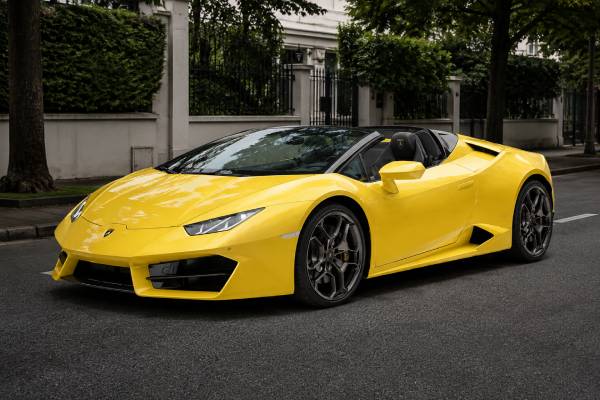
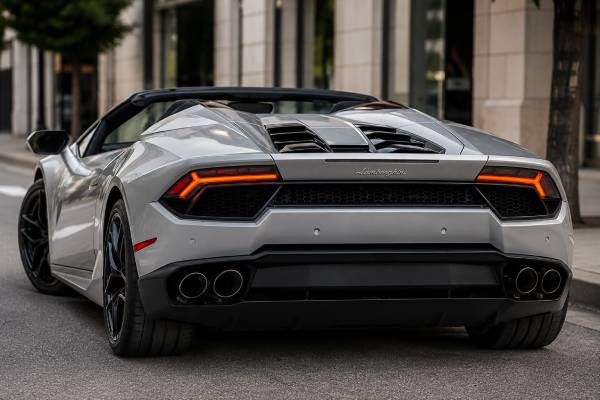
The Lamborghini Huracán LP 580-2 Spyder is the open-top, rear-wheel-drive Huracán for drivers who want more steering clarity, more throttle-led balance, and less all-wheel-drive filtering. It keeps the naturally aspirated 5.2-liter V10, the seven-speed Lamborghini Doppia Frizione dual-clutch gearbox, and the dramatic low-slung Huracán shape, but sends 580 metric horsepower to the rear wheels only. That single change gives the car its personality.
Built during the pre-EVO Huracán era, the LP 580-2 Spyder sits between the more secure LP 610-4 Spyder and the later, sharper Huracán EVO RWD Spyder. It is not the rarest Huracán, and it was not marketed as a numbered limited edition, but it has become a sweet-spot car for buyers who want the V10 sound, a folding roof, and the purer rear-drive chassis without stepping into Performante, STO, or Tecnica money.
Table of Contents
- Why the RWD Spyder Matters
- V10, Chassis, and Core Specs
- Variants, Options, and Identification
- Design, Engineering, and Spyder Details
- How the LP 580-2 Spyder Drives
- Maintenance, Reliability, and Known Risks
- Market Values and Buying Checks
Why the RWD Spyder Matters
The LP 580-2 Spyder matters because it gives the Huracán a more traditional supercar feel. The all-wheel-drive Huracán is quicker from a stop, but the rear-wheel-drive Spyder is lighter in character, more adjustable, and more focused on driver feel than launch numbers.
The Huracán replaced the Gallardo as Lamborghini’s entry V10 supercar line. The first production Huracán, the LP 610-4 coupe, arrived for the 2014 model era with all-wheel drive, a carbon-aluminum structure, a digital cockpit, and the new LDF dual-clutch transmission. The Spyder version followed, then Lamborghini expanded the line with the LP 580-2: a rear-wheel-drive version aimed at drivers who wanted less front-axle intervention and more road texture through the steering.
The LP 580-2 Spyder was unveiled in 2016 and became available in many markets as a 2017 model. It used the same basic naturally aspirated 5.2-liter V10 architecture as the all-wheel-drive Huracán but with a 580 CV tune, revised chassis calibration, dedicated RWD stability-control logic, and model-specific front and rear styling. The “LP 580-2” name follows old Lamborghini logic: longitudinal rear engine placement, 580 metric horsepower, and two driven wheels.
Its importance is not about rarity alone. Lamborghini did not publish a clean, global production figure for the LP 580-2 Spyder as a separate body-and-drivetrain variant, and buyers should be careful with unsupported “one of X” claims. Its real significance is that it represents the naturally aspirated, rear-drive, open V10 formula before the Huracán EVO RWD Spyder and before Lamborghini moved toward hybrid replacement powertrains.
For collectors and owners, the LP 580-2 Spyder is appealing because it combines three things that may age well:
- a naturally aspirated V10 with no turbochargers or hybrid system;
- rear-wheel drive, which gives it a clearer enthusiast identity;
- an open roof, which makes the intake and exhaust note part of the cabin experience.
It is also usable in a way older Lamborghinis rarely were. The dual-clutch gearbox shifts cleanly in traffic, the nose-lift system is common on well-specified cars, the cabin is modern enough for regular driving, and the chassis is far more rigid and predictable than many earlier open Lamborghini models. That mix of theater and usability is why the car still gets attention from owners who drive their cars, not only collectors who store them.
V10, Chassis, and Core Specs
The core specification is simple: a naturally aspirated 5.2-liter V10, rear-wheel drive, a seven-speed dual-clutch transmission, and a folding soft top. The LP 580-2 Spyder gives up some launch traction to the LP 610-4 Spyder, but it gains a more direct rear-drive identity.
| Item | Specification |
|---|---|
| Production era | 2016–2019, commonly sold as 2017–2019 model years depending on market |
| Body style | Two-door, two-seat convertible Spyder |
| Engine | 5.2-liter naturally aspirated 90-degree V10 |
| Displacement | 5,204 cc |
| Induction | Naturally aspirated |
| Fuel injection | Multi-point injection plus direct stratified injection |
| Power | 580 CV / 572 hp / 426 kW at 8,000 rpm |
| Torque | 540 Nm / 398 lb-ft at 6,500 rpm |
| Transmission | 7-speed Lamborghini Doppia Frizione dual-clutch automatic |
| Drivetrain | Rear-wheel drive with rear mechanical self-locking differential |
| Chassis | Hybrid aluminum and carbon-fiber structure |
| Suspension | Aluminum double wishbones, coil springs, anti-roll bars |
| Steering | Electromechanical power steering; Lamborghini Dynamic Steering optional |
| Roof | Electrohydraulic fabric soft top, opens or closes in about 17 seconds |
The V10 is the star of the car. It is not a lazy torque engine; it wants revs. The power peak arrives high in the rev range, and the engine’s character builds from a hard-edged mechanical growl into a sharp, metallic wail near the top. Because there is no turbocharger, the throttle response is immediate and the sound changes directly with pedal position.
The LP 580-2 Spyder uses Lamborghini’s LDF gearbox. Earlier Gallardos could be ordered with e-gear single-clutch automated manuals, and some older cars feel abrupt at low speed. The Huracán’s dual-clutch unit is smoother, faster, and much easier to live with. In Strada mode it can behave like a refined automatic; in Sport and Corsa it shifts more aggressively and holds gears longer.
| Measurement | Figure |
|---|---|
| 0–100 km/h | About 3.6 seconds |
| Top speed | About 319 km/h / 198 mph |
| Dry weight | About 1,509 kg / 3,327 lb |
| Power-to-weight ratio | About 2.6 kg per hp |
| Length | 4,459 mm / 175.6 in |
| Width without mirrors | 1,924 mm / 75.7 in |
| Width with mirrors | 2,236 mm / 88.0 in |
| Height | About 1,180 mm / 46.5 in |
| Wheelbase | 2,620 mm / 103.1 in |
| Fuel capacity | About 80 liters / 21.1 gallons |
| EPA fuel economy, 2017 Spyder 2WD | 16 mpg combined, 14 city, 20 highway |
The chassis construction is central to the car’s feel. The Huracán uses a carbon and aluminum structure rather than the older Gallardo’s simpler aluminum spaceframe approach. The Spyder body adds roof hardware and reinforcement, so it is heavier than the coupe, but it still feels tight for an open car. Cowl shake is well controlled, and the structure gives the suspension a stable base.
The standard RWD setup uses steel brakes with aluminum brake disc hats. Carbon-ceramic brakes appear on many Huracán variants and may be fitted depending on equipment and market, so a buyer must inspect the exact car rather than assume one brake package. Steel brakes are less exotic but can be more sensible for road use because replacement costs are lower. Carbon ceramics are desirable for specification and heat capacity, but damaged discs are expensive.
Variants, Options, and Identification
The LP 580-2 Spyder is best understood as the rear-drive, open-roof counterpart to the LP 580-2 coupe. It is not a Performante, not an EVO, and not an all-wheel-drive LP 610-4 Spyder, so identification matters when checking listings, insurance documents, and service records.
The LP 580-2 coupe and Spyder share the same main V10 tune and rear-drive concept, but the Spyder has the power soft top, added body reinforcement, and the open-air cabin experience. The LP 610-4 Spyder has more power and all-wheel drive, while the later EVO RWD Spyder uses updated styling, infotainment, calibration, and a stronger 610 CV RWD tune.
| Version | Drivetrain | Power | Main character |
|---|---|---|---|
| LP 580-2 Spyder | Rear-wheel drive | 580 CV | Purist open-top Huracán with softer pricing than later EVO RWD cars |
| LP 610-4 Spyder | All-wheel drive | 610 CV | Quicker launch, more secure traction, more neutral daily confidence |
| EVO RWD Spyder | Rear-wheel drive | 610 CV | Later styling, more power, newer electronics, higher market pricing |
| Performante Spyder | All-wheel drive | 640 CV | Track-focused aero, lighter materials, stronger collector demand |
Factory options that affect value
Specification matters because many Huracáns were heavily personalized. A plain car can still be excellent, but the market usually rewards desirable factory equipment, clean colors, low mileage, and complete documentation.
Important options and features to confirm include:
- front axle lift, which is highly useful for steep driveways and city ramps;
- magnetorheological dampers, which broaden the car’s comfort and control range;
- Lamborghini Dynamic Steering, which some drivers like and others prefer to avoid for purity;
- forged wheels or upgraded factory wheel designs;
- carbon interior trim, carbon exterior parts, or factory style packages;
- sport exhaust or market-specific exhaust equipment;
- Sensonum premium audio;
- parking sensors, rear camera, navigation, and convenience equipment;
- contrast stitching, Alcantara, leather, and Ad Personam interior choices.
Ad Personam colors can help or hurt value. A rare factory color with a tasteful interior may command a premium. A loud color combination with limited buyer appeal may take longer to sell even if it cost more when new. Original paint, factory option codes, and a build sheet are more important than the seller’s description.
Quick identification checks
A real LP 580-2 Spyder should show rear-wheel-drive model details in the VIN-linked build data, service system, sales invoice, or Lamborghini dealer printout. Visual checks help, but documents are stronger.
Look for these cues:
- LP 580-2 or RWD model description in factory and dealer paperwork;
- rear-wheel-drive-specific front and rear bumper treatment;
- 19-inch Kari wheels on many original cars, unless optioned differently;
- RWD chassis tuning and rear mechanical self-locking differential;
- soft-top mechanism and Spyder-specific body structure;
- no front driveshafts or front differential hardware, unlike LP 610-4 cars.
Because Huracáns are often wrapped, modified, or fitted with aftermarket aero, do not rely only on exterior appearance. A heavily modified car can look like a later EVO or Performante-style build while still being an LP 580-2 underneath.
Design, Engineering, and Spyder Details
The LP 580-2 Spyder looks like a Huracán, but the RWD details give it a slightly different face and stance. Lamborghini changed the front and rear treatment to separate it from the all-wheel-drive cars and to support the RWD car’s cooling and aerodynamic needs.
The Huracán design came from Lamborghini’s sharp, geometric design language of the 2010s. It is lower, cleaner, and more technical than the Gallardo, with short overhangs, a cab-forward cockpit, angular surfacing, and hexagonal themes throughout the lights, vents, and cabin shapes. The Spyder keeps that wedge-like shape but adds the visual drama of flying buttresses and a folding fabric roof.
The soft top is one of the car’s defining features. It opens or closes in about 17 seconds and can operate at low road speeds, which makes it practical when traffic starts moving or weather changes. With the roof down, the rear deck changes the car’s proportions. It looks less like a coupe with the roof removed and more like a purpose-designed open supercar.
The roof is fabric rather than a heavy folding hardtop. That choice saves weight, preserves the low rear body line, and suits the Huracán’s compact proportions. It also means buyers must inspect the fabric, frame, seals, drains, latches, hydraulic operation, and rear glass condition carefully. A roof that looks fine in photos can still have slow operation, water leaks, or trim wear.
Aerodynamics and cooling
The RWD Spyder has larger front air intakes and RWD-specific rear details. The goal is not extreme downforce like the Performante. It is airflow management, brake cooling, engine breathing, and stability at speed.
The mid-engine layout places the V10 behind the cabin, so cooling and intake routing shape much of the car. Side intakes feed the engine bay. Rear vents release heat. The open roof adds its own packaging challenge because the top must fold away without ruining cooling flow or the car’s center of gravity.
The LP 580-2 Spyder’s steel brake setup also shaped the cooling conversation. Lamborghini used contoured steel discs with aluminum hats to reduce weight and improve heat behavior. For road use, they are usually easier to manage than carbon ceramics, but hard mountain driving or track use can still consume pads, discs, and tires quickly.
Cockpit and controls
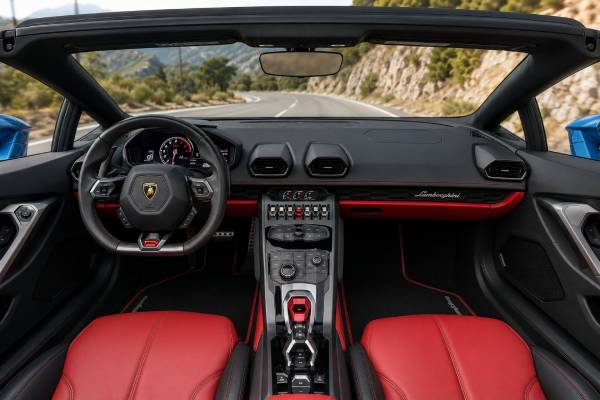
The cabin feels like a modern Lamborghini but still has enough Audi-era logic to be usable. The driver faces a large digital instrument panel, aviation-style switches, a red flip-up start cover, and paddle shifters mounted behind the steering wheel.
The ANIMA drive-mode selector changes the car’s behavior. Strada is the calmer daily mode. Sport loosens the car’s attitude and gives more oversteer-friendly behavior. Corsa is the most aggressive setting, sharpening throttle, gearbox, and stability-control logic for fast driving.
The seats, trim, and driving position vary by option package. Some cars have more comfortable road seats; others have sportier buckets. Tall drivers should sit in the exact car before committing, especially with the roof mechanism and seat shape. Visibility is acceptable for a mid-engine supercar, but rear-three-quarter visibility is limited with the top up, and rear-camera function is worth checking.
How the LP 580-2 Spyder Drives
The LP 580-2 Spyder drives like a Huracán with more conversation from the rear axle. It is still fast, stable, and electronically managed, but the steering and throttle balance feel less filtered than in the all-wheel-drive LP 610-4 Spyder.
At low speed, the car is easier than its shape suggests. The dual-clutch transmission creeps smoothly, the steering is light enough for town use, and the front lift option makes a major difference in daily confidence. Without the lift, ramps and driveways require more care. The nose is low, and damage to splitters and underbody panels can become an ownership nuisance.
The engine dominates every drive. Below the midrange it is tractable and clean, but the car comes alive as revs rise. The V10 does not deliver turbo-style low-rpm shove; instead, it builds intensity. That makes it feel more interactive. The driver chases rpm because the sound and response improve the harder the engine works.
The gearbox suits the engine well. In automatic mode it can be docile, but manual paddle control is more satisfying. Upshifts are quick and clean, while downshifts bring the engine into the right part of the rev range with theatrical precision. Cars with aftermarket exhaust systems can sound spectacular, but buyers should check legality, drone, emissions compliance, and whether original parts are included.
Rear-drive balance
The rear-wheel-drive chassis gives the car its identity. It does not have the all-weather traction of the LP 610-4, and it requires more respect on cold tires, wet roads, and broken pavement. But on a dry road with warm tires, it feels more natural when turning into a bend and more adjustable when exiting one.
The car’s weight sits toward the rear, which gives strong traction under acceleration, but it also means careless throttle inputs can move the car quickly. Stability systems are there, but this is not a car to treat like a video game. Tires, temperature, road camber, and driver smoothness matter.
The steering is accurate and quick. The standard electromechanical system is generally the purist choice because it feels consistent. Lamborghini Dynamic Steering varies the ratio and can make the car feel more agile at lower speeds, but some drivers find variable-ratio systems less transparent near the limit. A buyer who cares about feel should drive both before deciding.
Road, highway, and track use
On the highway, the LP 580-2 Spyder is more relaxed than its image suggests. Wind control is good with the roof down, and the car can cruise at low revs. Tire noise, exhaust volume, and cabin heat depend heavily on tires, exhaust specification, and roof position.
On mountain roads, it is at its best. The car feels compact, the brakes are strong when healthy, and the engine rewards clean corner exits. The open roof adds emotion without making the chassis feel loose.
Track use is possible, but the LP 580-2 Spyder is not the best Huracán for repeated circuit work. Heat, tires, brake wear, and insurance risk add up quickly. A Performante, STO, or well-prepared coupe is a better track tool. The LP 580-2 Spyder is better viewed as a fast road car that can handle occasional performance driving, not as a dedicated track-day platform.
Maintenance, Reliability, and Known Risks
The LP 580-2 Spyder can be dependable when serviced correctly, but it is still an exotic mid-engine Lamborghini. The expensive failures usually come from deferred maintenance, accident damage, neglected fluids, weak batteries, roof issues, worn brakes, old tires, or poorly installed modifications.
Routine service should be treated as annual exotic-car care, not normal used-car maintenance. Even low-mileage examples need time-based attention. Oil, brake fluid, filters, coolant checks, battery health, tires, software updates, and inspection of rubber components all matter. A car that has covered only a few thousand miles may still need meaningful reconditioning if it sat unused.
The V10 itself is generally strong, but it must be inspected carefully. Listen for abnormal valvetrain noise, check for leaks, review oil service history, scan the engine control modules, and inspect cooling system condition. Misfires, old fuel, weak ignition components, or intake leaks can become expensive if ignored.
The LDF gearbox is more livable than older Lamborghini single-clutch systems. It does not have the same clutch-wear reputation as the old e-gear cars, but it still needs diagnostic checks. A pre-purchase inspection should review fault codes, shift quality, launch-control use where available, fluid service history, heat events, and any signs of harsh engagement.
Spyder-specific risks
The roof system is one of the most important inspection areas. A good roof should move smoothly, latch correctly, sit evenly, and seal well. Slow operation, warning messages, uneven panel gaps, wet carpets, musty smells, or water stains can point to problems that are not obvious during a short test drive.
Check:
- soft-top fabric condition, fading, abrasion, and stitching;
- rear glass and seal condition;
- roof frame alignment;
- hydraulic operation and pump noise;
- drains and water paths;
- roof warning messages;
- wind noise and water leaks;
- trim panels around the roof storage area.
Because these cars are often used in sunny climates, interior leather shrinkage, sticky switches, faded trim, and dash wear can appear even on lower-mileage examples. UV exposure matters.
Brakes, tires, suspension, and lift
Brake condition is a major cost driver. Steel brakes are cheaper to replace than carbon ceramics, but a full brake refresh is still expensive. Carbon-ceramic discs require careful measurement and inspection for chips, cracks, heat damage, and wear. Never value a car only by pad thickness.
Tires are equally important. Old Pirelli P Zero tires can make the car feel nervous, noisy, or grip-limited even if the tread looks deep. On a rear-drive Huracán, tire age and compound condition affect safety, not just handling. Check DOT dates, matching sizes, and whether the car has been aligned properly.
The front lift system is desirable but should work quickly and evenly. Any warning light, uneven lift behavior, or hydraulic leak should be investigated. Magnetorheological dampers, if fitted, should be scanned for faults and checked for leaks. Worn suspension bushings or alignment issues can make the car tramline and reduce confidence.
Electrical systems, recalls, and documentation
Battery condition is critical. Many exotic-car “electrical problems” start with weak batteries, inconsistent charging, or poor storage habits. A Huracán should live on a proper maintainer when not driven often. Low voltage can trigger warning lights and confuse diagnosis.
Recall status should be checked by VIN through Lamborghini or the relevant national database. Huracán recalls and service actions may depend on model year, market, VIN range, and equipment. Headlight-related campaigns have affected broad Huracán production ranges, while some rear-camera and compliance items apply only to certain years. Do not assume a recall applies or does not apply based only on a listing headline.
The best cars have:
- complete Lamborghini dealer or recognized specialist service records;
- invoices, not only stamped books;
- original window sticker or build sheet;
- owner’s manuals, keys, charger, tools, and accessories;
- proof of completed recalls and campaigns;
- paint-meter readings and accident inspection notes;
- original parts retained if the car has reversible modifications.
Market Values and Buying Checks
The LP 580-2 Spyder now sits in a useful market lane: more special than a basic coupe to many buyers, usually less expensive than a Performante Spyder, and often below the later EVO RWD Spyder. The best cars trade on condition, mileage, color, options, and documentation more than model year alone.
As of mid-2026, public market data commonly places clean LP 580-2 Spyders around the low-$200,000 to mid-$200,000 range in the U.S., with higher prices for very low-mileage, high-spec, clean-history cars. Average figures can move quickly because the sample size is small and a few unusual cars can distort the numbers. Modified cars, high-mileage cars, branded-title cars, accident-history cars, or cars with missing records should be priced with a clear discount.
The strongest value drivers are:
- low verified mileage without long-term neglect;
- clean history with no structural damage;
- desirable factory color and interior combination;
- front lift and other useful factory options;
- complete Lamborghini or specialist service history;
- original paint or well-documented paintwork;
- no questionable tuning, turbo kits, or irreversible modifications;
- roof system in perfect working order;
- tires, brakes, and battery recently addressed;
- all recalls and campaigns checked by VIN.
A buyer should be cautious with cars that have many cosmetic upgrades but weak paperwork. Carbon trim, loud exhausts, wraps, and wheels can make a car look exciting online, but the inspection should focus on the structure, drivetrain, roof, electronics, brakes, tires, and service history.
| Area | What to verify |
|---|---|
| Identity | VIN, LP 580-2 Spyder build data, options, market specification |
| History | Accident records, paintwork, ownership chain, title status |
| Engine | Leaks, misfires, service history, scan data, cooling performance |
| Gearbox | Shift quality, fault codes, heat events, service records |
| Roof | Smooth operation, seals, drains, fabric, warning messages |
| Brakes | Disc condition, pad life, cracking, corrosion, replacement cost |
| Tires | Correct size, matching set, DOT age, wear pattern, alignment clues |
| Suspension | Lift system, MagneRide faults, leaks, bushings, alignment |
| Electronics | Battery health, infotainment, camera, sensors, software updates |
| Documents | Invoices, manuals, keys, recalls, original parts, build sheet |
The best example to buy is not always the lowest-mileage car. A very low-mileage Spyder with old tires, weak battery, outdated services, sticky trim, and no recent use may need more money than a 10,000- to 20,000-mile car that has been serviced properly and driven regularly. Condition beats odometer worship.
The cars to avoid are easy to define: accident-damaged cars with vague repair details, cars with aftermarket forced induction unless priced as modified-risk vehicles, cars missing records, cars with roof faults, cars on old tires, and cars advertised with “just serviced” but no invoices. A seller who cannot document expensive work probably has not done it.
Long-term collectability looks promising but not speculative in the same way as numbered limited editions. The LP 580-2 Spyder has the right ingredients: naturally aspirated V10, rear-wheel drive, open roof, strong brand identity, and pre-hybrid character. However, it was not a limited-production halo car. The ownership case should come first: buy it because you want to drive and enjoy a rear-drive V10 Lamborghini. If values remain firm, treat that as a benefit rather than the only reason to own one.
References
- Lamborghini Huracán Rwd – Technical Specifications, Pictures, Videos 2026
- Huracán (R)evolution: a story of technology and innovation 2024
- A Driving Experience Dedicated to Lamborghini Huracán 2024
- Fuel Economy of 2017 Lamborghini Huracan 2017
- Recall Campaign | Lamborghini.com 2026
Disclaimer
This article is for informational purposes only and is not a substitute for professional diagnosis, repair, appraisal, or pre-purchase inspection. Specifications, torque values, service intervals, repair procedures, recall status, and equipment can vary by VIN, market, model year, and factory options. Always verify details against official Lamborghini service documentation and have the exact vehicle inspected by a qualified Lamborghini dealer or specialist.
If this guide helped you, please share it on Facebook, X/Twitter, or your favorite car community to support our work.