
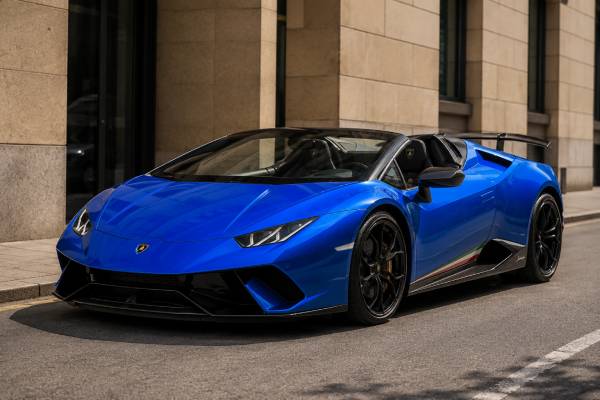
The Lamborghini Huracán Performante Spyder is the open-top version of one of the sharpest naturally aspirated V10 Lamborghinis ever built. It combines the Performante coupe’s 640 hp engine, active ALA aerodynamics, lighter Forged Composites body parts, all-wheel drive, and track-focused chassis tuning with the drama of a folding soft top. That mix gives it a rare place in the modern supercar world: it is usable enough for road miles, theatrical enough for weekend drives, and special enough for collectors who want the sound and response of Lamborghini’s pre-hybrid V10 era. It is not the lightest or most focused Huracán, and it is not a numbered limited edition, but the Performante Spyder remains important because it captures Lamborghini’s naturally aspirated formula at a high point before the brand moved toward hybrid successors.
Table of Contents
- Why the Performante Spyder Still Matters
- V10 Specs and Chassis Data
- Production Details, Variants, and Options
- ALA Aero, Forged Composites, and Design
- How It Feels on Road and Track
- Ownership, Service, and Known Risks
- Market Values and Smart Buying Checks
Why the Performante Spyder Still Matters
The Performante Spyder matters because it is the most focused open-roof version of the first-generation Huracán line. It gives buyers the sound, speed, and active-aero engineering of the Performante coupe while adding the sensory appeal that makes a Lamborghini Spyder feel so alive.
Lamborghini introduced the Huracán as the Gallardo’s replacement, then expanded it into a broad family of all-wheel-drive, rear-wheel-drive, coupe, Spyder, EVO, STO, Tecnica, Sterrato, and race-derived variants. The Performante sat near the top of that family before the EVO arrived. It was built to sharpen the standard Huracán’s character with more power, less weight, more aero control, revised suspension tuning, and a more direct track personality.
The Spyder version arrived for the 2018–2019 period and was shown publicly at Geneva in 2018. It was not a soft grand-touring convertible with cosmetic upgrades. It carried the core Performante hardware: the 5.2-liter naturally aspirated V10, 7-speed Lamborghini Doppia Frizione dual-clutch transmission, electronically controlled all-wheel drive, ALA active aerodynamics, carbon-ceramic braking, and revised chassis setup.
Its historical appeal has grown for one simple reason: the naturally aspirated Lamborghini V10 is now a finite era. Later supercars have become quicker through turbocharging, hybrid boost, and heavier electronic systems, but the Performante Spyder still delivers a direct throttle, a hard-edged intake note, and a high-rpm character that newer powertrains struggle to copy. For many owners, that emotional quality matters as much as the stopwatch.
Collectors also pay attention because the Performante badge has a clear identity. A standard Huracán Spyder is fast and dramatic, but the Performante Spyder is more technical and purposeful. It has visible aerodynamic parts, lighter materials, sharper calibrations, a louder personality, and a stronger connection to Lamborghini’s track-development story. The coupe earned much of the attention because of its Nürburgring record narrative, but the Spyder adds rarity of use case: open-air V10 theatre with serious aero and chassis engineering.
It is best understood as a peak road car rather than a pure track tool. The later Huracán STO is more extreme, lighter in philosophy, and rear-wheel drive, while the EVO Spyder is more polished and digitally integrated. The Performante Spyder sits between them. It is rawer and more special than a normal Huracán Spyder, yet still more usable and weather-flexible than the hardest-core variants.
V10 Specs and Chassis Data
The key number is 640 hp from a naturally aspirated 5.2-liter V10, sent to all four wheels through a 7-speed dual-clutch gearbox. The other important number is 1,507 kg dry weight, which makes the Spyder heavier than the coupe but still lighter than the regular Huracán 4WD Spyder.
| Category | Specification |
|---|---|
| Model | Lamborghini Huracán Performante Spyder, often identified as LP640-4 Performante Spyder |
| Production era | 2018–2019 period, with many markets treating it as a 2019 model-year car |
| Engine | 90-degree naturally aspirated V10 |
| Displacement | 5,204 cc, or 5.2 liters |
| Fuel system | Dual injection: multi-point injection plus direct stratified injection |
| Bore x stroke | 84.5 mm x 92.8 mm |
| Power | 640 CV, commonly listed as 640 hp metric or about 631 hp SAE, at 8,000 rpm |
| Torque | 600 Nm, or 443 lb-ft, at 6,500 rpm |
| Transmission | 7-speed Lamborghini Doppia Frizione dual-clutch automatic |
| Drivetrain | Electronically controlled all-wheel drive |
| Body and chassis | Hybrid aluminum and carbon-fiber structure with Forged Composites components |
| Dry weight | 1,507 kg, or 3,322 lb |
| Weight distribution | 43 percent front, 57 percent rear |
| 0–100 km/h | 3.1 seconds |
| 0–200 km/h | 9.3 seconds |
| Top speed | 325 km/h, or about 202 mph |
| 100–0 km/h braking | About 31.5 meters, manufacturer figure |
The engine is the heart of the car. Lamborghini revised the Performante V10 with freer breathing, Motorsport-influenced intake ducting, a lighter exhaust, and calibration changes that make it feel more urgent than the standard Huracán unit. It does not rely on turbos, electric torque fill, or artificial sound enhancement to make its point. The power rises with revs, the engine gets harder-edged near the top of the tachometer, and the dual-injection system helps combine response with emissions compliance.
The gearbox is the LDF dual-clutch unit. In simple terms, it uses two clutches so one gear can be engaged while the next gear is prepared. The result is very quick shifting without the single-clutch drama that older Lamborghinis were known for. It is smoother in traffic than the older E-gear system and much faster when driven hard.
| Area | Detail |
|---|---|
| Length | About 4,506 mm |
| Width | About 1,924 mm excluding mirrors |
| Height | About 1,180 mm |
| Wheelbase | 2,620 mm |
| Front tires | 245/30 R20 |
| Rear tires | 305/30 R20 |
| Front wheels | 20 x 8.5 inches |
| Rear wheels | 20 x 11 inches |
| Suspension | Double wishbones front and rear, with optional magnetorheological dampers on many cars |
| Steering | Electric power steering; Lamborghini Dynamic Steering was optional in many markets |
| Brakes | Carbon-ceramic discs with large fixed calipers |
| Fuel tank | About 83 liters |
| Front luggage space | About 100 liters |
Fuel use is not a strength, and that should surprise nobody. The Performante Spyder is a high-revving all-wheel-drive V10 supercar with wide tires and aggressive gearing. For buyers, fuel economy is less important than fuel quality, storage habits, annual service discipline, and avoiding long periods on old fuel.
Production Details, Variants, and Options
The Performante Spyder was a short-run derivative rather than a numbered limited edition. Exact public production totals are not as clear as they are for special numbered models, so buyers should judge rarity by specification, condition, mileage, market region, and documentation rather than by an official build-number claim.
The main related versions are easy to separate:
| Variant | What separates it |
|---|---|
| Huracán LP610-4 Spyder | The regular all-wheel-drive open Huracán, less powerful and less track-focused |
| Huracán Performante coupe | The closed-roof version, lighter and slightly quicker to 100 km/h and 200 km/h |
| Huracán Performante Spyder | The open-top Performante with ALA aero, 640 hp V10, AWD, and folding fabric roof |
| Huracán EVO Spyder | The later facelifted Spyder with updated electronics and design, but a different personality |
| Huracán STO | A more track-biased, rear-wheel-drive later model with a more extreme motorsport-style brief |
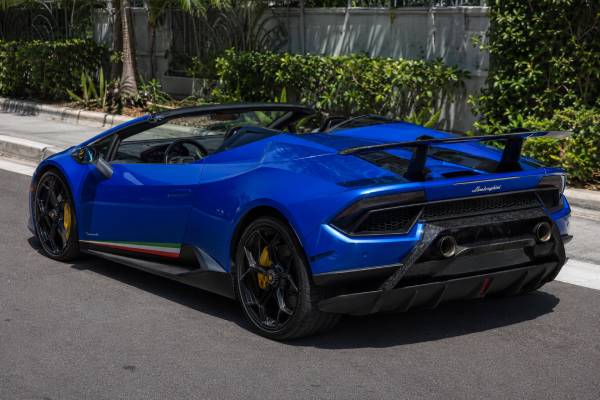
The quickest visual identifiers are the Performante aero parts, high-mounted center exhaust outlets, fixed rear wing, deeper front splitter, Forged Composites details, Performante badging, and more aggressive rear diffuser. The Spyder adds the folding soft top and the extra body reinforcement needed for open-roof stiffness.
Options matter a lot because they affect both value and ownership experience. Many cars were configured through Lamborghini’s Ad Personam personalization program, so two examples can feel very different even when the mechanical specification is the same. Desirable and commonly discussed equipment includes:
- Front axle lift, which is highly useful on steep driveways and city ramps.
- Magnetorheological suspension, which improves ride flexibility and track control.
- Lamborghini Dynamic Steering, which changes the steering ratio based on mode and speed.
- Sport seats or comfort seats, depending on owner preference.
- Lamborghini Telemetry System for track use and data review.
- Apple CarPlay and smartphone integration where fitted.
- Forged 20-inch wheel choices such as Narvi or Mimas-style fitments, depending on market and configuration.
- Carbon-fiber interior trim, visible Forged Composites pieces, and extended Alcantara.
- Exterior carbon packages, contrast stitching, branding packages, and painted brake calipers.
- Parking sensors, rear camera, and other usability options that matter more than some collectors expect.
Color and interior specification can move value. Loud Lamborghini colors such as Verde Mantis, Arancio Anthaeus-style orange tones, Giallo finishes, Blu shades, and special matte paints can command interest when paired with the right interior. Dark colors can look sinister and show the carbon elements well, but they may hide repair work or paint mismatch less obviously in photos. Matte paint needs careful inspection because refinishing and touch-ups are more complicated than on gloss paint.
Documentation is central. A serious buyer should want the original window sticker where available, owner’s books, service invoices, recall completion records, battery-maintainer evidence, tire date records, option list, paint-protection-film documentation, and any warranty or extended-warranty paperwork. For a modern Lamborghini, “low miles” without annual service history is not automatically a benefit. Time matters as much as mileage.
ALA Aero, Forged Composites, and Design
The Performante Spyder’s defining engineering feature is ALA, short for Aerodinamica Lamborghini Attiva. It is an active aerodynamic system that changes airflow for downforce or reduced drag instead of relying only on fixed wings and splitters.
The system uses active flaps in the front and rear aerodynamic paths. When more grip is needed, airflow is managed to increase vertical load and stability. When acceleration and top speed matter more, the system reduces drag. In cornering, the rear wing’s internal air channels can support aero vectoring, helping the car behave more sharply by changing the aerodynamic load side to side.
That is the clever part of the Performante story. Many supercars add big wings, larger splitters, and stiffer springs. The Performante uses aero as an active handling tool. In the Spyder, that technology has extra emotional appeal because the driver can hear more of the air, exhaust, induction, and tire noise with the roof lowered.
Forged Composites are the other signature material. Instead of a traditional woven carbon-fiber look, Lamborghini’s Forged Composites have a chopped, marbled pattern. They allow complex shapes, save weight, and give the Performante its distinct visual texture. The material appears in aerodynamic and body components, including areas around the engine cover, diffuser, splitter, and wing depending on configuration.
The body design is sharper than a normal Huracán Spyder. The front end looks lower and more technical, the side profile is tense, and the rear is dominated by the wing, diffuser, and high exhaust outlets. The central exhaust position is not just decorative. It shortens the path and gives the car a more motorsport-like rear view, while the lightweight exhaust helps the Performante feel and sound more urgent.
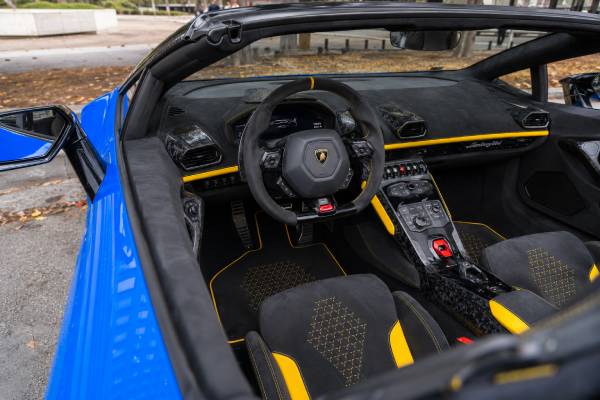
Inside, the cockpit is still recognizably Huracán: low seating, dramatic start-button cover, digital display, angular dashboard, and a driving position that feels built around the driver’s hips and shoulders. The Performante adds more Alcantara, motorsport-style graphics, and a stronger sense of occasion. In Corsa mode, the display prioritizes revs and gear position, which fits the car’s track-focused character.
The roof is a fabric system rather than a removable carbon panel. That choice keeps the Spyder usable and quick to transform. It opens or closes in about 17 seconds, making the car easy to enjoy without turning every stop into a manual roof ceremony. The tradeoff is weight. The Spyder is heavier than the coupe because it needs reinforcement and roof hardware, but it rewards the owner with a more intense soundscape.
The design is not subtle, and that is part of the point. A Performante Spyder does not pretend to be an understated driver’s car. It is a technical, loud, extroverted Lamborghini that also happens to have real engineering depth behind the theatre.
How It Feels on Road and Track
The Performante Spyder feels immediate, loud, and secure, but not delicate. It is an all-wheel-drive V10 supercar with huge mechanical grip, quick shifts, and active aero, so the defining impression is confidence mixed with drama.
The engine response is the main event. At low revs, the V10 is tractable and cleaner than an older exotic engine. It can roll through town without coughing or loading up, and the dual-clutch gearbox makes normal traffic far easier than older single-clutch Lamborghinis. Push harder, and the engine changes character. The upper rev range is where the Performante earns its name: throttle response sharpens, the intake hardens, and the exhaust note becomes more metallic and urgent.
The gearbox behaves differently depending on mode. In Strada, it is calmer and more polished. In Sport, it feels more playful and dramatic, with louder exhaust behavior and more aggressive responses. In Corsa, it is more disciplined and track-focused, holding gears, shifting quickly, and giving the driver a more direct sense of the drivetrain.
Steering depends heavily on the car’s options and alignment. Standard electric power steering can feel stable and accurate, while Lamborghini Dynamic Steering adds a variable ratio that some drivers like for tight roads and others find less natural than a fixed-ratio system. A proper alignment is essential. A tired alignment, old tires, or uneven wear can make the car feel nervous even when nothing major is wrong.
The braking performance is immense when the carbon-ceramic system is warm and healthy. On the road, the pedal may feel firm, and low-speed noise can be normal depending on pad condition and use. On track, the brakes need proper heat management. Carbon-ceramic discs are expensive, so “track-day capable” should never mean “cheap to track.” A pre-purchase inspection should measure disc condition and inspect for chips, cracks, heavy heat marking, and pad life.
Ride quality is firm but not unbearable. Cars with magnetorheological dampers have a wider comfort range. The Spyder structure is strong, but it cannot feel exactly like the coupe because open cars have different stiffness and mass. On rough roads, the Performante Spyder can feel busy, especially on cold tires. On smooth, fast roads, it feels planted and keyed-in.
Tires are central to the experience. The car was tuned around serious performance tires, and tire temperature changes the whole personality. Cold or old tires can make the car feel blunt, noisy, or skittish. Fresh, correct-spec tires make the steering cleaner, braking stronger, and traction systems less intrusive. Owners who use the car lightly should still watch date codes because age can matter more than tread depth.
As a road car, the Performante Spyder is best on open, flowing routes where the engine can stretch and the aero can work. In cities, it attracts attention, has limited visibility, and needs care over ramps. With front lift, parking sensors, and a rear camera, it becomes much easier to live with. Without them, the car is still usable, but the owner must be patient.
Ownership, Service, and Known Risks
The Performante Spyder can be reliable when maintained correctly, but it is still an exotic car with expensive consumables and complex systems. The biggest ownership risks are deferred service, old tires, weak batteries, damaged carbon-ceramic brakes, roof-system problems, and poorly repaired cosmetic or accident damage.
The V10 itself has a strong reputation, especially compared with more fragile exotic engines, but it does not reward neglect. Annual servicing is wise even when mileage is low. Oil, filters, brake fluid, coolant condition, spark plugs, belts, and software updates should be handled by a qualified Lamborghini dealer or a proven specialist. A car that has sat unused for long periods may need more work than a car with moderate, regular use.
The 7-speed LDF gearbox is far more livable than older Lamborghini single-clutch systems. Still, buyers should check for harsh engagement, warning lights, fluid leaks, overheating signs, and service records. Launch-control abuse, hard track use, or repeated low-speed clutch slipping can shorten component life.
Common inspection points include:
- 12-volt battery condition, maintainer use, and low-voltage fault history.
- Roof operation, including smooth movement, seals, latches, hydraulic or motor behavior, and water leaks.
- Nose-lift function, because lift systems can be expensive to repair.
- Magnetorheological damper leaks or warning faults where fitted.
- Carbon-ceramic brake disc condition and pad thickness.
- Tire date codes, tire brand, tire size, and uneven wear.
- Wheel damage on inner rims, not just visible outer rash.
- ALA flap operation and related warning messages.
- Exhaust valve operation and evidence of non-factory exhaust modifications.
- Front splitter, diffuser, undertray, and jacking-point damage.
- Paintwork, panel gaps, paint-protection film edges, and signs of prior impact repair.
- Sticky interior buttons, worn Alcantara, seat bolster wear, and loose trim.
- Infotainment behavior, rear camera function, Apple CarPlay operation where fitted, and instrument-cluster warnings.
Carbon-ceramic brakes deserve special attention. A car can show plenty of pad material yet still have discs that have been heat-cycled hard, chipped, or damaged. Replacement costs are high enough to change the economics of a purchase. Always have a specialist inspect the discs rather than relying on photos.
The roof system is another Spyder-specific risk. The fabric, rear window area, seals, drains, and mechanism should be tested with the car cold and warm. Water leaks can damage trim and electronics. A roof that operates slowly or unevenly can point to adjustment or component issues.
Recalls and service campaigns should be checked by VIN. Broad Huracán recall topics have included headlight adjustment compliance and rearview camera software issues, but the only responsible approach is to check the exact car through Lamborghini or an official recall lookup. Never assume that a recall applies, or that it has been completed, just because a model year appears in a broad recall description.
Modifications require caution. Exhausts, tunes, lowering kits, wheel spacers, aftermarket carbon parts, and removed catalytic components can reduce value, create inspection problems, or complicate emissions compliance. Some buyers like tasteful exhaust changes, but collectors usually prefer reversible upgrades with all original parts retained.
The best ownership pattern is simple: keep the car on a maintainer, drive it regularly, service it annually, replace aged tires, avoid cheap repairs, and store every invoice. A well-documented Performante Spyder will always be easier to sell than a cheaper example with missing records.
Market Values and Smart Buying Checks
The Performante Spyder sits above ordinary Huracán Spyders in value because it has the right mix of power, aero technology, rarity, and V10 character. In the mid-2026 market, good examples commonly trade or list from the high-$200,000s into the $300,000s, while exceptional low-mileage, highly optioned, or rare-color cars can sit higher.
Value depends less on the model year printed in an ad and more on condition, options, color, mileage, service history, and accident history. A 2019 car with poor records is not automatically better than a 2018-titled car with excellent history. Likewise, ultra-low mileage is not always ideal if the car has not been serviced, exercised, or stored properly.
The strongest cars usually have:
- Original paint or clearly documented paintwork.
- No structural accident history.
- Complete service records from Lamborghini dealers or respected specialists.
- Recent tires from an approved high-performance brand and correct sizes.
- Verified carbon-ceramic brake health.
- Clean roof operation and dry interior.
- Front lift, useful parking equipment, and desirable interior trim.
- Original exhaust and emissions equipment, or original parts retained.
- Window sticker, books, tools, keys, battery tender, and option documentation.
- Tasteful color combination with broad buyer appeal.
| Inspection area | What to verify | Why it matters |
|---|---|---|
| Service history | Annual services, fluid changes, dealer or specialist invoices | Low mileage does not protect a neglected exotic |
| Brake system | Disc condition, pad life, chips, cracks, heat marks | Carbon-ceramic replacement can be a major cost |
| Roof system | Full operation, seals, drains, fabric, water intrusion | Spyder-specific repairs can be expensive and annoying |
| Underside | Splitter, diffuser, undertray, lift points, suspension arms | Low supercars often hide damage underneath |
| Electronics | Fault scan, rear camera, lift, dampers, ALA, infotainment | Control-module faults can outcost simple mechanical wear |
| Tires and wheels | Date codes, matching sizes, inner rim damage, alignment wear | Tires strongly affect grip, safety, and AWD behavior |
| Body and paint | Panel gaps, paint depth, PPF edges, carbon fitment | Cosmetic repairs can affect originality and resale |
Avoid cars that are cheap for unclear reasons. A suspiciously low price can hide accident repair, missing history, worn brakes, roof faults, tuned software, title issues, or expensive deferred maintenance. Also be careful with cars advertised as “collector grade” but missing basic records. A collector-grade modern Lamborghini should have paperwork, not just low mileage and glossy photos.
For long-term collectability, the case is strong but not risk-free. The Performante Spyder has the naturally aspirated V10, active aero, open-roof drama, and a clear place in the Huracán story. It is also usable enough that owners can enjoy it rather than store it like a fragile artifact. The risk is that the broader Huracán family is large, and future buyers may separate only the best specifications from ordinary examples. That means the right car matters.
A smart buyer should pay more for the right history, options, and condition. Saving money on a car with weak records can disappear quickly after brakes, tires, fluids, roof repairs, paint correction, and electronic diagnostics. The best Performante Spyder is not always the cheapest or the lowest-mileage one. It is the car that has been used carefully, serviced consistently, documented thoroughly, and kept close to factory specification.
References
- Lamborghini Huracán Performante Spyder- Technical Specifications, Pictures, Videos 2026 (Manufacturer Technical Page) ([Lamborghini.com][1])
- Huracán Performante Spyder and Urus Showcased in Geneva 2018 (Manufacturer News Release) ([Lamborghini.com][2])
- Recall Campaign | Lamborghini.com 2026 (Manufacturer Recall Lookup) ([Lamborghini.com][3])
- Part 573 Safety Recall Report 22V-081 2022 (Recall Database)
- Lamborghini Huracán LP640-4 Performante Spyder Market – CLASSIC.COM 2026 (Market Data) ([Classic.com][4])
Disclaimer
This article is for informational purposes only and is not a substitute for professional diagnosis, repair, appraisal, or inspection. Specifications, torque values, service intervals, fluids, software, recall status, and repair procedures can vary by VIN, market, equipment, and model-year registration. Always verify details against official Lamborghini service documentation and have any purchase inspected by a qualified Lamborghini dealer or marque specialist.
If this guide helped you, please share it on Facebook, X/Twitter, or your preferred car community to support our work.