
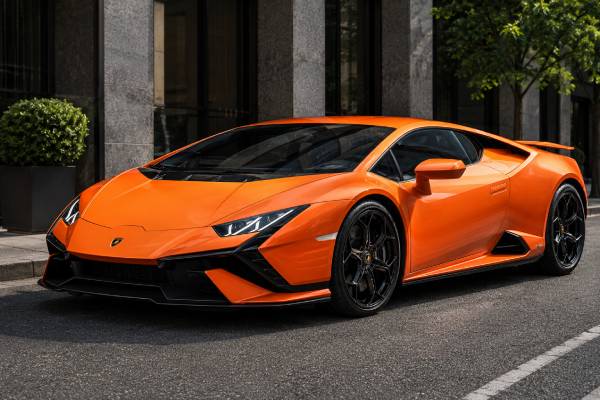
The Lamborghini Huracán Tecnica is the most balanced road-focused version of the final naturally aspirated V10 Huracán family. It takes the 640 CV engine and rear-drive attitude of the track-biased STO, adds more usable bodywork, keeps the everyday comfort missing from harder-core variants, and gives buyers a car that feels special without being too extreme to enjoy often. For collectors, the Tecnica matters because it sits near the end of Lamborghini’s non-hybrid V10 era. For drivers, it matters because it delivers the noise, throttle response, steering energy, and mid-engine drama people expect from a modern Lamborghini, but with a less punishing personality than the STO. The right example is not simply the lowest-mileage car. Specification, service history, tire and brake condition, software updates, paint quality, and provenance all shape value and ownership risk.
Table of Contents
- Why the Tecnica matters in the Huracán line
- V10 specs, chassis data, and performance figures
- Production years, options, and identification details
- Aerodynamics, cockpit, and V10 character
- Road, track, and everyday driving feel
- Maintenance, reliability, and specialist ownership
- Market values and buyer inspection priorities
Why the Tecnica matters in the Huracán line
The Huracán Tecnica is best understood as the road-and-track middle point between the Huracán EVO RWD and the Huracán STO. It is sharper, more powerful, and more aerodynamically developed than the EVO RWD, but it avoids the full race-car theater, cost exposure, and compromise of the STO.
Lamborghini revealed the Tecnica in April 2022 as the Huracán family was entering its final chapter. That timing is important. By then, Lamborghini had already made all-wheel-drive Huracáns, rear-drive Huracáns, the Nürburgring-famous Performante, the updated EVO, the Super Trofeo-inspired STO, and later the off-road-themed Sterrato. The Tecnica arrived as a deliberate blend rather than a simple trim package.
Its appeal comes from three ingredients. First, it uses the 5.2-liter naturally aspirated V10 in 640 CV tune, matching the headline output of the STO. Second, it is rear-wheel drive, which gives it a more expressive character than the all-wheel-drive Huracán EVO. Third, it uses special chassis, steering, aerodynamic, and cooling calibration to make the car feel precise without turning it into a stripped track tool.
For enthusiasts, the Tecnica is significant because it preserves the old-school supercar pleasure of a high-revving, naturally aspirated engine. There are no turbochargers softening the sound and no hybrid system changing the response. The engine’s character is immediate, loud, and mechanical.
For collectors, the significance is different. The Tecnica belongs to the last production phase of the V10 Huracán before Lamborghini moved into a new hybrid era. It was not a numbered limited edition in the same sense as the Sterrato or special end-of-line models, but it still has “last of the breed” appeal. That phrase is overused in the collector market, yet it applies here because the Tecnica represents a final road-focused expression of Lamborghini’s naturally aspirated V10 formula.
The Tecnica also has a clear place in the model hierarchy:
- EVO RWD: lighter, simpler, less powerful, more playful at lower speeds.
- EVO AWD: faster from a launch, more secure, less adjustable on throttle.
- STO: more focused, louder, wider in personality, and more track-led.
- Tecnica: the usable 640 CV rear-drive choice with stronger aero and better road manners than the STO.
- Sterrato: a separate, lifted, limited-production all-terrain concept.
Today, buyers pay attention to the Tecnica because it gives them much of the STO’s drivetrain drama in a more livable package. It also avoids some of the usability concerns that come with carbon-heavy, track-styled special editions. The result is a car that can be collected, driven, shown, and used on fast roads without feeling like the wrong tool.
V10 specs, chassis data, and performance figures
The Tecnica’s core specification is simple but serious: a 5,204 cc naturally aspirated V10, rear-wheel drive, a 7-speed dual-clutch gearbox, carbon-ceramic brakes, rear-wheel steering, and 640 CV at 8,000 rpm. It is a modern supercar built around engine response and chassis balance rather than hybrid boost or turbocharged torque.
| Category | Specification |
|---|---|
| Engine | 5.2-liter naturally aspirated V10 |
| Displacement | 5,204 cc |
| Bore x stroke | 84.5 mm x 92.8 mm |
| Compression ratio | 12.7:1 |
| Maximum power | 470 kW / 640 CV at 8,000 rpm |
| Maximum torque | 565 Nm at 6,500 rpm |
| Lubrication | Dry sump |
| Transmission | 7-speed LDF dual-clutch automatic |
| Drivetrain | Rear-wheel drive |
| Chassis | Hybrid aluminum and carbon-fiber structure |
| Body | Aluminum and synthetic material |
The V10 is the reason the car feels different from many newer supercars. Its peak power arrives high in the rev range, and the torque peak sits at 6,500 rpm. That means the engine rewards revs, gear selection, and commitment. It is not a lazy torque engine. It wants to be used.
| Item | Figure |
|---|---|
| Top speed | 325 km/h |
| 0–100 km/h | 3.2 seconds |
| 0–200 km/h | 9.1 seconds |
| 100–0 km/h braking | 31.5 meters |
| Dry weight | 1,379 kg |
| Weight-to-power ratio | 2.15 kg/CV |
| Weight distribution | 41% front / 59% rear |
| Front wheels | 8.5J x 20 |
| Rear wheels | 11J x 20 |
| Front tires | Bridgestone Potenza Sport 245/30 R20 |
| Rear tires | Bridgestone Potenza Sport 305/30 R20 |
| Front brakes | Carbon ceramic, 380 mm x 38 mm |
| Rear brakes | Carbon ceramic, 356 mm x 32 mm |
| Measurement | Figure |
|---|---|
| Length | 4,567 mm |
| Width excluding mirrors | 1,933 mm |
| Width including mirrors | 2,236 mm |
| Height | 1,165 mm |
| Wheelbase | 2,620 mm |
| Seats | 2 |
The suspension uses magnetorheological dampers, which adjust damping behavior electronically. The steering is electromechanical, and the Tecnica also uses rear-wheel steering. At low speeds, the rear wheels can help the car rotate more easily; at higher speeds, they support stability. Combined with torque vectoring, traction-control tuning, and Lamborghini’s LDVI vehicle-dynamics control, the Tecnica is not just a rear-drive Huracán with more power. Its software and hardware are tuned to make the car more agile and more predictable.
Fuel consumption is not the point, but official combined figures are high, as expected from a naturally aspirated V10 supercar. The Tecnica’s quoted WLTP combined consumption is 14.5 L/100 km, with combined CO2 emissions of 328 g/km. In the United States, the combined EPA figure commonly shown for the model is 15 mpg.
Production years, options, and identification details
The Tecnica was introduced in 2022 and sold during the last production years of the Huracán line, with most customer cars appearing as 2023 and 2024 model-year examples depending on market. Lamborghini has not treated it publicly as a numbered limited edition, so condition and specification matter more than a build number.
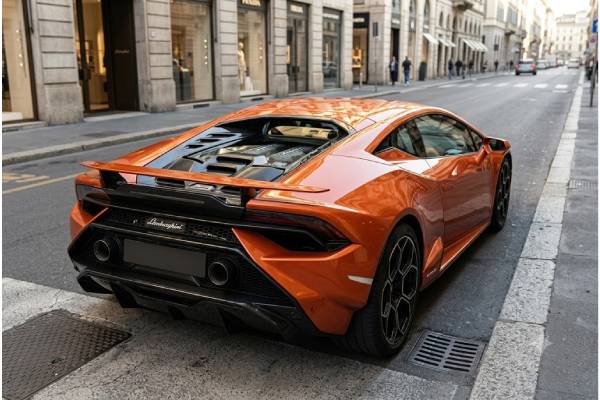
The easiest way to identify a Tecnica is by its bodywork. It has a distinctive front bumper, sharper “shark nose” treatment, revised front splitter, fixed rear wing, unique rear treatment, and a redesigned engine cover using lightweight carbon fiber and glass. It looks less extreme than an STO, but it is clearly more aggressive than an EVO RWD.
Buyers should understand the main factory and personalization choices because they strongly affect desirability. The Tecnica was offered with wide Lamborghini personalization through standard colors, optional colors, and Ad Personam finishes. The brochure references 8 standard colors, 3 optional colors, and more than 300 Ad Personam possibilities. That makes paint and interior combination a major part of the buying decision.
Wheels and exterior options
The Tecnica’s wheel selection is unusually important because the car’s stance changes noticeably with wheel finish and design. Factory wheel families included 20-inch AESIR, NARVI, DAMISO, and LODGE designs, with finishes such as Graphite Grey, Shiny Silver, Shiny Black, Matt Black, Diamond Cut, Bronze, Shiny Gold, and other Ad Personam treatments.
Carbon-fiber exterior additions also affect value and inspection risk. Buyers should look for:
- carbon-fiber front and rear bonnet elements;
- optional carbon-fiber rear spoiler finish;
- carbon-fiber mirror caps;
- titanium wheel bolts where fitted;
- paint-protection film quality and coverage;
- splitter and underbody condition, especially on cars used in cities or on steep driveways.
The front overhang is low enough that scuffs are common. A freshly painted splitter or front bumper is not automatically a problem, but the repair should be documented. Poor color match, rough edges, overspray, or missing fasteners suggest cheaper repair work.
Interior and technology choices
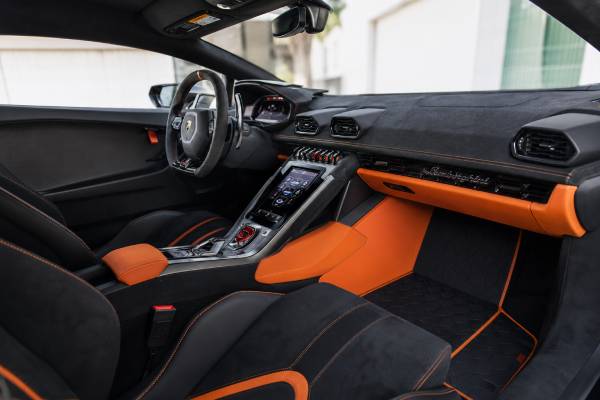
Inside, the Tecnica combines Huracán familiarity with more model-specific trim. Alcantara, Tecnica stitching, laser-engraved trim on sport seats, contrast stitching, and Ad Personam color choices can make two cars feel very different.
Commonly desirable interior features include:
- sport seats or lightweight-style seating depending on market and configuration;
- Alcantara-heavy trim in clean condition;
- contrast stitching that matches exterior paint;
- Lamborghini Telemetry where fitted;
- Apple CarPlay and Android Auto functionality;
- front axle lift if the car will be used regularly;
- connected services with proper account transfer.
Technology equipment should be tested before purchase. Supercars with very low mileage can still have weak batteries, expired subscriptions, incomplete software updates, or modules that need dealer attention.
Documentation and provenance
For a modern Lamborghini, provenance is less about matching-numbers engine drama and more about clean records. A strong Tecnica file should include the original window sticker or build sheet, purchase paperwork, service invoices, recall or campaign confirmation, option list, paint-protection-film invoice, tire records, and any warranty-extension documents.
A car with 2,000 miles and no annual service history is not automatically better than one with 8,000 miles and a complete Lamborghini dealer file. The second car may be the safer ownership bet.
Aerodynamics, cockpit, and V10 character
The Tecnica’s design is functional, not just decorative. Lamborghini changed the body to improve downforce, cooling, brake temperature control, and stability while keeping the car usable on the road.
The front end is the first giveaway. The bumper uses a sharper nose, more defined inlets, and a front splitter shaped to guide air more effectively. The body side and rear fender area help feed the engine and manage airflow. At the back, the fixed rear wing gives the Tecnica a more purposeful look without reaching the STO’s race-car visual volume.
Important aerodynamic and cooling features include:
- new underbody deflectors;
- a revised diffuser with central blowing;
- optimized rear-fender engine air inlets;
- a fixed rear wing;
- redesigned brake-cooling airflow at both axles;
- lightweight carbon-fiber and glass engine-cover elements.
The brake-cooling work matters because carbon-ceramic brakes can handle huge heat, but the surrounding components still need airflow management. Better cooling helps maintain pedal consistency, especially on repeated fast-road stops or short track sessions.
The cockpit is low, narrow, and driver-led. It is not as roomy or airy as newer supercars with more upright cabins. Visibility is better forward than rearward, and the driver sits close to the front axle line, with the V10 just behind. That gives the Tecnica the classic mid-engine sensation of being surrounded by mechanical mass.
The interior’s Human-Machine Interface, or HMI, is more track-influenced than early Huracáns. The digital displays and driving-mode feedback are intended to keep the driver focused on revs, gear selection, and vehicle mode. It is not a luxury-first cabin in the grand-touring sense. It is best judged as a high-drama driving cockpit.
The V10 gives the car its emotional center. It is naturally aspirated, dry-sumped, and mounted behind the cabin. The sound builds with revs instead of arriving as a low-rpm wall of turbocharged torque. Around town, it can feel theatrical even at normal speeds. On open roads, the final third of the tachometer is where the car becomes memorable.
That engine also gives the Tecnica long-term identity. Many modern supercars are faster in a straight line, and hybrid successors will be more powerful. But very few offer a 10-cylinder engine that revs hard, responds instantly, and sounds this raw from the factory. That is why design, engineering, and sound cannot be separated in this car. The bodywork tells you it is technical; the engine tells you it is still emotional.
Road, track, and everyday driving feel
The Tecnica feels sharp and alive without being as intense as the STO. Its best use case is fast road driving, mountain roads, occasional track work, and weekend use by an owner who wants real feedback rather than only acceleration numbers.
At low speeds, the car is more manageable than its shape suggests. The dual-clutch gearbox is smooth enough in Strada mode, the suspension can relax, and the V10 will pull cleanly without demanding constant high-rpm work. The car is still wide, low, loud, and attention-grabbing, so it is never anonymous transport. But it is not fragile or miserable in normal use.
The ANIMA drive-mode selector changes the car’s personality:
- Strada gives the most stable and controlled response for road use, poor weather, and daily driving.
- Sport opens the car up, sharpens response, and allows more playful rear-drive behavior.
- Corsa tightens the car for precision, faster shifts, and track-focused control.
The rear-wheel steering is a major part of the feel. At slower speeds, it helps the car turn in with less effort, making the wheelbase feel shorter. At higher speeds, it adds calmness, especially during quick direction changes or braking zones. The result is a car that feels smaller than its width when driven quickly, but still stable when loaded hard.
Throttle response is one of the Tecnica’s best traits. Because the engine is naturally aspirated, small pedal movements produce clear changes in acceleration and sound. Drivers used to turbocharged cars may need time to adjust. The V10 does not deliver its full character at 2,500 rpm. It builds, hardens, and becomes more urgent as the revs climb.
The gearbox is fast and effective. In automatic mode, it suits city driving better than older Lamborghini single-clutch systems. In manual mode, paddle shifts are quick and clean, especially when the car is being driven with intent. It does not have the mechanical involvement of a manual gearbox, but it matches the engine’s speed and the chassis’ reaction time.
Steering feel is direct and more communicative than many modern supercars, though not old-school heavy. The front end responds quickly, and the rear axle can be influenced with throttle in a way all-wheel-drive Huracáns do not allow as naturally. This is where the Tecnica earns its appeal. It is fast, but its value is in adjustability.
On track, the Tecnica can run hard, but buyers should be honest about its mission. It is not an STO with number plates. It has better road manners, less extreme aero, and a more livable cabin. For serious track drivers, brake wear, tire wear, stone chips, heat cycles, and warranty questions become real costs. For occasional track days, it is more than capable, but it should be inspected before and after.
Tires strongly affect the car. Cold tires make the Tecnica feel more nervous, especially in cool weather. Fresh high-performance tires transform steering response and braking confidence. Old, heat-cycled, or mismatched tires are a red flag on any Huracán, but especially on a rear-drive 640 CV car.
Maintenance, reliability, and specialist ownership
The Tecnica is generally viewed as a robust modern Lamborghini when maintained correctly, but ownership is still exotic-car ownership. The big risks are not usually simple engine failure; they are deferred servicing, old tires, carbon-ceramic brake expense, electronic faults caused by low voltage, cosmetic damage, and poorly documented repairs.
The 5.2-liter V10 has a strong reputation across the Huracán family. It is not a fragile, short-life engine when serviced on time and warmed properly. The dry-sump system is built for sustained performance use, but oil level, correct oil specification, and time-based service are not optional. Low-mileage cars still need annual attention.
The LDF dual-clutch gearbox is also far more livable than Lamborghini’s older automated single-clutch units. It does not require the same routine clutch-wear anxiety as an old E-gear Gallardo. That said, it is still an expensive gearbox. A pre-purchase inspection should check for stored faults, overheating history, poor shift behavior, leaks, and calibration issues.
Key ownership inspection points include:
- engine oil service history and correct annual maintenance;
- coolant leaks, hose condition, and radiator debris;
- gearbox fault codes and shift quality;
- rear tire wear, date codes, and heat cycling;
- carbon-ceramic brake disc condition and pad life;
- front splitter, undertray, and diffuser damage;
- front axle lift operation if fitted;
- magnetorheological damper leaks or faults;
- rear-wheel-steering system faults;
- battery condition and charging history;
- connected-services, infotainment, and software status;
- recall and service-campaign completion by VIN.
Carbon-ceramic brakes need specialist judgment. A visual check is not enough. Chips, cracks, pad material transfer, deep scoring, and thickness or weight measurements can change the buying decision. Replacement costs are high enough that a cheap car with worn brakes may not be cheap at all.
Tires are another major cost and safety factor. Because many Tecnicas are used lightly, tire age can matter as much as tread depth. A car showing original tires after several years may look “new,” but the rubber may be past its best. Flat spotting can also happen when cars sit for long periods without proper storage.
The 12-volt battery deserves attention. Modern Lamborghinis are sensitive to voltage. A weak battery can cause warning lights, communication errors, and convenience-feature problems that look more serious than they are. A car kept on the correct maintainer is more reassuring than one that has been jump-started repeatedly.
Factory campaigns and recalls should be checked by VIN. Recall exposure can vary by country, model year, build date, and equipment. Some markets reported a small Huracán high-beam software recall affecting Tecnica among other Huracán variants. The practical advice is simple: do not rely only on a listing description. Use Lamborghini’s recall lookup, an authorized dealer, and market-specific recall databases before purchase.
Restoration is not yet the right word for most Tecnicas. These cars are too new. The better term is repair quality. Look closely at paintwork, panel gaps, front-end respray evidence, underbody fasteners, wheel damage, carbon-fiber finish, and records for any bodywork. A minor splitter respray is normal. Undocumented structural repair is not.
Market values and buyer inspection priorities
The Tecnica sits in a strong but selective market because it combines late Huracán status, rear-wheel drive, 640 CV, and naturally aspirated V10 appeal. As of early 2026, good examples generally trade at a premium over many standard EVO models, while the most collectible STO, Sterrato, and special-spec cars can still sit above it depending on mileage and market.
In broad terms, asking prices commonly cluster from the high-$200,000s into the mid-$300,000s in the United States, with exceptional low-mileage or unusual Ad Personam specifications asking more. UK and European values vary with taxes, registration costs, currency, and supply, but clean Tecnicas often sit around the low-to-mid £200,000s, with very special examples higher.
Value is driven by more than mileage. The strongest Tecnicas usually have:
- desirable exterior color or Ad Personam paint;
- clean, original paint or documented high-quality protection;
- low but usable mileage;
- complete Lamborghini dealer service history;
- active or extendable warranty coverage where available;
- clean brake and tire condition;
- documented campaign and recall completion;
- desirable wheels and carbon-fiber options;
- well-kept Alcantara and seat bolsters;
- no accident history and no questionable repainting.
Cars to approach carefully include those with missing service history, mismatched tires, worn carbon-ceramic brakes, repeated battery issues, track use without maintenance records, heavy front-end repainting, incomplete option documentation, or imported histories that are hard to verify.
A serious pre-purchase inspection should be done by a Lamborghini dealer or a recognized independent specialist with Huracán diagnostic capability. The inspection should not be a generic used-car check. It should include diagnostic scans, brake assessment, tire date-code review, suspension and lift-system checks, paint-depth readings, underbody inspection, campaign verification, and a review of factory options.
| Area | What to check | Why it matters |
|---|---|---|
| Documentation | Build sheet, service invoices, warranty papers, recall confirmation | Proves provenance and reduces ownership uncertainty |
| Paint and body | Paint depth, panel gaps, splitter, undertray, carbon trim | Front-end damage and poor repairs hurt value |
| Brakes | Carbon-ceramic disc condition, pads, chips, cracks, wear data | Replacement cost can change the real purchase price |
| Tires | Correct sizes, date codes, brand match, heat cycling | Old or poor tires compromise a rear-drive 640 CV car |
| Drivetrain | Fault codes, shift behavior, leaks, service history | Major repairs require specialist tools and high-cost parts |
| Electronics | Battery health, infotainment, cameras, connected services, software | Low-voltage faults and module issues are common exotic-car annoyances |
| Options | Wheels, carbon, lift, telemetry, interior trim, Ad Personam details | Specification strongly affects desirability and resale |
The best Tecnica to buy is usually not the cheapest one. It is the car with the best combination of specification, originality, maintenance, tires, brakes, warranty position, and seller transparency. A lightly used car with perfect records and fresh consumables can be a better purchase than a delivery-mile car that has sat badly, missed service, or needs expensive recommissioning.
Long term, the Tecnica has a strong collectability argument. It is attractive, usable, naturally aspirated, rear-wheel drive, and positioned at the end of a famous Lamborghini V10 line. It may not be the rarest Huracán, but it is one of the most coherent. For an owner who wants one modern Lamborghini to drive and keep, that coherence may matter more than rarity alone.
References
- Lamborghini Huracán Tecnica | Lamborghini.com 2024 (Technical Specifications)
- Lamborghini Huracán Tecnica_EN_WCAG 2024 (Digital Brochure)
- Gas Mileage of 2023 Lamborghini Huracan 2023 (EPA Fuel Economy)
- Recall Campaign | Lamborghini.com 2026 (Recall Database)
- Lamborghini Huracan Tecnica For Sale & Price Guide 2026 (Market Data)
Disclaimer
This article is for informational purposes only and is not a substitute for professional diagnosis, inspection, repair, or valuation. Specifications, torque values, service intervals, software campaigns, recall status, and repair procedures can vary by VIN, market, model year, equipment, and factory updates. Always verify details against official Lamborghini service documentation and consult an authorized Lamborghini dealer or qualified specialist before buying, servicing, modifying, or repairing a Huracán Tecnica.
If this guide helped you, please share it on Facebook, X/Twitter, or your favorite car community to support our work.