
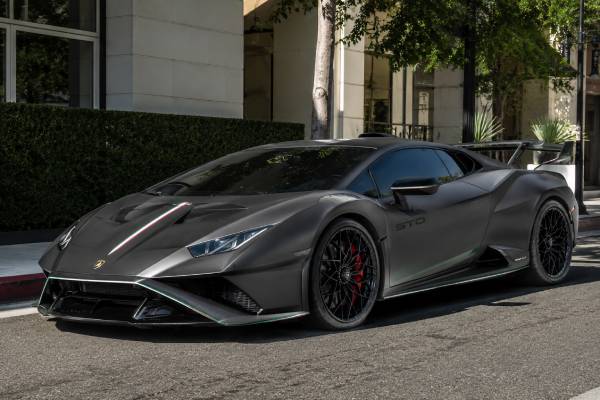
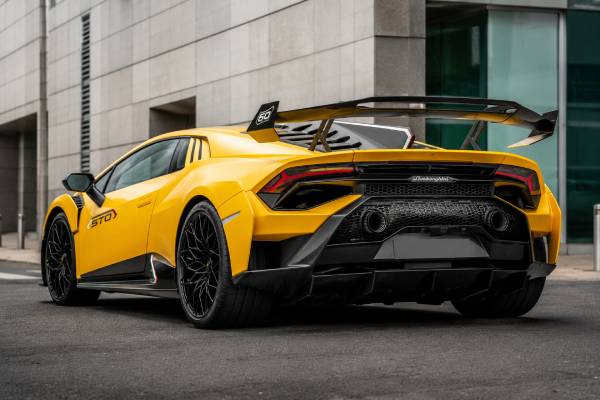
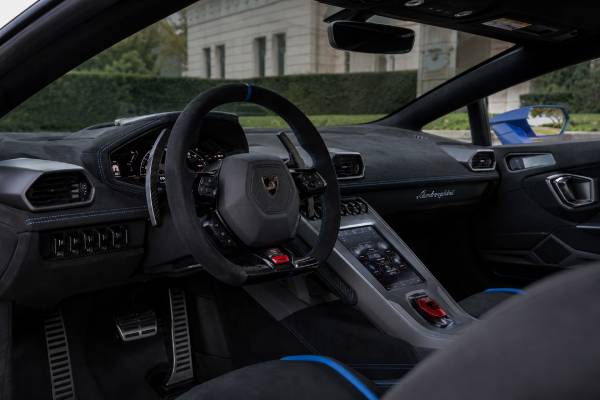
The Lamborghini Huracán STO 60th Anniversary Edition is the rare commemorative version of Lamborghini’s most track-focused road-legal V10 Huracán. Built for the brand’s 60th anniversary in 2023, it keeps the STO’s core formula: a naturally aspirated 5.2-liter V10, rear-wheel drive, race-derived aerodynamics, carbon-fiber bodywork, and a chassis tuned to feel closer to a Super Trofeo car than a regular road coupe. The anniversary package matters because it adds real scarcity and identifiable factory details without changing the mechanical character that makes the STO special. For buyers, the appeal is not only the 640 hp engine or the 3.0-second 0–100 km/h claim. It is the mix of final-era Lamborghini V10 drama, limited-edition presentation, and collector-grade provenance. The best examples are low-mileage, original, documented, unmodified, and serviced by authorized or highly experienced Lamborghini specialists.
Table of Contents
- What the STO 60th Anniversary Represents
- V10 Specs and Track Hardware
- Limited Production, Colors, and Identification
- Aero, Carbon Fiber, and Race-Derived Details
- How the STO Feels on Road and Track
- Maintenance Risks and Specialist Care
- Market Value and Buyer Checklist
What the STO 60th Anniversary Represents
The Huracán STO 60th Anniversary Edition is a collector-focused version of the STO, not a higher-output mechanical upgrade. Its value comes from the STO’s already serious engineering plus the anniversary-only production run, factory details, and connection to Lamborghini’s 1963–2023 milestone.
STO stands for Super Trofeo Omologata. In plain terms, Lamborghini built the STO to bring the feel and technology of its Huracán Super Trofeo and GT3 programs into a road-legal car. The normal Huracán range covered several personalities: all-wheel-drive EVO models for speed and usability, rear-drive models for purity, the Tecnica as a balanced road-and-track car, and the STO as the hardest-edged track-biased road model.
The 60th Anniversary Edition arrived in 2023 as part of a trio of limited Huracán anniversary models: STO, Tecnica, and EVO Spyder. Each was limited to 60 units, with the STO representing the most aggressive, motorsport-led side of the lineup. That matters because 2023 also sat near the end of the naturally aspirated V10 Huracán era. Lamborghini later moved its junior supercar strategy toward hybrid power, making the STO one of the clearest final statements of the old-school V10 formula.
For enthusiasts, the STO is important because it avoids the easy route of all-wheel-drive launch speed. It is rear-wheel drive, lighter than the Performante, sharper in steering response, and more focused on braking, aerodynamics, and lap consistency. It feels less like a luxury supercar with track settings and more like a road car built around track habits.
For collectors, the 60th Anniversary Edition adds a more narrow buying question: is the car a true factory anniversary example, and is it still in original specification? The special edition should have its “1 of 60” carbon-fiber plate and anniversary branding, and its colors and interior should match the factory configuration. Any missing factory detail weakens the ownership story.
Today, the car’s reputation rests on four pillars:
- It uses Lamborghini’s naturally aspirated 5.2-liter V10 at 640 CV.
- It is rear-wheel drive with rear-wheel steering, not an all-wheel-drive safety net.
- It has functional aero and extensive carbon-fiber bodywork.
- It is a limited anniversary variant from a key brand year.
That combination gives it stronger long-term appeal than a normal high-spec Huracán, especially when mileage, condition, documentation, and original paint are all strong.
V10 Specs and Track Hardware
The STO 60th Anniversary Edition uses the same core mechanical package as the standard Huracán STO. The important numbers are 5,204 cc, 640 CV, 565 Nm, rear-wheel drive, a 7-speed dual-clutch transmission, and a Lamborghini-claimed 0–100 km/h time of 3.0 seconds.
| Category | Specification |
|---|---|
| Model year covered | 2023 |
| Body style | 2-door coupe |
| Engine | 5.2-liter naturally aspirated 90-degree V10 |
| Displacement | 5,204 cc |
| Fuel system | Multi-point injection plus direct stratified injection |
| Maximum power | 640 CV / 470 kW at 8,000 rpm |
| Maximum torque | 565 Nm at 6,500 rpm |
| Transmission | 7-speed LDF dual-clutch automatic |
| Drivetrain | Rear-wheel drive |
| Steering | Fixed, direct steering ratio with rear-wheel steering |
| 0–100 km/h | 3.0 seconds |
| 0–200 km/h | 9.0 seconds |
| Top speed | 310 km/h |
| 100–0 km/h braking | 30.0 meters |
| Dry weight | 1,339 kg |
| Weight-to-power ratio | 2.09 kg per CV |
| Fuel capacity | 80 liters |
The engine is the heart of the car’s appeal. It is not turbocharged, not hybrid-assisted, and not tuned for quiet flexibility. It makes its best sound and response at high revs, with a sharp pedal map intended to make small throttle changes feel immediate. That is a major part of the STO’s character and a key reason collectors see it as one of the last great naturally aspirated Lamborghini V10 road cars.
The chassis is just as important as the engine. The STO is rear-wheel drive, yet it also uses rear-wheel steering to help stability and rotation. At lower speeds the rear axle can help the car pivot; at higher speeds it supports stability. The result is a car that feels alert but not loose when the tires are warm and the setup is correct.
The braking system is one of the STO’s standout features. Lamborghini fitted Brembo CCM-R carbon-ceramic brakes, a more track-focused type of carbon brake than the usual road-car carbon-ceramic setup. The aim is consistent high-temperature braking, strong pedal response, and better endurance during repeated heavy stops.
The drive modes are also STO-specific:
- STO is the road setting, designed for fast street driving and mixed conditions.
- Trofeo is the dry-track mode, with the systems tuned for sharper response and maximum grip.
- Pioggia is the wet mode, tuned for slippery track or road conditions.
Buyers should understand that the STO’s headline acceleration is only part of the story. A four-wheel-drive Huracán EVO may feel easier from a stop, but the STO is about braking depth, front-end bite, aero balance, and driver involvement.
Limited Production, Colors, and Identification
The 60th Anniversary Edition’s desirability depends heavily on correct identification. A normal STO with anniversary-style cosmetic additions is not the same as a factory 60-unit anniversary car.
Lamborghini built 60 units of each Huracán 60th Anniversary special edition model. For the STO, the edition was offered with dedicated liveries, anniversary markings, and special interior details. Important factory markers include the “1 of 60” carbon-fiber plate and the “60th” anniversary logo painted on the doors and embroidered on the seats.
The commonly seen STO anniversary configurations include blue-themed and gray/black-themed presentations. The blue version is usually associated with Blu Aegeus and Blu Astraeus elements, often with exposed carbon-fiber details. The gray/black version is associated with Grigio Telesto and Nero Noctis, again paired with exposed carbon-fiber treatment. Interiors typically use Alcantara and contrast embroidery or stitching to match the exterior theme.
| Area | What to check | Why it matters |
|---|---|---|
| Edition plaque | Carbon-fiber “1 of 60” plate | Confirms limited-edition presentation |
| Door graphics | Painted 60th-anniversary logo | Harder to fake convincingly than loose trim |
| Seats | Embroidered 60th-anniversary logo | Supports factory interior authenticity |
| Color scheme | Matches known anniversary configuration | Protects value and provenance |
| Build records | Original order, invoice, window sticker, or dealer documentation | Separates true factory cars from modified STOs |
| VIN and option data | Verified through Lamborghini dealer or factory documentation | Essential before paying a limited-edition premium |
Because Lamborghini’s Ad Personam program allows deep personalization, buyers should not rely only on color names or seller descriptions. A car can have rare paint without being an anniversary car. A real anniversary car should have a clean chain of paperwork showing the original build, selling dealer, delivery date, options, service work, and any warranty or recall updates.
Market-specific equipment also matters. Cars delivered to the United States, Europe, the Middle East, or Asia may differ in lighting rules, emissions labels, number-plate treatment, and documentation. Importing one across markets can add complications, especially if the car lacks complete homologation records or has open campaigns.
For collectors, the safest example is:
- original paint with no repaint history;
- original wheels, seats, trim, and aero parts;
- no aftermarket exhaust tune or ECU flash;
- clear service records;
- no track damage hidden under new paint protection film;
- no missing anniversary trim;
- mileage that matches the condition of the cabin, brakes, tires, and underside.
A limited Lamborghini is only as valuable as its story is clean. The STO 60th Anniversary Edition rewards careful verification.
Aero, Carbon Fiber, and Race-Derived Details
The STO’s specialness is easy to see because the body is not just decorated. The aero package, carbon-fiber panels, cofango nose, shark fin, rear wing, brake cooling, and lightweight interior all exist to make the car work better at speed.
The most famous STO detail is the cofango, a front assembly that combines the hood and fenders into one large panel. The name blends the Italian words for hood and fender. It is visually dramatic, but its real purpose is functional: lower weight, better ducting, and cleaner airflow over the front of the car. It also makes inspection more important because damage to a large carbon assembly can be expensive to repair correctly.
The STO uses carbon fiber in more than 75% of its body panels. Lamborghini also used lightweight methods such as carbon-fiber sandwich construction in some areas to reduce material use while maintaining rigidity. The windshield is lighter than the regular Huracán glass, the wheels are magnesium on the standard STO package, and sound insulation is reduced.
The aero package includes:
- a front splitter to shape airflow and support front grip;
- hood ducts to release pressure and add downforce;
- louvers over the front wheel arches to reduce pressure in the wheel wells;
- a rear fender NACA intake;
- a roof-style air scoop and rear cooling flow management;
- a central shark fin to improve stability in yaw;
- a large slotted rear wing with manual adjustment;
- a rear diffuser tuned to help rear downforce.
This is not the quiet elegance of a grand tourer. The car looks busy because the details have jobs. The louvers, wing, ducts, and scoops make the STO feel like a racing tool with number plates.
Inside, the same idea continues. The cabin uses Alcantara, carbon fiber, lightweight trim, carbon-style panels, and a more stripped-back atmosphere than a regular Huracán. Depending on specification, cars may have a titanium rear arch and four-point belts, giving the cabin a stronger track-day feel. Lamborghini Connected Telemetry was also part of the STO’s track-use focus, allowing data and video analysis through the infotainment and app ecosystem.
The sensory character is a major part of the engineering. The V10 sits behind the cabin, the exhaust note sharpens as revs rise, and reduced sound insulation lets more mechanical sound into the car. On a cold start or at high rpm, the STO does not try to hide its drama. That makes it thrilling, but it also makes long-distance use more tiring than in softer Huracán variants.
The anniversary edition adds exclusivity to this package, but it does not soften it. Buyers should want the STO’s rawness before they want the badge. A person looking mainly for a comfortable limited Lamborghini may prefer a different Huracán variant. A person who wants the loudest, sharpest, most track-flavored road Huracán will understand why the STO exists.
How the STO Feels on Road and Track
The STO feels immediate, loud, firm, and highly alert. It is fast in a straight line, but its real character comes from front-end response, braking confidence, rear-drive balance, and the way the V10 rewards commitment near the top of the rev range.
At low speed, the STO feels less relaxed than a Huracán EVO. The ride is firm, road noise is higher, and the cabin feels more exposed to mechanical sound. The steering is direct, and the car follows road surface changes closely. On poor roads, that can feel nervous if the driver expects luxury-car calm.
On smoother roads, the STO starts to make sense. The nose reacts quickly, the rear axle feels tied into the chassis, and the throttle response is crisp. The naturally aspirated V10 does not give the huge low-rpm surge of a turbocharged engine. Instead, it builds speed in a clean, linear way and becomes more exciting as the tachometer climbs.
The dual-clutch gearbox shifts quickly and suits the engine well. In automatic mode it can manage normal driving, but the car feels best when the driver uses the paddles and keeps the V10 in its stronger range. The STO is a car that encourages active driving rather than passive speed.
On track, the braking system becomes one of the main advantages. The CCM-R brakes are designed to handle repeated high-energy stops, and the long, responsive pedal helps the driver judge pressure. Tire condition matters greatly. Cold, old, or heat-cycled tires can make the car feel edgy and less precise; fresh track-suitable tires bring the chassis alive.
The aero balance also becomes more meaningful at higher speed. The car feels planted, especially under braking and through faster corners, but it still has the adjustability of a rear-drive car. Trofeo mode sharpens the systems for dry circuit use, while Pioggia gives a more cautious setup for wet or slippery surfaces.
Daily usability is possible but compromised. Visibility is acceptable for a supercar, but the low nose, wide body, firm ride, heat, noise, and expensive carbon pieces make city driving stressful. A front-axle lift, if fitted, is highly desirable for real-world use. Parking sensors and camera systems should be checked carefully because even minor parking damage can become a large carbon-fiber repair.
The best way to describe the STO is this: it is not the easiest Huracán, but it may be the most memorable. It trades comfort and all-weather simplicity for involvement, sound, and track credibility.
Maintenance Risks and Specialist Care
The STO 60th Anniversary Edition is not fragile when maintained properly, but it is an exotic track-capable Lamborghini with expensive carbon, brakes, tires, electronics, and specialist labor. The biggest ownership risks are poor service history, hidden track damage, worn consumables, modified electronics, and incomplete recall or software work.
The 5.2-liter V10 has a strong reputation when serviced correctly. Regular oil service, proper warm-up, correct fluids, clean cooling airflow, and attention to warning lights matter more than casual mileage. Low-mileage cars still need time-based service because fluids, tires, seals, and batteries age even when the car is stored.
The gearbox is a 7-speed dual-clutch unit. It is generally durable, but buyers should test for clean engagement, smooth low-speed operation, no warning messages, and no evidence of fluid leaks. Track use, launch-style driving, and poor maintenance can accelerate wear.
The carbon-ceramic brake system requires a more careful inspection than normal steel brakes. Do not judge only by mileage. Track use can age discs and pads quickly. A specialist should measure wear, inspect surface condition, check for heat damage, and verify that the pedal feel is consistent. Replacement costs can be very high.
Tires are another major cost and safety item. The STO’s behavior depends heavily on correct tire type, age, tread, and heat history. A low-mileage car on old original tires may look collectible, but it should not be driven hard until the tires are replaced. For a buyer, old tires also suggest the car may have been stored more than exercised, which makes battery and seal checks more important.
Common inspection areas include:
- carbon-fiber splitter damage from ramps and curbs;
- stone rash on the front, rocker panels, and rear intakes;
- underside scrapes hidden by paint protection film;
- brake disc wear and pad life;
- tire date codes and uneven wear;
- lift-system operation, if equipped;
- cooling duct damage or blocked airflow;
- battery health and tender use;
- infotainment, camera, telemetry, and instrument display behavior;
- warning lights stored in control modules;
- evidence of ECU tuning, exhaust changes, or coding changes.
The 2023–2024 Huracán family was affected in some markets by headlight-related software recall activity, so any buyer should verify the car’s VIN with an authorized Lamborghini dealer or official recall database. Even if a listing claims “no recalls,” the VIN check is what matters.
For anniversary cars, cosmetic repair quality is also a value issue. A repaint on a normal used supercar may be acceptable if documented, but a repainted limited-edition panel can hurt collectability. Matching matte, pearl, exposed carbon, and special livery finishes can be difficult. Always inspect paint depth, panel edges, film edges, carbon weave, and fasteners.
Documentation should include:
- original purchase paperwork or window sticker;
- option list and factory configuration;
- service invoices;
- warranty and campaign records;
- tire and brake replacement history;
- paint protection film invoice, if fitted;
- battery tender and storage records;
- any inspection reports from Lamborghini or a known specialist.
Avoid cars with vague “fresh service” claims and no invoice detail. On this model, paperwork is part of the car.
Market Value and Buyer Checklist
The STO 60th Anniversary Edition sits above a normal Huracán STO when it has correct provenance, low mileage, clean condition, and all factory anniversary details intact. The market premium is real, but it is only justified when the car is clearly authentic and needs no expensive corrective work.
As of the current collector market, ordinary Huracán STO values vary widely with mileage, options, condition, and region. Standard STO asking prices often sit far below the most ambitious 60th Anniversary listings. Anniversary examples have appeared at roughly the high-$400,000 to mid-$500,000 level in some international dealer listings, while standard STO market benchmarks can be much lower. The gap reflects rarity, presentation, and seller expectations, not a different engine or chassis.
That difference makes inspection discipline essential. A buyer should not pay a large anniversary premium for a car that is missing documentation, has paintwork, has open campaigns, or has been modified.
| Value factor | Higher-value example | Riskier example |
|---|---|---|
| Authenticity | Factory-documented anniversary car | Seller-described special car with weak proof |
| Mileage | Low but exercised and serviced | Very low with aged tires, weak battery, and no annual service |
| Condition | Original paint, clean carbon, no underside damage | Repaired splitter, repainted panels, hidden track wear |
| Specification | Correct anniversary livery and interior | Missing or altered anniversary trim |
| Service history | Authorized dealer or specialist records | Gaps, verbal claims, or imported car with missing paperwork |
| Originality | No tune, no aftermarket exhaust, no removed factory parts | Modified ECU, non-factory exhaust, altered electronics |
Before buying, follow a sequence rather than falling for photos:
- Confirm the VIN and edition status through Lamborghini documentation.
- Match the exterior, interior, plaque, logos, and options to the factory build.
- Check for open recalls, campaigns, and software updates.
- Have a Lamborghini specialist inspect the carbon body, underside, suspension, brakes, tires, and control modules.
- Review service invoices, not just service stamps.
- Check paint protection film quality and look underneath edges where possible.
- Confirm that all original books, keys, accessories, charger, and factory parts are present.
- Price the car against both standard STO values and verified anniversary listings.
Seek cars with honest mileage and complete care. A delivery-mile car may be attractive, but a properly maintained low-mileage example can be a better ownership proposition than a static car with aged consumables. Avoid cars with unclear import history, unexplained paintwork, missing special-edition features, non-original exhaust or tuning, or seller resistance to a professional inspection.
Long-term collectability looks strong because the car combines final-era V10 emotion, motorsport-derived engineering, and anniversary scarcity. Still, future value will not protect a bad purchase. The right car is a documented, original, undamaged 60th Anniversary Edition with clean service history and no stories. The wrong car is an ordinary STO dressed up as something rarer, or a real anniversary car that has been used hard and repaired quietly.
References
- Lamborghini Huracán STO | Lamborghini.com 2024
- New Lamborghini Huracán STO: from racetrack to road 2020
- Three Limited Editions for the 60th Anniversary 2023
- Huracán (R)evolution: a story of technology and innovation 2024
- Part 573 Safety Recall Report 23V-826 2023 (Recall Database)
Disclaimer
This article is for informational purposes only and is not a substitute for professional diagnosis, repair, inspection, or valuation. Specifications, torque values, service intervals, software campaigns, recall status, and repair procedures can vary by VIN, market, equipment, and production update. Always verify details against official Lamborghini service documentation and have any purchase or repair decision checked by a qualified Lamborghini specialist.
If this guide helped you, please consider sharing it on Facebook, X/Twitter, or your favorite car community to support our work.