
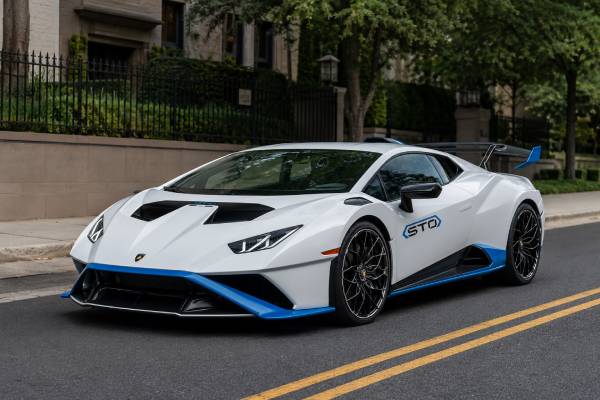
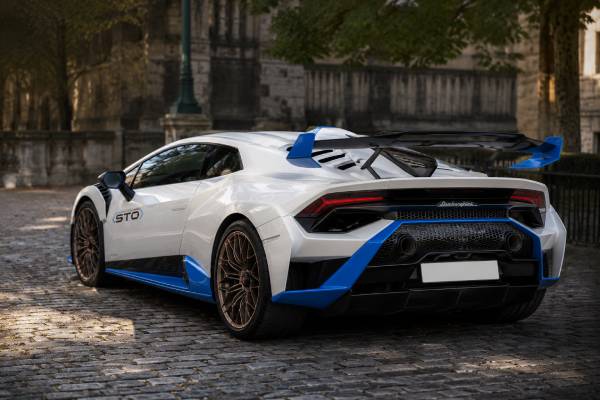
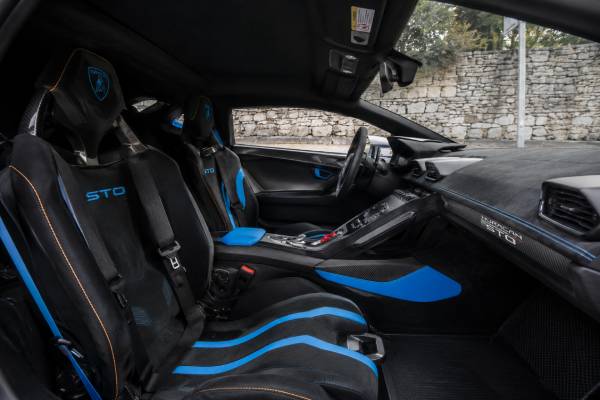
The Lamborghini Huracán STO is the most focused road-legal Huracán built around the naturally aspirated V10 formula. STO stands for Super Trofeo Omologata, and the point is clear: it brings the attitude of Lamborghini’s one-make Super Trofeo racers and GT3 program into a car that can still wear license plates. It is not the fastest Huracán in a straight line, and that is part of its character. The STO trades all-wheel-drive security and top-speed bragging for rear-wheel drive, reduced weight, serious aero, sharper steering, CCM-R brakes, and a cabin that feels closer to a pit lane than a boulevard. For buyers, it sits in a sweet spot: modern enough to use, raw enough to feel special, and likely to remain important as one of the final pure V10 Lamborghinis before the brand’s hybrid era.
Table of Contents
- Why the STO Matters in Huracán History
- V10 Specifications and Chassis Data
- Production Identity and Factory Options
- Aero, Lightweight Design, and Track Hardware
- How the STO Drives on Road and Track
- Maintenance Risks and Specialist Care
- Market Values and Buying Checks
Why the STO Matters in Huracán History
The Huracán STO matters because it is the most track-directed production Huracán and one of Lamborghini’s last naturally aspirated V10 road cars. It arrived after years of Huracán evolution, but instead of adding more comfort or electronics for broad appeal, Lamborghini made it lighter, louder, more aerodynamic, and more demanding.
The regular Huracán replaced the Gallardo and became Lamborghini’s junior mid-engine supercar line. Over its life, the Huracán family grew from the LP 610-4 into rear-wheel-drive models, Spyder versions, the Nürburgring-famous Performante, the EVO, the Tecnica, the Sterrato, and the STO. The STO sits near the sharp end of that family because it was built to connect the road car with Lamborghini Squadra Corse’s Huracán Super Trofeo and GT3 racing work.
Its timing also gives it extra significance. The car belongs to the closing chapter of Lamborghini’s non-hybrid V10 era. The brand’s next junior supercar direction moved toward electrification, which makes the STO feel like a final, concentrated version of the old recipe: a high-revving 5.2-liter V10, a dual-clutch gearbox, rear-wheel drive, a dramatic carbon-fiber body, and no electric assistance.
The STO is not a numbered special in the way a limited-run hypercar is. Its collectability comes from purpose, specification, and timing rather than a small engraved production cap. It is a car for buyers who want the most intense Huracán driving experience without stepping into a race-only Super Trofeo car.
Key reasons enthusiasts and collectors pay attention:
- It uses the 640 CV naturally aspirated V10 in a rear-wheel-drive layout.
- It deletes the Huracán Performante’s all-wheel-drive character and focuses more on driver feel.
- It uses extensive carbon fiber, including the front “cofango” body section.
- It has serious braking hardware with CCM-R carbon-ceramic discs.
- It is one of the most expressive factory Huracáns in sound, steering response, and visual drama.
- It represents the end of an era before Lamborghini’s V8 hybrid replacement strategy.
The STO also has a different reputation from the Huracán Performante. The Performante is famous for its active ALA aero system, all-wheel-drive traction, and lap-time credibility. The STO feels more like a road-legal track tool: more exposed, more physical, more visually aggressive, and more dependent on tire temperature, driver inputs, and setup quality.
V10 Specifications and Chassis Data
The important STO numbers are simple: 5.2-liter naturally aspirated V10, 640 CV, rear-wheel drive, 7-speed dual-clutch transmission, 0–100 km/h in 3.0 seconds, and a 310 km/h top speed. The top speed is lower than some other Huracáns because the STO carries more drag-producing aero, but its braking, downforce, response, and track stamina are the real story.
| Category | Specification |
|---|---|
| Model | Lamborghini Huracán STO, also known as LP 640-2 STO |
| Model code | LB724 |
| Production era covered | 2021–2024 registrations and model-year range, market dependent |
| Body style | Two-door fixed-roof coupe |
| Layout | Mid-engine, rear-wheel drive |
| Engine | 90-degree naturally aspirated V10 |
| Displacement | 5,204 cc |
| Induction | Naturally aspirated |
| Fuel system | Multi-point injection plus direct stratified injection |
| Power | 640 CV / 470 kW at 8,000 rpm |
| Torque | 565 Nm at 6,500 rpm |
| Gearbox | 7-speed Lamborghini Doppia Frizione dual-clutch automatic |
| Drivetrain | Rear-wheel drive with rear-wheel steering |
| Steering | Electromechanical power steering with fixed, direct ratio |
| Suspension | Magneto-rheological dampers |
| Brakes | CCM-R carbon-ceramic discs |
| Front brake discs | 390 mm x 34 mm |
| Rear brake discs | 360 mm x 28 mm |
| Front tires | 245/30 R20 Bridgestone Potenza Sport |
| Rear tires | 305/30 R20 Bridgestone Potenza Sport |
| Measurement | Figure |
|---|---|
| 0–100 km/h | 3.0 seconds |
| 0–200 km/h | 9.0 seconds |
| Top speed | 310 km/h |
| 100–0 km/h braking | 30 m |
| 200–0 km/h braking | 110 m |
| Length | 4,547 mm |
| Width, excluding mirrors | 1,945 mm |
| Width, including mirrors | 2,236 mm |
| Height | 1,220 mm |
| Wheelbase | 2,620 mm |
| Dry weight | 1,339 kg |
| Weight distribution | 41 percent front / 59 percent rear |
| WLTP combined fuel use | 13.85–13.9 L/100 km |
| WLTP CO2 | 331 g/km |
| EPA fuel economy, comparable U.S. Huracán 5.2 RWD listing | 15 mpg combined, 13 city, 18 highway |
The STO’s chassis is a hybrid aluminum and carbon-fiber structure, while the body uses aluminum and composite materials with carbon fiber over much of the outer skin. Dry weight is not curb weight, so a ready-to-drive car with fluids, fuel, options, and protection film will be heavier. Buyers should not compare Lamborghini dry weights directly with published curb weights from other brands.
The V10 is the emotional center. It is not turbocharged, so it builds power with revs rather than a sudden boost surge. The 8,000 rpm power peak and 6,500 rpm torque peak tell you how the car wants to be driven: keep it high in the rev range, let the gearbox work quickly, and use the final third of the tachometer where the engine becomes sharper and louder.
Production Identity and Factory Options
The STO was built as a focused coupe, not as a broad family with a Spyder or comfort-biased version. The main differences between cars come from market equipment, paint, livery, interior trim, carbon choices, telemetry, lift systems, and Ad Personam personalization.
Lamborghini did not position the STO as a simple trim package. The front bodywork, aero package, brakes, steering calibration, drive modes, lightweight interior approach, and rear-drive chassis make it a distinct Huracán variant. The car is usually identified by its STO badging, roof scoop, shark fin, large rear wing, single-piece front “cofango,” special bumpers, and race-style cabin details.
Model-year and market notes
The STO appeared during the final years of Huracán production, with some markets showing 2021 registrations and many market databases listing the model mainly from 2022 through 2024. This matters when comparing cars internationally. A European first-registration year, a U.K. registration year, and a U.S. model year may not line up perfectly.
For buyers, the exact build date and VIN matter more than the advertised year. Ask for:
- VIN and market of original delivery.
- Original window sticker or order sheet.
- Lamborghini dealer service history.
- Proof of recall completion where applicable.
- Factory build specification.
- Paint, livery, and Ad Personam documentation.
- Evidence of any track-day preparation or post-track inspection.
Factory identity points
A correct STO should feel and look different from a standard Huracán EVO or Tecnica. Important identifiers include:
- Rear-wheel-drive LP 640-2 layout.
- Large fixed rear wing with manual adjustment positions.
- Roof intake and dorsal shark fin.
- Carbon-fiber front cofango combining hood and fenders.
- Wheel-arch vents and aggressive front aero.
- CCM-R carbon-ceramic brakes.
- STO, Trofeo, and Pioggia drive modes.
- Lightweight interior trim with Alcantara and Carbon Skin.
- Optional or market-dependent titanium roll bar and harness setup.
Options that affect desirability
The STO market cares strongly about specification. A plain-looking car can be excellent to drive, but rare colors, strong factory liveries, and documented Ad Personam builds often draw more buyer attention.
Valuable or desirable equipment can include:
- Front axle lift, especially for city use and steep driveways.
- Lamborghini Connected Telemetry for track-focused buyers.
- Factory livery packs.
- Ad Personam paint or interior combinations.
- Exposed carbon details.
- Magnesium center-lock-style wheel appearance and correct wheel finish.
- Racing seats with desirable trim.
- Titanium roll bar and harnesses where legal and market-correct.
- Parking camera and sensors for usability.
- Full paint protection film if professionally installed and documented.
The best cars have a complete paper trail that proves what was factory, what was dealer-installed, and what was added later. This distinction matters because aftermarket exhausts, wraps, painted calipers, changed wheels, and non-factory carbon parts can change value. Some buyers love a modified STO, but collectors usually pay most for factory originality with tasteful protection, not irreversible changes.
Aero, Lightweight Design, and Track Hardware
The STO’s design is functional first: the wild shape exists to reduce weight, feed air, extract heat, add downforce, and make the car stable under hard braking and fast cornering. It looks theatrical, but most of the drama has a job.
The front cofango is the clearest example. The term blends “cofano” and “parafango,” meaning hood and fender. Instead of separate front panels, Lamborghini created a front section that integrates the hood, fenders, and related aero surfaces. This saves weight, improves access, and lets the front vents and ducts work as a single aero package.
Airflow management is everywhere. The front splitter helps generate ground effect. Hood ducts and louvers manage pressure and extract air from the wheelhouses. The roof scoop feeds cooler air toward the engine bay area. The shark fin improves stability, especially when the car is yawing in corners. The rear diffuser and large manually adjustable wing help tune rear downforce.
The STO does not chase the same aero philosophy as the Performante. The Performante’s ALA system used active aero to change airflow. The STO relies on a more visible fixed and manually adjustable layout, closer in spirit to a race car. That makes the car feel less like a hidden electronic trick and more like a machine wearing its engineering on the outside.
Lightweight choices
Lamborghini removed weight in several places, not just one. The body panels use more than 75 percent carbon fiber by area, and Lamborghini described a lighter carbon-fiber “sandwich” method for some components. The STO also uses a lighter windshield, magnesium wheels, reduced sound insulation, racing-style interior materials, and a titanium rear arch.
The result is a car that feels more immediate. Less soundproofing means more intake and tire noise. Less mass means more response when the driver turns in or brakes. The tradeoff is that the STO is less relaxed than a Huracán EVO, especially on rough roads.
Brake system and track intent
The CCM-R brakes are one of the STO’s defining pieces of hardware. They are carbon-ceramic discs developed with track use in mind, supported by dedicated cooling and a pedal setup intended to give consistent response. On the road, they can feel firm and serious. On track, they are meant to resist fade and provide repeatable stops.
The brake system is also one of the most important inspection areas. Replacement costs can be high, and casual buyers often underestimate the cost of discs, pads, tires, and alignment work after track use. A car with low mileage can still have heat-cycled brakes and tires if it spent those miles on circuit.
Interior character
Inside, the STO feels lighter and more purposeful than a regular Huracán. Carbon fiber appears across the cabin, Alcantara is common, and the driving position is low and focused. The optional roll bar and harness setup add a race-car feel, but they also affect comfort and usability.
This cabin is not crude, but it is not a luxury GT cabin either. The driver sees and feels the track mission through the seats, trim, sound, reduced insulation, and visibility over the low nose and wide front arches. The car still has modern infotainment and connectivity features, but the center of attention is the wheel, the paddles, the engine, and the road ahead.
How the STO Drives on Road and Track
The STO feels sharper, louder, and more rear-driven than the all-wheel-drive Huracáns. It rewards commitment and clean inputs, but it is still a modern Lamborghini with stability systems, drive modes, rear-wheel steering, fast shifts, and strong braking support.
The first thing most drivers notice is throttle response. Without turbochargers, the V10 responds crisply and builds intensity as revs rise. It does not deliver a huge low-rpm shove like a turbocharged supercar. Instead, it feels more mechanical and progressive. The reward comes when the engine is kept alive above the middle of the rev range, where the sound hardens and the car feels eager to chase the redline.
The 7-speed dual-clutch gearbox suits the engine well. In gentle driving, it can move through gears cleanly. In hard use, the shifts become quick and aggressive enough to match the car’s attitude. Paddle response is a major part of the experience because the engine wants frequent interaction.
Drive modes
The STO’s three main modes are specific to its mission:
- STO mode is the road setting. It is still lively, but it gives the car enough compliance and stability support for normal driving.
- Trofeo mode is the dry-track setting. It sharpens the car for lap work and lets the chassis feel more neutral and immediate.
- Pioggia mode is the wet setting. It softens the car’s behavior and helps the rear-wheel-drive platform find grip on slippery surfaces.
These modes matter because the STO is tire-sensitive. On cold tires or damp pavement, rear-drive traction can feel very different from an all-wheel-drive Huracán. Pioggia is not just a gimmick; it is useful when the road surface is cold, dirty, or wet.
Steering and balance
The STO replaced Lamborghini Dynamic Steering with a fixed, direct steering ratio. That gives the front end a cleaner, more predictable feel. The rear-wheel steering helps the car rotate at lower speeds and stay stable at higher speeds. Compared with a regular Huracán, the STO feels more alert and more willing to change direction.
The chassis balance is serious but not unfriendly. It has strong front response, a stable rear when the tires are warm, and a clear sense that aero and brake performance are part of the package. The driver feels more of the road surface, more of the tire, and more of the engine than in the softer Huracán variants.
Road usability
On the road, the STO is usable but not relaxed. The ride can feel busy on broken pavement, tire noise is noticeable, and the low carbon-fiber aero needs care. A front lift is valuable for real ownership. Parking visibility is manageable for a supercar, but the wide body, low nose, and expensive carbon panels make cameras, sensors, and patience important.
Highway driving is stable, but the car always feels awake. It is not the Huracán to buy if you want quiet long-distance comfort. It is the Huracán to buy if you want every short drive to feel like an event.
Track behavior
On track, the STO makes the most sense. The brakes, aero, seats, cooling, and modes all come together. It can handle repeated hard stops better than a normal road-biased supercar, and the rear-drive chassis gives the driver more involvement.
Even so, it is not a cheap track toy. A serious track day can consume tires, brake material, fuel, and service budget quickly. Heat, curbing, gravel, off-track debris, and rushed cooldown laps are the enemies. A well-driven and properly maintained STO can handle track work, but a poorly inspected used one can hide expensive wear behind low mileage.
Maintenance Risks and Specialist Care
The STO can be dependable by exotic-car standards, but only when maintained like a high-performance Lamborghini, not like a normal used coupe. The biggest risks are track wear, expensive consumables, carbon damage, brake condition, gearbox campaign history, tire age, battery health, and poor documentation.
The naturally aspirated V10 is generally respected because it is not a highly stressed turbocharged engine chasing huge boost. That does not make it low-maintenance. It still runs hot, uses expensive fluids and parts, and needs technicians who understand Lamborghini diagnostics, torque procedures, cooling systems, clutch adaptations, and electronic systems.
Known ownership watch points
Important areas to inspect include:
- Gearbox recall status: Certain Huracán EVO and 2022 STO vehicles were affected by a gearbox oil quantity recall. Confirm completion by VIN, not by seller memory.
- Dual-clutch behavior: Shifts should be clean, quick, and consistent. Hesitation, warnings, or clutch slip messages need specialist diagnosis.
- Carbon-ceramic brakes: Check disc condition, pad life, surface damage, heat marks, and service records.
- Tires: Verify age, correct size, even wear, heat-cycle history, and whether track tires were used.
- Front lift system: Check operation, leaks, compressor behavior, and warning messages.
- Magneto-rheological dampers: Look for leaks, uneven ride height, warning lights, and knocking.
- Cooling system: Inspect radiators and ducts for stone damage, leaks, clogged debris, and track rubber buildup.
- Underbody aero: Check splitters, undertrays, diffuser, and mounting points.
- Carbon body panels: Inspect the cofango, wheel arches, doors, rear wing, and diffuser for cracks, repairs, and paint mismatch.
- Battery and modules: Low battery voltage can trigger confusing electronic faults, especially on cars that sit.
- Infotainment and telemetry: Confirm screens, cameras, telemetry, connectivity, and software functions work as ordered.
Service reality
Service intervals and procedures must be verified from the owner’s service book and official documentation for the exact VIN, market, and equipment. As a practical ownership rule, an STO should have at least annual specialist attention even if mileage is low. Fluids age, tires age, batteries decline, seals dry out, and software updates can matter.
A strong maintenance file should show:
- Annual service entries from an authorized Lamborghini dealer or recognized specialist.
- Correct engine oil and filter services.
- Brake-fluid services at proper time intervals.
- Gearbox and driveline service evidence where required.
- Recall and campaign completion.
- Tire invoices with date codes and correct specifications.
- Alignment records after tire changes or track use.
- Pre-track and post-track inspections if the car was used on circuit.
- Battery tender use and battery replacement history.
Restoration and repair difficulty
The STO is too new to be a traditional restoration subject, but accident repair can already be a major issue. Carbon-fiber panel replacement, paint matching, aero alignment, sensor calibration, and suspension geometry all require the right shop. A small front impact can become a large repair because the cofango, splitter, ducts, and mounting hardware are specialized and expensive.
Avoid cars with vague accident stories. “Minor cosmetic repair” can mean very different things on a carbon-bodied supercar. A proper inspection should include paint-depth readings where useful, lift inspection, panel-gap review, underside photos, diagnostic scan, wheel and tire inspection, and confirmation that all aero parts are OEM or correctly documented.
Originality matters. Protective film is usually a positive if it was installed cleanly and removed or replaced without paint damage. Non-factory exhausts, ECU tunes, lowered suspension, aftermarket wheels, and aggressive track alignment can reduce collector appeal unless the car is priced accordingly and all original parts come with it.
Market Values and Buying Checks
The STO is still a modern used exotic, but it is already separating itself from ordinary Huracán values. In the current market, mileage, color, factory specification, condition, service history, and originality create large price gaps.
Public auction data and dealer listings have shown STOs trading or advertised from the low-$300,000 area into the mid-$400,000 range, with special low-mileage, highly optioned, or unusual-color cars listed higher. Some asking prices are ambitious, so treat active listings as negotiation signals, not guaranteed market value. Auction results, dealer asking prices, and private-sale numbers can differ sharply.
The STO’s long-term appeal looks strong because it combines several collector-friendly traits: final-era naturally aspirated V10, rear-wheel drive, track-focused engineering, aggressive factory aero, and a clear identity inside the Huracán line. The risk is that many examples were bought for the exact reason they exist: hard driving. A carefully used and documented track car can still be excellent, but hidden track wear should lower value.
What drives value
The strongest STOs usually have:
- Low but believable mileage.
- Full Lamborghini dealer or specialist service history.
- Original paint or documented factory paint.
- Desirable Ad Personam configuration.
- Factory livery rather than aftermarket wrap.
- Front lift and useful road equipment.
- Lamborghini Connected Telemetry for track-focused buyers.
- Clean carbon panels with no hidden repairs.
- No accident history.
- Complete books, keys, charger, tools, and factory accessories.
- VIN-confirmed recall completion.
- Sensible ownership story.
Color matters more than many buyers expect. Loud factory colors and high-contrast liveries fit the STO’s personality and often attract attention. Subtle colors can be appealing too, especially for buyers who want the shape without the full race-car look, but resale may depend on how well the specification suits the car’s character.
Cars to seek
The best buy is usually not the cheapest STO. Seek a car that has been driven enough to prove it works, but not abused. A 1,000-mile garage queen can still need tires, battery work, software updates, and recommissioning. A 7,000-mile car with annual service, fresh tires, clean diagnostics, and careful ownership may be the better driver’s car.
Good signs include:
- Dealer service records from new.
- Fresh matching tires with correct date codes.
- Clean diagnostic report.
- No warning lights or stored serious faults.
- Smooth gearbox behavior.
- Consistent brake feel.
- No carbon cracks around exposed edges.
- Original parts retained after any reversible modification.
- Clear paint-protection-film documentation.
- Independent inspection from a Lamborghini-experienced shop.
Cars to avoid
Be cautious with any STO that has stories instead of records. Avoid cars with unclear accident history, missing service entries, mismatched tires, worn carbon brakes, non-factory tuning, unresolved warning lights, or seller claims that cannot be checked.
Red flags include:
- “Track use unknown” on a car with rubber pickup, brake heat marks, and worn shoulder tread.
- Fresh wrap hiding paint condition.
- No recall confirmation.
- Dead or weak battery during inspection.
- Cheap replacement tires.
- Uneven panel gaps around the cofango or rear aero.
- Underbody scrape damage beyond normal light contact.
- Modified exhaust without original parts.
- Missing factory accessories or build documents.
- Seller resistance to a pre-purchase inspection.
Pre-purchase inspection sequence
Use a structured inspection process rather than a quick test drive.
- Verify VIN, market, build date, title status, and original selling dealer.
- Compare the car to its factory build sheet or window sticker.
- Confirm all service records and recall campaign completion.
- Scan all control modules with proper Lamborghini-compatible diagnostics.
- Inspect carbon panels, aero parts, underbody, suspension, brakes, wheels, and tires on a lift.
- Check front lift, drive modes, telemetry, cameras, screens, lights, and HVAC.
- Road test from cold and warm, listening for gearbox, suspension, brake, and engine issues.
- Price the car after estimating immediate needs such as tires, annual service, brake work, film replacement, or paint correction.
The ownership decision should be based on total risk, not just purchase price. A cheaper STO with worn brakes, old tires, missing records, and paintwork can quickly become more expensive than a better car bought at a higher price. For a collector, originality and documentation should lead the decision. For a driver, mechanical condition, tires, brake health, and setup quality matter most. The ideal STO has both.
References
- Lamborghini Huracán STO | Lamborghini.com 2024 (Manufacturer Specifications)
- Huracán STO Supercar | Lamborghini Abu Dhabi 2024 (Manufacturer Dealer Specification)
- Gas Mileage of 2022 Lamborghini Huracan 2022 (Fuel Economy)
- IMPORTANT SAFETY RECALL 2022 (Recall Notice)
- Lamborghini Huracán STO Market – CLASSIC.COM 2026 (Market Data)
Disclaimer
This article is for informational purposes only and is not a substitute for professional diagnosis, repair, appraisal, or inspection. Specifications, torque values, service intervals, approved fluids, repair procedures, recalls, and equipment can vary by VIN, market, model year, and factory options. Always verify details against official Lamborghini service documentation and have any prospective purchase inspected by a qualified Lamborghini technician.
If this guide helped you, please share it on Facebook, X/Twitter, or your favorite car community to support our work.