
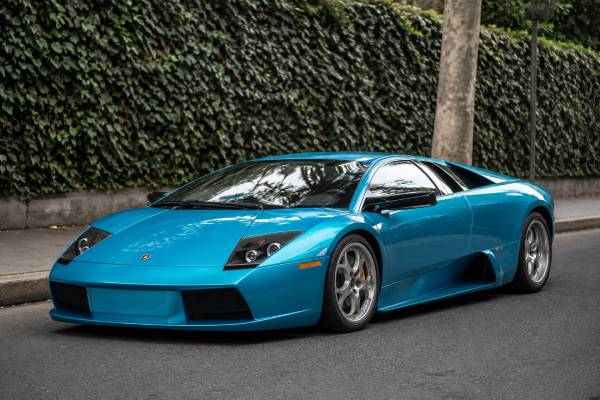
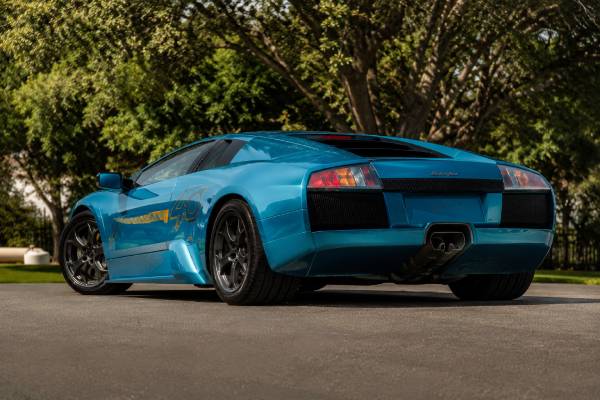
The Lamborghini Murciélago 40th Anniversary Edition is one of the most visually distinctive early Murciélagos and one of the clearest modern links between Lamborghini’s old-school V12 drama and its Audi-era engineering discipline. Built in 2003 to mark 40 years of Automobili Lamborghini, it kept the standard 6.2-liter naturally aspirated V12, all-wheel drive layout, scissor doors, and broad-shouldered L147 shape, but added a special Verde Artemis three-layer pearl finish, numbered plaques, carbon-fiber exterior details, unique interior trim, and a more collectible identity. Only 50 were built, which gives the car a different buying and ownership profile from a regular early Murciélago. It is not the fastest Murciélago, and it is not the most extreme, but it is one of the most elegant, analog, and historically meaningful versions. Buyers should treat it as a limited-production collector car first and a usable V12 supercar second.
Table of Contents
- Why the 40th Anniversary Murciélago Matters
- V12 Specs, Chassis, and Performance Data
- Production Details, Options, and Identification
- Design, Engineering, and Special Anniversary Features
- How the 6.2 V12 Murciélago Drives
- Maintenance, Reliability, and Restoration Risks
- Market Values, Buying Checks, and Collector Outlook
Why the 40th Anniversary Murciélago Matters
The 40th Anniversary Edition matters because it captures the first-generation Murciélago at its most collectible without changing the car’s core mechanical character. It is a limited, numbered celebration model from Lamborghini’s early Audi-ownership period, but it still feels rooted in the wild Countach and Diablo bloodline.
The Murciélago arrived for the 2002 model year as the replacement for the Diablo and as Lamborghini’s first all-new V12 flagship under Audi ownership. That context is important. The Diablo had charisma in huge supply, but it also came from a more chaotic era of Lamborghini development. The Murciélago kept the low, wide, mid-engine V12 theater, yet brought cleaner ergonomics, better cooling, improved assembly quality, and a more stable all-wheel-drive platform.
The 40th Anniversary Edition was introduced in 2003, exactly 40 years after Ferruccio Lamborghini founded the company in 1963. Lamborghini had already used anniversary editions to mark major brand moments: the Countach 25th Anniversary in 1988 and the Diablo SE30 in 1993. The Murciélago 40th Anniversary followed that pattern, but with a more restrained approach. It was not a lighter track model or a high-output special. It was a carefully specified commemorative edition based on the early 6.2-liter Murciélago coupé.
That gives it a specific personality. Later Murciélagos, especially the LP 640 and LP 670-4 SuperVeloce, are quicker and sharper. The 40th Anniversary car is more about purity, color, rarity, and the original L147 design. It carries the cleaner front and rear treatment of the first-series Murciélago, before the larger intakes and more aggressive LP 640 bodywork arrived.
For collectors, the car’s appeal rests on four pillars:
- it was limited to 50 numbered cars;
- it was tied directly to Lamborghini’s 40th anniversary;
- it used the early 6.2-liter naturally aspirated V12;
- it wore a unique Verde Artemis paint finish and model-specific trim.
For enthusiasts, the appeal is simpler: it is a manual-era, naturally aspirated V12 Lamborghini with scissor doors, a gated-shift character when so equipped, a dramatic cabin, and a design that still looks outrageous without needing modern aero clutter.
The 40th Anniversary Edition also sits at an interesting point in the brand’s timeline. It came before Lamborghini’s modern personalization explosion, before hybrid powertrains, before dual-clutch expectations, and before digital supercars became common. It is modern enough to be usable, but old enough to feel mechanical, loud, wide, and slightly intimidating.
V12 Specs, Chassis, and Performance Data
The 40th Anniversary Edition uses the same basic mechanical package as the early 6.2-liter Murciélago: a naturally aspirated 60-degree V12, all-wheel drive, and a six-speed transmission. Its value is mostly in the limited-edition specification, not in a major power upgrade.
| Category | Specification |
|---|---|
| Platform / internal code | L147 Murciélago |
| Body style | Two-door, two-seat coupé |
| Engine | 6.2-liter naturally aspirated Lamborghini V12 |
| Displacement | 6,192 cc |
| Configuration | 60-degree V12, quad cam, 48 valves |
| Power | 580 hp / 580 PS at 7,500 rpm |
| Torque | 650 Nm / 479 lb-ft at 5,400 rpm |
| Induction | Natural aspiration with variable intake geometry |
| Fuel system | Multi-point electronic fuel injection |
| Transmission | Six-speed manual or six-speed E-gear automated manual, market and car dependent |
| Drivetrain | Permanent all-wheel drive |
| Layout | Longitudinal mid-engine |
| Suspension | Independent double wishbones front and rear |
| Brakes | Ventilated steel discs with ABS |
| Steering | Power-assisted rack and pinion |
| Top speed | About 330 km/h / 205 mph |
| 0–100 km/h | About 3.8 seconds |
The engine is the star. Although heavily evolved by 2003, the Murciélago’s V12 belonged to the long-running Lamborghini V12 family that began with the company’s earliest grand tourers. In the Murciélago, it gained modern engine management, variable valve timing, a variable-geometry intake system, and drive-by-wire throttle control. Those systems helped broaden the torque curve and made the car more manageable than an older Countach or Diablo, while preserving the hard-edged V12 response that buyers expect.
The all-wheel-drive system gives the Murciélago a different feel from rear-drive supercars of the same era. It does not turn the car into something easy or compact, but it gives extra traction when the V12 is working hard. Early Murciélagos normally send most torque rearward, with the front axle helping when needed through the viscous coupling arrangement.
| Measurement | Approximate figure |
|---|---|
| Length | 4,580 mm / 180.3 in |
| Width | 2,045 mm / 80.5 in |
| Height | About 1,135–1,140 mm / 44.7–44.9 in |
| Wheelbase | 2,665 mm / 104.9 in |
| Curb weight | About 1,650 kg / 3,638 lb |
| Front / rear weight distribution | About 42 / 58 |
| Luggage capacity | About 140 liters / 4.9 cu ft |
The Murciélago is physically large, and that affects every part of the ownership experience. The width is more important than the acceleration figure in daily use. Narrow roads, old city centers, steep driveways, and underground garages demand patience. The nose lift system, where fitted, is valuable because the front overhang and low ride height are not forgiving.
The standard braking package uses steel discs rather than the later carbon-ceramic focus of many modern supercars. For collectors, that can be a benefit. Steel brakes are still expensive, but they are simpler to assess and usually less terrifying to replace than damaged carbon-ceramic rotors.
Production Details, Options, and Identification
The 40th Anniversary Edition was a 50-car limited series, so authenticity matters more than normal equipment choice. A correct car should have its numbered identity, anniversary trim, Verde Artemis paint, special interior details, and supporting documents.
Lamborghini built the edition for 2003 and sold cars mainly in Europe, the United States, and Japan. Every genuine example belongs to the early Murciélago coupé family, not the later LP 640 or Roadster line. The production count is the key fact: only 50 numbered cars were made.
Exterior identifiers
The most obvious identifier is the paint. The 40th Anniversary Edition used Verde Artemis, a jade-green, blue-green pearl finish with a three-layer effect. It can look more green, turquoise, or blue depending on light, which is part of the car’s appeal. A repaint can be very expensive to match correctly, and a poor repair will stand out under strong light.
Other exterior details include:
- 40th Anniversary side badging;
- carbon-fiber-look coating on the upper door moldings;
- carbon-fiber-look treatment around the rear-window pillar area near the fuel filler;
- anthracite gray wheels;
- silver-gray brake calipers;
- model-specific wheel center details;
- revised exhaust compared with the standard early Murciélago;
- numbered plaque visible inside the rear-window area.
The numbered plaque is especially important. A buyer should verify that the plaque, VIN, service records, registration history, and any factory or dealer documentation all tell the same story. A plaque alone does not prove a car is correct if the rest of the evidence is weak.
Interior identifiers
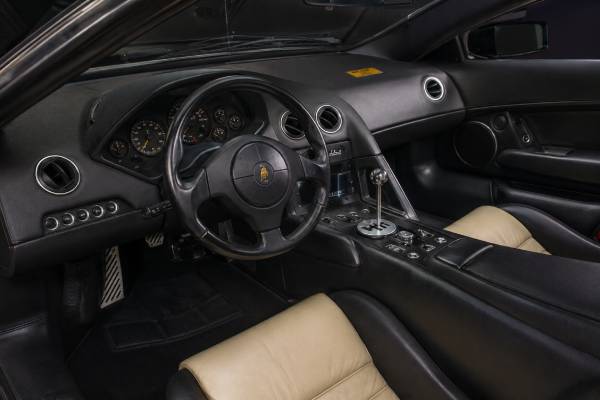
The cabin is more unusual than many people expect. Lamborghini used an asymmetrical interior treatment: the driver’s side was trimmed in Grigio Syrius dark gray perforated leather, while the passenger side used smooth black leather. This makes the car easy to recognize when compared with a standard Murciélago cabin, but it also creates restoration risk. Recreating the correct leather color, grain, perforation, stitching, and panel layout is not the same as retrimming a normal used supercar seat.
Typical special interior and accessory details include:
- 40th Anniversary floor mats;
- anniversary logo detailing;
- special leather treatment;
- Alpine radio with CD functionality;
- market-dependent navigation equipment on some cars;
- personalized certificate;
- signed carbon-fiber suitcase for the luggage compartment.
That suitcase is not a minor novelty. On a regular used car, missing luggage might not matter. On a 50-unit anniversary Lamborghini, missing factory accessories affect completeness and can influence buyer confidence. The same applies to books, tools, window sticker, import paperwork, service invoices, and ownership records.
Transmission and market differences
Early Murciélagos could be supplied with a traditional six-speed manual or Lamborghini’s E-gear automated manual system, depending on market, timing, and individual specification. Manual cars generally carry stronger collector demand because the gated shifter fits the early Murciélago’s analog character. E-gear cars can still be desirable when the example is correct, documented, and well maintained, but buyers should price clutch wear, system calibration, and future service needs carefully.
Factory options were limited compared with modern Ad Personam-era Lamborghinis. That makes originality more important than chasing a long option list. On a 40th Anniversary Edition, the best specification is usually the one that remains closest to how the car left Sant’Agata.
Design, Engineering, and Special Anniversary Features
The 40th Anniversary Edition works because the early Murciélago shape was already strong. The anniversary package adds color, texture, and identity without turning the car into a louder body-kit special.
Luc Donckerwolke’s Murciélago design had to replace the Diablo without softening Lamborghini’s flagship image. It kept the scissor doors, wedge stance, huge rear haunches, and cab-forward mid-engine proportions, but the surfaces were cleaner and more architectural than the Diablo’s. The result was dramatic but less messy. Two decades later, the first-generation Murciélago often looks purer than some later supercars because it does not rely on exposed aero blades, stacked lights, or extreme vents to make its point.
The car’s proportions come from its engineering. A large V12 sits longitudinally behind the cabin, and the transmission, driveline, cooling needs, and rear structure all demand space. The side intakes are not decoration. The shoulder-mounted active air intakes open when the car needs more cooling, giving the Murciélago one of its signature visual moments. The rear wing also adjusts automatically at speed to improve stability.
The anniversary exterior treatment highlights those shapes. Verde Artemis is not a simple bright green. It is a complex pearl color that suits the car’s flat planes and curved shoulders. In shade, it can look subtle; in sun, it gives the car a jewel-like finish. That is why paint quality matters so much. A 40th Anniversary car with mismatched panels loses some of the very thing that makes it special.
The carbon-fiber exterior details also matter, but buyers should understand the wording. The anniversary treatment includes carbon-fiber-effect or carbon-fiber-coated trim areas rather than a full lightweight carbon body conversion. The Murciélago body already uses a mix of materials, including carbon-fiber composite panels, steel roof structure, and aluminum doors. The special edition’s carbon-look trim is mainly an identity and appearance feature.
Inside, the Murciélago is far more usable than a Countach and less raw than a Diablo, but it still feels exotic. The driving position is low. The windshield is steeply raked. Rear visibility is limited. The center tunnel is high, and the controls are arranged around the driver in a way that feels more early-2000s analog than modern touchscreen. The exposed manual gate, when fitted, is one of the car’s most important emotional features.
The sound is central to the experience. The 6.2-liter V12 does not have the smoother digital polish of later supercars. It has a metallic idle, a hard intake voice, and a rising mechanical edge as revs build. The anniversary exhaust gives the special edition a slightly different tone from the standard car, but the real character comes from displacement, cylinder count, and the short distance between the engine and the cabin.
How the 6.2 V12 Murciélago Drives
The early Murciélago feels fast, wide, mechanical, and serious rather than effortless. It is not a small playful sports car; it is a big V12 flagship that rewards smooth inputs and punishes careless driving.
The engine dominates the first impression. At low rpm, the V12 is more flexible than older Lamborghini folklore might suggest. The variable intake and valve timing help the engine pull cleanly without needing constant high-rpm work. But the car comes alive as the revs rise. Above the middle of the tachometer, the engine hardens, the sound sharpens, and the Murciélago begins to feel much lighter than its size suggests.
A manual car delivers the most traditional experience. The clutch is not something to abuse in traffic, and the gated shifter responds best to deliberate, accurate movements. Rushed shifts can feel clumsy; well-timed shifts feel memorable. The gearbox is part of the event, not just a control. That is one reason manual Murciélagos have moved so strongly in the collector market.
E-gear changes the character. It can be exciting when driven hard, but it is less smooth at low speed and can wear the clutch quickly if used poorly. Creeping in traffic, reversing uphill, and repeated low-speed maneuvering are exactly the situations that hurt these single-clutch automated systems. A well set-up E-gear car can be enjoyable, but buyers should not judge it by modern dual-clutch standards.
The steering is heavy enough to remind you how much tire and car you are managing. Feedback is honest, but the Murciélago’s width always stays in your mind. On fast open roads it feels planted and stable. On narrow roads it can feel enormous. The all-wheel-drive system helps traction, especially when the road is cold or imperfect, but it does not remove the need for respect. This is still a mid-engine V12 car with serious mass and speed.
Ride quality is firm but not unbearable. Compared with modern track-focused supercars, an early Murciélago can feel surprisingly compliant on decent roads. Poor surfaces, sharp ramps, and broken city streets are a different matter. Wheel condition, tire age, alignment, suspension bushings, and damper health all have a major effect on how the car feels.
Braking performance is strong when the system is fresh. The important word is fresh. Old brake fluid, aged hoses, worn discs, tired pads, or a car that has sat unused can make the pedal feel worse than expected. A proper inspection should include brake age and condition, not only remaining pad thickness.
The cabin experience is intense. Heat, engine noise, tire noise, and limited visibility are part of the car’s charm and part of its challenge. It can cruise, and many owners use Murciélagos for road trips, but it is not relaxing in the way a modern grand tourer is. The reward is occasion. Every start, door swing, shift, and tunnel pull feels special.
Maintenance, Reliability, and Restoration Risks
A Murciélago can be durable when maintained correctly, but neglect becomes expensive quickly. The 40th Anniversary Edition adds a second layer of risk because rare trim, correct paint, and completeness matter as much as mechanical health.
The V12 itself is generally strong when serviced, warmed properly, and not modified badly. Problems usually come from age, heat, deferred maintenance, low use, poor storage, or unqualified repair work. A car with very low mileage is not automatically better if fluids, seals, hoses, tires, and hydraulic components have aged in place.
Key mechanical areas to inspect
A serious pre-purchase inspection should focus on the systems that create the highest repair exposure:
- clutch condition and engagement behavior;
- E-gear pump, actuator, calibration, and clutch wear reading if applicable;
- gearbox operation when cold and hot;
- coolant hoses, radiators, fans, and signs of overheating;
- oil leaks from engine, gearbox, and differential areas;
- front lift operation and hydraulic leaks if fitted;
- suspension bushings, dampers, ball joints, and alignment;
- brake discs, pads, calipers, hoses, and fluid age;
- power steering leaks;
- alternator, battery condition, and charging behavior;
- air-conditioning function;
- warning lights and diagnostic fault history.
Clutch replacement is one of the major cost events. On a Murciélago, clutch work is labor-intensive and may involve removing the engine assembly, so the bill can become large even before “while you are in there” items are added. Sensible owners often address seals, hoses, mounts, fluids, sensors, and access-dependent parts during the same service, which raises the invoice but can reduce future labor duplication.
Cooling health is also critical. A V12 Lamborghini creates a lot of heat, and any weakness in radiators, fans, hoses, expansion tanks, or bleeding procedure can turn into a serious problem. Buyers should look for stable operating temperatures, clean coolant, no dried residue around hose joints, and invoices showing preventive cooling work.
Body, paint, and trim risks
The body inspection is not just about accident damage. On this model, paint originality and repair quality are major value factors. Verde Artemis is difficult to reproduce perfectly because of its pearl effect. A panel that looks acceptable indoors may mismatch in direct sun. Inspect the car under multiple lighting conditions and check panel edges, jambs, bumper covers, and lower surfaces.
Carbon-fiber trim and anniversary-specific pieces should be checked carefully. Damaged or missing special trim may be hard to source, and recreating it can create authenticity questions. The same applies to the interior. The asymmetrical leather layout, correct floor mats, plaques, certificate, luggage, books, tools, and stereo/navigation details all affect collector confidence.
Accident damage is a major concern on any low, wide supercar. Look for:
- uneven panel gaps;
- repaint lines around doors, intakes, and rear quarters;
- repaired undertrays;
- scraped front bumper undersides;
- cracked wheel lips;
- incorrect fasteners;
- missing factory labels;
- inconsistent carbon trim finish;
- suspension alignment that cannot be brought into spec.
A car that has had careful cosmetic correction after a minor scrape is not necessarily bad. A car with vague stories, missing records, or signs of structural repair should be priced very differently.
Service rhythm and storage
Annual servicing is wise even when mileage is low. Engine oil, brake fluid, clutch hydraulic fluid, coolant age, tires, belts, filters, and battery health matter more than odometer readings alone. These cars dislike being ignored. A collector car that is started, warmed, driven, serviced, and stored correctly will often be healthier than a lower-mile example that sits for years.
For long-term ownership, budget for preventive maintenance rather than only repairs. The cheapest way to own a Murciélago is usually to buy a properly maintained car at a strong price, not a weak car at a discount.
Market Values, Buying Checks, and Collector Outlook
The 40th Anniversary Edition now trades as a collector Murciélago, not just as an early used Lamborghini. Rarity, manual-transmission demand, completeness, paint quality, and documentation can matter more than small mileage differences.
Market data moves, but the pattern is clear: early manual Murciélagos command serious attention, and the 40th Anniversary Edition sits above ordinary first-series cars because of its 50-unit production run and unique specification. Public sales have shown strong results for documented low-mile cars, with exceptional examples reaching well into the modern collector-supercar range. Asking prices for regular Murciélagos can vary widely, but a correct 40th Anniversary car should be evaluated against other limited Murciélagos and manual V12 collector cars, not against tired base examples.
| Value factor | Why it matters |
|---|---|
| Original Verde Artemis paint | The color is central to the edition’s identity and difficult to match after repair. |
| Numbered plaque and documentation | Confirms the car’s limited-edition identity and helps avoid clone or story-car risk. |
| Manual transmission | Usually attracts the strongest collector demand and best analog driving appeal. |
| Complete accessories | Certificate, books, tools, floor mats, and carbon-fiber luggage strengthen provenance. |
| Service history | Detailed invoices prove care better than stamp-only records. |
| Low but usable mileage | Collectors like low mileage, but mechanical health still depends on use and maintenance. |
| No accident history | Structural or poor cosmetic repair can seriously reduce confidence and value. |
| Correct interior trim | The asymmetric anniversary cabin is difficult and expensive to restore accurately. |
A buyer should start with identity before condition. Confirm the VIN, plaque number, paint, interior, market delivery, and documents. Then assess mechanical condition. Many buyers do this backward: they fall in love with the color, drive the car, then discover missing accessories, old repairs, or weak paperwork. With a 50-unit car, that is a mistake.
Pre-purchase inspection checklist
Use a Lamborghini specialist who knows Murciélagos, not just a general exotic-car shop. The inspection should include:
- Verify VIN, numbered plaque, title history, and factory/dealer records.
- Confirm Verde Artemis paint quality with paint-depth readings and visual inspection in natural light.
- Check for accident repair, underbody damage, bumper scrapes, and suspension repair.
- Read diagnostic faults and, on E-gear cars, clutch wear and system data.
- Road-test from cold and hot, including shift quality, clutch behavior, braking, steering, and cooling stability.
- Inspect radiators, hoses, fans, fluid leaks, lift system, brakes, tires, and suspension joints.
- Confirm books, tools, certificate, luggage, floor mats, stereo/navigation equipment, and service invoices.
- Price upcoming maintenance realistically before negotiating.
Cars to seek are easy to describe and hard to find: original paint where possible, complete anniversary equipment, clear ownership history, recent specialist service, matching documentation, and no excuses. Cars to avoid are the ones with missing plaques, unexplained repainting, non-original interior changes, poor E-gear behavior, neglected fluids, patchy imports, or sellers who cannot explain the car’s history.
The long-term outlook is favorable because the car has several traits collectors consistently reward: limited production, naturally aspirated V12 power, Lamborghini flagship status, distinctive factory color, early Murciélago purity, and an anniversary story. The risks are cost and selectivity. Buyers at this level are becoming more informed, and weak examples will not rise equally with strong ones.
For an owner who wants the fastest Murciélago, an LP 640 or LP 670-4 SV makes more sense. For an owner who wants one of the most elegant and historically tied Murciélagos, the 40th Anniversary Edition is the more nuanced choice. Its best use is not heavy commuting or speculative storage. It is occasional, careful, documented driving, backed by preventive maintenance and preservation of every special detail that makes the car more than a normal 6.2.
References
- Lamborghini Murciélago: the first V12 engine of the new millennium 2022
- Used Lamborghini Murciélago – Buy Certified | Lamborghini.com 2026
- Lamborghini Murcielago 40th Anniversary Edition (2003) – pictures, information & specs 2003
- Lamborghini Murcielago 6.2 V12 48V (580 Hp) /Coupe 2001 2001
- Check for Recalls: Vehicle, Car Seat, Tire, Equipment | NHTSA 2026 (Recall Database)
Disclaimer
This article is for informational purposes only and is not a substitute for professional diagnosis, repair, appraisal, or inspection. Specifications, torque values, service intervals, repair procedures, equipment, recall applicability, and market details can vary by VIN, market, production date, and individual vehicle history. Always verify details against official Lamborghini service documentation, factory records, recall tools, and a qualified Lamborghini specialist before buying, repairing, or restoring a Murciélago.
If this guide helped you, please share it on Facebook, X/Twitter, or your favorite car community to support our work.