
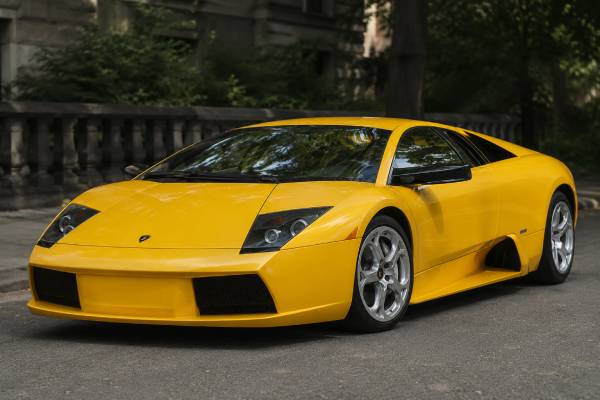
The Lamborghini Murciélago 6.2 is the bridge between the wild analog Diablo era and the more disciplined Audi-backed Lamborghini that followed. Built from 2001 to 2006 before the LP640 update took over, it kept the classic mid-mounted V12 drama, scissor doors, brutal stance, and low-slung cabin that made Lamborghini famous, but added better build quality, improved ergonomics, and a more usable all-wheel-drive chassis. It is still a demanding exotic, not a casual supercar, yet that is a large part of its appeal.
For buyers, the early Murciélago matters because it combines the original 6.2-liter V12, the cleanest Luc Donckerwolke design, and the possibility of a gated manual gearbox. For enthusiasts, it remains one of the defining supercars of the early 2000s: loud, wide, theatrical, fast, and unmistakably Lamborghini.
Table of Contents
- Why the 6.2 Murciélago Still Matters
- V12 Specs, Chassis, and Performance Data
- Coupe, Roadster, Options, and Identification
- Design, Engineering, and Signature Details
- What the Early Murciélago Feels Like to Drive
- Maintenance, Weak Points, and Ownership Reality
- Market Values and Buying Checklist
Why the 6.2 Murciélago Still Matters
The first-generation Murciélago matters because it was Lamborghini’s first all-new V12 flagship after Audi took control of the company. It replaced the Diablo, kept the old-school V12 supercar formula alive, and showed how Lamborghini could become more usable without losing its sense of danger and theater.
Launched in 2001 for the 2002 model year in many markets, the Murciélago sat at the top of Lamborghini’s range above the smaller Gallardo, which arrived later. The car was not a reinvention of the brand’s identity. It was a careful modernization of it. The layout stayed familiar: a naturally aspirated V12 behind the cabin, dramatic scissor doors, two seats, a very wide body, and performance that still felt extreme even next to Ferrari’s 550 Maranello, Porsche’s 911 Turbo, and later the Ferrari 575M.
The project code L147 is often used by specialists and parts suppliers to identify the Murciélago family. The early 6.2-liter cars are usually called simply “Murciélago,” not LP580-4 in normal factory naming, even though some registries and sellers use LP580-4 as a descriptive shorthand. The later LP640 brought a larger 6.5-liter engine, revised styling, bigger brakes, and more power, but the 2001–2006 car has its own appeal because it is the original form of the model.
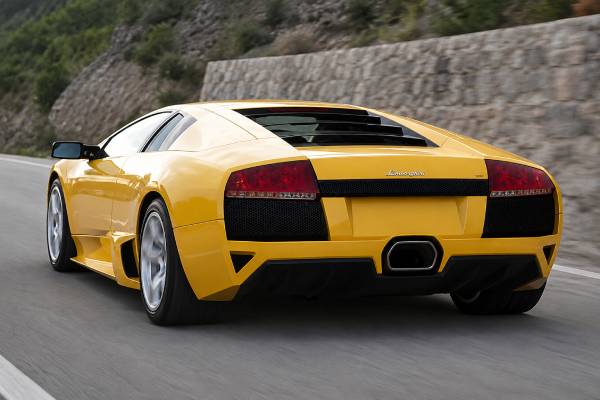
Luc Donckerwolke’s design gave the car a cleaner and more geometric look than the Diablo. It was still outrageous, but it looked less patched together and more architectural. The proportions were pure Lamborghini: a short nose, huge cabin-forward windshield, deep side intakes, broad rear haunches, and a low roofline. The movable rear intakes became one of the car’s signature details, opening like mechanical gills when cooling demand increased.
Collectors now view the 6.2 Murciélago through two lenses. The first is emotional: it is one of the last Lamborghinis that still feels deeply connected to the Countach and Diablo line. The second is market-driven: gated manual examples have become much more valuable than e-gear cars because the manual gearbox gives the V12 experience a physical, mechanical quality that modern supercars rarely offer.
The Murciélago also marked the beginning of Lamborghini’s modern production confidence. It was better finished than the Diablo, more stable at speed, easier to use in traffic, and more consistent from car to car. Yet it remained huge, hot, loud, expensive to maintain, and intimidating on narrow roads. That mix is exactly why it still draws attention from collectors, owners, and fans.
V12 Specs, Chassis, and Performance Data
The core specification is simple: a 6.2-liter naturally aspirated Lamborghini V12, all-wheel drive, a six-speed gearbox, and around 580 metric horsepower. The important detail is that the Murciélago delivers those numbers through a hand-built exotic-car platform, not a mass-market performance-car layout.
| Category | Specification |
|---|---|
| Model code | L147 |
| Production focus | First-generation Murciélago coupe and 6.2 Roadster |
| Engine | 60-degree naturally aspirated V12 |
| Displacement | 6,192 cc / 6.2 liters |
| Valvetrain | DOHC, 48 valves |
| Induction | Naturally aspirated with multi-point fuel injection |
| Power | 580 PS / about 572 bhp / about 426–427 kW |
| Torque | 650 Nm / about 479 lb-ft |
| Transmission | Six-speed manual; six-speed e-gear automated manual on later cars and Roadster |
| Drivetrain | Permanent all-wheel drive with viscous center coupling |
| Suspension | Independent double wishbones front and rear |
| Brakes | Ventilated discs with ABS; early cars used steel brakes |
| Tires | 245/35 ZR18 front, 335/30 ZR18 rear |
| Wheelbase | 2,665 mm |
| Length | 4,580 mm |
| Width | 2,045 mm |
| Height | About 1,135–1,140 mm depending on source and measurement method |
| Curb weight | About 1,650 kg for the coupe |
| Fuel capacity | About 100 liters |
The V12 is the heart of the car. It traces its family line to Lamborghini’s long-running twelve-cylinder architecture, but in Murciélago form it was enlarged, electronically managed, and packaged for a more refined flagship. The engine uses dry-sump lubrication, which helps oil control during hard cornering and allows the engine to sit lower than a conventional wet-sump design would permit.
Most specification sheets list peak power at 7,500 rpm and torque at 5,400 rpm. Some manufacturer history material presents the output as 580 CV at a slightly different rpm, which is common when older factory data is republished across markets. For buyers, the exact rpm wording matters less than condition, compression health, service history, and correct running behavior.
The gearbox choice strongly affects desirability. The gated manual is the collector favorite because it gives the Murciélago a direct mechanical connection: clutch pedal, open metal gate, and a long lever movement. The e-gear automated manual offers paddle shifting but is not a modern dual-clutch gearbox. It still uses a single-clutch mechanical transmission, with hydraulic and electronic actuation doing the clutch and shift work.
Performance remains serious. The coupe is commonly quoted at about 3.8 seconds from 0–100 km/h and around 330 km/h at the top end. Real-world acceleration depends heavily on tires, clutch condition, launch technique, road surface, and driver sympathy. A tired clutch, old tires, or poorly maintained e-gear system can make the car feel far slower and harsher than the figures suggest.
The chassis is a high-strength steel tubular structure with carbon-fiber body panels and metal sections where needed. This gives the car more rigidity and production consistency than the Diablo, while still keeping a hand-built exotic feel. The suspension uses double wishbones, anti-roll bars, and coil-over dampers. Steering is hydraulic, not electric, which helps give the car the weight and feedback many modern cars lack.
Coupe, Roadster, Options, and Identification
The coupe is the purest and most collectible form of the 6.2 Murciélago, especially with a gated manual. The Roadster is rarer, more theatrical, and more open-air, but it brings added complexity, extra chassis reinforcement, and a roof system that demands careful inspection.
The early Murciélago coupe arrived first and carried the cleanest version of the design. It has the original front and rear styling, 18-inch wheels, steel brake setup, large side intakes, and the active rear cooling intakes that open automatically. The later LP640 looks related but is easy to distinguish by its revised front bumper, different rear treatment, larger central exhaust outlet, and 6.5-liter engine.
The Roadster appeared after the coupe and used the same 6.2-liter V12. It was designed more as an open supercar than a comfortable convertible. The roof is a temporary fabric panel rather than a fast, power-operated luxury convertible top. With the roof fitted, the car has a recommended speed limitation, so owners should treat the Roadster as a car meant to be driven open whenever possible.
Key 6.2 Murciélago versions and identifiers include:
- Early coupe: the original form, usually most desirable when manual, low-mileage, and unmodified.
- Later 6.2 coupe with e-gear option: easier to find than manuals in some markets, but less collectible unless condition and history are exceptional.
- Roadster: visually dramatic and rarer, with special rear bodywork, removable roof panel, and added chassis bracing.
- 40th Anniversary edition: a limited special series from the 6.2 era, most recognized by Verde Artemis paint, special trim, and numbered presentation.
- Market-specific cars: lighting, emissions equipment, bumper details, speedometer units, and documentation can vary by market.
Factory options were not as wide-ranging as later Lamborghini Ad Personam builds, but specification still matters. Desirable features can include special paint, contrasting stitching, carbon-fiber interior trim, engine-bay carbon details, navigation on later cars, front axle lift, upgraded audio, and documented factory personalization.
Authenticity is important because many Murciélagos have been modified. Common changes include aftermarket exhausts, LP640-style bumpers, aftermarket wheels, stereo changes, carbon interior pieces, lowered suspension, and cosmetic updates. Some changes improve usability or sound, but they can hurt value if original parts are missing.
A buyer should confirm the following before treating a car as a top-tier collector example:
- VIN, engine number, gearbox details, and market specification match the paperwork.
- Factory color and interior match build records, service book, or heritage documentation.
- The car has its manuals, tools, keys, service invoices, and recall/service-campaign records.
- Any aftermarket exhaust, wheel, brake, or body change is reversible.
- Paint readings support the seller’s claims about accident history.
- The clutch, e-gear system, suspension, and cooling system have recent specialist documentation.
Matching-numbers thinking is different for a modern Lamborghini than for a 1960s classic, but originality still matters. A car with its original drivetrain, original color, complete books, clean history, and known ownership chain will always be easier to sell than a repainted, modified, undocumented example.
Design, Engineering, and Signature Details
The Murciélago looks dramatic because its design is functional, not just decorative. The wide body, side openings, low nose, active intakes, and compact cabin all serve the needs of a mid-engine V12 car that must cool itself at high speed and still look like a Lamborghini.
Luc Donckerwolke’s shape is sharper and calmer than the Diablo’s. The Diablo had grown through years of updates, spoilers, vents, and market changes. The Murciélago reset the form with a cleaner wedge, a smoother nose, and a more integrated rear. The result is a car that still looks modern because it avoids unnecessary clutter.
The scissor doors are more than a party trick. They are part of Lamborghini’s V12 identity, dating back to the Countach. On the Murciélago, they also help in tight spaces because the doors lift upward rather than swinging far outward, although the car’s huge width still makes parking and garage access stressful.
The active rear side intakes are among the car’s best details. They sit flush with the body at rest and open when the car needs more cooling air. Visually, they make the Murciélago feel alive, almost like a machine reacting to its own heat and speed. Mechanically, they remind the driver that the V12 generates enormous thermal load.
The rear wing is also active, adjusting position at speed to balance drag and stability. This is not the same kind of aggressive active aero used in modern track-focused supercars, but for the early 2000s it gave the Murciélago useful high-speed stability while preserving the clean body shape.
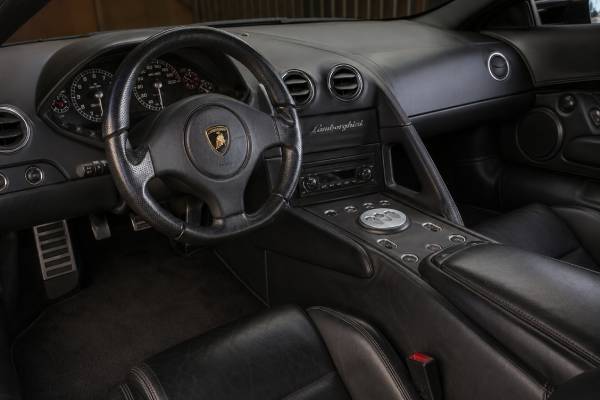
Inside, the cabin is more rational than a Diablo’s. The driving position is still low and offset by modern standards, but the controls are easier to understand, the materials are better, and the layout is less chaotic. The central tunnel is high, the windshield is steeply raked, and rear visibility is limited. The cabin feels special because it places the driver deep inside the car, close to the front axle line, with the V12 just behind the seats.
The exhaust and intake character define the emotional side of the car. At low rpm, the 6.2 V12 has a deep, mechanical idle. As revs rise, the sound hardens into a sharp metallic wail. Aftermarket exhausts are common, but the best setups keep the tone clean rather than turning the car into a droning, over-loud street spectacle.
The engineering is unusual by normal-car standards but logical for a flagship Lamborghini. The V12 is mounted longitudinally, the drivetrain sends power to all four wheels, and the car relies on huge rear tires for traction. The result is more stable than a rear-drive Diablo but still very physical. It does not shrink around the driver the way a smaller sports car does. It feels like a large, powerful machine that expects respect.
What the Early Murciélago Feels Like to Drive
The early Murciélago feels fast, wide, heavy in its controls, and intensely mechanical. It is easier to drive than a Diablo, but it is not an easy car in the modern sense; its size, heat, clutch weight, visibility, and running costs are always present.
The engine dominates the experience. Below the midrange, the V12 is tractable and smoother than its reputation suggests. Above that, it becomes urgent and increasingly dramatic. The car does not rely on turbo boost or hybrid torque. It builds speed through displacement, revs, gearing, and noise. That makes the acceleration feel progressive at first, then very serious once the engine is fully awake.
Manual cars reward patience. The gated shifter feels best when the oil is warm and the driver uses deliberate movements. Rushing cold shifts is a mistake. The clutch can be heavy in traffic, and careless launches shorten clutch life quickly. A well-driven manual Murciélago is deeply satisfying because every shift feels like an event.
E-gear cars need a different mindset. The system is not as smooth as a modern dual-clutch gearbox, especially at low speeds. It can feel abrupt during parking maneuvers and stop-start traffic. On open roads, it makes more sense, especially when the driver lifts slightly during shifts or drives with mechanical sympathy. A properly set up e-gear car is enjoyable, but a poorly maintained one can feel jerky, expensive, and frustrating.
Steering is heavy at low speed and more natural once moving. The front end is not nervous. It has a planted, stable character, helped by all-wheel drive and a long wheelbase. The car prefers flowing roads over tight, narrow lanes. On mountain roads, the driver must place the car carefully because the width is the biggest limitation.
Braking performance is strong when the system is fresh, but the pedal feel and endurance depend heavily on pad condition, fluid age, disc condition, and tire quality. Old tires are a serious problem on these cars. A Murciélago on aged rubber can feel vague, harsh, and unpredictable; on fresh correct-size performance tires, it feels much more composed.
Ride quality is firm but not unbearable. The car was built before ultra-stiff modern track packages became fashionable, so it can cover distance better than many people expect. The challenge is not only ride comfort. It is the full ownership environment: cabin heat, attention from other drivers, low ground clearance, fuel use, parking anxiety, and the constant awareness that small mistakes can be expensive.
On track, the Murciélago is exciting but not cheap to run. It is heavy, powerful, and hard on consumables. Brake fluid, tires, clutch condition, cooling performance, and gearbox behavior must all be watched closely. It is better as a fast road car and occasion machine than as a regular track-day tool.
Maintenance, Weak Points, and Ownership Reality
A Murciélago is not unreliable in a simple sense; it is an aging exotic that punishes neglect. The best cars are usually those maintained by recognized Lamborghini specialists, used regularly enough to stay healthy, and kept close to factory specification.
The V12 itself is strong when serviced correctly, but access is difficult and labor is expensive. Oil leaks, coolant leaks, aged hoses, tired sensors, brittle wiring connectors, and heat-related deterioration are common ownership concerns as cars pass the 20-year mark. A car that has covered very few miles can still need major recommissioning if it sat unused for long periods.
The clutch is one of the most important inspection points. Manual cars can wear clutches through poor technique, repeated hard launches, or city use. E-gear cars can consume clutches faster if the system is misadjusted, used heavily in traffic, or driven without understanding the single-clutch behavior. A pre-purchase inspection should include clutch wear data where available and a specialist road test.
Cooling system health is critical. The Murciélago produces a lot of heat, and blocked radiators, old coolant, weak fans, leaking hoses, or poor bleeding can become expensive quickly. The active side intakes should operate correctly, and the car should hold stable temperatures in traffic and after hard driving.
Important ownership checks include:
- Clutch and gearbox: confirm clutch wear, engagement quality, shift behavior, and e-gear hydraulic function if fitted.
- Cooling system: inspect radiators, hoses, expansion tank, fans, thermostat behavior, and signs of overheating.
- Suspension: check dampers, bushings, ball joints, alignment, lift system operation, and uneven tire wear.
- Brakes: inspect disc thickness, cracks, caliper condition, brake lines, ABS function, and fluid service history.
- Electrical systems: test windows, locks, dashboard lights, HVAC, alarm, battery drain, and engine-management faults.
- Body and structure: look for accident repairs, underbody damage, cracked carbon panels, poor repainting, and mismatched panel gaps.
- Interior: check sticky switchgear, leather shrinkage, worn bolsters, loose trim, and non-original audio or navigation changes.
Parts availability is better than for many older exotics, but prices are high and some trim or body parts can take time to source. Used parts exist, but buyers should be cautious with unknown electronic modules, damaged carbon panels, or parts removed from crash cars.
Recalls and service campaigns should be checked by VIN. Lamborghini notes that recall repairs do not expire and should be completed by an authorized dealer if the car is affected. Because recall applicability depends on build date, market, VIN, and equipment, never assume a Murciélago is covered or not covered based only on model year.
Restoration is possible but expensive. A rough Murciélago can easily become a bad financial decision if it needs paint correction, clutch work, suspension renewal, interior repair, cooling-system work, and electrical diagnosis at the same time. The cheapest car to buy is rarely the cheapest car to own.
Originality versus upgrades is a real decision. A tasteful exhaust, modern tire fitment in the correct sizes, and carefully maintained mechanical upgrades can make the car better to use. But irreversible body kits, missing factory parts, non-factory paint, unknown tuning, or poorly installed electronics can hurt both reliability and resale value.
Market Values and Buying Checklist
The 6.2 Murciélago market now rewards originality, manual gearboxes, low mileage, desirable colors, and complete history. E-gear cars remain more accessible, but the gap between average cars and outstanding manual examples has widened sharply.
As of 2026, public market data shows driver-quality early Murciélagos commonly sitting in the low-to-mid six-figure range, while clean manual coupes with desirable colors and low mileage can climb far higher. Asking prices for exceptional manual cars can reach well beyond ordinary valuation-guide numbers, especially when the car has low miles, original paint, strong documentation, and a known specialist history. Roadsters add rarity and drama, but condition and roof-related completeness matter more than the open body style alone.
Do not buy only by mileage. A 4,000-mile car that sat for years may need more immediate spending than a 20,000-mile car with continuous specialist service. Likewise, a modified low-mile car may be less desirable than a higher-mile original car with complete records.
| Value factor | Why it matters |
|---|---|
| Manual gearbox | The gated manual is the strongest collector driver and usually commands a major premium. |
| Original paint and panels | Accident repairs are costly and can permanently reduce confidence. |
| Service history | Specialist invoices prove the car was maintained, not merely stored. |
| Color combination | Bold period Lamborghini colors can be more desirable than plain resale-safe specs. |
| Completeness | Books, tools, keys, covers, original parts, and factory accessories support value. |
| Clutch and e-gear condition | Major drivetrain work can change the real cost of a car immediately. |
| Modifications | Reversible upgrades are acceptable; irreversible cosmetic changes are risky. |
A serious pre-purchase inspection should be done by a Lamborghini specialist who knows the Murciélago specifically, not just a general exotic-car shop. The inspection should include cold start, hot restart, diagnostic scan, lift inspection, paint meter readings, road test, clutch assessment, brake inspection, cooling-system check, suspension check, and verification of service records.
Seek cars with:
- documented annual or mileage-based servicing;
- recent fluids, tires, battery, and brake maintenance;
- no warning lights or hidden diagnostic faults;
- clean underbody and front-lift operation;
- original books, tools, keys, and factory parts;
- stock bodywork or fully reversible upgrades;
- no stories around title, mileage, accident history, or import paperwork.
Avoid cars with:
- missing service history;
- suspiciously fresh paint without explanation;
- poorly fitted LP640-style conversions;
- unknown aftermarket electronics;
- clutch slip, rough e-gear behavior, or transmission warnings;
- overheating, coolant smell, or fan issues;
- old tires, weak brakes, or neglected suspension;
- seller resistance to a specialist inspection.
Long-term collectability looks strong for the early Murciélago because it represents a clear moment in Lamborghini history. It is the first Audi-era V12 flagship, the last clean pre-LP640 body style, and one of the last flagship Lamborghinis available with a true manual gearbox. The safest buy is not the cheapest example. It is the car with the best combination of originality, mechanical health, documentation, and specification.
For an enthusiast, the 6.2 Murciélago is about sound, shape, width, heat, effort, and drama. For a collector, it is about provenance, gearbox, color, and condition. The best examples satisfy both sides: they feel alive to drive and remain correct enough to preserve.
References
- Lamborghini Murciélago: the first V12 engine of the new millennium 2022 (Manufacturer History)
- Recall Campaign | Lamborghini.com 2026 (Recall Lookup)
- Search Safety Issues | NHTSA 2026 (Recall Database)
- Lamborghini Murcielago 6.2 V12 48V (580 Hp) | Technical specs, data, fuel consumption, Dimensions 2026 (Specifications)
- 2002 Lamborghini Murcielago Base | Hagerty Valuation Tool® 2026 (Valuation Guide)
Disclaimer
This article is for informational purposes only and is not a substitute for professional diagnosis, repair, inspection, valuation, or legal advice. Specifications, torque values, service intervals, recall status, procedures, and parts compatibility can vary by VIN, market, production date, equipment, and later updates. Always verify details against official Lamborghini service documentation, authorized dealer records, and a qualified Lamborghini specialist before buying, repairing, restoring, or modifying a Murciélago.
If this guide helped you, please consider sharing it on Facebook, X/Twitter, or your favorite car community to support our work.