
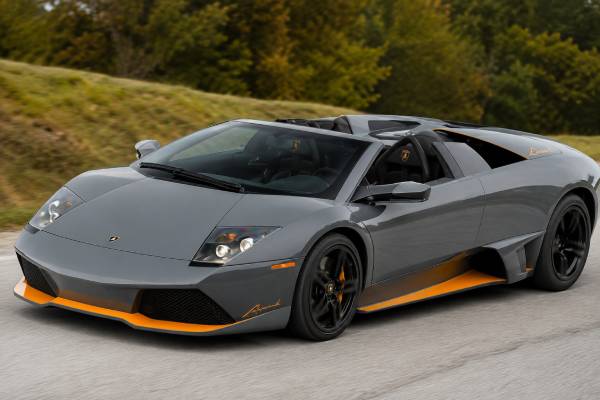
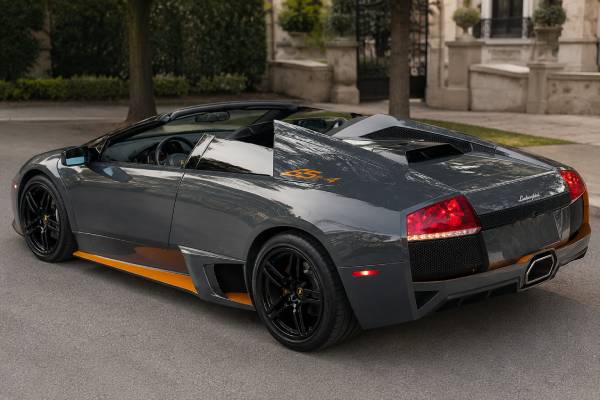
The Lamborghini Murciélago LP 650-4 Roadster is one of the rarest open V12 Lamborghinis of the modern era. Built as a 50-car limited edition near the end of Murciélago production, it combined the drama of the LP 640 Roadster with a small power increase, a fixed visual identity, and the last-generation feel of Lamborghini’s pre-dual-clutch flagship. It is not the lightest Murciélago, the most track-focused, or the most technically advanced, but that is part of its appeal. It is a loud, wide, naturally aspirated, all-wheel-drive roadster with scissor doors, a removable roof panel, and a 6.5-liter V12 mounted longitudinally behind the cabin. For buyers, the car is about rarity, condition, originality, documentation, and specialist care. For enthusiasts, it is about the sound, stance, color scheme, and old-school Lamborghini theater that disappeared as supercars became faster, quieter, and more digital.
Table of Contents
- Why the LP 650-4 Roadster Matters
- V12, Drivetrain, Chassis, and Key Specs
- Production Run, Options, and Authenticity Checks
- Design, Engineering, and Roadster Details
- How the LP 650-4 Roadster Drives
- Maintenance Risks and Specialist Care
- Market Value and Buying Advice
Why the LP 650-4 Roadster Matters
The LP 650-4 Roadster matters because it is a 50-unit final-series Murciélago Roadster with the full 6.5-liter V12 experience and a factory-only identity. It sits between the standard LP 640 Roadster and the harder LP 670-4 SuperVeloce in the Murciélago story.
The Murciélago itself was a major turning point for Lamborghini. Introduced in 2001 as the replacement for the Diablo, it was the brand’s first new V12 flagship of the Audi era and the first Lamborghini V12 supercar of the 21st century. The internal platform family is often associated with the L147 code, and the car kept the classic Lamborghini ingredients: mid-mounted V12, scissor doors, low wedge profile, extreme width, and a cabin that made every drive feel like an event.
The LP 650-4 Roadster arrived late in the model’s life. By then, the Murciélago had evolved from the original 6.2-liter car into the 6.5-liter LP 640, with updated styling, revised cooling, more power, and a stronger road presence. The LP 650-4 Roadster took that formula and added a small bump to 650 CV, a limited run of 50 cars, and a distinctive Grigio Telesto and Arancio LP 650-4 color theme.
It was not designed as a stripped race special. That role belonged more naturally to the LP 670-4 SuperVeloce coupe. The LP 650-4 Roadster was instead a celebratory open flagship: rare, dramatic, and highly visible. Its importance comes from three things:
- It is one of the last factory Murciélago Roadsters.
- It uses the mature 6.5-liter version of Lamborghini’s naturally aspirated V12.
- It has a factory-limited identity that makes authenticity easier to judge than on many personalized supercars.
Collectors care because 50 units is a small number even by exotic-car standards. Enthusiasts care because the car still feels mechanical, physical, and theatrical. It predates the smoother Aventador generation and avoids the turbocharging, hybrid boost, and heavy software filtering that now define many modern performance cars.
The LP 650-4 Roadster is also important because it captures the end of an era for open V12 Lamborghinis. It has all-wheel drive, an E-Gear automated manual transmission, carbon-ceramic brakes, active cooling details, and modern safety equipment for its time, yet it still feels raw compared with current supercars. That combination gives it a special place in the market: newer than the Diablo Roadster, rarer than most Murciélagos, and more analog in character than later V12 Lamborghinis.
V12, Drivetrain, Chassis, and Key Specs
The headline specification is simple: a 6.5-liter naturally aspirated Lamborghini V12, 650 CV, permanent all-wheel drive, and a claimed 0–100 km/h time of 3.4 seconds. The details matter because condition, market equipment, and service history affect how these cars feel today.
| Category | Specification |
|---|---|
| Model | Lamborghini Murciélago LP 650-4 Roadster |
| Platform family | L147 Murciélago family |
| Body style | Two-door, two-seat roadster |
| Production type | Limited edition |
| Production volume | 50 units |
| Engine layout | Longitudinal rear mid-mounted V12 |
| Displacement | 6,496 cc |
| Induction | Naturally aspirated |
| Power | 650 CV at 8,000 rpm |
| Torque | 660 Nm at about 6,000 rpm |
| Transmission | Six-speed E-Gear automated manual |
| Drive system | Permanent all-wheel drive |
| 0–100 km/h | 3.4 seconds, factory claim |
| Top speed | 330 km/h, factory claim |
The “LP” in the name stands for Longitudinale Posteriore, meaning the engine is mounted longitudinally behind the occupants. The “650” refers to metric horsepower, and the “4” identifies all-wheel drive. In U.S. horsepower terms, the output is commonly expressed as about 641 hp, but the model is correctly known by its 650 CV factory designation.
The engine is a high-revving, multi-valve Lamborghini V12. It is not boosted by turbochargers or electric motors, so its character depends on displacement, intake sound, exhaust flow, and revs. Peak power arrives near the top of the tachometer, while the broad torque curve gives the car strong response from lower speeds without making it feel lazy or muted.
The E-Gear transmission is an automated single-clutch manual gearbox. It uses paddles and electrohydraulic actuation rather than a clutch pedal. It is not a torque-converter automatic and not a dual-clutch gearbox. That distinction matters for driving feel and maintenance. It can shift quickly for its period when used correctly, but it has the deliberate, mechanical interruption of an automated manual.
| Item | Typical figure or equipment |
|---|---|
| Length | About 4,610 mm |
| Width | About 2,058 mm without mirrors |
| Height | About 1,135 mm |
| Wheelbase | About 2,665 mm |
| Fuel capacity | About 100 liters |
| Wheels | 18-inch Hemera-style alloy wheels on many examples |
| Brakes | Carbon-ceramic brake system |
| Suspension | Independent double-wishbone layout with performance dampers |
| Roof | Removable soft-top system intended for limited-speed use |
Weight figures vary across sources because some quote dry weight, some quote curb weight, and some include market equipment. For buying and comparison, it is safer to treat the LP 650-4 Roadster as a heavy open V12 supercar rather than a lightweight special. The roadster structure, all-wheel-drive system, large V12, and luxury equipment all add mass. The car’s speed comes from torque, traction, and engine output, not from a stripped cabin.
Production Run, Options, and Authenticity Checks
The LP 650-4 Roadster was limited to 50 units, and authenticity is central to its value. The right car should have the correct color scheme, numbered identity, original specification records, and clear ownership documentation.
Lamborghini presented the LP 650-4 Roadster as a special edition with a highly specific look. The exterior was Grigio Telesto gray with Arancio LP 650-4 orange accents. The orange appeared on the front spoiler and side sills, and the theme carried into the cabin through stitching, trim details, and paddle-shift accents on many cars. This fixed identity is important because it separates the LP 650-4 from a normal LP 640 Roadster repainted or retrimmed to look special.
How it differs from an LP 640 Roadster
The LP 650-4 Roadster is closely related to the LP 640 Roadster, but it is not merely a badge. The key differences are the limited production run, 650 CV engine rating, factory color and trim package, and numbered special-edition status.
| Area | LP 640 Roadster | LP 650-4 Roadster |
|---|---|---|
| Role | Main production 6.5-liter Murciélago Roadster | Limited final-series roadster |
| Power | 640 CV | 650 CV |
| Production | Regular low-volume exotic production | 50 units |
| Color identity | Broad factory and Ad Personam choice | Grigio Telesto with Arancio LP 650-4 accents |
| Buyer focus | Condition, mileage, transmission, color, options | Authenticity, numbered status, originality, condition |
Some cars may be titled, registered, or advertised as 2010 examples depending on market, registration date, and local paperwork. That does not necessarily contradict the model’s 2009 launch and limited-run identity. A buyer should focus on VIN, factory documentation, numbered plaque, Lamborghini records, and the exact build specification rather than the wording in an advertisement alone.
Options and equipment that affect desirability
Because the LP 650-4 Roadster had a defined edition appearance, value depends less on unusual paint and more on preservation. Still, equipment matters. Desirable or important features include:
- Transparent engine cover, because it showcases the V12 and suits the roadster’s visual drama.
- Carbon-ceramic brakes, which are expected on many late Murciélago examples and expensive to refresh.
- Front-axle lift, which improves usability and protects the low nose.
- Original wheels in the correct finish and size.
- Correct orange accents, brake calipers, stitching, and paddle details.
- Factory books, tool kit, car cover, roof equipment, battery tender, and delivery accessories.
- Service invoices from Lamborghini dealers or recognized V12 specialists.
Manual-transmission Murciélagos have become especially valuable, but the LP 650-4 Roadster is generally understood as an E-Gear special edition. Any claimed manual conversion should be treated as a major modification, not a standard factory feature. A conversion may make a car more enjoyable to some drivers, but it can also complicate authenticity and concours-level value.
Documentation to verify before purchase
A strong example should have a paper trail that makes the car easy to understand. The minimum documentation package should include factory or dealer delivery records, service invoices, inspection reports, tire and brake records, and a clear ownership chain.
For a car this rare, the buyer should also check:
- VIN consistency across the chassis, title, service records, and import documents.
- Numbered-edition plaque and whether it matches known registry information.
- Original color and trim confirmation.
- Evidence of accident repair, paintwork, or carbon-panel replacement.
- Open recall status by VIN in the relevant market.
- Whether the car has ever had E-Gear calibration, clutch replacement, or engine-out service.
- Whether all roadster-specific parts are present and undamaged.
A missing book pack or incomplete service file does not make the car worthless, but it does change the risk. On a 50-unit Lamborghini, missing proof often costs more than missing mileage.
Design, Engineering, and Roadster Details
The LP 650-4 Roadster looks special because the Murciélago shape was already extreme, and the limited-edition color treatment makes the car even more recognizable. Its design is not subtle; it is a low, wide, open V12 wedge built around presence.
The original Murciélago design was led by Luc Donckerwolke, and the LP-generation cars sharpened the form with updated bumpers, larger intakes, and a more modern rear treatment. The LP 650-4 Roadster keeps the classic Murciélago proportions: short front overhang, long rear deck, cab-forward cabin, scissor doors, and massive rear haunches.
The Grigio Telesto paint gives the car a technical, almost military look, while the Arancio LP 650-4 accents add visual heat. The orange detailing works because it is limited to high-impact areas rather than applied everywhere. On an original car, the scheme should feel intentional, not like an aftermarket wrap.
Body structure and roof character
The Murciélago Roadster is not simply a coupe with the roof cut away. It required structural reinforcement and a different open-cabin experience. The removable soft-top system is part of the car’s charm but not one of its strongest usability features. It is best viewed as emergency weather protection rather than a grand-touring convertible roof.
That matters for ownership. A buyer should inspect the roof frame, seals, storage parts, and fitment. Replacement parts may be expensive, and missing roadster-specific pieces can be frustrating to source. The car is at its best roof-off, where the V12 sound fills the cabin and the low windshield makes the experience feel more exposed.
Aerodynamics and cooling
The Murciélago uses several visual features that also serve function. The side intakes feed the engine and cooling systems, while rear openings and exhaust routing manage heat from the V12. The LP-era bodywork improved airflow and visual aggression compared with the earliest Murciélago.
Heat management is central to the design. A large mid-mounted V12 creates serious thermal load, especially in slow traffic or hot climates. The rear deck, side intakes, oil cooling, and engine-bay ventilation are not decorative details. On an inspection, heat-damaged trim, brittle plastics, tired wiring sleeves, or coolant stains should be taken seriously.
Cockpit feel and special details
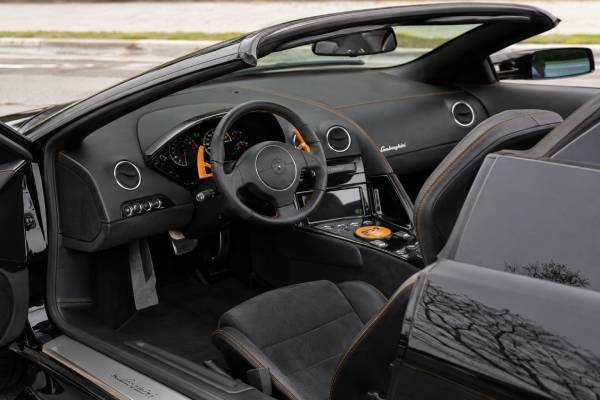
Inside, the LP 650-4 Roadster is more old-school than current Lamborghinis. The seating position is low, the view forward is dramatic, and rear visibility is limited. The dashboard layout is functional rather than luxurious by current standards, but the cabin has enough leather, microsuede, stitching, and special-edition color detail to feel expensive.
The most memorable parts are not screens or driver-assistance systems. They are the orange paddle shifters, the engine noise behind your shoulders, the scissor doors, the low roofline, and the sense that the car is always wider than the road expects. Modern supercars are easier to place, easier to park, and easier to drive quickly. The LP 650-4 Roadster makes the driver work around the machine.
How the LP 650-4 Roadster Drives
The LP 650-4 Roadster drives like a large, dramatic, naturally aspirated V12 car with serious traction and a very physical personality. It is fast by any normal standard, but the real appeal is the way it delivers speed.
The engine is the center of the experience. Below the upper rev range, it feels muscular and clean rather than explosive. As the revs rise, the V12 hardens, the intake and exhaust note sharpen, and the car feels increasingly alive. The power delivery is linear, which makes it easier to read than a turbocharged engine, but the speed still builds very quickly.
The all-wheel-drive system gives the car strong launch traction and confidence on imperfect roads. It does not make the Murciélago feel small or light. Instead, it helps the car put power down while preserving the rear-biased feel expected from a mid-engine Lamborghini. The driver still feels the width, the mass, and the engine behind the cabin.
E-Gear shift behavior
The E-Gear transmission defines much of the driving character. It works best when the driver treats it like a manual gearbox controlled by paddles. Lifting slightly during relaxed upshifts can smooth the shift. Full-throttle shifts feel more dramatic and more mechanical than a modern dual-clutch shift.
In traffic, E-Gear needs sympathy. Creeping, repeated low-speed starts, steep driveways, and poor calibration can increase clutch wear. A well-set-up car feels deliberate but acceptable. A tired car can feel jerky, slow to engage, or reluctant when maneuvering. That difference is crucial during a pre-purchase inspection.
Steering, ride, and braking
The steering has real weight, especially at low speeds. Once moving, the car feels more communicative than many newer supercars, partly because the front tires, chassis, and road surface are not fully filtered by modern software. The roadster body is less rigid than a coupe, so some flex and shake can be part of the experience, especially on rough roads. Excessive rattles, vibration, or looseness should not be dismissed as “just Lamborghini character.”
The carbon-ceramic brakes are powerful, but their condition matters more than their badge. Cold pedal feel can be different from iron brakes, and replacement costs are high. On a test drive, the car should stop straight, without vibration, grinding, warning lights, or a long pedal. Brake-disc condition should be measured, not guessed from appearance alone.
Usability in the real world
The LP 650-4 Roadster can be driven on the road, but it is not casual transportation. The car is very wide, rear visibility is poor, the nose is low, and the cabin can become warm. Parking requires care. Tight city streets demand patience. Fuel consumption is heavy. The roof is not as convenient as a modern power-folding convertible.
On the right road, those drawbacks become part of the event. The car feels special at moderate speeds because the noise, driving position, steering weight, and visual drama are always present. It does not need a racetrack to feel memorable. It needs space, heat in the tires, a smooth surface, and a driver who understands that this is a high-value collector car as well as a performance machine.
Maintenance Risks and Specialist Care
The LP 650-4 Roadster is not a normal used car; it is a low-volume V12 exotic that needs specialist care even when mileage is low. The biggest ownership risks are deferred maintenance, E-Gear and clutch wear, brake costs, heat-related aging, and incomplete documentation.
Low mileage can be a positive value factor, but it is not a substitute for care. A car that has sat for years may need fluids, tires, seals, batteries, belts, hydraulic attention, fuel-system checks, and electronic diagnosis. Regular use and regular specialist service often produce a better car than storage without maintenance.
Major areas to inspect
| Area | What to check | Why it matters |
|---|---|---|
| Engine | Leaks, misfires, compression, cooling behavior, service records | V12 work is labor-intensive and costly |
| E-Gear system | Clutch wear reading, pump behavior, actuator leaks, calibration | Bad setup can make the car unpleasant and expensive |
| Clutch | Wear percentage, engagement quality, replacement history | Low-speed use can shorten life |
| Carbon-ceramic brakes | Disc condition, pads, cracks, corrosion around hardware | Replacement cost can be very high |
| Cooling system | Radiators, fans, hoses, coolant stains, operating temperature | Mid-engine V12 heat exposes weak parts |
| Suspension | Dampers, bushings, ball joints, lift system, uneven tire wear | Heavy cars punish suspension parts |
| Body and chassis | Paint depth, panel fit, carbon repairs, underside damage | Accident repair can sharply reduce value |
| Roadster equipment | Soft top, seals, storage parts, wind deflector, trim fit | Missing parts are rare and expensive |
The E-Gear system deserves special attention. It is not inherently a reason to avoid the car, but it must be healthy. A proper inspection should include diagnostic readings, not just a short drive around the block. Ask for clutch wear data, recent calibration records, and evidence that the hydraulic system works correctly.
Tire age is another common issue. Collector cars often wear tires with plenty of tread but too much age. On a 330 km/h roadster, old tires are not acceptable. The correct tire specification, date codes, storage conditions, and alignment all matter.
Parts and labor reality
Parts availability is generally better through Lamborghini channels and specialist suppliers than for many older exotics, but prices can be severe. Labor time is also significant because access to major components can be difficult. Engine-out or drivetrain-related work can turn a neglected “deal” into a very expensive car.
Owners should budget for annual service even if the car travels few kilometers. A sensible ownership plan includes:
- Annual fluid and safety inspection.
- Battery maintenance with the correct tender.
- Periodic brake-fluid and clutch-hydraulic checks.
- Tire replacement by age as well as wear.
- Cooling-system inspection before summer use.
- Regular E-Gear diagnosis and calibration when needed.
- Immediate attention to warning lights, leaks, or abnormal noises.
Originality versus upgrades is a serious choice. Some owners improve usability with modern audio, cameras, exhaust changes, or E-Gear adjustments. Reversible upgrades are less damaging than permanent changes. For a 50-unit car, originality usually protects value better than personalization.
Market Value and Buying Advice
The LP 650-4 Roadster sits in the upper tier of Murciélago Roadster collectability because of its 50-unit production, special-edition identity, and late 6.5-liter V12 specification. The strongest examples are original, low-mileage, documented, and freshly serviced by recognized specialists.
Recent market data places good LP 650-4 Roadsters around the mid-six-figure U.S. dollar range, with public results and benchmarks commonly clustering around roughly $500,000 to $600,000 for strong cars. Exceptional provenance, very low mileage, numbered significance, or unusually complete documentation can push asking prices higher. Cars with stories, gaps, modifications, deferred service, or accident history should trade lower, even if they look attractive in photos.
The market also compares the LP 650-4 Roadster against several nearby Murciélago categories. Gated-manual LP 640 Roadsters can command extraordinary premiums because manual production was tiny and collector demand is intense. LP 670-4 SuperVeloce coupes appeal to buyers who want the sharpest Murciélago. The LP 650-4 Roadster appeals to buyers who want open-air rarity, factory-limited identity, and the full V12 theater.
What drives value
| Value factor | Effect on desirability |
|---|---|
| Original specification | Very high; incorrect paint or trim weakens the car’s identity |
| Documentation | Very high; factory records, books, tools, and invoices protect value |
| Mileage | Important, but only when matched by service history |
| Service status | Major; fresh specialist care reduces immediate ownership risk |
| Brake and clutch condition | Major; both can change the real purchase cost |
| Accident history | Major negative if structural, poorly documented, or poorly repaired |
| Completeness | Important; roof parts, books, cover, keys, tools, and accessories matter |
| Modifications | Usually negative unless high quality and fully reversible |
Buyer checklist
A serious buyer should follow a collector-car process, not a normal used-car process.
- Confirm the VIN, edition identity, and numbered plaque before discussing price seriously.
- Request factory or dealer documentation showing original build specification.
- Review service records in chronological order and identify gaps.
- Commission a Lamborghini V12 specialist inspection with diagnostic data.
- Measure clutch wear and verify E-Gear operation under cold, warm, low-speed, and full-throttle conditions.
- Inspect carbon-ceramic brakes, tires, suspension, lift system, cooling system, and underside damage.
- Check paint depth, panel fit, front splitter, side sills, wheel condition, and signs of repainting.
- Verify that the roof, tools, books, keys, car cover, and accessories are present.
- Check recall status by VIN in the car’s market.
- Price the car after estimating immediate maintenance, not before.
The best example to buy is not always the lowest-mileage car. The best example is the one with original specification, complete records, correct equipment, healthy diagnostics, no accident story, and recent maintenance by people who know Murciélagos. A higher purchase price can be rational if it prevents a six-figure correction after delivery.
Avoid cars that rely on rarity alone. A rare Lamborghini with old tires, weak documentation, missing roadster parts, unknown clutch wear, and cosmetic stories is still a risky Lamborghini. Also avoid cars modified to chase short-term drama at the expense of originality. Exhaust changes, wraps, non-factory trim, and manual conversions may appeal to some buyers, but they narrow the collector audience.
Long term, the LP 650-4 Roadster has strong collectability fundamentals: naturally aspirated V12, limited production, factory identity, open body style, dramatic design, and a clear place near the end of Murciélago history. Its risk is not lack of interest. Its risk is ownership cost. Buyers who understand that will see the car clearly: not just as a poster car, but as a rare, demanding, highly emotional machine that rewards careful stewardship.
References
- Lamborghini Murciélago LP 650 Roadster – Technical Specifications, Pictures 2009 (Manufacturer Model Page)
- Lamborghini Murciélago: the first V12 engine of the new millennium 2022 (Manufacturer History)
- Standard Navigation – Lamborghini Service Information 2026 (Repair and Maintenance Information)
- Check for Recalls: Vehicle, Car Seat, Tire, Equipment | NHTSA 2026 (Recall Database)
- Lamborghini Murcielago LP650-4 Roadster Market – CLASSIC.COM 2026 (Market Data)
Disclaimer
This article is for informational purposes only and is not a substitute for professional diagnosis, repair, inspection, valuation, or legal advice. Specifications, torque values, service intervals, recall status, parts, procedures, and equipment can vary by VIN, market, model year, and individual vehicle history. Always verify details against official Lamborghini service documentation and have any purchase inspected by a qualified Lamborghini specialist.
If this guide helped you, please share it on Facebook, X/Twitter, or your favorite car community to support our work.