
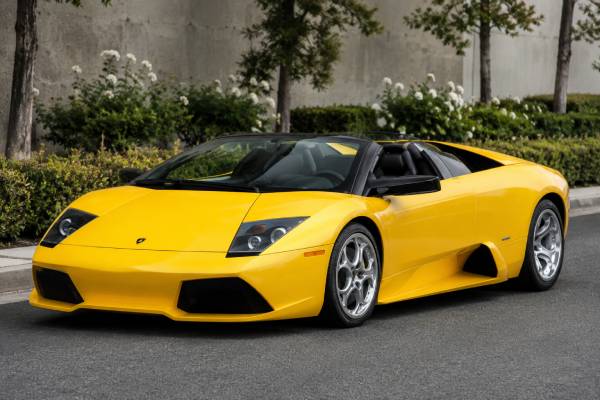
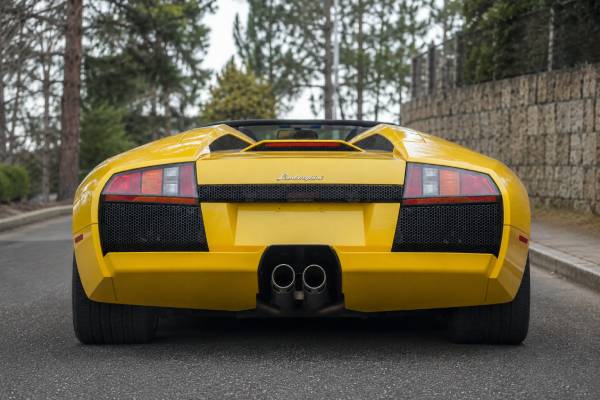
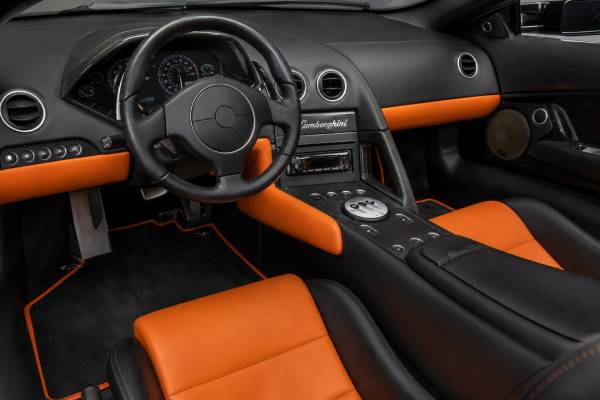
The Lamborghini Murciélago Roadster is the open-air version of Lamborghini’s first V12 flagship of the Audi era, and the early 6.2-liter model is now one of the most charismatic modern collector Lamborghinis. Built before the LP640 facelift, it keeps the original Luc Donckerwolke shape, the 580 hp naturally aspirated V12, permanent all-wheel drive, and the choice of a gated six-speed manual or early e-gear automated manual. It is not a relaxed convertible in the normal sense. The removable roof is temporary, the cabin is loud and dramatic, and the car rewards careful ownership more than casual use. That is exactly why collectors pay attention. The 2004–2006 Murciélago Roadster sits between old-school Lamborghini theater and modern Audi-era build discipline, which makes condition, documentation, transmission choice, and originality especially important.
Table of Contents
- Why the 6.2 Roadster Matters
- 6.2-Liter V12 Specs and Chassis Data
- Model Years, Options, and Authenticity Clues
- Roadster Design and Engineering Details
- How the 580 hp Roadster Drives
- Maintenance Risks and Specialist Repairs
- Values, Inspection, and Buying Strategy
Why the 6.2 Roadster Matters
The Murciélago Roadster matters because it was Lamborghini’s first open V12 flagship after Audi ownership gave the company more engineering structure. It still feels raw and theatrical, but it is more cohesive than the Diablo Roadster it replaced.
The Murciélago coupe arrived in 2001 as the successor to the Diablo and became Lamborghini’s headline model for the new century. The Roadster followed as a production car in 2004 after an earlier concept appearance, giving buyers a way to experience the V12, scissor doors, and extreme wedge shape without a fixed roof. For many enthusiasts, the 6.2 Roadster is the sweet spot because it keeps the clean early styling and the original 6192 cc V12 before the later 6.5-liter LP640 redesign.
This car also sits at an important cultural point. It belongs to the era before supercars became highly digital, hybrid-assisted, and heavily mode-driven. It has traction control and all-wheel drive, but its appeal still comes from a large naturally aspirated V12, a dramatic seating position, heavy controls, and a sense that every journey is an event.
Collectors care about the 2004–2006 Roadster for four main reasons:
- It is a pre-LP640 Murciélago, so it has the original body language and early interior character.
- It was available with a gated six-speed manual, now a major value driver.
- It is rarer and more visually distinctive than the coupe.
- It represents the end of a more analog Lamborghini period before the Aventador generation made the V12 flagship more digital and automated.
The Roadster is not the most powerful Murciélago, and it is not the most usable open supercar. Its temporary roof, wide body, low nose, and maintenance demands make it a serious ownership decision. But as a collectible V12 Lamborghini, it has the right ingredients: limited supply, dramatic design, real mechanical character, and a direct link to the classic Countach-Diablo lineage.
6.2-Liter V12 Specs and Chassis Data
The key specification is simple: a 6.2-liter naturally aspirated Lamborghini V12, 580 hp, permanent all-wheel drive, and either a manual or e-gear six-speed transmission. The Roadster is mechanically close to the coupe, but it has structural changes to compensate for the missing fixed roof.
| Item | Lamborghini Murciélago Roadster 6.2 |
|---|---|
| Production years covered | 2004–2006 |
| Platform / project code | L147 |
| Engine | 60-degree naturally aspirated Lamborghini V12 |
| Displacement | 6192 cc |
| Output | 580 hp at 7,500 rpm |
| Torque | 650 Nm at 5,400 rpm |
| Valvetrain | DOHC, 48 valves, variable valve timing |
| Fuel and engine management | Sequential multipoint injection, drive-by-wire throttle, Lamborghini L.I.E. engine management |
| Lubrication | Dry sump |
| Standard transmission | Six-speed manual |
| Optional transmission | Six-speed e-gear automated manual with steering-column paddles |
| Drivetrain | Permanent all-wheel drive with central viscous coupling |
The 6.2 V12 is a development of Lamborghini’s long-running twelve-cylinder family. It is mounted longitudinally behind the cabin, and the gearbox sits ahead of the engine in classic Lamborghini fashion. That layout helps explain the car’s long rear deck, wide stance, and high service complexity.
| Area | Specification |
|---|---|
| Body style | Two-seat roadster with scissor doors |
| Structure | Roadster-specific steel and carbon structural reinforcements |
| Front suspension | Independent double wishbones, anti-roll bar, anti-dive geometry |
| Rear suspension | Independent double wishbones, anti-roll bar, anti-squat geometry |
| Dampers | Koni FSD self-adjusting dampers |
| Brakes | Four ventilated discs with ABS; carbon-ceramic brakes on certain later or specially equipped cars |
| Front wheels and tires | 8.5-inch wheels with 245/35 ZR18 tires |
| Rear wheels and tires | 13-inch wheels with 335/30 ZR18 tires |
| Measure | Figure |
|---|---|
| Length | 4,580 mm |
| Width | 2,045 mm |
| Wheelbase | 2,665 mm |
| Front track | 1,635 mm |
| Rear track | 1,695 mm |
| Dry weight | 1,650 kg |
| Weight distribution | 42 percent front, 58 percent rear |
| 0–100 km/h | 3.8 seconds |
| Top speed | About 320 km/h, depending on aerodynamic configuration |
| Roof-in-place speed limit | 160 km/h recommended maximum |
The top-speed figure needs context. Some period sources quote higher figures for the Murciélago family, but Lamborghini’s Roadster release described the open car’s maximum speed as around 320 km/h depending on aero configuration. The temporary roof is not meant for high-speed driving, so buyers should treat roof condition as a usability item, not as evidence that the car behaves like a normal convertible.
Model Years, Options, and Authenticity Clues
The 2004–2006 Roadster is the original 6.2-liter open Murciélago, not the later LP640 Roadster. For buyers, the most important distinction is whether the car is a gated manual, an e-gear car, or a later 6.5-liter LP640 that falls outside this exact version.
The early Roadster entered production in 2004 and continued until the LP640 update replaced the 6.2-liter model. The LP640 brought a 6.5-liter engine, revised bumpers, changed side intake treatment, updated electronics, and different market positioning. A car advertised as a “2006 Roadster” therefore needs careful identification because 2006 can include late pre-LP640 examples, early LP640-era cars in some markets, and different registration dates.
Transmission choice is the biggest value split
The standard gearbox was a six-speed manual, and that is the version collectors chase hardest. The gated shifter gives the Roadster a mechanical quality later Lamborghinis mostly lost, and supply is much tighter than demand.
The e-gear version uses paddle actuation on a single-clutch automated manual gearbox. It is still mechanically related to the manual, but the clutch, hydraulic actuation system, calibration, and wear pattern create a different ownership profile. A well-set-up e-gear car can be exciting and period-correct, but a poorly maintained one can feel clumsy and expensive.
For authenticity, confirm:
- the original build specification, not only the current advertisement;
- transmission type by VIN, factory records, and physical inspection;
- original exterior and interior color combination;
- original wheels, brake specification, exhaust, and carbon trim;
- presence of books, tools, roof bag, tire inflator equipment, and service invoices;
- whether any aftermarket stereo, exhaust, carbon trim, wrap, or wheel change is reversible.
Factory and desirable equipment
The Roadster could be ordered with notable comfort and visual options. Some options matter because replacement parts are scarce, while others matter because they help prove originality.
Important equipment and details include:
- front axle lifting system, which raises the nose at low speed;
- temporary R-top roof and storage bag;
- windbreaks behind the seats and windscreen area;
- carbon-fiber engine-bay stiffening lattice on cars so equipped;
- carbon-fiber internal engine cover;
- navigation system where fitted;
- asymmetrical leather and Alcantara interior details;
- correct 18-inch wheels and Pirelli-size tire fitment;
- carbon-ceramic brake equipment on specific cars, especially later 2006 examples where applicable.
The best cars have factory documentation and a service trail from Lamborghini dealers or respected independent specialists. A low-mile car without time-based maintenance is not automatically better than a higher-mile car that has been exercised and serviced correctly. On this model, long storage can create its own problems: aged tires, dry seals, sticky hydraulics, weak batteries, and old fluids.
Roadster Design and Engineering Details
The Roadster is not just a Murciélago coupe with the roof removed. Lamborghini gave it its own rear structure, engine-bay treatment, cockpit details, and safety systems so the open car would look intentional rather than compromised.
Luc Donckerwolke’s original Murciélago design moved Lamborghini away from the busier late Diablo shape while keeping the wedge stance, scissor doors, and low front end. The Roadster adds a different rhythm behind the seats. The rear buttresses, exposed engine area, and reshaped upper surfaces make it more dramatic from above, which matters because open Lamborghinis are as much theater as transportation.
The most important engineering change is structural. Removing a fixed roof from a mid-engine supercar can reduce torsional stiffness, so Lamborghini redesigned key steel and carbon structural components. The engine compartment gained a special stiffening lattice, with an exposed carbon version available as an option. This is one reason buyers should inspect the rear structure carefully after any accident repair. Poor repairs may not show from normal viewing angles, but they can affect alignment, panel gaps, roof fit, and chassis behavior.
The roof is temporary by design
The soft roof is one of the car’s most misunderstood features. It is not a quick, modern convertible roof. It is a temporary R-top intended for unexpected weather, and Lamborghini recommended a maximum speed of 160 km/h with it installed.
That means a missing roof kit affects value, but a present roof does not make the car rainproof in the way a Mercedes SL or Porsche 911 Cabriolet is. Check the fabric, frame, latches, seals, storage bag, and signs of water entry. A car that lived as a sunny-day open toy may have fewer roof issues than a car that was repeatedly driven in wet weather.
Safety and cockpit details
The automatic roll bars are a signature Roadster feature. They sit behind the seats and deploy only when needed, preserving the clean design in normal use. The cabin also has a more driver-focused feel than the coupe, with asymmetrical trim, integrated headrest-air vent forms, and a low wraparound glasshouse Lamborghini compared visually to a helmet visor.
Usability is better than the drama suggests, but it is still a wide, low, heat-generating V12 supercar. The front lift helps with driveways, the visibility is acceptable forward but limited rearward, and the cabin is tight by modern standards. The doors create the occasion, but they also make gas struts, hinges, alignment, and trim condition important inspection points.
How the 580 hp Roadster Drives
The 6.2 Roadster feels fast because the V12 is large, immediate, and close behind you. It is not as polished as later dual-clutch supercars, but it has a more physical and memorable driving character.
The V12 dominates the experience. At low rpm, it has enough torque to move cleanly without drama. As revs rise, the sound hardens and the car starts to feel more like a traditional Lamborghini flagship: wide, loud, urgent, and slightly intimidating. The peak torque arrives at 5,400 rpm and peak power at 7,500 rpm, so the engine rewards revs rather than short-shifting.
The manual gearbox is the purist choice. A good one has a deliberate mechanical action, and the open gate turns every shift into part of the event. It also requires respect. Cold oil, worn linkage adjustment, clutch wear, and rushed shifts can make a car feel worse than it really is. A properly adjusted manual car should not crunch, baulk badly once warm, or show clutch slip under load.
The e-gear car is different. It can be exciting when driven hard, because the system suits committed throttle and clear shift inputs better than half-hearted city driving. In traffic, it can feel slow or jerky by modern standards. A buyer should not judge e-gear by dual-clutch expectations. The real question is whether the system is healthy, calibrated, and showing acceptable clutch life.
Steering is heavy enough to feel serious but not crude. The all-wheel-drive system gives traction out of slower corners, while the rear-biased weight distribution keeps the car from feeling neutral in a bland way. The Murciélago is wide, so road placement matters. On narrow mountain roads, the driver is always aware of the car’s width, nose length, and rear haunches.
Ride quality is firm but not punishing when the suspension is healthy and the tires are fresh. Old tires transform the car in the wrong way. Flat-spotted, aged, or incorrect tires can make the Roadster tramline, ride harshly, and lose confidence under braking. Brake feel depends heavily on disc type, pad condition, fluid age, and whether the car has been used enough to keep the system healthy.
The best use case is a fast open-road drive, not urban posing or repeated short trips. The car needs warm oil, room to breathe, and a driver who understands that mechanical sympathy is part of the experience.
Maintenance Risks and Specialist Repairs
The Murciélago Roadster is not unreliable in a simple sense, but it is expensive when neglected. Age, storage, heat, hydraulic systems, clutch wear, and poor repairs cause more trouble than the basic V12 architecture.
A pre-purchase inspection by a Lamborghini specialist is essential. A normal exotic-car inspection is not enough unless the shop knows Murciélagos specifically. The Roadster has model-specific risks around its roof hardware, rear structure, roll bars, lift system, transmission actuation, and body alignment.
| Area | What to Check |
|---|---|
| Clutch | Wear reading, engagement quality, slipping under load, service history, e-gear calibration |
| E-gear system | Hydraulic pump, accumulator, actuator, position sensors, fluid leaks, shift consistency |
| Manual gearbox | Warm shift quality, synchro behavior, linkage adjustment, clutch pedal feel |
| Cooling system | Radiators, fans, coolant hoses, leaks, heat-soak behavior, service records |
| Front lift | Correct operation, leaks, pump condition, low-speed raise height |
| Suspension | Bushings, dampers, ball joints, uneven tire wear, crash damage signs |
| Brakes | Disc wear, pad condition, fluid age, ABS warnings, carbon-ceramic rotor hardware where fitted |
| Roadster roof | Completeness, fit, fabric condition, seals, latches, storage bag |
| Body and structure | Panel gaps, underside damage, rear lattice condition, paintwork, prior repairs |
| Electronics | Warning lights, side intake operation, battery health, modules, sticky switches |
Service history matters more than mileage alone
A 3,000-mile car can be a poor buy if it sat for years with old fluids, old tires, and no clutch or hydraulic maintenance. A 15,000-mile car can be better if it has annual servicing, fresh tires, clutch data, brake records, and documented specialist care.
For stored cars, inspect for:
- stale fuel issues and fuel odor;
- aged coolant hoses and dry seals;
- weak battery damage to control modules;
- flat-spotted or expired tires;
- sticky interior trim and switchgear;
- seized fasteners from lack of use;
- condensation or water entry around the roof and cabin.
Recalls and campaigns need VIN-level checking
Every buyer should check the exact VIN with Lamborghini or the relevant national recall database. Some later Murciélago recalls affect LP640-era cars more directly, but 2006 cars with certain equipment can fall into safety campaigns, including carbon-ceramic brake rotor screw concerns on affected vehicles. Do not assume a recall applies or does not apply based only on model year. Equipment, VIN range, market, and previous campaign completion all matter.
Originality is another maintenance issue. Many Murciélagos received aftermarket exhausts, wheels, stereos, carbon trim, or cosmetic changes. Some upgrades improve sound or usability, but collector buyers usually prefer reversible changes and retained original parts. Missing factory components can be expensive or difficult to source.
Values, Inspection, and Buying Strategy
The best buying strategy is to pay more for the right car rather than trying to rescue a cheap one. On a Murciélago Roadster, deferred maintenance can quickly erase any saving and may damage long-term collectability.
The current market separates e-gear and manual cars sharply. Early 6.2 Roadsters with e-gear often sit in a lower price band than gated manuals, while documented manual cars with low mileage, strong colors, and original equipment can sell for several times more than a tired or modified e-gear example. Exceptional manual Roadsters have shown upper-six-figure potential, especially when mileage, color, provenance, and presentation line up.
Value is driven by:
- gated manual transmission;
- low but believable mileage;
- complete Lamborghini or specialist service history;
- original paint or high-quality documented paintwork;
- desirable colors such as orange, yellow, black, silver, and rare Ad Personam combinations;
- matching factory interior specification;
- complete roof kit, books, tools, and accessories;
- clean title and accident-free structural history;
- documented clutch life and recent major service;
- verified recall and campaign status.
Avoid cars with vague stories. “Just serviced” should mean invoices, dates, mileage, fluid details, parts, and the name of the shop. “Clutch is fine” should mean a measurement or specialist assessment. “No accidents” should be supported by underside inspection, paint meter readings, panel alignment, and records.
Pre-purchase inspection checklist
Use this sequence before committing money:
- Verify VIN, model year, market specification, and transmission type.
- Confirm the car is a 6.2 Roadster, not an LP640 or a later-converted car.
- Review all service invoices, not just stamped books.
- Check clutch wear, gearbox operation, and e-gear data where applicable.
- Inspect the front lift, roof system, roll bars, and hydraulic systems.
- Measure paint and inspect the underside, rear structure, and suspension points.
- Check tire date codes, brake condition, and wheel originality.
- Confirm all accessories, manuals, tools, roof bag, and original parts are present.
- Run a VIN-level recall and campaign check through official channels.
- Budget for immediate service even if the car appears excellent.
The best example to buy is a documented, original, specialist-maintained car that has been driven enough to stay healthy. For collectors, a gated manual with original paint, complete accessories, and a clean factory specification is the prize. For drivers, a well-sorted e-gear Roadster can be a better value if the transmission system is healthy and the buyer accepts the early automated-manual character.
The examples to avoid are usually easy to identify: missing roof parts, unknown clutch life, patchy service records, warning lights, aftermarket bodywork, cheap paint correction hiding deeper issues, old tires, no specialist inspection, or a seller who cannot explain the car’s history clearly. With this model, uncertainty is expensive.
Long term, the 6.2 Murciélago Roadster has strong collector logic. It has the right engine, the right silhouette, the right era, and a shrinking supply of properly kept examples. It will never be cheap to own, but the right one offers something modern supercars often struggle to match: a naturally aspirated V12 Lamborghini with genuine mechanical drama and open-air theater.
References
- Lamborghini Murciélago LP 670 Roadster – Scheda Tecnica, Foto 2026 (Manufacturer History Page)
- Lamborghini Murciélago: the first V12 engine of the new millennium 2022 (Manufacturer News)
- Used Lamborghini Murciélago – Buy Certified | Lamborghini.com 2026 (Manufacturer Pre-Owned Model Page)
- Brake Rotor attaching Screws may fail 2013 (Recall Database)
- 2004 – 2006 Lamborghini Murciélago Roadster – Images, Specifications and Information 2004 (Press Release Archive)
Disclaimer
This article is for informational purposes only and is not a substitute for professional diagnosis, repair, valuation, or inspection. Specifications, torque values, service intervals, recall applicability, and repair procedures can vary by VIN, market, model year, and equipment. Always verify details against official Lamborghini service documentation and have any Murciélago Roadster inspected by a qualified Lamborghini specialist before purchase or repair.
If this guide helped you, please share it on Facebook, X/Twitter, or your favorite car community to support our work.