
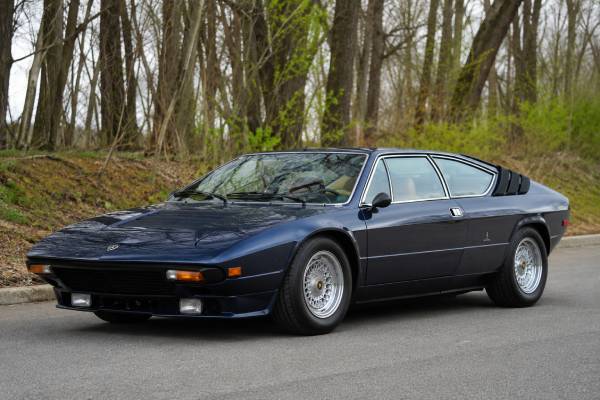
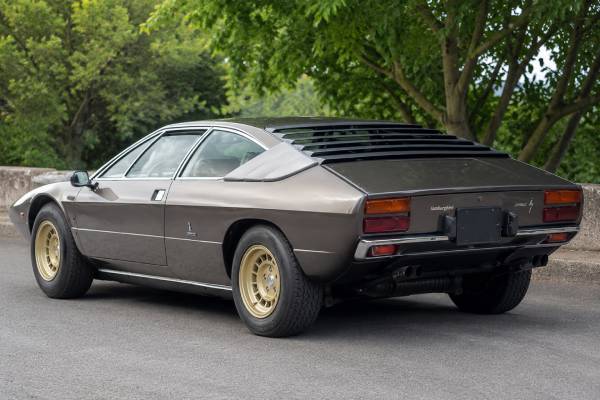
The Lamborghini Urraco P300 is the sharpest and most developed version of Lamborghini’s original junior V8 supercar. It took the compact 2+2 idea of the Urraco P250 and gave it the engine it always deserved: a 3.0-liter L302 V8 with quad-cam cylinder heads, chain drive, Weber carburetors, and enough power to make the car feel genuinely exotic rather than merely interesting. Built in small numbers from the mid-1970s to 1979, the P300 sits in a fascinating place. It is rarer than most people realize, less famous than the Miura and Countach, and much more complex to buy correctly than its simple wedge profile suggests. For collectors, it offers rarity, Bertone design, and early Lamborghini V8 importance. For drivers, it offers a light, compact, mechanical road feel that modern supercars have largely left behind.
Table of Contents
- Why the Urraco P300 Matters Today
- L302 V8 Specs and Chassis Data
- Production Numbers, Variants, and Authenticity
- Bertone Design and Clever Engineering
- How the P300 Drives on Real Roads
- Maintenance Risks, Restoration, and Ownership
- Market Values and Buyer Inspection Guide
Why the Urraco P300 Matters Today
The Urraco P300 matters because it is the most complete expression of Lamborghini’s first production V8 idea. It gave Sant’Agata a smaller, more usable mid-engine car below the V12 flagships, while still carrying the styling drama and mechanical ambition that made the brand different.
Lamborghini showed the Urraco prototype at the 1970 Turin Motor Show, but production did not begin quickly. The company was trying to expand beyond expensive V12 cars into a market where the Porsche 911, Ferrari Dino, Maserati Merak, and Alfa Romeo Montreal all competed for buyers who wanted something exotic but not as large or costly as a traditional front-engine grand tourer. The Urraco was Lamborghini’s answer: a compact mid-engine 2+2 coupé with a new V8, Bertone bodywork, and a lower price point than the Miura or Countach.
The P300 arrived later as the evolved version. Where the P250 used a 2.5-liter single-overhead-cam V8, the P300 used the larger L302 3.0-liter engine with dual overhead camshafts per bank. That change gave the car stronger performance and made it feel more like a true Lamborghini rather than a clever junior model.
The Urraco also has historical weight because it helped establish a Lamborghini V8 bloodline. The direct family path runs through the Silhouette and Jalpa, but the broader idea of a smaller, more approachable Lamborghini later reappeared in far more successful cars such as the Gallardo and Huracán. The Urraco did not sell in huge numbers, yet the concept was ahead of its time: a mid-engine, compact, high-performance Lamborghini for a wider audience.
Marcello Gandini’s design for Bertone gives the P300 much of its lasting appeal. The Urraco has the low nose, angled glass, slatted rear bodywork, and wedge stance that connect it visually to the Countach era, but it is softer and more compact. It does not have the poster-car violence of the Countach. Instead, it has a clean, almost architectural shape that looks better the more closely you study it.
Today, the P300 attracts three kinds of buyers. The first wants a rare classic Lamborghini without Miura or Countach pricing. The second wants a usable, high-revving 1970s Italian driver’s car. The third sees the P300 as an undervalued part of Lamborghini history. All three buyers need to be careful, because the car’s market value can be far lower than the cost of correcting a neglected example.
L302 V8 Specs and Chassis Data
The P300’s key mechanical upgrade is its 3.0-liter L302 V8, a compact transverse mid-mounted engine with four camshafts and Weber carburetors. Period horsepower figures vary because some sources quote around 250 bhp while others quote 265 PS or CV, but the important point is that the P300 is meaningfully stronger and more sophisticated than the earlier P250.
| Item | Specification |
|---|---|
| Engine code | L302 |
| Engine layout | 90-degree V8, transversely mounted behind the cabin |
| Displacement | 2,995.8 cc |
| Bore x stroke | 86 mm x 64.5 mm |
| Valve gear | Dual overhead camshafts per bank, chain driven, two valves per cylinder |
| Induction | Four twin-barrel Weber 40 DCNF downdraft carburetors |
| Compression ratio | 10.5:1 |
| Power | 250 bhp at about 7,500 rpm; also commonly quoted as 265 PS/CV in period-style data |
| Torque | About 195 lb-ft / 264 Nm at about 3,500 rpm |
| Fuel system | Electric fuel pump with Weber carburetors |
| Lubrication | Wet sump |
| Cooling | Water cooling with electric fans |
| Transmission | Five-speed manual transaxle |
| Drive | Rear-wheel drive |
The L302 was not just a bored-out P250 unit. The larger displacement, quad-cam heads, and chain-driven cam layout changed the car’s character. It revs hard, responds well when properly tuned, and sounds more serious than its compact size suggests. The engine is also tightly packaged, so maintenance access is not generous. That matters when inspecting one today.
| Item | Specification |
|---|---|
| Body style | Two-door 2+2 coupé |
| Body construction | Steel body and steel structure |
| Wheelbase | 2,450 mm |
| Length | 4,285 mm |
| Width | 1,740 mm |
| Height | 1,160 mm |
| Weight | About 1,280–1,300 kg, depending on source and equipment |
| Suspension | Independent suspension with MacPherson struts, coil springs, and telescopic dampers |
| Brakes | Ventilated discs front and rear, servo assisted |
| Steering | Rack and pinion |
| Wheels | 14-inch Campagnolo cast magnesium wheels |
| Typical tires | 195/70 VR14 front and 205/70 VR14 rear Michelin XWX-type fitment |
| Fuel capacity | About 80 liters |
Performance figures should be treated as period claims rather than laboratory constants. A healthy P300 is usually quoted at about 260 km/h, or 161–162 mph, with 0–100 km/h times ranging from the mid-five-second range to roughly 6.5 seconds depending on source, gearing, tires, tuning, and test method. For a 1970s 3.0-liter car, that was serious performance.
The P300’s specification also shows why the car is expensive to restore correctly. It is not a simple front-engine steel coupé with generic parts. It uses a mid-mounted Lamborghini V8, a model-specific transaxle, magnesium wheels, 1970s Italian electrical hardware, and body trim that may be difficult or impossible to replace without specialist help.
Production Numbers, Variants, and Authenticity
The P300 is rare, and production totals are not quoted consistently across all sources. Many marque references list about 190 cars, while other registries and market sources use roughly 205; a careful buyer should treat either figure as a warning that documentation matters more than casual production claims.
The Urraco family included several main versions. The P250 was the original 2.5-liter model. The P250S brought refinements to trim and specification. The P200 used a 2.0-liter V8, mainly for the Italian market where tax rules penalized larger engines. The P111 was a U.S.-focused emissions version related to the 2.5-liter cars. The P300 sat at the top of the range, with the 3.0-liter quad-cam engine and the most desirable mechanical package.
The P300 was presented in the mid-1970s and remained part of the range until 1979. Registration dates can be misleading because small-production Italian cars were often completed, sold, registered, or imported at different times. A car described as a 1975, 1976, or 1977 example may still need chassis, engine, and factory-record verification before any serious buyer treats the date as meaningful.
How the P300 differs from earlier Urracos
The biggest difference is the engine. The P300’s 3.0-liter L302 V8 brought more capacity, better breathing, and the quad-cam layout that collectors focus on today. The car also gained braking and detail improvements that make it feel more mature than the P250.
Useful P300 identifiers include:
- 3.0-liter L302 V8 specification rather than the smaller P250 or P200 engine.
- Dual overhead camshafts per bank with chain drive.
- P300 badging and model-specific documentation.
- Correct Weber carburetor setup and Lamborghini transaxle.
- Period-correct Campagnolo magnesium wheels.
- Factory-style interior trim, switchgear, instruments, and Bertone body details.
Because Urracos have sometimes been modified, restored with available parts, or incorrectly described, “P300” should not be accepted as a badge-only claim. The best cars have matching or well-documented engine and chassis identities, old registration papers, invoices, ownership history, restoration records, and confirmation from recognized Lamborghini specialists or heritage sources.
Factory options were not as complex as modern supercar option sheets. Buyers should expect variations in paint, upholstery, stereo equipment, glass, air conditioning fitment, market lighting, and trim. Metallic paint, leather, tinted glass, power windows, and period audio equipment can add interest when original, but the largest value drivers are still identity, condition, completeness, and provenance.
Right-hand-drive cars are especially scarce. Some specialists quote roughly 30-plus factory RHD P300s, but any RHD claim should be checked carefully because conversion history, import-market changes, and restoration work can blur the story. A factory RHD P300 with strong paperwork is a very different proposition from a later converted car.
Bertone Design and Clever Engineering
The Urraco P300 looks restrained next to a Countach, but its design is one of its greatest strengths. Marcello Gandini gave it a compact wedge shape that connected Lamborghini’s rounded 1960s cars to the sharper design language that would define the 1970s and 1980s.
The front is low and clean, with slim proportions that make the car look wider than it is. The side view is the most important angle. The rising beltline, angled rear quarter, sloping roof, and louvered rear deck make the Urraco clearly related to the Countach era without copying the Countach’s theatrical extremes. It is a subtler car, but not an ordinary one.
The packaging is more clever than it first appears. Lamborghini placed the V8 transversely behind the cabin to keep the car compact while still allowing small rear seats. Those rear seats are not generous, and adults will not enjoy them for long, but their presence changed the car’s mission. The Urraco was intended as a more practical exotic: something with mid-engine balance, Lamborghini styling, and enough cabin flexibility for short trips with children or luggage.
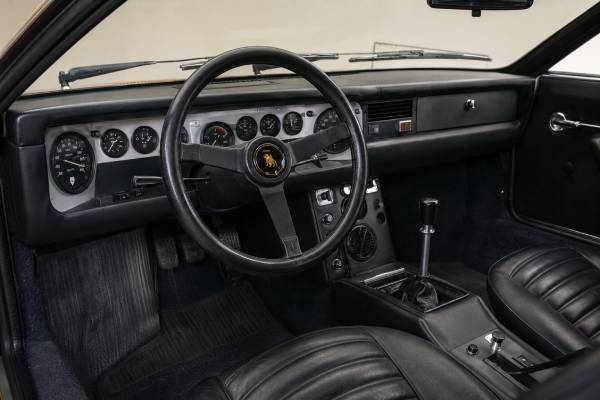
The cockpit also has period Lamborghini character. The dashboard is unusual, the seating position is low, and the glass area gives the car a distinct feel. Compared with many later supercars, visibility is not terrible, but the driving position and pedal layout should be judged in person. Tall drivers may fit better than expected in some cars and poorly in others, depending on seat condition and trim work.
Cooling and service packaging were shaped by the mid-engine layout. The radiator and airflow paths, engine-bay heat, carburetor position, and rear body louvers all matter. The P300 generates real heat, and a marginal cooling system can turn a pleasant drive into a stressful one. Good examples run properly because someone has already renewed hoses, fans, wiring, and radiator condition. Poor examples often reveal themselves in traffic.
The materials also deserve attention. The steel body gives restorers something familiar to repair, but it also means corrosion is a serious issue. The Campagnolo magnesium wheels are correct and desirable, but old magnesium deserves expert inspection. Refurbishing or replacing correct wheels is not the same as buying a modern alloy wheel for an ordinary classic.
The P300’s sound is another defining feature. It is not a deep V12 howl and it is not the later hard-edged V10 noise of a Gallardo. It is a compact, carbureted, high-revving V8 with mechanical texture from the induction, valve gear, and exhaust. When the carburetors are synchronized and the ignition is right, the engine has a crisp, urgent character that suits the car’s size.
How the P300 Drives on Real Roads
A good Urraco P300 feels light, compact, and mechanical rather than brutally fast by modern standards. Its appeal is not just acceleration; it is the combination of steering feel, carburetor response, mid-engine balance, and a high-revving V8 that asks the driver to stay involved.
Cold starts require patience. This is a carbureted 1970s Italian exotic, not a modern injected car. Until warm, throttle response can be uneven, idle quality can vary, and the gearbox may feel reluctant. A sorted car improves as fluids warm and the engine clears its throat. A badly tuned car never really comes together, and that difference is one of the easiest ways to separate a well-owned P300 from a neglected one.
The engine is flexible enough for normal road use, but it feels happiest when revved. The torque peak is relatively low on paper, yet the personality is in the upper half of the tachometer. The P300 rewards smooth inputs: let the V8 build, keep the carburetors cleanly on song, and the car feels much quicker than its modest size suggests.
The manual gearbox should feel mechanical but not abusive. Slow shifts when cold are normal for many old transaxles, but grinding, jumping out of gear, heavy baulking, or noisy bearings are serious warnings. Gearbox work can quickly become one of the largest ownership costs, so a road test should include gentle low-speed shifts, higher-rpm upshifts, downshifts after warm-up, and listening under both load and overrun.
The steering is one of the car’s best features when the suspension is healthy. It is unassisted, so it carries weight at parking speeds, but it should lighten and communicate once moving. A tired front end, old tires, incorrect alignment, or seized suspension hardware can make the car feel vague or heavy. With fresh bushings, correct tires, and proper setup, the P300 has the delicacy that makes small mid-engine classics so rewarding.
Ride quality is firm but not punishing when the car is on suitable tires and dampers. Modern tire choices can change the car dramatically. Too much tire, the wrong compound, or old rubber can make the steering heavier and the breakaway less progressive. Period-correct Michelin XWX-style tires preserve the right look and much of the intended feel, though buyers should still check production dates and condition.
Braking is good for the period but must be judged with classic-car expectations. The P300’s ventilated discs and servo assistance give it more confidence than earlier unassisted-feeling setups, but it will not behave like a modern car with ABS, large multi-piston calipers, and sticky tires. A firm pedal, straight stopping, no pulling, no fluid leaks, and no servo oddities are more important than raw stopping numbers.
In traffic, the P300 can be hot, noisy, and demanding. On the right road, it becomes the opposite: narrow enough to place, quick enough to entertain, and exotic enough to feel special at sensible speeds. That is why the best examples are worth saving. The P300 does not need to outrun a modern sports car to justify itself. It offers a type of interaction that newer cars often filter away.
Maintenance Risks, Restoration, and Ownership
The Urraco P300 is not a cheap classic to own simply because it costs less than a Countach. Its biggest risk is the gap between market value and restoration cost; buying a poor car can be more expensive than buying the best one available.
The engine is robust when maintained, but it is not tolerant of neglect. Weber carburetors need correct synchronization, clean fuel supply, and proper jetting. Old fuel lines, weak pumps, dirty tanks, and ethanol-damaged rubber can create running problems or fire risk. Ignition parts, plug condition, distributor setup, and charging-system health all affect how the car starts and drives.
The chain-driven quad-cam layout is one reason the P300 is desirable, but chains, tensioners, guides, valve clearances, oil leaks, and cam-cover sealing still need expert attention. A car that has sat for years should not be awakened with only fresh fuel and optimism. It needs inspection, fluids, belts where fitted for accessories, hoses, cooling-system checks, and careful recommissioning.
Cooling is a major ownership area. The P300 depends on a healthy radiator, working fans, correct thermostat function, clean passages, good hoses, and sound wiring. Overheating can be caused by obvious faults or by many small weaknesses working together. A buyer should see the car idle until hot, confirm fan operation, watch temperature behavior in traffic, and check for signs of past coolant leaks.
The gearbox and clutch deserve special attention. The transaxle shares the cramped mid-engine service environment, and parts availability is not like a mass-market classic. A tired clutch hydraulic system may be straightforward compared with internal gearbox wear. Synchro issues, bearing noise, worn linkages, and oil leaks can turn a tempting purchase into a major project.
| Area | What to Check | Why It Matters |
|---|---|---|
| Engine | Oil leaks, compression, valve-train noise, carburetor balance, smoke, hot idle | Major engine work requires specialist knowledge and can exceed normal classic-car budgets |
| Fuel system | Tank condition, hoses, pump, filters, carburetor seepage, fuel smell | Old fuel components create poor running and fire risk |
| Cooling system | Radiator, fans, thermostat, hoses, coolant stains, temperature stability | Heat management is critical in a compact mid-engine car |
| Gearbox | Cold and warm shifts, synchros, bearing noise, leaks, clutch action | Transaxle repairs are expensive and specialist-dependent |
| Body shell | Sills, floors, lower doors, wheel arches, suspension points, nose structure | Rust repair can become a full body restoration |
| Wheels | Cracks, corrosion, previous repairs, correct size and type | Original magnesium wheels are valuable but need expert inspection |
| Electrical system | Fuse box, grounds, fans, windows, lights, instruments, charging | Small electrical faults can affect cooling, starting, and drivability |
| Interior and trim | Seats, dashboard, switches, glass, badges, lamps, seals | Missing model-specific trim can be harder to solve than mechanical wear |
Corrosion is the hidden killer. The Urraco’s steel structure can rust in places that are expensive to access and difficult to repair cleanly. Inspect the sills, floor sections, lower door skins, wheel arches, front compartment, radiator support areas, suspension mounting points, engine-bay seams, and any previous repair seams. Fresh paint should make you more cautious, not less. A magnet, lift inspection, paint-depth readings, and photographs from any restoration are all useful.
Restoration quality varies widely. Some cars were restored when values were low, which means corners may have been cut because the finished car could not justify proper expenditure at the time. Others have been cosmetically refreshed while mechanical needs remained untouched. The best restorations are documented with photographs, invoices, parts lists, specialist names, and clear explanations of what was rebuilt, repaired, replaced, and preserved.
Originality is valuable, but usable correctness matters too. Sensible updates such as modern fuel hoses, improved cooling reliability, discreet electrical repairs, and high-quality brake rebuilds can make a car safer without damaging its character. Heavy modifications, non-original engines, incorrect interiors, missing trim, or poorly executed color changes should reduce value unless they are fully reversible and reflected in the price.
Market Values and Buyer Inspection Guide
The Urraco P300 is still relatively affordable by classic Lamborghini standards, but it is not a bargain if it needs major work. As of 2026, public market data commonly places good and usable cars below the cost of a full high-quality restoration, which makes condition the single most important buying factor.
Recent public results and price guides show a wide spread. Average or “good” condition figures can sit well below six figures in some guides, while stronger public auction benchmarks and model-specific market data can approach or exceed the $100,000 level. Exceptional, rare, highly documented, or right-hand-drive examples may be priced above ordinary public averages, but asking prices are not the same as completed sales.
The P300’s market is also thin. A Miura or Countach has global recognition and a deeper buyer pool. A Urraco P300 appeals to a more informed audience. That can create opportunity, but it also means liquidity is not guaranteed. The car must be bought with care, not just enthusiasm.
The strongest cars usually have:
- Confirmed P300 identity with chassis and engine documentation.
- Clear ownership history and old registration records.
- Specialist maintenance from recognized Lamborghini or Italian exotic workshops.
- Correct L302 engine specification and original-style induction.
- Healthy gearbox and clutch operation.
- Solid body structure with no hidden corrosion.
- Complete trim, badges, glass, lights, and interior pieces.
- Correct or properly restored Campagnolo wheels.
- A documented restoration or long-term preservation history.
- Sensible recent recommissioning rather than vague claims of “runs well.”
Cars to avoid are easy to describe but tempting in person. Avoid incomplete projects unless you already know where the missing parts will come from. Avoid cars with unclear engine identity, poor rust repairs, overheating, bad gearbox behavior, incorrect trim, or fresh paint over unknown metalwork. A non-running P300 can look like a rare opportunity, but it may only be rare because previous owners already understood the cost.
Pre-purchase inspection priorities
A proper P300 inspection should be more like a collector-car audit than a normal used-car check.
- Confirm identity first. Check chassis number, engine number, title, registration history, and any factory or registry correspondence.
- Inspect the body on a lift. Focus on corrosion, accident damage, suspension mounting points, and old repair quality.
- Test the engine cold and hot. Look for smoke, noise, leaks, poor idle, overheating, and carburetor imbalance.
- Drive the car long enough to warm the gearbox. Check every gear, both up and down, and listen for bearing noise.
- Confirm cooling-fan operation. Watch temperature behavior at idle and in slow traffic.
- Check the brakes and clutch hydraulics. Old hoses, seized calipers, weak servos, and leaking cylinders are common age-related issues.
- Inspect wheels and tires. Old magnesium wheels and aged tires are safety issues, not cosmetic details.
- Review invoices line by line. Recent spending matters only if it was done by competent specialists and addressed the right systems.
- Price the car after the inspection, not before. The cost difference between a sorted P300 and a needy one can be enormous.
For long-term collectability, the P300 has real strengths. It is rare, mechanically interesting, designed by Gandini, built by Bertone, and tied to Lamborghini’s first V8 chapter. It is also more usable in size than the brand’s V12 icons. Against that, it carries real ownership complexity and a smaller buyer pool. The best cars should remain desirable because they combine rarity with usability. Poor cars may remain difficult to sell because informed buyers know how expensive they are to correct.
The right P300 is a rewarding classic Lamborghini for someone who values engineering, design, and history more than badge drama alone. The wrong one is a restoration invoice wearing a Bertone body. Buy the car with the best structure, strongest paperwork, and most credible specialist history you can find.
References
- Lamborghini Urraco: innovation turns 50 2020 (Manufacturer publication) ([Lamborghini.com][1])
- Milestones | Lamborghini.com 2026 (Manufacturer history page) ([Lamborghini.com][2])
- Lamborghini Urraco P300 – Specs & Performance 2015 (Technical specifications) ([LamboCars][3])
- Lamborghini Urraco P300 Market – CLASSIC.COM 2026 (Market data) ([Classic.com][4])
- 1977 Lamborghini Urraco P300 | Hagerty Valuation Tool® 2026 (Valuation guide) ([Hagerty][5])
Disclaimer
This article is for informational purposes only and is not a substitute for professional diagnosis, inspection, repair, or restoration advice. Specifications, torque values, service intervals, procedures, and parts details can vary by VIN, market, production date, equipment, and previous restoration work. Always verify technical information against official service documentation and consult a qualified Lamborghini specialist before buying, repairing, or restoring a Urraco P300.
If this guide helped you, please share it on Facebook, X/Twitter, or your favorite classic-car community to support our work.