
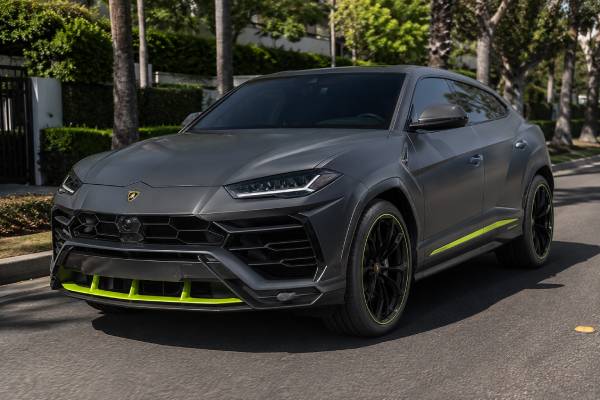
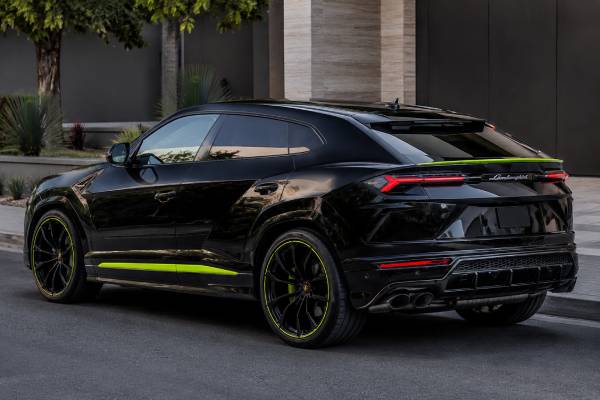
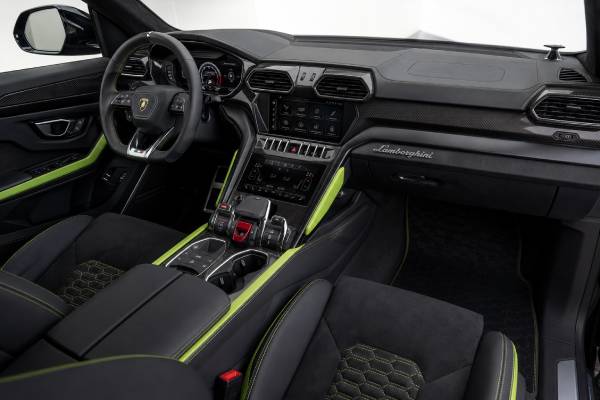
The Lamborghini Urus Graphite Capsule is the Urus for buyers who want the original 650-hp Super SUV with a sharper factory design identity. It is not a separate high-performance model like the later Urus Performante, and it does not change the basic DHU 4.0-liter twin-turbo V8 formula. Its appeal comes from factory-curated matte paint, high-gloss accent colors, 23-inch Taigete wheels, special cabin trim, and the pre-facelift Urus driving character.
For 2021 and 2022 shoppers, the Graphite Capsule sits in a useful place. It has the full 650 hp output, permanent all-wheel drive, active chassis technology, carbon-ceramic brakes, and daily usability that made the Urus Lamborghini’s volume-changing model. At the same time, it carries a more distinctive factory specification than many standard cars. That makes condition, service history, VIN-specific recall status, original options, and paint care especially important when buying one used.
Table of Contents
- Why the Graphite Capsule Still Matters
- DHU V8 Specs and Chassis Data
- Colors, Options, and Identification Details
- Design and Engineering Character
- How the 650-hp Urus Drives
- Maintenance Risks, Recalls, and Ownership Reality
- Market Value and Buying Strategy
Why the Graphite Capsule Still Matters
The Graphite Capsule matters because it combines the original 650-hp Urus mechanical package with a factory design treatment that is easy to identify and desirable on the used market. It is best understood as a special visual and trim configuration, not as a limited-run engine or chassis upgrade.
Lamborghini launched the Urus as the brand’s modern Super SUV: a five-door, front-engine, all-wheel-drive Lamborghini that could carry passengers, luggage, and winter tires while still delivering supercar-level acceleration. That was a major shift for a company best known for mid-engine V10 and V12 cars. The Urus also became a business turning point, bringing Lamborghini to a much wider group of customers who wanted brand drama without giving up everyday usability.
The Graphite Capsule arrived for model year 2021, during the first generation of the Urus before the later Urus S, Performante, and SE updates changed the range. Its purpose was simple: give customers a darker, more technical-looking factory configuration with matte paint and vivid accent colors. For many buyers, that made the Urus look more deliberate than a heavily optioned standard car.
The model’s reputation today rests on three strengths:
- It uses the full 650 hp version of the 4.0-liter twin-turbo V8.
- It carries factory Graphite Capsule design details rather than aftermarket wrap-and-trim changes.
- It sits in the desirable pre-facelift Urus era, before the model line became more fragmented.
Collectors should not treat the Graphite Capsule like a numbered homologation special. Lamborghini did not position it as a motorsport derivative or a low-volume collector car in the way some supercar special editions are. Its value comes from factory specification, condition, originality, mileage, color combination, service file, and ownership history.
Enthusiasts still care because the early Urus has a clear identity. It is loud in design, brutally quick for its size, and more physical than many newer luxury performance SUVs. The Graphite Capsule sharpens that identity without changing what made the Urus successful.
DHU V8 Specs and Chassis Data
The key technical point is that the Graphite Capsule keeps the same core mechanical layout as the standard 2021–2022 Urus: a 3,996 cc twin-turbo V8, eight-speed automatic transmission, permanent all-wheel drive, active chassis systems, and carbon-ceramic brakes. The trim changes the look and equipment mix, not the engine output.
| Item | Specification |
|---|---|
| Model years covered | 2021–2022 |
| Model family | Urus Graphite Capsule, LB636 family |
| Engine code | DHU 4.0-liter twin-turbo V8 |
| Displacement | 3,996 cc |
| Power | 650 CV / 478 kW at 6,000 rpm |
| Torque | 850 Nm, delivered across the mid-range |
| Transmission | 8-speed automatic with paddle shift |
| Drivetrain | Permanent all-wheel drive with active rear torque vectoring |
| 0–100 km/h | 3.6 seconds |
| Top speed | 305 km/h |
The DHU V8 is part of the Volkswagen Group’s high-output 4.0-liter twin-turbo family, tuned for Lamborghini’s throttle response, exhaust character, cooling needs, and drive-mode strategy. It is not a traditional naturally aspirated Lamborghini engine, but in the Urus it makes sense. A large SUV needs torque, thermal control, and fast response under load, and the twin-turbo V8 gives the Urus the low-end and mid-range force that a heavy performance SUV needs.
| Area | Specification or feature |
|---|---|
| Body style | Five-door performance SUV |
| Seating | Four-seat or five-seat layouts depending on configuration |
| Suspension | Adaptive air suspension with selectable ride height and damping |
| Steering | Front steering with rear-wheel steering assistance |
| Roll control | Active roll stabilization system |
| Brakes | Carbon-ceramic discs, 440 mm front and 370 mm rear |
| Factory Graphite Capsule wheels | 23-inch Taigete wheels with gloss black finish |
| Length | About 5,112 mm |
| Width | About 2,016 mm without mirrors |
| Height | About 1,638 mm |
| Wheelbase | About 3,003 mm |
| Fuel tank | About 85 liters |
The most important specification is not one number. It is the full system: torque-rich V8, fast automatic gearbox, active all-wheel drive, rear-wheel steering, air suspension, anti-roll control, and huge carbon-ceramic brakes. This is why the Urus can feel much smaller on a quick road than its size suggests.
Buyers should also remember that options affect weight and feel. Panoramic roof, large wheels, rear entertainment, audio upgrades, seat configuration, carbon trim, and ADAS packages can change both curb weight and ownership complexity. A highly optioned Graphite Capsule may be more desirable, but it also gives a specialist more systems to inspect.
Colors, Options, and Identification Details
The easiest way to identify a true Graphite Capsule is by its factory matte exterior color, high-gloss accent treatment, 23-inch Taigete wheels, and matching interior theme. A wrap, wheel swap, or aftermarket accent package should not be valued the same as a documented factory Graphite Capsule build.
Lamborghini offered the Graphite Capsule around four satin-effect matte body colors:
- Nero Noctis
- Grigio Keres
- Grigio Nimbus
- Bianco Monocerus
Those main colors were paired with bright high-gloss accent tones, including orange, yellow, and green choices such as Arancio Leonis, Arancio Dryope, Giallo Taurus, and Verde Scandal. The accents appear on areas such as the front splitter, door inserts, and rear spoiler, giving the car a two-tone factory look. A gloss black rear diffuser and 23-inch Taigete rims complete the exterior theme.
Inside, the Graphite Capsule uses the same idea: dark technical surfaces with controlled flashes of color. Look for ventilated Alcantara seats, hexagonal Q-citura stitching, embroidered Lamborghini logos, matte-finish carbon-fiber inserts, and black anodized aluminum details. The best cars have a clear relationship between exterior accent color and cabin stitching or trim.
Factory documentation matters
A buyer should ask for the original window sticker, factory build sheet, purchase invoice, Lamborghini service records, and any certification paperwork. These documents matter because many Urus examples have been customized after delivery. Paint protection film, wheel refinishing, vinyl accents, black badges, and interior trim changes can all make a standard Urus resemble a Graphite Capsule at a glance.
The most desirable examples are usually:
- documented as Graphite Capsule from new
- finished in a strong but tasteful matte-and-accent combination
- protected with high-quality paint protection film early in life
- maintained by authorized Lamborghini dealers or recognized specialists
- free from accident paintwork, poor wheel repairs, or interior retrimming
- complete with books, keys, service invoices, recall records, and original accessories
Version context
For 2021–2022, the Graphite Capsule sits above a standard Urus in visual distinctiveness but below later performance-focused models in mechanical development. The Urus Performante, revealed later, brought more power, weight reduction, aero changes, and a sharper chassis brief. The Urus S also updated the standard model line. That means a Graphite Capsule buyer is usually buying style, originality, and the original Urus driving flavor rather than the quickest or newest Urus variant.
That can be a strength. Some owners prefer the early 650-hp car because it has the original cabin layout, less complicated model hierarchy, and a slightly more classic pre-facelift identity. Others will compare it directly with Urus S, Performante, or even the plug-in hybrid Urus SE. The right choice depends on whether the buyer wants the Graphite Capsule design or the latest performance hardware.
Design and Engineering Character
The Graphite Capsule’s design works because it makes the Urus look more technical and less decorative. The matte paint reduces visual glare, while the bright accents pull attention to the SUV’s sharp surfacing, wide stance, and Lamborghini-style geometric details.
The Urus is not a subtle car. It uses a long hood, low roofline, angular front intake treatment, strong shoulder line, and short visual rear deck to make a large SUV feel more like a Lamborghini product than a conventional luxury 4×4. The Graphite Capsule leans into that language. Satin finishes make the surfaces look tighter, and the gloss accent colors emphasize the body’s cuts and edges.
Engineering also shapes the design. The front-mounted V8 needs serious cooling, the large brakes need airflow, and the wide tires demand broad arches. The result is aggressive because it has to manage heat, mass, grip, and speed. The Urus may share group architecture with other high-end SUVs, but Lamborghini tuned the visual and dynamic package to feel much more dramatic.
Active systems define the car
The Urus is not trying to be light and simple. It is trying to use technology to make size less obvious. Several systems work together:
- adaptive air suspension changes ride height and firmness
- active roll stabilization helps keep the body flatter in corners
- rear-wheel steering improves low-speed agility and high-speed stability
- active torque vectoring helps the car rotate and exit corners harder
- drive modes alter throttle response, gearbox behavior, suspension, steering, and stability control
This is why a healthy Urus can feel surprisingly alert. It still weighs far more than a Huracán or Aventador, but it does not drive like a traditional luxury SUV. The active chassis is central to the experience.
Interior and sensory appeal
The cabin mixes Lamborghini drama with everyday SUV usability. The driving position is high, the console layout feels aviation-inspired, and the screens manage infotainment, climate, drive settings, and vehicle functions. The Graphite Capsule’s Alcantara, matte carbon, stitching, and accent color help the interior feel less like a standard luxury SUV and more like a Lamborghini product.
Sound is part of the character, too. The twin-turbo V8 is not as exotic as a naturally aspirated Lamborghini V10 or V12, but it has a deep, hard-edged voice, especially in Sport and Corsa. It is more muscular than musical. That suits the Urus: the car feels like a large, fast, high-grip machine rather than a delicate sports car.
How the 650-hp Urus Drives
The 650-hp Urus drives with immediate torque, strong traction, and a surprisingly aggressive chassis for a vehicle of its size. Its defining trait is not delicacy; it is the ability to make huge speed feel easy and repeatable.
In normal driving, the Urus can be calm. Strada mode softens the responses, the automatic gearbox shifts smoothly, and the air suspension gives the car enough compliance for daily use. It is still wide, expensive, and visually loud, but it can handle commuting, school runs, long motorway trips, and bad weather better than most traditional exotic cars.
Push harder and the car changes character. The V8 delivers its best punch in the mid-range, where the turbos are awake and the gearbox can keep the engine in the torque band. The response is not naturally aspirated-sharp, but it is fast and forceful. Overtaking is effortless, and launch acceleration feels violent for something with five doors and a usable cargo area.
Sport and Corsa modes make the drivetrain more urgent. The gearbox holds lower ratios, the exhaust becomes more vocal, and the chassis allows more energy through the body. On a mountain road, the rear-wheel steering and torque vectoring help the Urus rotate more cleanly than expected. It still cannot hide all of its weight, especially in tight direction changes, but it resists the lazy, top-heavy feel that many large SUVs suffer from.
The brakes are a major part of the confidence. Carbon-ceramic discs give the Urus the stopping power needed for repeated high-speed use, but buyers should understand their feel. At low speeds they can feel different from ordinary steel brakes, and their replacement cost is high. Inspection matters far more than casual driving impressions.
Best and worst driving environments
The Urus is at its best on fast roads, open highways, long sweepers, and mixed-weather routes where traction and power matter. It can also be entertaining on a flowing back road, provided the driver respects its width and mass.
It is less happy in narrow city streets, tight parking garages, and rough urban environments where the 23-inch wheels and low-profile tires are exposed to curbs, potholes, and careless tire mounting. The Graphite Capsule’s matte paint adds another concern: it looks fantastic when cared for properly, but poor washing, cheap polishing attempts, or mismatched repairs can hurt appearance and value.
On track, the Urus is capable but not cheap to use. It can run fast laps for an SUV, but tires, brakes, fluids, and heat management become serious costs. A car with repeated track use should be inspected more deeply than one used mainly for road driving.
Maintenance Risks, Recalls, and Ownership Reality
The Urus is not fragile when maintained correctly, but it is an exotic performance SUV with expensive consumables, complex active systems, and VIN-specific recall considerations. The safest ownership approach is to buy the best-documented car, not the cheapest one.
Routine maintenance should be handled by a Lamborghini dealer or a specialist familiar with the Urus platform. Oil services, brake inspections, tire replacement, alignment, software updates, battery health, fluid condition, and diagnostic scans all matter. A neglected Urus can still look impressive, but deferred maintenance quickly becomes expensive.
Common ownership inspection areas include:
- tire age, matching tire type, tread depth, and inner-edge wear
- carbon-ceramic brake disc condition, pad life, and caliper damage
- 23-inch wheel cracks, bends, curb rash, and poor refinishing
- air suspension leaks, compressor behavior, and ride-height faults
- active roll and rear-steering warning messages
- coolant leaks, oil seepage, turbo-related heat issues, and misfires
- battery condition, module communication faults, and infotainment glitches
- matte paint staining, polishing damage, film edges, and panel color mismatch
The engine itself is strong when serviced correctly, but the amount of heat packed into the engine bay means leaks, brittle hoses, aging seals, and cooling-system concerns should never be ignored. A pre-purchase inspection should include a cold start, warm restart, full diagnostic scan, underbody inspection, service-history review, and road test through several drive modes.
Recall and campaign checks
Recall status must be checked by VIN, because not every 2021–2022 Urus is affected by every campaign. Important Urus-related recall context includes the 2021 engine cylinder bore campaign affecting a very small number of 2021 vehicles, the 2021 rear middle-seat belt locking retractor campaign, and the later rearview-camera software recall population that includes 2019–2024 Urus vehicles.
The engine bore recall is especially important to verify because its remedy involved engine replacement for affected vehicles. A car with that campaign should have clear dealer records showing the work was completed. The seat-belt campaign matters most for compliance and child-seat use. The rearview-camera software campaign matters because it affects visibility when reversing and may require dealer software action depending on the vehicle and campaign status.
Matte paint care
Graphite Capsule paint is a value feature and a liability if mishandled. Matte finishes should not be polished like gloss paint. Abrasive correction can create shiny spots, and spot repairs can be difficult to blend. Paint protection film is common and often desirable, but only if it was installed well and has not yellowed, lifted, trapped dirt at the edges, or damaged the finish during removal.
A buyer should inspect matte panels in bright natural light from several angles. Look for inconsistent sheen, cloudy patches, machine-polishing marks, film seams, stone chips, and repainted panels that do not match. A perfect service history cannot fully offset poor matte-paint repair on a Graphite Capsule because the exterior specification is central to the car’s appeal.
Market Value and Buying Strategy
The best Graphite Capsule to buy is a documented, unmodified, low-to-moderate-mileage car with strong factory colors, clean matte paint, complete service records, and closed recalls. A cheaper example with weak history, tired tires, damaged wheels, unclear paintwork, or missing documentation can cost more in the long run.
As of the current used market, 2021–2022 Urus Graphite Capsule examples often sit above ordinary high-mileage standard Urus listings but below the newest Urus S, Performante, and SE cars. In the United States, many retail examples appear broadly in the high-$100,000s to mid-$200,000s, with exceptional low-mileage, certified, or highly optioned cars advertised higher. European and UK values vary widely because VAT status, registration taxes, mileage, service location, and specification have a large effect.
Do not judge value by year alone. A 2021 car with excellent history, better color, protective film, new tires, and completed campaigns can be a better buy than a rougher 2022 car. Mileage matters, but condition and documentation matter more once mileage is within a normal exotic-SUV range.
| Check | Why it matters |
|---|---|
| Factory Graphite Capsule proof | Confirms the car is not a standard Urus with aftermarket visual changes |
| VIN recall status | Verifies engine, seat-belt, camera, and other campaigns are complete or scheduled |
| Matte paint inspection | Repairs and polishing damage can reduce value sharply |
| Dealer or specialist service history | Shows whether maintenance was done on time and by qualified technicians |
| Tires and wheels | Large wheels and performance tires are expensive and easy to damage |
| Carbon-ceramic brakes | Replacement costs are high, so condition must be measured carefully |
| Diagnostic scan | Reveals hidden faults in chassis, infotainment, ADAS, and powertrain systems |
| Modification review | Tunes, exhaust changes, lowering links, and non-factory trim can affect warranty and resale |
The examples to seek are original, clean, and boring in the best possible way: one or two careful owners, full records, no accident history, complete keys and books, professional paint protection, matching premium tires, and no warning lights. The examples to avoid are the ones that look dramatic online but show signs of hard use: cheap wraps, mismatched tires, missing service invoices, unexplained paintwork, curbed 23-inch wheels, tuned ECUs, and vague seller answers.
Long-term collectability should be viewed realistically. The Urus changed Lamborghini’s business, and the Graphite Capsule is one of the more recognizable early factory specifications. That gives it enthusiast and resale appeal. But production volume, SUV usage patterns, and the arrival of faster updated versions mean it is unlikely to behave like a rare numbered supercar. The strongest cars will be the ones preserved closest to factory condition with great colors, low mileage, complete records, and careful ownership.
References
- Urus Graphite Capsule | Lamborghini.com 2021 (Manufacturer Specifications)
- Lamborghini Urus Graphite Capsule: Limitless Customization 2020 (Manufacturer News)
- Part 573 Safety Recall Report 21V-336 2021 (Recall Database)
- Part 573 Safety Recall Report 21V-603 2021 (Recall Database)
- Part 573 Safety Recall Report 25V903 2025 (Recall Database)
Disclaimer
This article is for informational purposes only and is not a substitute for professional diagnosis, repair, inspection, or valuation. Specifications, torque values, service intervals, recall applicability, software versions, and procedures can vary by VIN, market, production date, and equipment. Always verify details against official Lamborghini service documentation and have any purchase inspected by a qualified Lamborghini dealer or specialist.
If this guide helped you, please share it on Facebook, X/Twitter, or your favorite car community to support our work.