
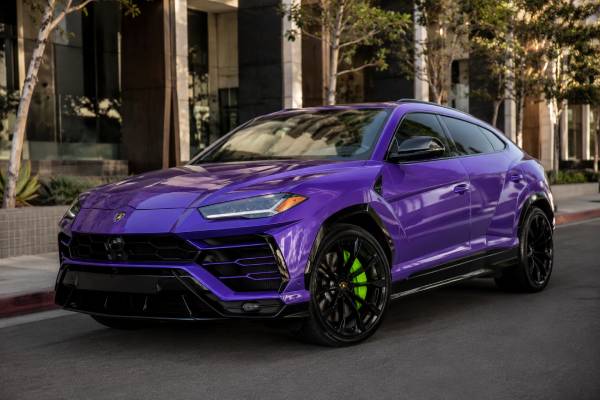
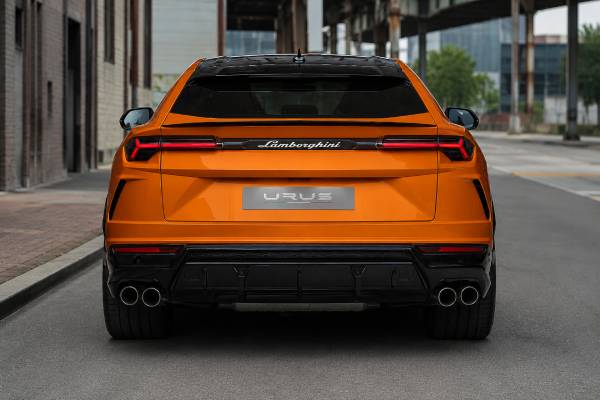
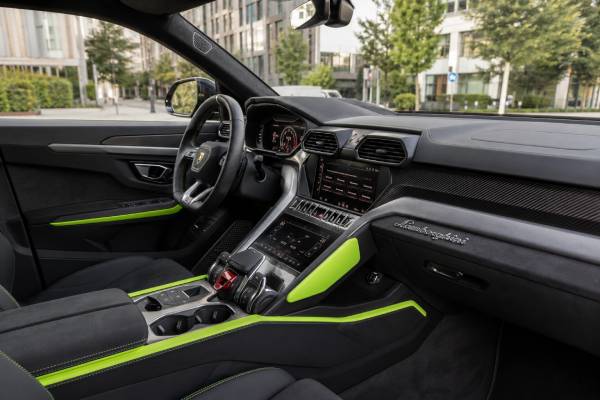
The Lamborghini Urus Pearl Capsule is not a separate high-output Urus; it is the 650 hp pre-facelift Urus with a factory design package that makes the car far more distinctive. For 2021 and 2022 buyers, that matters. The mechanical base is the same serious 4.0-liter twin-turbo V8 Super SUV, but the Pearl Capsule adds the visual drama many people expect from Lamborghini: vivid four-layer pearl paint, gloss-black contrast pieces, special 23-inch wheels, and a matching two-tone cabin. It sits in an interesting place in the Urus story, too. It came after the model had proved its commercial strength, before the later Urus S, Performante, and SE hybrid changed the line. For owners, the appeal is simple: everyday usability, supercar pace, and a specification that looks factory-special rather than merely option-heavy.
Table of Contents
- Why the Pearl Capsule Matters
- DHU V8 Specifications and Chassis Data
- Colors, Options, and Identification Details
- Design, Engineering, and Urus Character
- How It Drives on Road and Track
- Maintenance Risks and Ownership Reality
- Market Values and Buyer Checklist
Why the Pearl Capsule Matters
The Urus Pearl Capsule matters because it turns the early Urus into a more visibly Lamborghini product without changing the proven 650 hp hardware underneath. It is best understood as a factory styling and personalization package for the 2021 model year onward, aimed at buyers who wanted the Super SUV to feel brighter, rarer, and more expressive than a standard black, white, gray, or silver example.
The Urus itself was a major turning point for Lamborghini. It gave the brand a third model line and moved Lamborghini into the high-performance luxury SUV space with a product that could be used every day. Earlier Lamborghinis could be dramatic, loud, and impractical; the Urus kept the drama but added five doors, real cargo space, all-wheel drive, driver assistance systems, and a driving position suited to city traffic as well as open roads.
The Pearl Capsule arrived after the Urus had already become a commercial success. That timing is important. Lamborghini did not need to reinvent the car mechanically. Instead, it used color, contrast, wheels, trim, and cabin materials to make the Urus feel closer to the brand’s loudest supercars. In that sense, the Pearl Capsule is less about lap times and more about specification quality.
For collectors and buyers, the package has three main attractions:
- It is factory-built, not an aftermarket wrap or dealer cosmetic conversion.
- It uses the vivid colors most closely associated with Lamborghini’s modern identity.
- It gives the early 650 hp Urus a clearer identity before the later Urus S and Performante arrived.
The model code LB636 places this car in the original Urus generation. The DHU reference is commonly used in powertrain identification contexts for the 4.0-liter V8 specification covered here, but buyers should still verify engine, market, and equipment details by VIN rather than relying only on a listing headline.
The Urus Pearl Capsule is not rare in the way a numbered limited-production Lamborghini is rare. Lamborghini did not sell it as a one-of-100 collector special. Its desirability comes from configuration, condition, mileage, documentation, and whether the car still presents as a correct factory Pearl Capsule rather than a standard Urus made to look similar later.
DHU V8 Specifications and Chassis Data
The key technical fact is simple: the Pearl Capsule keeps the standard pre-facelift Urus powertrain, a 3,996 cc twin-turbocharged V8 rated at 650 hp and 850 Nm. That makes it fast enough to feel like a Lamborghini while still using an eight-speed automatic gearbox and permanent all-wheel drive suited to daily use.
| Item | Specification |
|---|---|
| Model generation | LB636 pre-facelift Urus |
| Engine | 4.0-liter 90-degree twin-turbocharged V8 |
| Displacement | 3,996 cc |
| Output | 650 hp / 478 kW at 6,000 rpm |
| Torque | 850 Nm from about 2,250 to 4,500 rpm |
| Valve gear | Four valves per cylinder, continuously variable camshaft adjustment |
| Transmission | Eight-speed automatic |
| Drivetrain | Permanent all-wheel drive with active rear torque vectoring |
| 0–100 km/h | 3.6 seconds |
| 0–200 km/h | 12.8 seconds |
| Top speed | 305 km/h |
| 100–0 km/h braking | About 33.7 meters |
The engine is part of the Volkswagen Group’s high-performance 4.0-liter V8 family, but Lamborghini tuning and vehicle integration give the Urus its own feel. It is not a high-revving naturally aspirated V10 or V12. It is a boost-rich, torque-heavy V8 designed to move a large SUV with authority. The broad 850 Nm torque plateau matters more in normal driving than the peak horsepower figure, because it gives the car immediate mid-range shove without needing constant downshifts.
The gearbox is a conventional torque-converter automatic rather than a dual-clutch unit. That choice suits the Urus. It gives smooth low-speed behavior, better towing and crawling manners, and strong launch performance, while still shifting quickly enough in Sport and Corsa modes. For an SUV that may see school runs, long highways, rough weather, and mountain roads, the eight-speed automatic is the right match.
| Area | Detail |
|---|---|
| Body structure | Lightweight aluminum and steel construction |
| Suspension | Multi-link front and rear with adaptive air suspension |
| Active systems | Electromechanical active roll stabilization and rear-wheel steering |
| Front brakes | Carbon-ceramic discs, 440 mm |
| Rear brakes | Carbon-ceramic discs, 370 mm |
| Wheelbase | 3,003 mm |
| Length | 5,112 mm |
| Width, excluding mirrors | 2,016 mm |
| Height | 1,638 mm |
| Ground clearance | About 158–248 mm, depending on air-suspension setting |
| Fuel capacity | 85 liters in many markets, 75 liters for U.S. market references |
| Luggage capacity | About 616–1,596 liters |
The carbon-ceramic brake package is one of the Urus’s defining engineering features. The front discs are enormous, and the system is designed to control repeated high-speed stops in a heavy, powerful vehicle. On a used car, however, carbon-ceramic brakes are also a major inspection item. A car can look perfect and still need very expensive brake work if discs are chipped, heat-damaged, heavily worn, or incorrectly cleaned.
Colors, Options, and Identification Details
The easiest way to identify a real Pearl Capsule is to look for the complete factory combination, not just bright paint. A correct car should have one of the signature pearl exterior colors, gloss-black contrast elements, dedicated wheel treatment, and a matching interior theme.
The three headline Pearl Capsule colors are:
- Giallo Inti, a vivid yellow pearl.
- Arancio Borealis, a bright orange pearl.
- Verde Mantis, a sharp green pearl.
The exterior treatment pairs those colors with gloss-black lower bumpers, rocker covers, roof, rear diffuser, spoiler lip, and other dark details. The 23-inch Taigete wheels in shiny black with a body-color accent are one of the package’s strongest visual clues. A standard Urus with aftermarket wheels, black trim, and a wrap can imitate the idea, but it will not carry the same factory specification value.
Inside, the Pearl Capsule uses a two-tone Alcantara and leather theme that matches the exterior color family. Lamborghini names include Verde Faunus, Arancio Leonis, and Giallo Taurus for the color accents. The cabin also uses Q-Citura hexagon stitching, dedicated embroidery, black anodized aluminum details, and carbon trim depending on the exact build.
The most desirable cars usually have a clean, coherent specification. That does not always mean the most expensive option list. A Pearl Capsule works best when the exterior, interior accent, wheel finish, stitching, brake caliper color, and trim choices all look intentional.
Factory options that affect desirability
Buyers should pay close attention to the option list because two Pearl Capsule cars can feel very different in use and value. Important options and equipment areas include:
- 23-inch Taigete wheels with the correct Pearl Capsule finish.
- Carbon interior and exterior trim packages.
- Ventilated and fully electric front seats.
- Four-seat rear layout versus five-seat rear bench.
- Bang & Olufsen 3D audio system.
- Head-up display.
- Full ADAS, Highway, or Urban Road assistance packages.
- Panoramic roof, where fitted.
- Off-road-oriented equipment, where specified.
- Rear-seat entertainment or market-specific connectivity features.
Four-seat cars feel more executive and special, but five-seat cars are often easier to live with and may suit families better. Neither is automatically “better.” The right choice depends on the buyer’s use case and the rest of the build.
Documentation and authenticity checks
The best proof of a Pearl Capsule is not a seller’s description. It is factory documentation. Before paying a premium, ask for:
- Original window sticker or factory build sheet.
- Lamborghini dealer option printout.
- VIN-based configuration report.
- Service history from authorized Lamborghini dealers or recognized specialists.
- Paint meter readings and body inspection.
- Clear photos of wheels, seat embroidery, trim, and interior accents.
- Recall completion records.
A genuine Pearl Capsule with repaint work, missing wheels, retrimmed seats, or non-original black exterior pieces may still be a good car, but it should not be valued like a complete and original example.
Design, Engineering, and Urus Character
The Pearl Capsule works because the Urus already has an aggressive shape that can carry loud color. The package does not fight the design; it sharpens it by using contrast to make the roofline, lower body, diffuser, wheels, and stance look more dramatic.
The Urus design borrows familiar Lamborghini cues and scales them up. The nose is angular and low for an SUV, the glasshouse is shallow, and the body sides use strong creases rather than soft surfacing. The hexagon theme appears throughout the cabin and exterior details. It is not subtle, but subtlety was never the point.
Under the skin, the Urus is a high-performance SUV built around an advanced mixed-material body and shared large-SUV architecture. That shared foundation helps with packaging, safety, refinement, and electronics, while Lamborghini-specific tuning gives the car its steering, suspension, drive-mode, and visual character.
The most important engineering systems are the ones that make the car feel smaller than it is:
- Rear-wheel steering helps low-speed maneuverability and high-speed stability.
- Adaptive air suspension changes ride height and firmness.
- Active roll stabilization keeps body movement under control in fast corners.
- Torque vectoring helps the rear axle rotate the car under power.
- Large carbon-ceramic brakes give the stopping performance expected of a 305 km/h SUV.
The ANIMA drive-mode selector is central to the car’s personality. Strada is the daily mode, Sport adds sharper throttle response and a louder attitude, and Corsa gives the most aggressive road behavior. Neve, Terra, and Sabbia modes support low-grip, dirt, and sand use when fitted and configured. EGO mode lets the driver mix steering, suspension, and powertrain settings.
Inside, the Urus feels more like a performance cockpit than a traditional luxury SUV. The seating position is low by SUV standards, the center console rises toward the driver, and the start switch has a theatrical fighter-jet-style cover. The dual-screen infotainment layout gives the cabin a modern look, but it also means buyers should test every screen, haptic control, climate function, camera view, and connectivity feature before purchase.
The sound is different from Lamborghini’s naturally aspirated cars. It is deeper, more muscular, and more turbocharged in character. It does not scream like a Huracán, but it has a hard-edged V8 bark under load, especially in Sport and Corsa. For many owners, that balance is the Urus’s charm: dramatic enough to feel special, restrained enough to use often.
How It Drives on Road and Track
The Urus Pearl Capsule drives like a very fast performance SUV, not like a lifted supercar. That distinction matters. Its pace is enormous, but its real skill is combining speed, grip, comfort, and bad-weather confidence in one car.
Acceleration is the first thing most drivers notice. The twin-turbo V8 gives hard, immediate thrust from low and medium revs. The car does not need to be wrung out to feel fast. In normal traffic, a small throttle input is enough to move decisively. On an open road, the gearbox drops gears quickly and the V8 pulls with a broad, forceful surge.
Launch control makes the published acceleration numbers believable when tires, temperature, and surface are right. The Urus squats, grips, and fires forward with very little drama for something so large. The experience is impressive partly because the car does not feel fragile or nervous while doing it.
Steering is quick and accurate, helped by rear-wheel steering. At low speeds, the rear axle helps the Urus feel less bulky in parking lots and tight streets. At higher speeds, it adds stability. The steering is not rich in old-school feedback, but it is precise and confidence-building.
The ride depends heavily on wheels, tires, suspension mode, and road quality. Pearl Capsule cars on 23-inch wheels look fantastic, but they give less sidewall protection than smaller wheels. On smooth roads, the car feels controlled and expensive. On rough urban roads, the big wheels can make impacts sharper. Buyers who plan to daily-drive in cities with poor roads should inspect wheels carefully for bends, cracks, curb damage, and tire sidewall bubbles.
The brakes are powerful, but brake feel can seem firm and slightly different from conventional steel brakes. Carbon-ceramic systems often feel best when warm and used decisively. On a test drive, the car should stop straight, without vibration, grinding, warning lights, or a long pedal.
In corners, the Urus hides weight better than expected. Active roll control keeps it flat, and the all-wheel-drive system helps the driver apply power early. Still, physics remains physics. This is a large SUV with wide tires and heavy running gear. It can be driven very quickly, but a skilled driver should leave more margin than in a lower, lighter supercar.
On long trips, the Urus is at its best. It has the speed to pass effortlessly, the traction to handle weather, the cabin quality to cover distance, and enough cargo space for real use. That is why many Urus examples have higher mileage than comparable Lamborghini coupes. Owners use them because they are usable.
Maintenance Risks and Ownership Reality
The Urus is more usable than most Lamborghinis, but it is still an exotic performance vehicle with exotic repair costs. The smartest ownership approach is preventive maintenance, VIN-based recall checking, and inspection by someone who knows the model before money changes hands.
Routine servicing is usually annual or mileage-based, depending on market guidance and usage. Oil and filter services are only the start. A proper service visit should include diagnostics, brake inspection, tire inspection, suspension checks, cooling-system checks, battery health, software updates, and a road test. Cars used hard, driven in hot climates, or run on large wheels over poor roads deserve closer attention.
Common ownership inspection areas include:
- Turbocharged V8 oil leaks, coolant leaks, and heat-related hose condition.
- Charge-air, intake, and cooling-system integrity.
- Engine mounts and drivetrain vibration.
- Eight-speed automatic shift quality in all modes.
- Front and rear differential or transfer-case noises.
- Air-suspension height changes, compressor behavior, and warning messages.
- Active roll-control faults or chassis-system alerts.
- Carbon-ceramic brake wear, chips, scoring, and pad condition.
- 23-inch wheel damage and uneven tire wear.
- Infotainment screens, camera systems, sensors, and software version.
- Battery age, especially on cars stored for long periods.
The braking system deserves special respect. Carbon-ceramic discs can last a long time under normal road use, but they are not immune to abuse. Track use, stone damage, aggressive cleaning chemicals, or incorrect handling can create expensive problems. A specialist should inspect disc thickness, surface condition, edge chips, pad life, and brake warning data.
Tires are another major cost and safety item. The Urus uses wide, high-performance tires that must match the car’s speed rating and load requirements. Mismatched tires, old date codes, uneven wear, or cheap replacements are warning signs. Poor alignment can quickly ruin a set of tires and may also point to impact damage.
Recall and campaign checks
Recall history should be checked by VIN, not by model year alone. For 2021–2022 cars, important areas include the small 2021 engine-cylinder-bore recall group, the 2021 rear middle seat belt automatic-locking-retractor campaign, and the 2022 infotainment or rearview camera recall affecting certain vehicles. Later camera-related campaigns may also apply to some Urus model years depending on market and software.
A completed recall is not automatically a problem. An unrepaired recall, unclear paperwork, or a seller who cannot explain the status is the issue. For a premium Pearl Capsule, the file should be clean and easy to verify.
Originality versus upgrades
Many Urus examples receive aftermarket wheels, lowering modules, exhausts, wraps, carbon pieces, tunes, and audio changes. Some upgrades are tasteful, but they can hurt value if they replace Pearl Capsule-specific parts or create warranty and diagnostic issues.
For buyers, originality is usually safer. Seek cars with factory wheels, factory paint, original trim, no engine tune, no warning lights, no accident history, and documented Lamborghini service. A modified car should cost less unless the work is reversible, documented, and done by a respected specialist.
Market Values and Buyer Checklist
The Pearl Capsule usually deserves a premium over an ordinary early Urus only when the car is genuine, complete, well documented, and in a desirable color. A bright factory Pearl Capsule with low mileage and the right options can stand out; a rough one with missing details is just an expensive used SUV with costly risks.
In the current used market, 2021–2022 Urus values vary widely by country, mileage, history, color, and options. In the United States, many 2021 cars sit around the high-$100,000 to low-$200,000 range, while cleaner, lower-mile, better-optioned Pearl Capsule examples can ask more. In the United Kingdom and Europe, mileage and tax structure can create a wider spread, with high-mile cars priced much lower than collector-grade examples.
The biggest value drivers are:
- Genuine Pearl Capsule specification.
- Low mileage with regular use, not long neglect.
- Complete Lamborghini dealer or specialist service history.
- Clean paint, original body panels, and no accident story.
- Correct 23-inch wheels and matching interior accents.
- Desirable exterior color, especially Verde Mantis, Giallo Inti, or Arancio Borealis.
- Strong option list without awkward color clashes.
- Remaining warranty, certified pre-owned coverage, or eligible extended warranty.
- Clean recall completion record.
- No questionable tuning or hidden modifications.
Pre-purchase inspection priorities
A serious buyer should treat the inspection like an exotic-car inspection, not a normal SUV check. The Urus may be practical, but repair costs are still Lamborghini-level.
| Area | What to verify |
|---|---|
| Identity | VIN, factory build sheet, Pearl Capsule option confirmation, market specification |
| Paint and body | Paint meter readings, panel gaps, gloss-black trim condition, evidence of repaint or wrap damage |
| Interior | Correct color split, stitching, embroidery, carbon trim, seat operation, leather and Alcantara wear |
| Powertrain | Cold start, leaks, boost behavior, engine faults, gearbox shifts, drivetrain noises |
| Chassis | Air suspension, active roll system, rear-wheel steering, alignment, wheel damage |
| Brakes | Carbon-ceramic disc condition, pad life, vibration, warning data, service records |
| Electronics | Infotainment screens, cameras, sensors, ADAS, keys, software updates, diagnostic scan |
| Paperwork | Service invoices, recall records, warranty status, ownership history, title status |
Avoid cars with vague service history, heavy modifications, unexplained warning lights, accident repairs, missing Pearl Capsule parts, mismatched tires, or sellers who refuse a specialist inspection. A cheap Urus can become expensive quickly if it needs brakes, tires, suspension work, infotainment repairs, and deferred service at the same time.
The best examples to seek are original, well-optioned, factory-bright cars with clean documentation and consistent maintenance. They are not necessarily the cheapest cars on the market, but they are the ones most likely to hold appeal as the Urus line moves further into later S, Performante, and hybrid SE generations.
Long-term collectability should be viewed realistically. The Pearl Capsule is desirable, but it is not a numbered lightweight special. Its future value will depend less on rarity claims and more on how many remain original, clean, and correctly documented. For an enthusiast who wants one Urus that looks unmistakably Lamborghini, the Pearl Capsule is one of the most satisfying early specifications.
References
- Urus Pearl Capsule Lamborghini | Lamborghini.com 2021 (Official Model Page)
- Lamborghini Urus Pearl Capsule: New Colors for New Adventures 2020 (Manufacturer News)
- Lamborghini Urus_EN 2017 (Technical Data)
- Gas Mileage of 2021 Vehicles by Lamborghini 2021 (Official Fuel Economy)
- Part 573 Safety Recall Report 21V-336 2021 (Recall Database)
Disclaimer
This article is for informational purposes only and is not a substitute for professional diagnosis, repair advice, or a pre-purchase inspection by a qualified Lamborghini technician. Specifications, torque values, service intervals, recall applicability, software requirements, and repair procedures can vary by VIN, market, production date, and equipment. Always verify details against official Lamborghini service documentation and current VIN-based records before buying, servicing, or modifying any vehicle.
Please share this guide on Facebook, X/Twitter, or your preferred car community if it helped you. Your support helps us keep producing detailed enthusiast and buyer resources.