

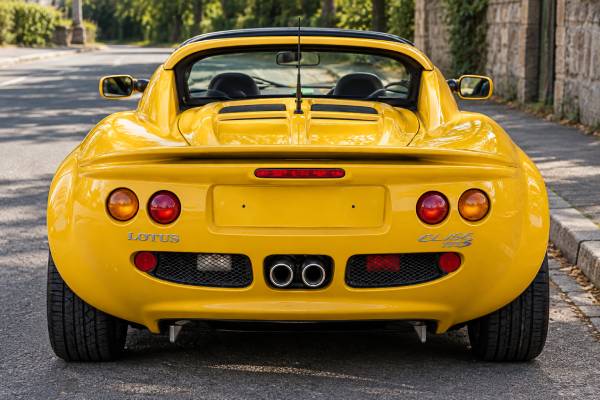
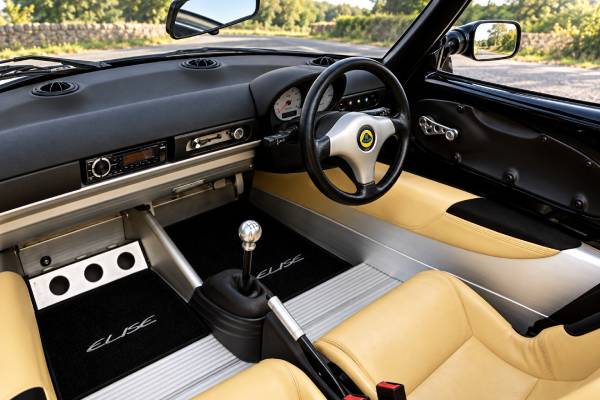
The Series 1 Lotus Elise 111S is the road-focused high-performance S1 for drivers who want more speed without the sharper compromises of the Sport 160. Introduced in 1999, it pairs the Elise’s bonded aluminium chassis with Rover’s 1.8-litre K-series VVC engine, raising output to 143 bhp and broadening the useful power band through mechanically variable inlet-cam control. Lotus also matched the engine with closer gearing and wider rear tires, creating a car that is meaningfully quicker than the 118 hp Elise while remaining tractable in everyday use. The 111S has its own ownership details: the VVC mechanism adds complexity, the engine uses a second small timing belt for the rear cam drive, and cars of this age need careful cooling-system and chassis inspection regardless of mileage. It is also a variant whose identity can be blurred by later wheels, spoilers, engine swaps, and tuning parts. A good one feels neither like a basic Elise with extra trim nor like a nervous track special—it is a cohesive, flexible, very light road car.
Table of Contents
- VVC Changes the S1 Character
- How Rover VVC Works
- Elise 111S Core Data
- Gearbox, Tires, and Real-World Pace
- VVC-Specific Service Points
- Buying a 111S With Confidence
- Preserve, Upgrade, or Drive
- Diagnosing VVC Behaviour Before Buying Parts
- Setting Up a 111S for Fast-Road Use
VVC Changes the S1 Character
The 111S adds performance without abandoning the Elise’s usable road manners. Its 143 bhp VVC engine revs harder than the base K-series yet still delivers torque progressively, making it easier to exploit away from a racetrack than a more aggressively cammed engine.
Lotus launched the 111S in March 1999 after the project had circulated under the Sprint name. Rover’s VVC engine was the central change. Peak power rose to 143 bhp at 7,000 rpm, while torque reached roughly 174 Nm around 4,500 rpm. Period performance figures put 0–60 mph in the mid-five-second range and top speed around 133 mph.
Those numbers only partly explain the difference. The standard 118 hp Elise makes its torque low and feels brisk because the car is light. The 111S keeps pulling as revs rise, so overtakes can be completed in a lower gear with a stronger top-end surge. The effect is smooth rather than step-like; unlike a simple two-profile system that suddenly switches to a high-lift cam, Rover VVC continuously alters the effective duration of the inlet cam events through a mechanical control mechanism.
The 111S also received visual and chassis details that help identify it: six-spoke wheels, wider 225-section rear tires, a rear spoiler, revised grille treatment, and distinctive interior trim on many cars. Specifications changed over time and individual cars have often been personalized, so factory appearance should be verified against build history rather than a single internet photo.
A close-ratio gearbox is a major part of the performance gain. Keeping the engine nearer its stronger rev range makes the car feel more alert even before the extra horsepower is counted. That also means motorway engine speed can feel busier than in a standard S1.
How Rover VVC Works
Rover’s VVC system varies inlet-valve event duration continuously rather than simply switching between two cam profiles. For an owner, the practical consequence is a broad torque curve and a more complex cylinder-head drive system that deserves specialist knowledge.
The K-series VVC head uses mechanisms at the inlet camshafts to alter camshaft motion relative to the drive. The system can change how long the inlet valves remain open as engine speed and load vary. Engine management controls the VVC mechanism hydraulically. At low and medium speeds the engine can maintain useful torque and drivability; at higher speed it can extend valve duration to support airflow and power.
That design is technically elegant but adds components not found on the standard 18K4F. The VVC mechanism can develop wear or noise, and correct diagnosis matters because not every top-end sound means the same failure. Oil quality and level are important because the mechanism depends on clean lubrication and hydraulic control.
The timing arrangement is also easy for a non-specialist to misunderstand. The main timing belt at the front of the engine is not the whole story: the VVC engine uses an additional short belt at the rear to drive the second cam arrangement. A service invoice that says only “cam belt” should be checked to see exactly which belts, tensioners, seals, and related parts were changed.
The 111S therefore rewards a specialist familiar with Rover VVC rather than a workshop that knows only the ordinary K-series. A competent technician can distinguish normal mechanical character from worn VVC components, verify timing, and inspect the cooling system at the same visit.
Elise 111S Core Data
The 111S is a mid-engined, naturally aspirated petrol ICE sports car using Rover’s 1,796 cc VVC K-series and a five-speed manual transaxle. It retains the S1’s bonded aluminium structure while adding power, shorter effective gearing, and wider rear rubber.
| Specification | Value |
|---|---|
| Engine code/family | Rover K-series 18K4K VVC |
| Displacement | 1,796 cc (1.8 L) |
| Bore × stroke | 80.0 × 89.3 mm |
| Construction | Aluminium block and cylinder head |
| Valvetrain | DOHC, 16 valves, VVC on inlet valve operation |
| Induction | Naturally aspirated |
| Maximum power | 143 bhp (about 105 kW) at 7,000 rpm |
| Maximum torque | About 174 Nm (128 lb-ft) at 4,500 rpm |
| Timing drive | Main toothed belt plus VVC rear cam belt |
| Specification | Value |
|---|---|
| 0–60 mph | Approximately 5.4 seconds in period figures |
| 0–100 mph | Approximately 14.4 seconds in period figures |
| Top speed | Approximately 133 mph (214 km/h) |
| Power delivery | Progressive variable inlet-cam duration with strong high-rpm breathing |
| Specification | Value |
|---|---|
| Transmission | 5-speed manual transaxle |
| Gearbox character | Closer ratios than the standard S1 application |
| Drive | Rear-wheel drive |
| Clutch | Hydraulic operation |
| Differential | Open differential in standard road configuration |
| Specification | Value |
|---|---|
| Chassis | Epoxy-bonded aluminium extrusion structure |
| Body | Composite panels with removable clamshell assemblies |
| Suspension | Independent unequal-length double wishbones front and rear |
| Steering | Unassisted rack and pinion |
| Rear tire width | 225-section factory fitment on 111S specification |
| Brakes | Four-wheel disc system; check exact production specification on the individual car |
| Specification | Value |
|---|---|
| Seating | 2 |
| Wheelbase | 2,300 mm (90.6 in) |
| Length | 3,726 mm (146.7 in) |
| Width excluding mirrors | 1,701 mm (67.0 in) |
| Engine location | Mid-mounted, transverse |
| Item | Why it matters |
|---|---|
| Main timing belt | Age-related failure can cause severe engine damage |
| Rear VVC belt | Often overlooked by owners unfamiliar with the VVC head |
| Cooling system | Stable temperature and correct bleeding are critical to K-series longevity |
| VVC mechanism | Needs correct oil level, clean lubrication, and diagnosis of abnormal top-end noise |
| Geometry | Small alignment errors noticeably affect Elise steering and tire wear |
Gearbox, Tires, and Real-World Pace
The 111S feels faster than a standard S1 not only because it has 25 more horsepower, but because Lotus matched the VVC engine to gearing and rear-tire capacity that help keep it in its productive rev range.
The close-ratio five-speed is especially noticeable on a fast B-road. A downshift places the VVC engine closer to the part of the rev range where airflow and power build, so acceleration continues more strongly toward 7,000 rpm. The trade-off is increased engine speed in cruising conditions. A buyer expecting modern long-legged gearing may initially think the car needs another ratio; in context, the gearing is a deliberate performance choice.
The wider 225-section rear tires add traction and help support the extra pace. They also make tire choice important to balance. Fitting a very sticky modern rear tire with an unrelated front compound can move the handling balance in unexpected ways. On an Elise, matched axle pairs, suitable compounds, correct pressures, and fresh date codes are more important than chasing the widest available rubber.
The steering remains unassisted. At parking speed it has some weight, but once rolling it becomes one of the car’s main advantages. The driver receives information about front-tire load before the car reaches the limit. That makes the 111S approachable despite its mid-engined layout, provided geometry and tires are correct.
Brake feel should be firm and linear. Cars that have spent years doing track days may have upgraded pads, hoses, fluid, or discs. These changes can be useful, but check for heat damage, cracked discs, seized calipers, and old racing fluid that has not been refreshed. “Track prepared” should mean more maintenance, not less.
VVC-Specific Service Points
The 111S has the same broad ageing issues as any S1 plus several VVC-specific checks. Preventive servicing is cheaper than diagnosing a mistimed or overheated engine after damage occurs.
Start with belt history. Confirm dates and mileage for both the primary timing belt and the small VVC belt. Ask whether tensioners and water pump were inspected or replaced as appropriate. If the paperwork is unclear, price the work immediately after purchase.
Listen to the top end at idle and through a gentle increase in rpm. Some mechanical noise is normal, but pronounced rattling or irregular noises from the VVC mechanism justify specialist assessment. Do not accept “all VVC engines sound like that” without comparison to a known healthy car.
The cooling system deserves the same discipline as the base K-series. Inspect the front radiator, long coolant pipes, hoses, expansion tank, cap, fan operation, and signs of dried coolant. A correct head-gasket repair is not a reason to reject a car; repeated unexplained overheating is. Good invoices should describe the condition of the cylinder head and cooling components rather than merely recording a gasket replacement.
Oil service affects the VVC mechanism as well as the bearings and hydraulic tappets. Use an oil grade and specification appropriate to Lotus/Rover guidance and the car’s operating conditions. Check level frequently if the car is driven hard. Long storage intervals are not a reason to stretch annual oil changes indefinitely.
At this age, ancillary systems matter too. Inspect engine mounts, clutch hydraulics, gear linkage, driveshaft boots, wheel bearings, ball joints, dampers, toe links, and brake hoses. The Elise is so light that a single worn damper or alignment problem is easy to feel.
Buying a 111S With Confidence
The best 111S is the car with a sound aluminium tub, a healthy VVC engine, complete belt and cooling history, and coherent specification. Cosmetic perfection comes after those fundamentals.
Verify identity through VIN, engine details, registration records, and build documentation. The 111S was widely modified when it was simply a used sports car. Some now wear Sport 160-style parts, aftermarket wheels, different spoilers, replacement engines, or upgraded ECU hardware. Changes are not automatically negative, but they affect originality and should be documented.
A specialist inspection should focus on the aluminium chassis and crash structures. Look for crushed jacking points, distorted suspension pickups, corrosion at dissimilar-metal interfaces, and evidence of drilling or welding. The tub is not repaired like a conventional steel monocoque. Any major structural work should have a credible paper trail.
Then inspect the powertrain from cold. The engine should start promptly, settle without severe hunting, warm steadily, and restart hot. Once temperature is stable, use the rev range progressively and check that power builds smoothly. Hesitation at high rpm, misfire under load, coolant loss, or smoke are reasons to stop and diagnose.
The transmission should select all ratios cleanly. A clutch with a very high bite point, slip under full throttle, or poor disengagement can indicate work ahead. Gearshift slop may be linkage related, but crunching should not be ignored.
Finally, look at age rather than odometer alone. Ten-year-old tires on a 20,000-mile car are a liability. Dampers, bushes, belts, coolant, fuel hoses, battery cables, and brake fluid all deteriorate with time. A 70,000-mile car maintained continuously can be the better buy.
Preserve, Upgrade, or Drive
A good 111S occupies a useful middle ground: collectible enough to preserve thoughtfully, yet common and usable enough to enjoy regularly. The smartest modifications improve condition and consistency without obscuring what makes the variant special.
For a road car, start with restoration rather than tuning. Fresh correct tires, geometry, dampers, bushings, brake fluid, a reliable radiator, and a fully serviced VVC engine can transform a tired example. Many owners discover that the “need” for more power disappears once the chassis is working as Lotus intended.
If performance modifications are desired, keep original parts and document everything. Intake and exhaust changes can alter noise more than speed. Aggressive cams or head work may compromise the broad VVC character that differentiates the 111S from other S1 variants. ECU calibration should be undertaken by someone who understands the specific VVC hardware.
For occasional track use, maintenance cadence should tighten. Inspect brakes, tires, wheel bearings, toe links, fluid levels, and coolant before and after events. High lateral loads and sustained rpm expose weaknesses that gentle road mileage may never reveal.
For collectors, provenance is increasingly important. Original six-spoke wheels, spoiler, interior details, sales paperwork, keys, manuals, and service invoices add confidence. A car with reversible period modifications and all original parts retained can be more appealing than one restored with reproduction pieces but little history.
The 111S is ultimately valuable because of the way its systems complement each other. The VVC engine adds high-rpm energy without turning the car into a peaky special, the close gearbox keeps it responsive, and the S1 chassis still dominates the experience. It is a faster Elise without becoming a fundamentally different kind of Elise.
Diagnosing VVC Behaviour Before Buying Parts
A VVC engine that feels wrong should be diagnosed methodically because several unrelated faults can produce the same complaint. Hesitation, weak top-end power, rough idle, and mechanical noise do not automatically mean the VVC mechanism itself has failed.
Begin with fundamentals. Verify compression, cam timing, ignition condition, fuel pressure, injector operation, throttle position, manifold pressure sensing, coolant-temperature input, and exhaust restriction. A tired ignition lead or weak fuel pump can become obvious only under load, exactly where an owner expects the VVC system to be doing its best work.
Next consider oil. The VVC hardware depends on correct lubrication and hydraulic control, so level, viscosity, contamination, and pressure matter. An engine filled with the wrong oil after a generic service can behave differently from one maintained to the proper specification. Heavy deposits are also a warning sign on an engine whose complex top end relies on clean oil passages.
Mechanical noises require localization. A stethoscope and an experienced ear are more useful than forum descriptions of “a rattle.” Noises from the alternator, tensioners, exhaust heat shields, clutch release mechanism, or timing belt area can be transmitted through the lightweight structure and mistaken for cylinder-head trouble.
Cam timing deserves special attention after belt service. The VVC head is more involved than the fixed-cam K-series, and a car can run while still being mistimed enough to lose performance. Ask who performed the work and whether the technician used the correct locking and timing procedures.
The small rear VVC belt is another reason service history matters. Owners accustomed to the base K-series may simply overlook it. When comparing two cars, a higher-mileage 111S with invoices for both belts, tensioners, coolant work, and VVC inspection is usually a safer proposition than a lower-mileage example with vague “full service” stamps.
On a test drive, evaluate the engine across several conditions. At low speed it should accept throttle without excessive bucking. Through the middle range it should pull cleanly. At higher revs it should continue to build power rather than flatten suddenly. Repeat the test after a hot soak and restart, because some ignition, sensor, and heat-related faults appear only then.
Also watch the exhaust. A puff after long overrun can suggest different issues from continuous smoke under load. Sweet-smelling white vapor after full warm-up, persistent blue smoke, or heavy crankcase pressure all justify deeper investigation. Do not confuse normal condensation on a cold morning with a cooling-system failure.
If repairs are needed, preserve the character of the engine. The 111S is appealing because the VVC system gives it breadth. Converting to fixed aggressive cams can create more peak power but remove the progressive road manners that distinguish this version. For a road car, restoring correct factory operation is often the most satisfying “tuning” available.
The same philosophy applies to the rest of the car. Diagnose before replacing, measure before aligning, and fix the cause before modifying the symptom. An Elise is sensitive enough that careful baseline work is immediately obvious from the driver’s seat.
Setting Up a 111S for Fast-Road Use
A fast-road 111S should be set up for confidence on imperfect surfaces, not for the lowest ride height. The factory car already has enough power and rear tire to move quickly, so the most useful gains come from making steering, damping, braking, and tire behavior consistent.
Start with tires of the correct dimensions and a compound that works from cold. Track-oriented rubber can be outstanding once hot but disappointing in rain or on a short road journey. Match front and rear tire families where possible, and measure pressures cold before changing alignment to cure a problem that may simply be pressure related.
Next inspect ride height and damper condition. If adjustable suspension is fitted, record current settings before changing anything. The front must retain enough bump travel to absorb compressions without riding the bump stops. A car that bottoms in a corner can suddenly lose front grip even though it felt sharp on smooth pavement.
Geometry should be set only after mechanical wear is eliminated. Rear toe-link play is especially important because rear toe changes under load can make a mid-engined car feel unpredictable. Check ball joints, wheel bearings, steering joints, bushes, and wishbone condition, then align the car on a level rack with the driver load strategy recommended by the specialist.
Brake preparation is simple. Fresh high-quality fluid, healthy discs, correct pads, free-moving calipers, and sound hoses are more important than cosmetic multi-piston upgrades. For road use, choose a pad that develops friction from low temperature and does not require repeated hard stops to work properly.
Seats and driving position also matter. The Elise communicates best when the driver is braced without clinging to the steering wheel. Ensure the seat is secure, pedals can be operated without stretching, and the steering wheel is correctly positioned. A loose driving position makes the car feel busier than it is.
Finally, establish a repeatable warm-up routine. Keep revs and load moderate until coolant has stabilized and the oil has had additional time to reach temperature. Once warm, use the VVC engine fully rather than lugging it in a high gear. Its broad delivery means it can be driven smoothly, but the strongest acceleration still comes from deliberate gear selection.
A good fast-road setup should make the 111S easier to drive, not more dramatic. If steering becomes nervous, ride harshness increases, or wet grip deteriorates, the changes have probably moved away from the balance that made the car effective in the first place.
References
- The Lotus Elise 111S 2000 (Model Technical Information)
- The Lotus Elise S1 2002 (Model Technical Information)
- Lotus Elise S1 Service Manual 1996 (Service Manual)
- Lotus Elise S1 Service Manual 1996 (Service Notes PDF)
- LOTUS ELISE Service Manual (complete) 1996 (Service Manual)
Disclaimer
This article is for informational purposes and is not a substitute for professional diagnosis, inspection, or repair. Specifications, torque values, service intervals, parts, and procedures can vary by VIN, market, production change, and equipment, so verify all work using the official Lotus and Rover documentation for the individual vehicle.
Please share this guide on Facebook, X/Twitter, or your preferred Lotus community if it was useful and you would like to support our work.