
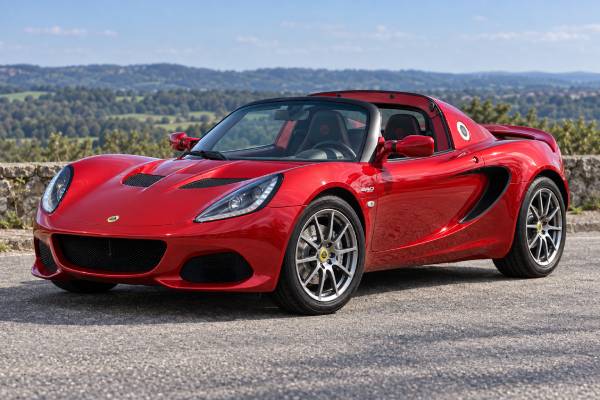
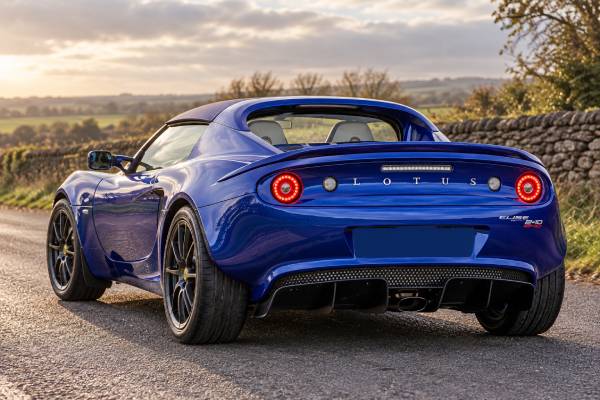
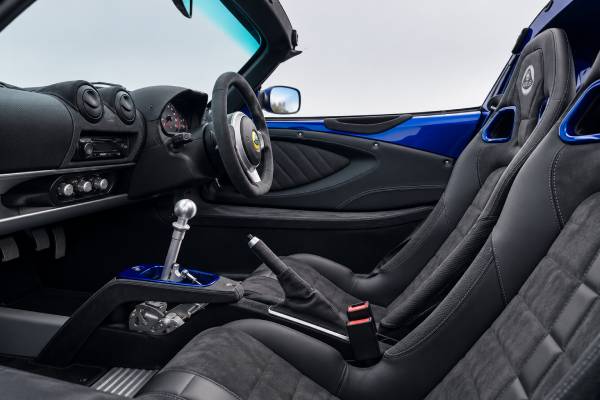
The 2021 Lotus Elise Sport 240 Final Edition is the road-focused farewell to the Elise, pairing the familiar supercharged 1.8-liter 2ZR-FE with a revised 240 bhp calibration, 244 Nm, lightweight forged wheels, TFT instruments, a redesigned steering wheel, and model-specific Final Edition trim. Lotus quoted 922 kg in standard form and as little as 898 kg with all available lightweight options, giving the car a power-to-weight ratio of roughly 260 bhp per tonne. Unlike the Cup 250 Final Edition, the Sport 240 does not depend on a large wing and aggressive track aero to define its character. It is the purer roadster conclusion: fast, compact, open, and still centered on manual steering and a six-speed manual gearbox. That makes it attractive both to drivers and collectors. Buyers should resist treating low mileage as the only measure of quality. A Final Edition that has spent years stored with old fluids, aged tires, a weak battery, or damp interior can need more work than a regularly exercised example with careful records and complete original equipment.
Table of Contents
- Why the Sport 240 Is the Road-Focused Finale
- Engine Calibration and Real-World Performance
- Sport 240 Final Edition Technical Data
- Lightweight Options and Final Edition Equipment
- Maintenance on a Low-Mileage 2021 Elise
- Road Use, Modifications, and Long-Term Ownership
- Buying and Authenticating a Sport 240
Why the Sport 240 Is the Road-Focused Finale
The Sport 240 Final Edition is the final evolution of the road-oriented Sport 220 rather than a softened Cup. It adds power and equipment while preserving the classic roadster shape, removable roof, relatively clean aero, and everyday usability that made the Sport 220 the broadest late-Elise choice.
Lotus announced the car in February 2021 as Elise production approached its end after 25 years. The Sport 240 replaced the Sport 220 and gained an extra 23 bhp through revised engine calibration. The model name reflects 240 bhp, while some metric references list about 243 PS.
The final model also gained a new TFT instrument panel with two display styles, a flatter-bottomed leather/Alcantara steering wheel, Final Edition badging, new trim combinations, and heritage-inspired colors. These features gave the old platform a visible sense of occasion without burying it under modern convenience systems.
Standard forged wheels were lighter than the preceding Sport 220 wheels, helping keep mass to a quoted 922 kg. Optional carbon-fiber panels, lithium-ion battery, and polycarbonate rear window could lower the figure to about 898 kg. That lightest value depends on the full option combination and should not be applied to every Sport 240 advertised for sale.
Compared with the Cup 250 Final Edition, the Sport 240 has less power and far less high-speed aero. In exchange, it is easier to use on the road, less vulnerable to splitter and wing damage, and visually closer to the simple Elise form. For a buyer who values B-roads more than lap times, that may make it the more satisfying final car.
Engine Calibration and Real-World Performance
The extra power is noticeable, but the Sport 240’s biggest virtue is still the relationship between output and mass. With only about 922 kg to move, 240 bhp produces rapid acceleration without needing an oversized engine or complex drivetrain.
The 2ZR-FE remains a 1,798 cc Toyota-derived inline-four with dual variable valve timing. Lotus’s supercharger and charge-cooler system are carried over in concept, while the engine calibration raises output to 240 bhp at 7,200 rpm and broadens torque delivery to roughly 244 Nm from around 3,000 to 7,000 rpm in official Final Edition data.
Lotus quoted 0–60 mph in about 4.1 seconds, while 0–100 km/h is around 4.5 seconds. Maximum speed is approximately 237 km/h. These figures put the Sport 240 close to earlier Cup performance while preserving a road-biased body and tire setup.
Throttle response is immediate because the supercharger is mechanically driven. That makes the car easy to balance in a corner: small throttle changes create predictable changes in rear-tire load. There is no heavy all-wheel-drive system or turbo lag to dilute the relationship.
The six-speed manual remains central. Later exposed linkage gives the shift action a precise, mechanical character when properly adjusted. A worn linkage, tired clutch, or dragging cable can therefore be especially obvious because the rest of the control set is so clean.
Road speed builds quickly, but the car remains enjoyable below the limit. The unassisted steering communicates texture and load, the narrow body fits small roads, and low mass means braking and direction changes feel immediate. That is the practical reason the Final Edition is more than a collector’s badge exercise.
Sport 240 Final Edition Technical Data
The Sport 240 uses a supercharged and charge-cooled 1.8-liter engine, six-speed manual transmission, and rear-wheel drive in the classic two-seat Elise roadster layout. The figures below reflect published 2021 Final Edition specifications; individual-market equipment and homologation can differ. **Engine and drivetrain**
| Item | Specification |
|---|---|
| Engine | Toyota 2ZR-FE inline-four |
| Displacement | 1,798 cc |
| Valvetrain | DOHC, 16 valves, dual VVT-i |
| Induction | Supercharged with charge cooling |
| Maximum power | 240 bhp (approximately 243 PS) at 7,200 rpm |
| Maximum torque | 244 Nm from approximately 3,000–7,000 rpm |
| Transmission | 6-speed manual |
| Drive | Rear-wheel drive |
**Performance, economy, and mass**
| Measure | Published figure |
|---|---|
| 0–60 mph | Approximately 4.1 seconds |
| 0–100 km/h | Approximately 4.5 seconds |
| Top speed | Approximately 237 km/h |
| Standard quoted mass | 922 kg |
| Lightest quoted mass with options | 898 kg |
| Combined WLTP consumption | About 7.8 L/100 km |
| Combined CO2 | About 177 g/km |
**Chassis and suspension**
| Item | Specification |
|---|---|
| Chassis | Bonded extruded-aluminum Type 111 structure |
| Body | Composite roadster panels |
| Front suspension | Independent double wishbones |
| Rear suspension | Independent double wishbones |
| Dampers | Bilstein gas dampers |
| Springs | Eibach coils |
| Steering | Manual rack-and-pinion |
**Wheels and tires**
| Position | Specification |
|---|---|
| Front wheels | 10-spoke forged 16-inch wheels |
| Rear wheels | 10-spoke forged 17-inch wheels |
| Front tires | 195/50 R16 |
| Rear tires | 225/45 R17 |
| Period tire family | Yokohama V105 road-performance specification |
| Wheel saving | About 0.5 kg per wheel versus the cited Sport 220 wheel |
**Dimensions and utility**
| Item | Specification |
|---|---|
| Length | 3,824 mm |
| Width | 1,719 mm excluding mirrors |
| Height | 1,117 mm |
| Wheelbase | 2,300 mm |
| Seats | 2 |
| Luggage volume | About 112 liters in some European data |
| Roof | Removable roadster roof arrangement |
**Final Edition ownership checks**
| Item | What to verify |
|---|---|
| TFT display | Both display modes, warnings, backlighting, switch operation |
| Battery | Correct charger for battery chemistry, especially if lithium option fitted |
| Optional carbon | Factory documentation and damage at mounting points |
| Polycarbonate rear window | Scratches, hazing, correct cleaning history |
| Forged wheels | Bends, cracks, refinishing quality, correct dimensions |
| Original parts | Retain all replaced Final Edition-specific pieces |
Lightweight Options and Final Edition Equipment
The 898 kg figure is an option-dependent lightweight target, not the universal weight of every Sport 240. Buyers should verify which factory options are present and avoid paying for a “lightweight spec” based only on an advertisement claim.
Lotus offered carbon-fiber sill covers, engine cover, and other lightweight panels depending on market. A lithium-ion battery reduced mass further, while a polycarbonate rear window saved weight high in the body. Together with the forged wheels, these parts produced a meaningful cumulative reduction.
Factory carbon should be inspected for cracks, delamination, UV damage, and stressed mounting points. Cosmetic weave imperfections can occur, but structural cracks are different. Replacement panels may be expensive or difficult to source now that production has ended.
The polycarbonate window needs different care from glass. Abrasive cleaning can haze it, and deep scratches may be difficult to polish without distortion. If the car will be used regularly, treat the panel as a lightweight component rather than expecting glass-like durability.
The TFT cluster and steering wheel are not weight-saving items but are important to authenticity. Test them carefully. A non-functional display is more than an annoyance because it houses critical vehicle information.
Heritage-inspired colors are another Final Edition feature. Some echo early Elise press cars or significant Lotus schemes. Color can influence desirability, but a rare shade should never compensate for weak service history or structural concerns.
Maintenance on a Low-Mileage 2021 Elise
A low-mileage Final Edition still requires time-based care. Fluids absorb moisture, batteries degrade, tires harden, seals age, and brakes can corrode while a car sits.
Brake fluid is the easiest example. It should be replaced by time, not merely mileage, because absorbed water reduces boiling point. A collector car driven only a few hundred miles per year can still need fluid servicing.
Tire age is equally important. Original tires may add historical interest but can lose grip. Check date codes and sidewalls. If preserving originality matters, store the original tires separately and drive on fresh replacements.
The battery should be kept charged with a compatible maintainer. If a lithium-ion option is fitted, a charger intended only for conventional lead-acid batteries may be unsuitable. Repeated deep discharge is particularly undesirable.
Cooling systems benefit from regular use. Verify main radiator condition, fan operation, coolant level, and charge-cooler circulation. A car stored for months can develop small leaks or sticky electrical connections that only appear once fully hot.
Engine oil should be changed according to time and use. The 2ZR-FE’s chain-driven valvetrain and variable timing depend on clean oil. Low annual mileage does not make old oil permanently fresh.
Air conditioning, if fitted, should be operated periodically and tested. Repairs can involve significant labor because the Elise packages components tightly. Weak cooling may indicate low refrigerant, leaks, or other system faults rather than simply “that’s how Elises are.”
Road Use, Modifications, and Long-Term Ownership
The Sport 240 is one of the Elise versions least in need of modification. Its factory balance is already strong, and preserving reversibility is sensible because Final Edition-specific parts have growing provenance value.
A quality exhaust can improve sound and save weight, but keep the original. Intake changes should avoid drawing hot engine-bay air and should not interfere with sensors or emissions equipment. ECU tuning is possible, but the factory calibration is part of the model’s identity and already provides excellent performance.
Suspension upgrades make more sense when dampers eventually age. Use components chosen for road ride height and travel unless the car has a clear track mission. Excessive lowering can worsen bump steer, ground clearance, and ride quality.
Paint-protection film can be worthwhile because the low nose attracts stone chips. Well-installed film protects original paint; old or poorly applied film can yellow, lift at edges, or conceal cracks. Inspect it in strong light.
For long-term storage, avoid simply parking the car and forgetting it. Keep the fuel system, battery, tires, and brakes in mind. Periodic gentle use brings the drivetrain to temperature, circulates fluids, and exposes small issues before they become larger.
The cabin also benefits from dry storage. Check roof seals and window alignment, and do not leave the interior damp. Moisture can attack seat runners, fasteners, electrical contacts, and trim even though the main chassis is aluminum.
Buying and Authenticating a Sport 240
Authentication starts with the VIN and factory specification, not badges. Confirm that the car is a genuine 2021 Sport 240 Final Edition and document which lightweight options it received when new.
Look for the TFT cluster, Final Edition plaque, correct steering wheel, forged wheel design, trim details, and model-appropriate paint. Ask for the original sales invoice and any certificate or build information supplied by the dealer.
Inspect the aluminum tub from below. Low mileage does not prevent jack damage or transport damage. Look for crushed points, unusual holes, deformed suspension mounts, or suspicious fresh adhesive. Any structural concern should be referred to a Lotus specialist.
Check composite panels for stress cracks and evidence of repair. Paint meters are less decisive on composites than on steel, so use visual and documentary evidence. A well-repaired stone-damaged clam is less concerning than a poorly explained structural incident.
Warm the car fully. Monitor coolant temperature, check supercharger consistency, use every gear, and test clutch take-up. Confirm the TFT shows no unexplained warnings. After the drive, look for fluid leaks and coolant smell. **Sport 240 Final Edition purchase checklist**
| Area | Best evidence | Potential problem |
|---|---|---|
| Identity | VIN and invoice confirm Sport 240 Final Edition | Badges with no supporting paperwork |
| Options | Factory list proves carbon, lithium, and polycarbonate equipment | Lightest-weight claim with no evidence |
| Storage | Dry garage, battery maintenance, time-based services | Long static periods with old fluids and tires |
| Chassis | Straight, undrilled, correctly lifted | Unknown repair or distorted mounting point |
| Electronics | TFT and all switches fully functional | Intermittent warnings or dead display functions |
| Original parts | Complete and retained | Final Edition-specific pieces discarded |
The Sport 240’s strongest appeal is that it closes the Elise story without abandoning the qualities that made the original important. It is quicker, more polished in presentation, and more powerful than the early cars, but it still weighs less than many modern city cars and asks the driver to steer, shift, and manage grip directly.
That makes it one of the rare collectible cars that is difficult to justify leaving unused. Preserve the original specification, maintain it by time and condition, and drive it enough to keep systems healthy. A well-kept Sport 240 can serve both sides of its Final Edition identity: a documented piece of Lotus history and a deeply engaging road car whose engineering only makes full sense when the road begins to twist.
Sport 240 versus Cup 250 Final Edition
The two 2021 Elise Final Editions serve different buyers. The Sport 240 is the cleaner road car: less aero, a removable-roof emphasis, road-focused tires, and a slightly softer visual character. The Cup 250 adds functional splitter, wing, diffuser, wider front wheels, more downforce, and stronger circuit intent. Neither is simply the “better” Final Edition.
For mostly road use, the Sport 240’s simpler bodywork is easier around ramps, speed humps, and parking spaces. Its Yokohama V105-type road tires also have a broader everyday operating window than a more track-biased compound. On fast circuits, however, the Cup’s aero and front-end package justify their compromises.
The Sport 240 can therefore be the more faithful successor to the earliest Elise idea even though it is far faster and better equipped: low weight, open body, modest visual aggression, and direct controls. Buyers should choose based on use rather than the assumption that the higher-priced Cup is automatically more desirable.
Establishing a preservation-friendly maintenance routine
A Final Edition that will cover only a few thousand kilometers per year benefits from a calendar-based plan. Record the date of oil, brake-fluid, coolant, battery, and tire changes, then inspect the car before each driving season. Low mileage can stretch wear-based items, but it should not stretch moisture-sensitive fluids or rubber indefinitely.
Exercise the air conditioning if fitted, operate windows and locks, and move the roof mechanism so seals do not remain compressed in one position forever. Check the cabin after rain and keep the car ventilated when stored. A dehumidified garage can protect fasteners, seat runners, and electrical contacts, but avoid making the environment so dry or hot that rubber ages prematurely.
Clean forged wheels with non-aggressive products and inspect the inner barrels when the car is lifted. Low annual mileage means curb or pothole damage may remain unnoticed for years unless the wheels are checked directly.
What should remain untouched
Avoid drilling the bonded aluminum chassis for accessories. Do not cut factory wiring to install audio equipment, trackers, or cameras when reversible adapters are available. Do not discard the original steering wheel, TFT-related hardware, wheels, seats, exhaust, or unique trim after an upgrade. These parts are integral to the identity buyers pay for.
If paint-protection film is applied, document who installed it and when. If bodywork is repaired, photograph the damage before work and retain the specialist invoice. Transparent documentation turns a future inspection from speculation into evidence.
For a driver-owned Sport 240, preserving history does not require preserving every stone chip. It means making repairs to a high standard, keeping the structure unaltered, and retaining enough documentation that the car’s story remains clear.
A realistic cost reserve
Even a nearly new-looking Sport 240 deserves a reserve fund. Tires age, air-conditioning components fail, batteries have finite lives, composite bodywork can be expensive to paint, and suspension refreshes will eventually arrive. Set aside money based on specialist sports-car ownership rather than Toyota hatchback parts pricing.
That reserve is what allows an owner to use the car confidently instead of postponing important work because the annual mileage seems low. In a lightweight Lotus, fresh tires, accurate geometry, and healthy fluids preserve not only reliability but the steering and chassis qualities that make the Final Edition worth owning.
The best post-purchase first month
Use the first few weeks to learn the car rather than to modify it. Confirm tire pressures from cold, establish fluid dates, check the battery-maintainer setup, test the roof in wet conditions, and drive long enough to observe coolant temperature and charge-cooler consistency. A fresh alignment check is worthwhile if the steering wheel is not perfectly centered or the tires show any unusual wear.
Create a folder containing the original invoice, Final Edition paperwork, option list, service records, wheel and tire details, and photographs of the car as purchased. This is not administrative busywork; it preserves provenance and makes later servicing easier.
Once the baseline is known, decide whether any change is genuinely needed. Many owners find that the factory Sport 240 package is already the answer they were trying to build toward: low mass, strong response, enough performance, and fewer compromises than the Cup.
Road test conditions matter
Try to drive the Sport 240 on more than smooth urban streets. A rougher road reveals damper control and rattles, a steady-speed section exposes wheel balance and alignment, and slow traffic tests cooling fans and cabin systems. One varied drive can uncover far more than repeated full-throttle acceleration.
Keep the car’s story complete
Every service invoice, alignment sheet, option record, and photograph adds context to a Final Edition. Good provenance is not only for resale; it helps technicians understand what has changed and lets future maintenance decisions start from evidence instead of guesswork.
References
- Lotus waves goodbye to the Elise and Exige with Final Edition models – more power, performance and kit 2021 (Final Edition Technical Reference)
- Lotus Elise Sport 240 Final Edition | 2021MY 2021 (Lotus Final Edition Press Release reproduction)
- Lotus Elise Sport 240 Final Edition (2021) review | CompleteCar.ie 2021 (Period Road Test)
- Lotus Elise Sport 240 Final Edition (02/21 – 12/21): Technische Daten, Bilder, Preise | ADAC 2021 (Technical Data)
- Lotus Elise – Iconic Sports Car | Lotus Cars 2026 (Heritage Model Page)
Disclaimer
This article is for informational purposes and is not a substitute for professional diagnosis, inspection, or repair. Specifications, torque values, maintenance intervals, fluids, and procedures may vary by VIN, market, and equipment, and all technical work should be checked against official Lotus documentation for the specific vehicle. If you found this guide useful, please share it on Facebook, X/Twitter, or another enthusiast community to support our work.