
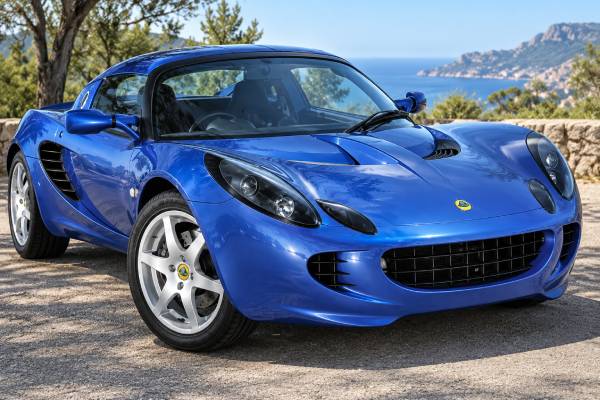
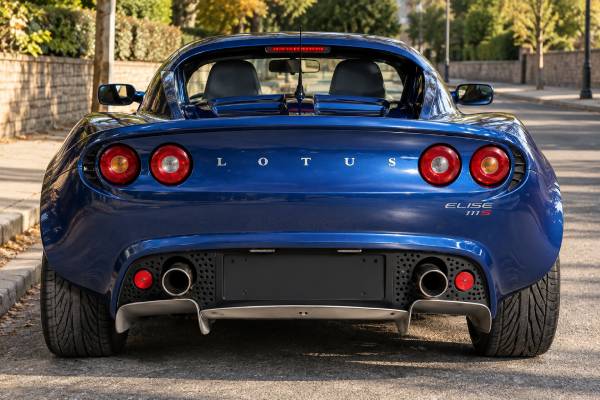
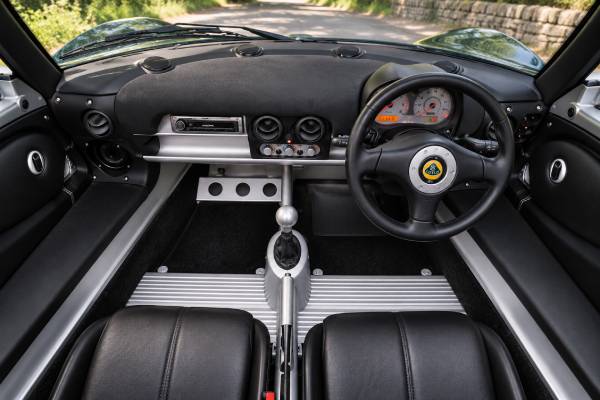
The Series 2 Lotus Elise 111S is the most polished factory expression of the Rover VVC-powered road Elise. Introduced for 2002, it combines the newer S2 body and cabin with a Lotus-managed 1.8-litre K-series VVC engine producing 156 bhp, lighter 8-spoke wheels, wider rear tires, and gearing chosen to deliver stronger acceleration without turning the car into a track-only special. It is important to separate production from registration: the Toyota-powered 111R began the next mechanical chapter in 2004, while some Rover 111S cars can appear on later registrations. That overlap is why a buyer should identify a car by VIN, engine, gearbox, and factory documentation rather than by registration year alone. The 111S remains attractive because it weighs less than later Toyota-powered Elises and has a flexible, progressive engine character. Its age, however, means cooling-system condition, timing-belt history, VVC servicing, chassis integrity, suspension wear, and previous accident repairs matter more than a low odometer. A sorted example is fast, supple, and unusually communicative.
Table of Contents
- Where the S2 111S Fits
- VVC Power With S2 Refinement
- Technical Data for the 156 hp 111S
- Chassis, Gearing, and Road Use
- Maintenance That Protects the Car
- Buying the Right 111S
- Ownership and Upgrade Strategy
- Production Dates, Registration Years, and Parts Ordering
- What a Major Refresh Should Cover
Where the S2 111S Fits
The S2 111S sits between the 120 bhp entry model and the later 189 hp Toyota-powered 111R, offering more pace than the base Rover car while retaining the lighter K-series powertrain and five-speed simplicity.
Lotus announced the higher-output S2 derivatives in 2002. The 111/111S family used Rover’s VVC K-series controlled by the Lotus-developed K4 engine-management system. Period material quotes 156 bhp at 7,000 rpm and 175 Nm at 4,650 rpm, with 0–62 mph in about 5.1 seconds and top speed near 132 mph.
Compared with the first-generation 111S, the S2 changes the surrounding car as much as the engine tune. The body is more angular, aerodynamic management is more developed, the cabin is easier to use, the roof is simpler, and the boot is larger. The S2 also uses 16-inch front and 17-inch rear wheels, so gearing and tire dimensions are different from the S1.
The 111S should not be confused with every S2 carrying a Rover engine. The standard car makes about 120 bhp from a non-VVC 18K4F, while the 111S uses the 18K4K VVC head and more power. Nor is it mechanically equivalent to the 111R, which introduced Toyota’s 2ZZ-GE, a six-speed C64 gearbox, servo-assisted ABS braking, and a different engine-management architecture.
That distinction matters to buyers because each car has different service priorities. The Rover 111S has the K-series cooling and belt history to verify, including the VVC drive. The 111R has lift-system and Toyota-specific drivetrain concerns. Buying by badge alone can lead to the wrong parts and wrong assumptions.
VVC Power With S2 Refinement
The 156 hp VVC engine gives the S2 111S a broad, progressive power curve that suits road driving. It pulls cleanly through the middle of the rev range and continues strongly toward 7,000 rpm rather than relying on a dramatic high-speed cam change.
Rover VVC varies effective inlet-valve duration through a mechanical system controlled hydraulically. This allows the engine to maintain useful torque at lower speed while increasing breathing as revs rise. The system is more complex than the fixed-cam base engine, but it produces a smoother transition than a two-stage high-lift mechanism.
Lotus’s K4 ECU and calibration are important parts of the S2 installation. The engine had to meet newer emissions and onboard-diagnostic requirements while retaining the Elise’s quick throttle response. The result is a car that feels more modern than the S1 VVC without losing the low-mass character of the Rover drivetrain.
The five-speed gearbox uses revised ratios compared with the base S2. Lotus shortened the lower gears for acceleration while using taller upper ratios to help cruising and economy. That is a more sophisticated compromise than simply fitting an across-the-board shorter final drive.
The engine’s modest mass also preserves the Elise’s balance. A later Toyota-powered car has more ultimate power and a stronger high-rpm rush, but the Rover 111S typically feels lighter in its responses. Drivers who spend more time on narrow roads than on fast circuits often value that quality.
Technical Data for the 156 hp 111S
This model is a naturally aspirated petrol ICE roadster with a mid-mounted Rover 1.8-litre VVC four-cylinder, five-speed manual transaxle, and rear-wheel drive. Its key numbers show a strong power-to-weight balance without the complexity of forced induction.
| Specification | Value |
|---|---|
| Engine | Rover K-series 18K4K VVC inline-four |
| Displacement | 1,796 cc (1.8 L) |
| Construction | Aluminium block and head |
| Bore × stroke | 80.0 × 89.3 mm |
| Valvetrain | DOHC, 16 valves, variable inlet valve control |
| Induction | Naturally aspirated |
| Fuel system | Sequential multi-point injection |
| Maximum power | 156 bhp (116 kW) at 7,000 rpm |
| Maximum torque | 175 Nm (129 lb-ft) at 4,650 rpm |
| Timing drive | Toothed belts, including VVC rear-cam drive |
| Specification | Value |
|---|---|
| 0–62 mph (0–100 km/h) | About 5.1 seconds |
| 0–100 mph (0–160 km/h) | About 14 seconds in period Lotus material |
| Top speed | About 132 mph (212 km/h) |
| CO₂ emissions | About 163 g/km in period European specification |
| Fuel tank | 32 L in commonly published S2 Rover specification |
| Specification | Value |
|---|---|
| Transmission | 5-speed manual transaxle |
| Drive | Rear-wheel drive |
| Gearbox strategy | Closer lower ratios with taller upper gearing than a simple close-ratio set |
| Differential | Open in standard road form |
| Clutch | Hydraulically operated single-plate type |
| Specification | Value |
|---|---|
| Chassis | Bonded aluminium extrusion structure |
| Body | Composite two-seat roadster |
| Length | 3,785 mm (149.0 in) |
| Width | 1,719 mm (67.7 in), excluding mirrors in commonly quoted data |
| Height | 1,143 mm (45.0 in) |
| Wheelbase | 2,300 mm (90.6 in) |
| Unladen weight | About 806 kg (1,777 lb) |
| Specification | Value |
|---|---|
| Suspension | Independent unequal-length double wishbones front and rear |
| Dampers/springs | Bilstein monotube dampers with Eibach coil springs in period specification |
| Front wheel | 5.5 × 16 in lightweight 8-spoke |
| Rear wheel | 7.5 × 17 in lightweight 8-spoke |
| Front tire | 175/55 R16 Bridgestone Potenza RE040 in launch specification |
| Rear tire | 225/45 R17 Bridgestone Potenza RE040 in launch specification |
| Steering | Unassisted rack and pinion |
| Item | Guidance |
|---|---|
| Timing belts | Confirm both main and VVC-belt history by date and mileage |
| Cooling system | Investigate any temperature instability or coolant loss before hard use |
| Brake fluid | Age matters even on low-mileage cars; renew to the applicable schedule |
| Geometry | Set only after worn joints, bearings, dampers, and tires are addressed |
Chassis, Gearing, and Road Use
The S2 111S is quick because its engine, gearing, and low mass reinforce one another. The chassis does not need huge tires or electronic torque management to feel secure, so the driver still experiences the Elise’s original light-touch philosophy.
Compared with the base 120 hp S2, acceleration is stronger once the VVC engine is above the middle of the rev range. The lower gears help place the engine where it works best. On a flowing road, the car responds well to holding a gear rather than constantly shifting, because the VVC system fills in the torque curve.
The unassisted steering is particularly revealing. Excessive kickback, wandering, or nervousness is not automatically “normal.” Old tires, incorrect pressures, poor toe settings, bent steering arms, worn ball joints, and mismatched dampers can all corrupt the feedback. A properly aligned 111S should be alert but not unstable.
The S2’s larger wheels add visual presence and accommodate its tire package, but they increase the importance of wheel condition. Check inner rims for bends, evidence of curb impacts, corrosion around bead seats, and correct fasteners. Lightweight factory 8-spoke wheels are part of the model’s identity and can affect value.
Braking should be firm and predictable. Many cars have cross-drilled discs or upgraded pads from option packages or later changes. Assess the actual condition and compatibility of components rather than assuming any “upgrade” is better. Track-oriented pads can be noisy and ineffective when cold on a road car.
Maintenance That Protects the Car
The 111S needs disciplined age-based maintenance more than exotic servicing. Cooling-system health, two timing belts, good oil, fresh fluids, and a tight suspension are the foundations of reliability.
The Rover K-series cooling system remains the first priority. The radiator is at the front while the engine is behind the cabin, creating long coolant runs. Poor bleeding, a tired radiator, damaged cap, hose leaks, fan problems, or thermostat faults can lead to overheating. Check for stable temperatures in traffic as well as at speed.
Head-gasket history should be evaluated with context. A properly repaired car with detailed invoices is not automatically inferior. Ask what gasket was used, whether the head was checked, whether liner heights and surface condition were considered, and what cooling-system fault caused the original problem. Repeated gasket work without diagnosis is the warning sign.
The VVC system makes belt servicing more specific. Both the main timing belt and small rear VVC belt age, and access is easier for someone familiar with the engine. The VVC mechanism itself relies on clean oil and correct hydraulic operation. Rattles, inconsistent power delivery, or unusual top-end noises need informed diagnosis.
The S2 aluminium chassis should never be treated like a steel monocoque. Inspect around suspension mounts and undertrays for impact damage and corrosion at mixed-metal interfaces. If the tub is seriously damaged, specialist advice is mandatory.
Ageing dampers are common. A car can still pass a basic roadworthiness test while damping has degraded enough to spoil the Elise’s control. Replacing all four with a matched road-focused set and then setting geometry can make a tired car feel dramatically younger.
Buying the Right 111S
Identify the car first, then judge condition. Because registrations can overlap model changes, a 2004 or later plate does not by itself tell you whether you are looking at a Rover 111S, a Toyota 111R, or a car that has been altered.
Confirm the VIN, engine family, five-speed gearbox, and factory paperwork. The 18K4K VVC engine and Rover installation are visually different from the Toyota 2ZZ. A genuine 111S should also have a coherent wheel, brake, interior, and trim specification, though option packages and market differences can alter details.
Inspect the tub and crash structures before cosmetic paint. Look for evidence of front or rear impacts, crushed jacking areas, distorted pickup points, repaired clamshells, and corrosion. Fiberglass repairs are common and can be acceptable when well executed; structural repairs require much more scrutiny.
Demand a cold start and a fully warm drive. Watch coolant behavior, listen to the VVC top end, test hot starting, and use full throttle only once temperature is stable. The engine should pull smoothly toward 7,000 rpm without misfire. The gearbox should not crunch, and the clutch should not slip under load.
Ask for belt dates, not just mileage. Check tire age, brake-fluid history, coolant changes, radiator replacement, damper work, ball joints, toe links, wheel bearings, and battery condition. A thick folder of ordinary maintenance is more valuable than a recent expensive detail.
Ownership and Upgrade Strategy
The S2 111S is best improved by restoring precision before adding performance. Its factory 156 bhp is already enough to exploit the chassis on the road, and poor suspension or cooling condition will undermine any engine modification.
For a road-focused car, prioritize quality tires, dampers, alignment, cooling reliability, brake fluid, and seat/roof condition. Keep original parts when replacing wheels, exhaust, intake, or trim. As these cars age, reversibility increasingly protects value.
For track use, strengthen inspection frequency rather than simply fitting harder components. Check rear toe links, wheel bearings, brake pads, disc condition, fluid, and tire shoulders. Higher sustained rpm also makes oil level and cooling condition more critical.
Compared with the 111R, the 111S offers less ultimate speed but a different kind of engagement. The Rover engine is lighter and more flexible below its power peak, the five-speed is simpler, and the car generally feels less dominated by a high-rpm cam transition. That can make it the more satisfying road choice even when the Toyota car is faster on paper.
Compared with the base S2, the 111S adds enough power to make overtaking and fast-road acceleration substantially stronger without fundamentally changing the chassis balance. It is therefore one of the sweet spots in the Elise range for an owner who wants a classic-feeling Lotus with useful modernity.
Buy on history and structural condition, service it with an age-first mindset, and resist the urge to “improve” a healthy car before learning it. A properly sorted 111S is already the product of a carefully balanced package.
Production Dates, Registration Years, and Parts Ordering
The S2 111S is a good example of why an Elise should be identified by VIN and build information rather than registration plate alone. Lotus introduced the VVC-powered S2 derivatives in 2002, then moved the range toward Toyota power from 2004. Cars can nevertheless appear on later registrations because unsold inventory, imports, and market-specific registration practices do not always follow the factory changeover date.
That matters when ordering parts. A supplier asked for “a 2005 Elise” may assume a Toyota 2ZZ car even if the vehicle in front of you is a Rover-powered 111S registered in 2005. Engine filters, belts, sensors, clutch components, gearbox parts, exhaust sections, ECU diagnostics, and service procedures can all differ. Give the VIN and engine type, not just the registration year.
The same caution applies to body and trim. Lotus implemented running changes, option packages, and supplier substitutions. Headlamps, seat trim, wheels, dampers, brake details, alarm systems, and HVAC equipment can change independently of the engine. Before declaring a component incorrect, compare it with the car’s build record and production change points.
For long-term ownership, create a personal specification sheet. Record VIN, engine number, gearbox type, wheel sizes, tire sizes, brake configuration, damper type, ECU details, key/alarm type, paint code, and option-package information. Add part numbers whenever original components are removed. This saves time later and helps a future buyer distinguish documented changes from mystery modifications.
The 111S also benefits from an age-based maintenance calendar. A car driven 3,000 miles per year can still need annual fluid checks, belt replacement by time, coolant renewal, brake-fluid service, tire replacement by age, and periodic suspension inspection. The odometer is only one clock.
If the car is stored over winter, prepare it rather than simply parking it. Wash road salt from the underside, dry the car thoroughly, maintain the battery, inflate tires appropriately, and avoid applying the parking brake for months if there is a safer storage method that prevents rear brake adhesion. Exercise the clutch and brakes periodically if conditions allow.
For owners planning European touring, the Rover 111S is well suited because the VVC engine has useful mid-range flexibility and the later S2 cabin is more practical than an S1. Before a long trip, inspect the radiator and coolant hoses, carry the correct immobiliser/key spares, verify tire-repair equipment, and make sure the roof can be fitted quickly in poor weather.
A roadside recovery service should be told that the car is low and mid-engined. Flatbed recovery is preferable, and loading angles need care around the front clamshell and undertray. Knowing the correct towing and recovery points prevents a minor failure from becoming expensive body or chassis damage.
Finally, keep a copy of the specialist’s alignment printout. The Elise is unusually sensitive to toe and ride height, so having a known-good baseline is useful after pothole strikes, tire changes, or suspension work. If the car suddenly feels different, comparing measurements is better than guessing.
The S2 111S rewards this kind of organized ownership. It is mechanically simple enough to understand, but old enough that undocumented changes accumulate. A clear record of what the car is, what has been changed, and when age-sensitive parts were serviced turns a potentially confusing classic into a very usable sports car.
What a Major Refresh Should Cover
A newly purchased S2 111S often benefits from one comprehensive baseline service even when the history looks good. The purpose is not to replace parts blindly; it is to synchronize all the age-sensitive systems so future maintenance has a known starting point.
Begin with fluids and filters. Confirm engine-oil grade, renew the oil filter, check gearbox oil, replace old brake fluid, inspect coolant concentration and condition, and service the air filter. If the coolant history is uncertain, drain and refill using the correct bleed procedure rather than simply topping up the expansion tank.
Then inspect both timing belts and their documented age. If they are due, combine belt work with tensioner inspection, cam-seal checks, water-pump assessment, and a close look at the VVC mechanism. Doing related work together reduces repeated access labor and produces a clearer service record.
The ignition system should be evaluated under load. Old plugs, leads where applicable, and coil components can work acceptably at idle but break down during high cylinder pressure. Misfire at the top of the rev range should not be masked by repeatedly clearing fault codes.
At the front of the car, inspect the radiator and condenser if air conditioning is fitted. Look through the intake for debris and corrosion, then verify both cooling-fan operation and temperature behavior in stationary traffic. A car that runs cool on the motorway can still overheat when the fans are needed.
Underneath, remove trays and inspect fasteners, leaks, the rear subframe, engine mounts, driveshaft boots, and suspension joints. The trays often conceal the first evidence of oil, coolant, or gearbox seepage. Clean them before refitting so future leaks are easier to identify.
Brake work should include more than pad thickness. Check disc runout symptoms, caliper dust boots, handbrake operation, flexible hoses, and pad wear across each axle. Uneven wear can reveal a sticking caliper before it becomes obvious in normal braking.
Finally, finish the refresh with tires and alignment. Note manufacturing dates as well as tread depth. Once tires and worn suspension parts are sorted, set geometry and keep the printout with the service file.
A baseline refresh can seem expensive because many small jobs arrive together, but it transforms ownership. Instead of wondering whether each noise belongs to an old car, the owner knows what has been inspected, what remains original, and when the next service clock started.
References
* The Lotus Elise S2 111 2002 (Model Technical Information) * 2002 Lotus Elise S2 111s Specifications – Ultimatecarpage.com 2002 (Specifications) * The Lotus Elise S2 2002 (Model History) * Manual download 2025 (Lotus Service Notes Index) * LOTUS 2004 ELISE SERVICE NOTES Pdf Download 2016 (Service Notes)
Disclaimer
This article is for informational purposes only and is not a substitute for professional diagnosis, inspection, or repair. Specifications, torque values, service intervals, and procedures vary by VIN, market, production change, and equipment; verify all work against the official Lotus and Rover service documentation for the exact car.
If this article helped you, please share it on Facebook, X/Twitter, or with another Lotus enthusiast to support our work.