

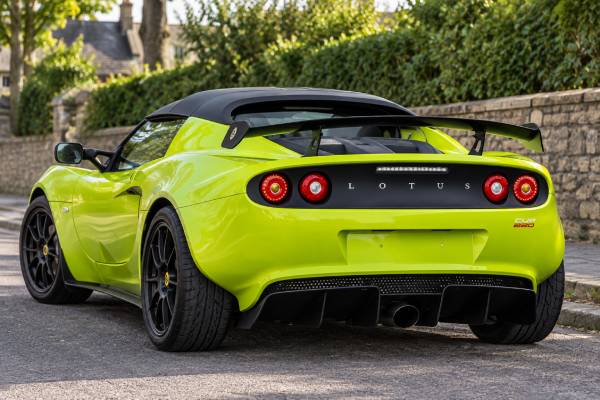
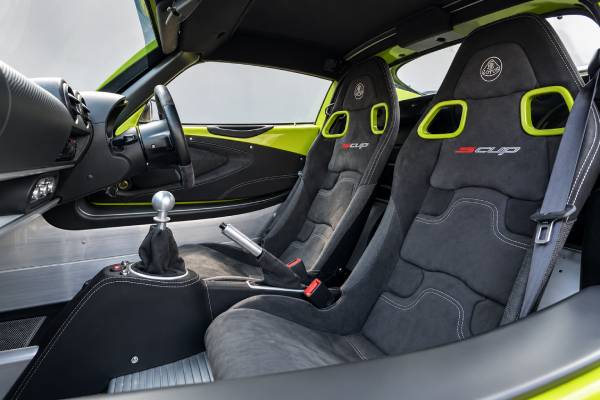
The 2015–2016 Lotus Elise Cup 220 is the road-going track-focused Elise that Lotus originally introduced as the Elise S Cup. It keeps the familiar supercharged 1.8-liter 2ZR-FE at 217 hp and 250 Nm, but adds an aggressive aero package developed from the Elise Cup R, a fixed roof, track-oriented chassis details, and up to 125 kg of claimed downforce at its 140 mph maximum speed. At 932 kg, it is not dramatically lighter than every road Elise; its defining feature is instead the way aerodynamic load and circuit-oriented hardware increase stability and cornering potential. That makes the Cup 220 more specialized than the standard Elise S and meaningfully different from the lighter, more powerful Cup 250 that replaced it. Buyers should verify what they are looking at because advertisements often mix the names and specifications. A healthy Cup 220 should have factory aero, a sound bonded-aluminum chassis, stable engine and charge-cooler temperatures, tight suspension, and documented use. Track mileage is acceptable when the maintenance history proves the car was treated like track-capable machinery rather than a disposable toy.
Table of Contents
- Elise S Cup or Cup 220: Naming the Car Correctly
- Aerodynamics and Why This Elise Feels Different
- Cup 220 Technical Specifications
- Track Hardware, Chassis, and Braking
- Engine, Charge Cooling, and Service Priorities
- Common Modifications and Track History
- How to Buy a Cup 220 with Confidence
Elise S Cup or Cup 220: Naming the Car Correctly
The car covered here was launched by Lotus as the Elise S Cup, but “Cup 220” is widely used retrospectively and helps separate it from the 243 hp Cup 250 introduced in 2016. The important thing is not the badge wording but the 217 hp specification, Cup R-derived aerodynamics, and 2015-era chassis package.
Lotus developed the road car from the Elise S Cup R race program. The standard Elise S already had the supercharged and charge-cooled Toyota 2ZR-FE, six-speed manual, bonded-aluminum tub, and rear-wheel-drive layout. The Cup version retained that core powertrain while adding a front splitter with end winglets, lateral bargeboards, a fixed roof, rear wing, and more purposeful diffuser.
The factory made a specific aerodynamic claim: 66 kg of downforce at 100 mph, 104 kg at 124 mph, and 125 kg at the 140 mph top speed. By comparison, period figures for the ordinary Elise S were only 5 kg, 7 kg, and 8 kg at those same speeds. This is why the Cup should not be summarized as merely an Elise S with a spoiler. At circuit speeds, the aero package materially changes vertical load.
That downforce comes with drag. Lotus quoted a drag coefficient around 0.45 for the S Cup, which is high for a conventional road car but understandable given the wings and splitters. Its maximum speed is about 140 mph, lower than the less aero-intensive Elise S even though engine output is the same. The Cup trades some straight-line efficiency for cornering support.
Period testing at Hethel was central to the marketing. Lotus said the aero package helped the S Cup lap its test circuit three seconds quicker than the standard S. That figure should not be treated as a universal track-time guarantee, but it illustrates the engineering goal: improve repeatable circuit performance without turning the car into a non-road-legal race machine.
Because the model straddles names, documentation matters. A seller may call a car Cup 220, S Cup, Elise Cup, or even confuse it with a later Cup 250. Check the VIN, production date, engine output, aero details, wheels, and original invoice before assuming the advertisement is accurate.
Aerodynamics and Why This Elise Feels Different
The Cup 220 becomes more stable as speed rises because the aero package generates genuine downforce, but that benefit only matters when the bodywork is complete, correctly mounted, and aligned. Missing splitters or damaged underbody elements can alter more than appearance.
At normal road speeds, the driver notices the same classic Elise traits first: unassisted steering, low seating, compact dimensions, and immediate weight transfer. The downforce numbers become significant mainly on fast circuits and high-speed bends. That makes the Cup 220 unusual among light roadsters, because the car’s character changes progressively with speed rather than relying only on mechanical grip.
The fixed roof is part of the package. In addition to changing the visual character, it supports the more track-oriented concept. Buyers who specifically want open-top touring should decide whether the Cup’s priorities suit them; converting or removing components can undermine originality and possibly aero behavior.
The front splitter is vulnerable. Driveways, trailer ramps, curbs, and off-track excursions can scrape or crack it. Inspect mounting points carefully. A replaced splitter is not automatically a concern on a low car, but damaged mounts or distorted adjacent bodywork may indicate a harder impact.
Bargeboards and side elements should also be present and secure. Rear wing mounts should not show stress cracking in the composite panels. The diffuser should be straight and attached with the intended hardware. Cosmetic damage is common on cars that have been used properly, but repairs should be neat and structurally sensible.
The aero load also raises the importance of suspension condition. Downforce is useful only if dampers, bushes, joints, tires, and geometry keep the tire contact patches controlled. A worn Cup 220 with impressive bodywork can be less capable than a standard Elise S in excellent condition.
Cup 220 Technical Specifications
The Cup 220 uses the supercharged 1.8-liter 2ZR-FE with 217 hp, a six-speed manual, and rear-wheel drive. Its signature technical difference is the Cup R-derived aero package, which adds substantial high-speed downforce while keeping the vehicle road legal. **Engine and forced induction**
| Parameter | Specification |
|---|---|
| Engine | Toyota 2ZR-FE inline-four |
| Displacement | 1,798 cc |
| Valvetrain | DOHC, 16 valves, dual VVT-i |
| Supercharger | Magnuson R900 using Eaton TVS technology |
| Charge cooling | Liquid charge-cooler system |
| Maximum power | 217 hp (220 PS) at 6,800 rpm |
| Maximum torque | 250 Nm at 4,600 rpm |
**Performance and mass**
| Measure | Factory/period figure |
|---|---|
| 0–60 mph | 4.2 seconds |
| 0–100 km/h | 4.6 seconds |
| Top speed | 140 mph (225 km/h) |
| Unladen mass | 932 kg |
| Power-to-weight | 233 hp per tonne, period quoted |
| Drag coefficient | Approximately 0.45 |
**Aerodynamic downforce**
| Speed | Elise Cup 220/S Cup | Period Elise S comparison |
|---|---|---|
| 100 mph (160 km/h) | 66 kg | 5 kg |
| 124 mph (200 km/h) | 104 kg | 7 kg |
| 140 mph (225 km/h) | 125 kg | 8 kg |
**Chassis and track-oriented hardware**
| Item | Specification |
|---|---|
| Chassis | Bonded extruded-aluminum Type 111 tub |
| Suspension | Independent double wishbones front and rear |
| Dampers/springs | Performance Bilstein dampers with Eibach springs |
| Brakes | Performance disc system with ABS |
| Roof | Fixed Cup configuration |
| Roll-over structure | Track-oriented hoop/provision depending on market specification |
| Aero | Splitter, winglets, bargeboards, rear wing, diffuser |
**Transmission and wheel layout**
| Item | Specification |
|---|---|
| Transmission | 6-speed manual with sports ratios |
| Drive | Rear-wheel drive |
| Steering | Manual rack-and-pinion |
| Front wheel diameter | 16 inches |
| Rear wheel diameter | 17 inches |
| Tire type | Performance road/track tire specification; verify exact factory fit by market |
**Track-use service checklist**
| System | High-value check |
|---|---|
| Brake fluid | Age, boiling-point suitability, pedal feel after hard use |
| Brake discs/pads | Thickness, cracking, heat damage, even wear |
| Tires | Heat cycles, shoulder wear, age, pressures |
| Wheel bearings | Play or rumble after repeated circuit loads |
| Toe links/joints | Play, fastener security, alignment |
| Aero mountings | Cracks, loose hardware, curb/impact damage |
Track Hardware, Chassis, and Braking
The Cup 220 is designed to tolerate serious circuit work, but track readiness is a maintenance state, not a permanent factory property. A car that left Hethel with Cup hardware can still be unsafe if its fluid is old, joints are loose, or tires are heat-cycled beyond usefulness.
The bonded aluminum tub remains the foundation. It is very light and stiff, but it is not a conventional steel unibody that any body shop should straighten and weld. Inspect the underside, suspension pick-up points, front crash structure, and areas around cage or harness installations. Non-standard holes in structural aluminum require specialist judgment.
The Cup’s track-oriented roll-over provision makes it tempting for owners to add a full cage and harnesses. That can be appropriate, but restraint systems must work together. Harness shoulder angles, seat compatibility, helmet clearance, and road legality all matter. A harness is not automatically safer than a three-point belt if installed incorrectly.
Brakes should feel firm from the first application. On a track-used car, inspect not only pad thickness but also disc cracking, caliper condition, hose age, and fluid history. Pedal travel that grows after several hard stops can indicate boiling fluid or other problems. Do not mask it with a more aggressive pad before diagnosing the hydraulic system.
The car’s aero can increase loads at high speed, so damper control matters. Leaking or tired dampers can let the body move excessively, changing ride height and aero attitude. Likewise, weak springs or worn bushes can allow geometry to shift under load.
Alignment is especially important after off-track excursions. A gravel-trap visit may leave only cosmetic marks yet still bend a toe link or alter settings. Ask for recent geometry sheets from a recognized specialist if the car has a circuit history.
Engine, Charge Cooling, and Service Priorities
The 217 hp 2ZR-FE is not highly stressed by modern standards, but the Cup 220’s likely use makes heat management and fluid condition more important than on a gently driven road Elise. Repeated hot laps are a different duty cycle from a Sunday drive.
The Magnuson supercharger should deliver smooth, repeatable boost. Listen for abnormal mechanical noise, inspect the belt drive, and ask whether the pulley or calibration has been changed. A stock-appearing car can still have software or pulley modifications, so invoices matter.
Charge-cooler health affects consistency. If intake temperatures rise excessively, performance can drop and the engine management may protect the engine. Verify coolant level and circulation, and investigate any unexplained power fade when hot. A proper diagnostic scan can show more than subjective acceleration impressions.
Main coolant temperature must remain stable. The front radiator and long connecting pipes are age-related service points on any Elise. Track debris can also damage cooling fins. Some owners upgrade radiators; a high-quality replacement with correct installation can be positive, but improvised plumbing is not.
Oil should be changed at an interval appropriate to use. A car that does several track events per year should not rely on the same schedule as a lightly driven road car. Owners should check level before events because sustained lateral load can expose low-oil conditions.
The transmission and clutch also take more load from repeated fast shifts and standing starts. Gear engagement should remain clean when hot. Check for clutch slip after the drivetrain reaches operating temperature. Heavy track launches can shorten clutch life even if total mileage is low.
Common Modifications and Track History
Modifications should be evaluated by function and execution, not by whether they are popular in the Lotus community. The Cup 220 is already a carefully integrated package, so poorly chosen changes can reduce reliability or upset the aero and chassis balance.
Engine upgrades are the highest-risk category. Smaller supercharger pulleys, remaps, injectors, exhausts, and intake changes can raise power, but they also alter heat load and calibration margins. If a seller claims 250 hp or more, ask for the full recipe, dyno documentation, fuel requirement, and charge-cooling strategy.
Suspension changes can be useful when dampers are worn or when the car has a defined track purpose. Reputable adjustable dampers with professional corner-weighting and alignment are a different proposition from generic coilovers set as low as possible. Ride height changes can also affect splitter clearance and aerodynamic attitude.
Wider or stickier tires increase grip but also load wheel bearings and suspension. Verify wheel offsets and clearance. Tire age is critical on cars that cover few road miles; track rubber can become hard after heat cycles even with visible tread remaining.
Aero modifications deserve unusual caution because the factory package is balanced. A larger rear wing without corresponding front aero can shift balance. Removing the front splitter because it scrapes may also change high-speed behavior. The safest assumption is that Lotus’s matched package works as a system.
Track history should be discussed openly. Ask which circuits, how often, and what post-event inspections were performed. Receipts for pads, fluid, tires, bearings, and alignments are reassuring because they show the owner understood the consumption associated with circuit use.
How to Buy a Cup 220 with Confidence
First prove the car’s identity, then prove its structural integrity, then judge mechanical condition. The Cup 220’s rarity and visual drama can make buyers skip that order and pay too much attention to paint color or carbon-looking parts.
Confirm whether the car was sold as Elise S Cup in its market and whether it matches the 217 hp specification. Check the production date and original invoice if available. Do not rely on a “Cup 220” badge alone, because badges can be added and later Cup models look broadly similar to casual observers.
Inspect every aero component. Note cracks, repairs, scrapes, missing fasteners, and mismatched finishes. Look closely where wing mounts transfer load into the body. Minor splitter scrapes are normal; movement or stress cracking around mounts is not.
Have the chassis inspected from below. Pay attention to the front crash structure, floor, rear subframe region, suspension mounts, and any areas modified for cages or harness equipment. If there is evidence of repair, obtain documentation and specialist confirmation.
During the drive, start with normal road behavior before chasing performance. The car should track straight, absorb bumps without repeated oscillation, and brake without pulling. Once warm, acceleration should be strong and consistent. Watch coolant temperature through traffic and harder use. **Cup 220 buyer priorities**
| Priority | What good looks like | Why it matters |
|---|---|---|
| Correct model | 217 hp S Cup/Cup 220 documentation | Prevents confusion with standard S or later Cup 250 |
| Aero integrity | Complete factory components, secure mounts | Package is functional, not decorative |
| Chassis | Straight bonded structure with no dubious repairs | Central to safety and geometry |
| Track maintenance | Fluid, tire, bearing, and alignment records | Shows hard use was supported properly |
| Thermal systems | Stable coolant and repeatable boost performance | Critical for supercharged circuit use |
| Modifications | Reversible, engineered, documented | Protects reliability and future value |
The Cup 220 is best for an owner who will actually use its focus. It gives up some open-road simplicity and top-speed efficiency to gain aero support and track intent. On public roads, a standard S can be just as enjoyable at legal speeds and easier to live with. On a fast circuit, the Cup’s stability and hardware make the reason for its existence much clearer.
That specificity is also what gives the model long-term appeal. It represents the transition from the Elise S to the later Cup 250 era and preserves the 217 hp engine tune in a genuinely aero-developed package. Buy a complete, straight, documented example and maintain it according to how it is used. The reward is not merely a rare badge, but one of the most purposeful road-legal expressions of the pre-Cup-250 Elise.
Reading track wear without overreacting
The Cup 220 was built to be used hard, so signs of circuit use are not automatically reasons to reject it. The useful distinction is between wear that has been monitored and wear that has been ignored. A front splitter with light scraping, fresh brake pads, and two sets of wheels may simply show that the owner used the car as intended. Cracked discs, loose wheel bearings, heat-damaged tires, leaking dampers, and no service records show something different.
Look at the relationship between consumables. If new tires are fitted but the inner shoulders are already feathering, geometry may be wrong. If aggressive pads are installed but brake fluid is several years old, the maintenance strategy is incomplete. If the car has a cage and harnesses but ordinary road tires and no evidence of alignment work, the modifications may have been chosen for appearance rather than function.
Ask whether the car was driven to events or trailered. A trailered car can accumulate intense track hours with low odometer mileage, so mileage alone is a weak proxy for use. Conversely, a road-driven Cup may have high mileage but little sustained thermal stress. Service invoices, tire dates, brake replacements, and alignment sheets reveal the duty cycle more accurately.
Aero repairs and replacement parts
Because the Cup 220’s aerodynamic package is functional, replacement parts should match the original geometry. An inexpensive aftermarket splitter that looks similar can have a different angle, thickness, or projection. The same concern applies to rear wings and diffuser pieces. If a component has been replaced, find out whether it is genuine Lotus, a recognized reproduction built to the same dimensions, or a custom part.
Mounting quality matters as much as the panel itself. Loose fasteners can enlarge holes in composite bodywork, while overtightened hardware can create stress cracks. Check that repairs distribute load correctly and do not rely on large washers hiding damaged material.
For road use, protect the splitter by approaching ramps diagonally and learning the car’s overhang rather than removing the aero. If ground clearance is unusually poor, check ride height before blaming the factory design; an excessively lowered suspension can make normal Cup bodywork nearly unusable.
Road usability after the excitement wears off
A Cup 220 can be used on the road, but its fixed-roof, aero-focused character is more demanding than a conventional Elise S. Check noise tolerance, ground clearance, cabin heat, and access before committing. A buyer who spends most of the year on congested roads may enjoy a standard S more often, while the Cup becomes compelling when fast, open roads and circuit days are a regular part of ownership.
The same logic applies to resale. The strongest Cup 220s are not necessarily the most polished cars; they are the ones whose specialized hardware remains complete and whose maintenance matches the way the car has been used. Evidence of careful track preparation can be more valuable than a vague claim that a visibly track-focused car has never seen a circuit.
Do not skip a specialist alignment
If the car is purchased, a specialist geometry check is one of the best early investments. It confirms that the wheels point where Lotus intended and creates a baseline for future tire wear. On an aero-sensitive Cup car, known ride height and alignment also make later suspension diagnosis far easier.
References
- Lotus Elise S Cup | 2015MY 2014 (Lotus Press Release reproduction)
- 2016 Lotus Elise Cup 250 Specifications – Ultimatecarpage.com 2016 (Successor Technical Reference)
- Lotus Elise S Cup – road-going track machine unveiled 2015 (Period Launch Coverage)
- Lotus Elise – Iconic Sports Car | Lotus Cars 2026 (Heritage Model Page)
- Introducing the Lotus Elise Cup 250 – TLF – Totally Lotus 2016 (Successor Launch Reference)
Disclaimer
This article is provided for informational purposes and is not a substitute for professional diagnosis, inspection, preparation, or repair. Specifications, torque values, maintenance intervals, fluids, and procedures vary by VIN, market, production date, and equipment; verify all work against official Lotus service documentation for the individual vehicle. If this guide was useful, please share it on Facebook, X/Twitter, or another enthusiast platform to support our work.