
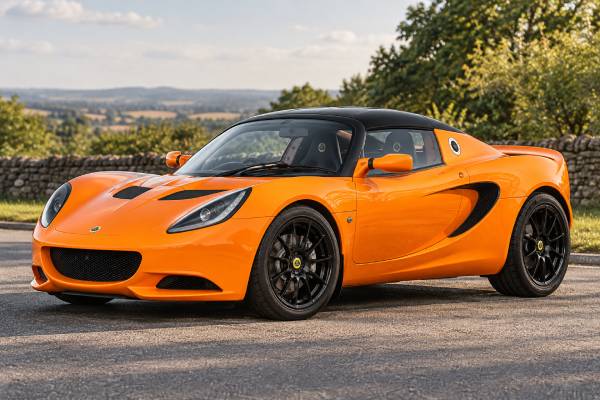
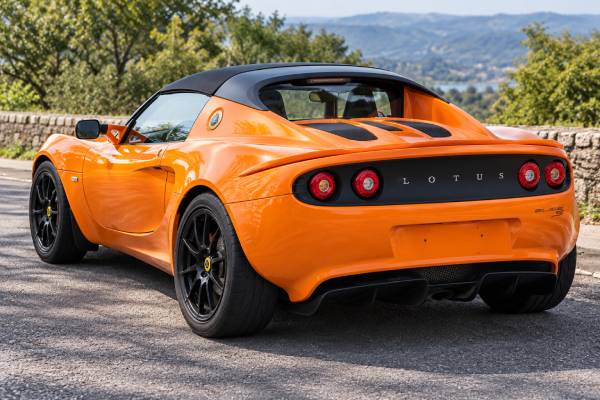
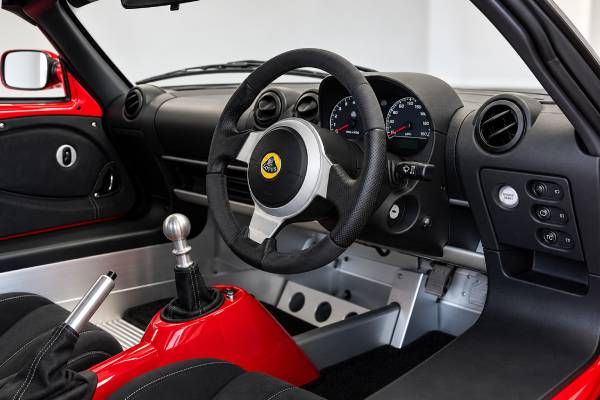
The 2013–2015 Lotus Elise S Club Racer combines the supercharged punch of the Elise S with the weight-conscious Club Racer philosophy. It keeps the 217 hp, 250 Nm 2ZR-FE powertrain but removes roughly 19.5 kg compared with the standard S, bringing quoted mass to about 904 kg in lightweight form. That small number has a noticeable effect because the Elise begins from such a low baseline: the car feels more immediate under braking and turn-in while retaining the broad mid-range torque that makes the supercharged S easy to drive quickly. It is also a model that rewards careful verification. Many examples were ordered with comfort options, later modified for track use, or upgraded with exhausts, intakes, suspension, and harness equipment. A factory-lightweight car is not automatically the best example if its cooling system, chassis, or geometry has been neglected. The strongest purchase is a documented car whose specification makes sense, whose bonded aluminum structure is undamaged, and whose supercharger and suspension remain tight and consistent.
Table of Contents
- How the S Club Racer Differs from the Standard S
- Weight Reduction and the Way It Drives
- S Club Racer Specifications
- Engine, Boost, and Thermal Management
- Chassis Setup, Brakes, and Track-Day Use
- Maintenance, Originality, and Modification Risk
- Buying a Good S Club Racer
How the S Club Racer Differs from the Standard S
The S Club Racer is a lighter, more focused version of the supercharged Elise S rather than a different engine variant. Its defining changes are reduced equipment and mass, Club Racer trim and chassis emphasis, and a stronger power-to-weight ratio with the same 217 hp output.
Lotus launched the model in 2013 after the naturally aspirated 1.6 Club Racer had already established the formula. The S Club Racer applies that idea to the 1.8-liter supercharged car. Period material quotes a maximum reduction of 19.56 kg relative to the standard Elise S, with final mass around 904 kg depending on equipment. Lotus also quoted a power-to-weight figure around 240 bhp per tonne.
The effect is more meaningful than the raw kilogram figure suggests. Removing 20 kg from a 900 kg sports car is proportionally similar to removing far more from a conventional coupe. More importantly, the reduction comes from the sort of equipment that does not improve the basic driving function. Depending on market and exact order, the Club Racer could omit or simplify items such as air conditioning, audio equipment, central locking, carpeting, and sound insulation. A smaller battery also contributed.
Some of the deleted features were available as options, so buyers should avoid rigid assumptions about what a “real” S Club Racer must lack. A factory invoice or build record is far more useful than internet checklists. One car may be a correct lightweight specification with almost no comfort equipment; another may have left the factory with air conditioning because the first owner wanted road usability.
Performance gains are modest on paper. Period figures give 0–60 mph in roughly 4.2 seconds and a top speed around 145 mph. The larger difference is in how the car responds to steering and braking inputs. Less mass makes the already sensitive Elise feel more alert, while the supercharger ensures it does not require the constant high-rpm work of the 1.6 Club Racer.
Weight Reduction and the Way It Drives
The S Club Racer feels defined by the combination of low inertia and strong mid-range torque. It is quicker to gather speed than the 1.6 Club Racer, yet it retains the sense that the chassis is doing most of the talking.
On a tight road, the engine’s 250 Nm means fewer downshifts. You can leave the car in third or fourth gear, meter the throttle, and let the supercharger fill the gaps between corners. Because the system is mechanically driven, boost response is immediate. That predictability helps when balancing the car near the limit, especially on corner exit.
The steering remains unassisted. At low speed it requires effort, but as road speed rises it becomes light and highly informative. A good car should not feel twitchy for the sake of being sporty. Excessive nervousness can come from old tires, aggressive toe settings, worn joints, or a poor alignment. The S Club Racer’s reputation for sharpness should never be used to excuse instability.
The ride is similarly more sophisticated than the stripped cabin suggests. Lotus’s use of double wishbones, quality dampers, and low unsprung mass gives the car control without requiring extremely harsh springs. A car that crashes over every broken surface may be modified or worn. Standard road-focused geometry usually works better on uneven public roads than a setup copied from a smooth circuit.
Braking is one of the clearest demonstrations of low mass. The standard system has less energy to absorb than brakes on a 1,400 kg performance car, so pedal response can remain consistent with appropriate pads and fluid. Track use changes the heat equation, but even there the best first upgrades are often consumables and cooling discipline rather than oversized hardware.
The lack of insulation increases mechanical sound. You hear the supercharger, gearbox, tires, and stones striking the wheel arches. That is part of the experience, but it complicates diagnosis because owners become accustomed to noise. Listen for changes—clunks, grinding, new whines, or knocks—not merely overall volume.
S Club Racer Specifications
The S Club Racer uses the 1.8-liter Toyota 2ZR-FE with a Magnuson R900/Eaton TVS supercharger and charge cooling, a six-speed manual, and rear-wheel drive. Its technical identity comes from pairing that powertrain with reduced mass and a minimalist two-seat roadster specification. **Engine and induction**
| Item | Specification |
|---|---|
| Engine | Toyota 2ZR-FE inline-four |
| Displacement | 1,798 cc |
| Valvetrain | DOHC, 16 valves, dual VVT-i |
| Induction | Magnuson R900 supercharger with Eaton TVS technology |
| Charge cooling | Liquid charge-cooler system |
| Maximum power | 217 hp (220 PS) at 6,800 rpm |
| Maximum torque | 250 Nm at 4,600 rpm |
**Performance and mass**
| Measure | Period figure |
|---|---|
| Quoted weight reduction | Up to 19.56 kg versus Elise S |
| Quoted mass | About 904 kg in lightweight form |
| 0–60 mph | Approximately 4.2 seconds |
| 0–100 km/h | Approximately 4.6 seconds |
| Top speed | Approximately 145 mph (233–234 km/h) |
| Power-to-weight | About 240 bhp per tonne, period quoted figure |
**Drivetrain and driver controls**
| Item | Specification |
|---|---|
| Transmission | 6-speed manual transaxle |
| Drive | Rear-wheel drive |
| Engine position | Mid-mounted, transverse |
| Throttle | Electronic |
| Dynamic controls | Lotus Dynamic Performance Management with Sport-oriented calibration, specification dependent |
| Steering | Manual rack-and-pinion |
**Chassis and suspension**
| Item | Specification |
|---|---|
| Structure | Bonded extruded-aluminum Type 111 chassis |
| Bodywork | Composite front and rear clams and panels |
| Front suspension | Independent double wishbones |
| Rear suspension | Independent double wishbones |
| Dampers | Bilstein gas dampers |
| Springs | Eibach coils |
| Wheelbase | 2,300 mm |
**Typical lightweight-equipment strategy**
| Area | Club Racer treatment |
|---|---|
| Battery | Smaller/lighter specification |
| Audio | Deleted or optional depending on build |
| Air conditioning | Deleted in lightest form; optional on some markets/builds |
| Carpets/insulation | Reduced |
| Central locking | Deleted in lightweight specification |
| Trim | Club Racer-specific colors and materials |
**Service reference priorities**
| System | Owner check |
|---|---|
| Main cooling | Radiator, fan, hoses, header tank, temperature stability |
| Charge cooling | Coolant level/circulation, pump function, leaks |
| Supercharger drive | Belt and tensioner condition, pulley alignment, unusual noise |
| Engine oil | Correct specification and regular level checks |
| Brake fluid | Age and track-use interval |
| Suspension geometry | Alignment after joint replacement or curb/track impacts |
Engine, Boost, and Thermal Management
Heat management is the central mechanical theme of the supercharged car. The 2ZR-FE itself has a strong reputation, but repeated hard use depends on the main coolant circuit, charge-cooler system, lubrication, and supercharger drive all being healthy.
The charge cooler is important because compressed intake air becomes hot. Lowering that temperature supports consistent density and reduces the engine’s tendency to pull timing under heat. A car that feels dramatically slower after several full-throttle runs may have a thermal-management problem, but diagnosis should include sensor data and system checks rather than guessing.
Inspect the charge-cooler circuit for leaks and confirm circulation. Depending on exact system layout and service access, a specialist may verify pump operation and temperature behavior electronically. Old coolant, air in the system, or a weak pump can reduce performance without producing an obvious puddle.
The main cooling system deserves the same discipline. The front-mounted radiator can corrode or become damaged by debris. Long coolant pipes connect it to the rear engine, creating several joints that can age. A stable digital temperature reading in traffic and during a spirited test drive is essential.
The supercharger has its own mechanical signature. Some whine is expected; harsh rattling, scraping, or bearing growl is not. Belt condition and tension should be checked. If an aftermarket smaller pulley is fitted, assume the engine has been tuned and ask for calibration details rather than accepting “stage” terminology as proof of quality.
The 2ZR-FE uses a timing chain, so there is no routine timing-belt service. That reduces one scheduled job but does not remove the need for correct oil. Chain tensioners and variable-timing systems depend on clean lubrication. Cold-start noise that persists, oil-pressure concerns, or cam-timing faults need investigation.
Chassis Setup, Brakes, and Track-Day Use
The S Club Racer is naturally suited to occasional circuit work, but its road manners depend on keeping alignment and tire choice sensible. A track-biased setup can make the car less enjoyable and less predictable on rough or wet roads.
Start with tires. The Elise responds strongly to compound, age, and pressure because each tire carries relatively little static load. Old rubber can retain deep tread yet offer poor wet grip. Mixed brands or different performance categories front and rear can upset balance. Replace as a matched strategy rather than treating each corner independently.
Geometry should be measured, not guessed. Toe settings have a large effect on straight-line stability and turn-in. Camber can improve cornering support but may cause inner-edge wear. If a seller proudly describes “race geometry,” ask for the actual numbers and the intended use. Aggressive values are not automatically better.
Wheel bearings, ball joints, wishbone bushes, anti-roll-bar links, and rear toe links should all be tight. The car’s low mass can conceal wear because components do not always make dramatic noises. Check with the suspension unloaded and loaded where appropriate.
On track, fresh brake fluid and adequate pad thickness are basic safety items. Heat cycles can crack or craze discs and age wheel bearings. After a circuit day, inspect tire shoulders, wheel torque, fluid levels, and underbody components. Owners who follow this routine are often safer purchases than owners who deny any hard use while showing cooked consumables.
A roll bar, harness, or fire extinguisher can be sensible track equipment, but installation quality matters. Never assume drilling into the chassis is acceptable because the modification is “for safety.” Harness geometry also affects occupant safety, especially if used with standard seats. Road and track restraint systems should be assessed as a complete package.
Maintenance, Originality, and Modification Risk
A valuable S Club Racer does not need to be untouched, but it should tell a coherent story. Reversible, documented changes can coexist with originality; unknown structural alterations and undocumented engine tuning are much harder to justify.
Service records should show routine oil changes plus time-based work on brake fluid and coolant. Because annual mileage may be low, date matters as much as odometer reading. A car that has traveled only a few thousand miles in five years still ages.
Look closely at the lightweight battery and charging system. Small batteries dislike deep discharge. A car left on an unsuitable charger can suffer battery damage, while repeated flat-battery events can trigger alarm or immobilizer frustrations. Identify whether the current battery is lead-acid, AGM, or lithium and use a compatible maintainer.
Water ingress remains a common ownership nuisance. Check footwells, seat rails, sill areas, and luggage space for dampness or corrosion. Reduced insulation can make leaks easier to spot but also leaves less material to absorb them. Window alignment and roof seals are adjustment items, not merely cosmetic concerns.
Aftermarket exhausts are common. A good system can reduce mass and improve sound, but check heat shielding, mounts, catalyst arrangement, and noise. Intake kits should be securely mounted and protected from hot engine-bay air. If a TRD-style airbox or period dealer accessory is claimed, ask for evidence.
Suspension upgrades can enhance the car when chosen for the actual roads it uses. Quality adjustable dampers set up by a specialist are very different from cheap coilovers fitted for stance. Excessive lowering can alter bump-steer behavior and reduce clearance under the front clam and floor.
Original wheels, seats, roof parts, and deleted trim have growing value. If the car has been modified, receiving the original pieces is a major advantage because it preserves future choices.
Buying a Good S Club Racer
The best buying strategy is to verify the car in layers: identity and original specification first, structural condition second, mechanical health third, and cosmetics last. That order protects you from paying a premium for the wrong things.
Confirm the VIN and model designation. Then establish which comfort options were factory-fitted. The lightweight claim assumes a certain specification, so a car with air conditioning and audio may legitimately weigh more. Do not treat that as deception if the paperwork supports it.
Inspect the bonded chassis on a lift with an Elise specialist. Look for crushed lift points, distorted mounts, unusual sealant, drilling, or evidence of a repaired impact. Composite clam damage can be repaired successfully, but damage to the aluminum structure is a different category of concern.
Check the cooling system from cold to fully warm. Watch temperature, fan operation, and coolant level. Drive long enough for heat soak to develop, then confirm the engine still delivers smooth, consistent power. Use every gear and feel for clutch slip under load.
The steering wheel should sit centered on a straight road. The car should not require constant correction. Braking should be strong and even. Knocks from the rear over bumps can come from several wear points, so avoid accepting a seller’s quick diagnosis without inspection. **S Club Racer pre-purchase scorecard**
| Area | Good evidence | Reason to pause |
|---|---|---|
| Model identity | VIN/build documents match Club Racer specification | Badges only, vague provenance |
| Chassis | Straight, undrilled, clean mounting points | Unknown bonding repair or deformation |
| Powertrain | Stable temperatures and consistent boost | Overheating, warning lights, abnormal supercharger noise |
| Geometry | Even tires and recent alignment sheet | Wandering, steering offset, severe inner-edge wear |
| Modifications | Reputable parts and invoices | Unknown ECU tune or extreme lowering |
| Original parts | Retained and included with sale | Irreplaceable factory pieces discarded |
If the inspection is strong, the S Club Racer occupies a particularly appealing middle ground in the Elise family. It is lighter and more purposeful than the standard S but less aerodynamically extreme than the later Cup cars. Its 217 hp is more than enough to make the chassis feel alive, while the absence of a large wing or extensive aero package keeps it visually close to the classic roadster shape.
That balance also makes it a compelling long-term ownership proposition. The engine is powerful enough for modern roads, the car is simple enough to understand, and the lightweight specification gives it identity beyond a cosmetic special edition. The key is to buy the engineering rather than the badge: straight structure, correct cooling, healthy boost, tight suspension, and a documented configuration. With those fundamentals in place, the S Club Racer delivers exactly what its name promises—a road-usable Elise with a stronger bias toward the driver and the circuit.
Living with the stripped specification
The S Club Racer makes the most sense when the owner accepts what its deleted equipment means in daily life. Cabin noise is higher, thin trim transmits more heat and vibration, and cars without air conditioning can become uncomfortable in traffic. Before paying a premium for the lightest possible example, sit in one on a warm day and decide whether the specification matches how you will actually use it.
Adding comfort equipment later is possible, but it can be expensive and may complicate originality. A factory air-conditioned S Club Racer can therefore be the smarter road purchase even though it is heavier. The same logic applies to a stereo, carpets, and roof equipment. The “best” specification depends on whether the car will be a Sunday road car, a mixed road-and-track machine, or a collector piece.
Storage also matters more than many buyers expect. A lightweight battery has limited reserve, so occasional-use cars benefit from a compatible maintainer. Keep the cabin dry, clear roof drains and seals, and inspect the sill area after heavy rain. Water left inside a stripped cabin can reach seat rails, fasteners, and wiring quickly because there is less carpet and insulation to hide or absorb it.
When evaluating a car with harnesses or track seats, check comfort as well as installation. Fixed-back seats that fit one driver perfectly can be miserable for another, and harness geometry must work with the seat and roll-over structure. For predominantly road use, the factory belt and seat arrangement is often the more practical and safer all-round solution.
Ownership budgeting beyond routine servicing
Set aside money for age-related chassis work even if the engine is healthy. A full refresh of bushes, ball joints, toe links, dampers, wheel bearings, and alignment can transform a tired Elise, but replacing everything at once is not inexpensive. Buying a car that has already had documented suspension work can therefore justify a higher purchase price.
Bodywork is another potential cost. Composite clams do not rust, but quality crack repair and paint matching require specialist skill. Stone-chipped original paint may be preferable to a shiny but poorly repaired nose. Budget decisions should follow structural condition first, mechanical condition second, and cosmetics third.
Why documentation matters on a lightweight special
Because factory deletions, optional comfort equipment, and later owner changes can look similar at a glance, paperwork carries unusual weight on an S Club Racer. An original invoice, build sheet, specialist service history, and receipts for removed or refitted parts help establish what the car really is. That clarity protects both the buyer and the long-term value of the car, especially when two visually similar examples have very different specifications.
References
- Lotus Elise – Iconic Sports Car | Lotus Cars 2026 (Heritage Model Page)
- New 2013 Lotus Elise S Club Racer – HD Pictures @ carsinvasion.com 2013 (Period Model Launch Coverage)
- 2013 Lotus Elise S Club Racer – HD Pictures @ carsinvasion.com 2013 (Lotus Press Release reproduction)
- Lotus Elise S Cup | 2015MY 2014 (Powertrain Technical Reference)
- Lotus launches new e-commerce site for parts, accessories and merchandise – Lotus Cars Media Site 2022 (Manufacturer Parts Information)
Disclaimer
This article is for informational purposes only and is not a substitute for professional vehicle diagnosis, inspection, or repair. Specifications, torque values, fluids, intervals, and procedures can differ by VIN, market, production date, and fitted equipment; confirm them in the official Lotus service documentation before carrying out work. If you found this guide useful, please share it on Facebook, X/Twitter, or your preferred enthusiast community to support our work.