

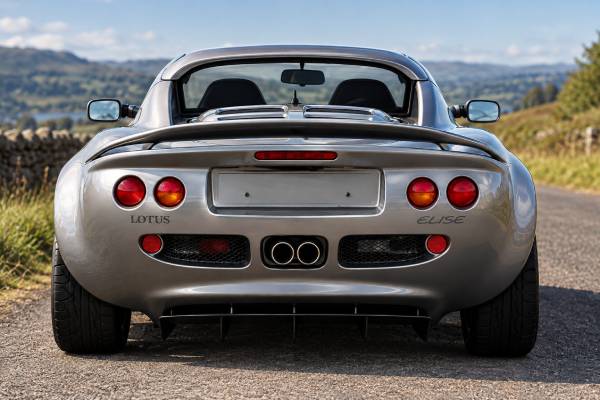
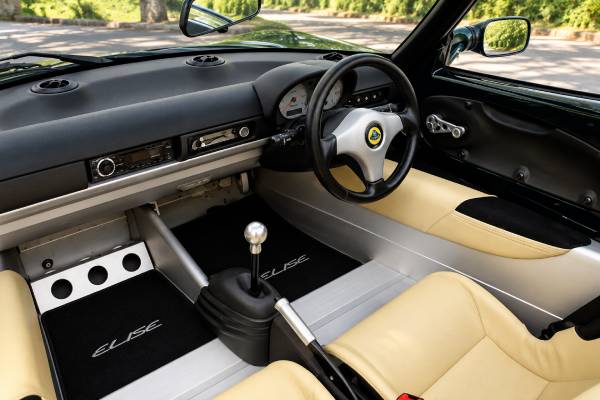
The original 118 hp Lotus Elise is the car that established the modern Elise formula: very low mass, a bonded aluminium chassis, unassisted controls, a modest Rover K-series engine, and almost no hardware that does not contribute to driving. Its power figure looks ordinary today, yet the car never depended on horsepower alone. Early examples weighed roughly three quarters of a tonne, so the 1.8-litre engine could deliver strong real-world acceleration while the light steering, brakes, and suspension remained unusually transparent. Production changes matter. Early cars used metal-matrix-composite brake discs, later cars moved to iron discs, weights rose as equipment evolved, and details changed through the 1998 model-year VIN revision and into the final S1 period. Buying one now is therefore less about finding “the standard Elise” and more about understanding a particular car’s build date, condition, repairs, and modifications. A structurally sound, properly cooled, well-aligned 118 hp Elise still demonstrates why simplicity can be a performance technology in its own right.
Table of Contents
- Why 118 hp Is Enough
- The Bonded-Aluminium Elise Idea
- S1 118 hp Specifications
- Production Evolution and Originality
- Keeping the K-Series Healthy
- Inspection From Chassis to Soft Top
- Who Should Buy the Base S1
- Living With an Early S1 Today
Why 118 hp Is Enough
The standard S1 proves that performance is a ratio, not a badge. With 118 bhp driving a car that began life around the low-700 kg range, it can reach 60 mph in roughly the high-five-second bracket while preserving throttle adjustability and usable road speeds.
The Rover K-series 1.8 sits transversely behind the cabin and drives the rear wheels through a five-speed manual transaxle. In standard Elise tune it produces 118 bhp at 5,500 rpm and about 165 Nm of torque at 3,000 rpm. Those numbers are important because they describe a different personality from the later VVC and Sport engines: the base unit has useful mid-range torque and does not need to be held near the limiter to make progress.
The engine is also very light. Its aluminium construction matched the entire Elise project, which was built around reducing mass before adding power. That philosophy affects almost every control. There is no power steering. Brake assistance is absent on the early S1 road car. The body panels are composite and non-structural. Even the original seat and cabin design minimize material.
As a result, speed feels immediate rather than isolated. The steering moves in the driver’s hands over cambers, the car rotates with small inputs, and the brakes reward pressure rather than ankle movement. It can seem crude if judged against a grand tourer, but that is the wrong frame of reference. The appeal is mechanical clarity.
The standard engine’s broad torque also makes it one of the friendlier S1 variants on ordinary roads. It will tolerate a higher gear through a village or traffic and still respond, whereas highly tuned versions can make the driver work harder. For many owners, preserving that balance is preferable to chasing dyno numbers.
The Bonded-Aluminium Elise Idea
The defining technology of the S1 is its chassis, not its engine. Lotus created a lightweight tub from aluminium extrusions bonded with structural adhesive, producing high stiffness without the mass of a conventional steel monocoque.
Hydro supplied the extrusions, which Lotus assembled into the main structure with adhesive bonding and mechanical fasteners at specified joints. The rollover hoop is integrated into the structure, while front and rear substructures support suspension and powertrain loads. The composite body clamshells shape the car and can be damaged without automatically condemning the chassis, but the aluminium tub itself needs specialist treatment if compromised.
This distinction is critical to ownership. A fiberglass crack can look dramatic yet be mainly cosmetic. A bent suspension pickup, distorted chassis rail, damaged bond line, or inappropriate welded repair is much more serious. An Elise should therefore be inspected from below, preferably with undertrays removed where practical, rather than judged by paintwork alone.
The suspension follows classic Lotus priorities: unequal-length double wishbones, coil springs over dampers, and carefully controlled geometry. The car has relatively narrow tires by modern standards, which helps steering feel and lets the chassis communicate before grip disappears. The standard wheels are staggered, with smaller front dimensions than rear, reflecting the Elise’s rear weight bias and handling targets.
Very early cars are also famous for their aluminium metal-matrix-composite brake discs. They saved unsprung mass and gave the first cars a distinctive technical story, but replacement cost and availability led Lotus to move to iron discs. An early car that still retains correct MMC hardware can be attractive to a collector, while an iron conversion can be entirely sensible for regular use. The key is to know what is fitted and whether it is in safe condition.
S1 118 hp Specifications
This Elise is a naturally aspirated petrol ICE roadster with a mid-mounted 1.8-litre four-cylinder engine, five-speed manual transmission, and rear-wheel drive. The essential specifications show how modest engine output becomes meaningful when the car’s dimensions and mass are kept unusually low.
| Specification | Value |
|---|---|
| Engine | Rover K-series 18K4F inline-four |
| Displacement | 1,796 cc (1.8 L) |
| Bore × stroke | 80.0 × 89.3 mm |
| Construction | Aluminium block and cylinder head |
| Valvetrain | DOHC, 16 valves, hydraulic tappets |
| Induction | Naturally aspirated |
| Fuel system | Electronic fuel injection |
| Maximum power | 118 bhp (88 kW) at 5,500 rpm |
| Maximum torque | 165 Nm (122 lb-ft) at 3,000 rpm |
| Timing drive | Toothed belt |
| Minimum fuel grade | 95 RON petrol |
| Specification | Value |
|---|---|
| 0–60 mph | About 5.8 seconds |
| Top speed | About 126 mph (202 km/h) |
| Urban consumption | 9.6 L/100 km (28.9 mpg UK) |
| Extra-urban consumption | 5.7 L/100 km (49.9 mpg UK) |
| Combined consumption | 7.1 L/100 km (39.4 mpg UK) |
| CO₂ emissions | 168 g/km |
| Specification | Value |
|---|---|
| Transmission | 5-speed manual transaxle |
| Drive | Rear-wheel drive |
| Final drive | 3.938:1 |
| 1st gear | 3.167:1 |
| 2nd gear | 1.842:1 |
| 3rd gear | 1.307:1 |
| 4th gear | 1.033:1 |
| 5th gear | 0.765:1 |
| Specification | Value |
|---|---|
| Body style | Two-seat, two-door roadster |
| Engine position | Mid-mounted, transverse |
| Wheelbase | 2,300 mm (90.6 in) |
| Length | 3,726 mm (146.7 in) |
| Width excluding mirrors | 1,701 mm (67.0 in) |
| Height | 1,202 mm (47.3 in) |
| Front track | 1,440 mm (56.7 in) |
| Rear track | 1,453 mm (57.2 in) |
| Specification | Value |
|---|---|
| Chassis | Bonded aluminium extrusion structure |
| Suspension | Independent double wishbones front and rear |
| Steering | Unassisted rack and pinion |
| Standard front wheel | 5½J × 15 |
| Standard rear wheel | 7J × 16 |
| Standard front tire | 185/55 R15 |
| Standard rear tire | 205/50 R16 |
| Brake disc diameter | 282 mm; material depends on production period |
| Item | Value or guidance |
|---|---|
| Routine service interval | Original published schedule: after initial service, approximately 15,000 km or annually |
| Timing belt | Replace by the age/mileage schedule applicable to the engine and documented service history |
| Cooling system | Use correct coolant and bleeding procedure; investigate any unexplained loss immediately |
| Chassis work | Use Lotus-approved repair principles and experienced aluminium-chassis specialists |
Production Evolution and Originality
A 1996 Elise and a 2001 Elise can both be “standard 118 hp” cars while differing in brakes, weight, trim, electrical details, and accumulated factory changes. Build date and VIN are therefore more useful than assuming every S1 was frozen at launch specification.
The first cars were the purest expression of the low-mass target. As production matured, Lotus responded to durability, legislation, supplier availability, and customer expectations. Later examples generally gained weight compared with the earliest cars. That does not make them inferior; it changes the ownership proposition. An early, very original car may appeal to a collector, while a later car can offer useful revisions and easier parts substitution.
The 1998 model-year change altered VIN coding, which helps identify production specification. Service notes use VIN and engine-number change points because registration date alone can mislead. A car might be registered well after it was built, imported later, or assigned a plate that does not neatly align with the production change.
Originality should be judged intelligently. A correct early MMC-brake car is historically interesting, but an owner who converted it to supported iron discs for safety and parts availability may have made a rational choice. The same applies to radiators, dampers, toe links, and exhausts. Ask whether modifications are reversible, correctly engineered, and documented.
Cosmetic originality can be harder to restore than mechanical parts. Factory seats, steering wheel, early switchgear, original wheels, roof hardware, and small trim pieces increasingly matter. A car that lost its original components during years of track use may cost more to return to standard than expected.
Keeping the K-Series Healthy
The K-series can be reliable in an Elise when its cooling system, belt drive, and sealing are maintained properly. The worst approach is to ignore small symptoms until overheating turns a manageable repair into cylinder-head damage.
Because the engine is behind the cockpit and the radiator is at the front, coolant travels through long pipes. Air trapped during filling, a weak radiator, failing fan, leaking hose, deteriorated cap, or thermostat issue can all undermine temperature control. The instrument display should settle normally in use. Sudden temperature changes, coolant smell, repeated topping-up, or hard hoses shortly after a cold start deserve diagnosis.
Head-gasket failure became the K-series’ defining reputation, but buyers should separate history from condition. Many Elises have already received improved repairs. A car with a documented, correctly executed gasket replacement and a sorted cooling system may be preferable to an untouched low-mileage car still relying on decades-old components.
Timing-belt service must be age conscious. A lightly used Elise may cover only a few thousand miles between services, yet rubber and tensioner components still age. If the history cannot prove when the belt, tensioner, and water-pump-related work were last checked, treat that as immediate maintenance rather than a bargaining-point footnote.
Oil leaks are easier to live with than coolant problems but still need tracing. Check around cam cover areas, seals, sump joints, and the engine/transmission interface. Maintain correct oil level: track use and sustained high rpm justify more frequent checks than gentle road use.
Finally, do not neglect the car because it is mechanically simple. Old brake fluid, perished fuel hoses, corroded electrical terminals, deteriorated engine mounts, tired dampers, and seized fasteners can accumulate on a low-mileage garage queen just as readily as on a regularly driven car.
Inspection From Chassis to Soft Top
A proper S1 inspection begins underneath and ends with paperwork. A perfect shine is less important than a straight tub, healthy cooling system, correct suspension geometry, and evidence of sustained maintenance.
Examine the aluminium chassis and visible bonds for impact damage, crushed jacking areas, drilled or modified sections, and corrosion where steel components meet aluminium. Look at the front crash structure and rear subframe. Uneven tire wear can point to geometry problems, but it can also reveal bent parts from curb or accident impacts.
Check suspension ball joints, wishbone bushes, wheel bearings, steering joints, dampers, springs, and rear toe links. The Elise is sensitive enough that worn parts materially alter how it drives. A car that feels vague is not showing “classic Lotus character”; a good one should feel precise.
Inspect the fiberglass clams for star cracks, blistering, previous repairs, and stress around mounting points. Panel gaps are not modern-supercar perfect, but obvious asymmetry should prompt questions. Check doors for hinge wear and window adjustment. Inspect the soft top, seals, and drainage areas for water entry.
Inside, confirm that the Stack instrument display works correctly. Test heater fan speeds, lights, indicators, alarm/immobiliser, horn, wipers, and any added electrical equipment. Aftermarket stereos and alarms sometimes introduce more trouble than the original circuits.
A test drive should include low-speed steering, braking from several speeds, smooth and fast gear changes, and a fully warm engine pull. Listen for wheel-bearing rumble, driveshaft clicks, suspension knocks, and exhaust contact. The car should track cleanly under braking and feel stable when the road surface changes.
Service history should show more than annual oil changes. Look for coolant work, timing-belt evidence, brake-fluid changes, suspension refreshes, tire dates, battery care, and specialist inspections. The best cars often have a thick file because owners understand that an Elise rewards attention to detail.
Who Should Buy the Base S1
Choose the 118 hp S1 if you want the Elise idea in its clearest road-going form rather than the most powerful factory derivative. Its appeal is balance: enough performance to be exciting, a torquey engine that works on ordinary roads, and minimal mass between the driver and the chassis.
It is particularly suited to drivers who value steering texture and cornering flow over acceleration contests. On narrow roads, an extra 50 or 100 hp is often less useful than confidence in the front axle and the ability to use full throttle without immediately reaching antisocial speeds.
The base car can also be the smartest ownership choice because its engine is relatively unstressed. That does not eliminate K-series concerns, but it means there is less reason to chase rare tuning hardware or preserve a highly specialized calibration. Parts support remains broad because the engine family was used widely outside Lotus.
Avoid buying solely on the cheapest asking price. Fiberglass repairs, chassis damage, cooling-system neglect, or a tired suspension can consume the difference quickly. Equally, do not assume the lowest-mileage car is best. Regular use with disciplined maintenance often keeps seals, brakes, cooling components, and electrical connections happier than prolonged storage.
For a first Elise, a well-sorted standard S1 is an excellent reference point. Drive it in good condition before modifying it. Fresh tires, correct geometry, renewed dampers, and properly functioning brakes often recover performance that owners mistakenly try to find with engine upgrades.
The original 118 hp Elise is historically important because it proved Lotus could create a modern sports car by taking mass out rather than piling equipment on. Nearly three decades later, that approach still feels fresh. A good example does not need excuses for its modest power figure; the entire car was engineered so that 118 hp would be enough.
Living With an Early S1 Today
Using a standard S1 regularly requires a different mindset from owning a modern sports car. The car is small, simple, and economical with consumables, but it asks the driver to accept noise, awkward access, minimal weather sealing, and the need to notice small mechanical changes before they become large ones.
Getting in and out is the first reminder. The wide sill is structural, so it is not going to become easier with a convenience package. Learn to step over rather than grind clothing and shoes across the sill trim. Check the driver’s seat mounting and runners because repeated entry can loosen or wear hardware. A seat that moves under braking is a safety issue, not a charming quirk.
The roof system rewards practice. Carrying a towel and a small bag for wet roof panels is more useful than pretending an old Elise will seal like a coupe. Inspect seals and tension carefully, but avoid over-adjusting doors and glass simply to chase a tiny drip; poor adjustment can create wind noise, stress, or alignment problems elsewhere.
Heating and ventilation are basic. Demisting can take patience, especially if the heater matrix, fan, ducts, or cable controls are not working perfectly. Fix those systems before winter rather than relying on anti-fog products. If a car has air conditioning, verify that the compressor, lines, condenser, and controls function because dormant systems can become expensive to revive.
Fuel range is reasonable for the car’s size, but the gauge and tank shape are not reasons to run very low regularly. Older fuel pumps benefit from being kept submerged, and track use can expose fuel pickup limitations at low tank levels. If the car will sit for months, fresh stabilized fuel is better than leaving old ethanol-blended petrol indefinitely.
Storage should protect the chassis as well as the paint. Use a dry, ventilated garage, avoid trapping moisture under impermeable covers, and keep the battery on an appropriate maintainer. Move or exercise the car periodically so brakes, clutch hydraulics, seals, and tires do not spend seasons in one position. If the car will be stored on stands, use the correct lifting points and support strategy; careless jacking can damage the aluminium structure.
Long trips are more practical than the cabin suggests if luggage is soft and compact. Keep heat-sensitive items away from the warm rear boot, carry a tire-repair solution suited to the wheel package, and bring basic spares such as fuses and bulbs. A compact toolkit should include the correct wheel fastener tool and equipment for the roof, not a random heavy workshop set.
Driver technique also affects reliability. Warm the oil as well as the coolant before sustained high rpm. Avoid resting a hand heavily on the gear lever. Do not use the clutch to hold the car on hills. Over speed humps, protect the front clamshell and chassis rather than approaching diagonally at excessive steering lock that loads the suspension.
For owners coming from modern cars, the biggest adjustment is interpreting feedback correctly. More steering kickback does not always mean a fault, more brake pedal effort does not mean weak brakes, and more drivetrain sound does not necessarily indicate failure. The goal is to establish a baseline with a known-good car or specialist inspection, then pay attention to changes from that baseline.
That close relationship is part of the standard S1’s charm. It asks more involvement during mundane journeys, yet it also makes 50 mph on a winding road feel meaningful. For many enthusiasts, that is a better long-term ownership reward than adding power until the car can only be explored fully on a circuit.
Reading an S1 on a Test Drive
A useful test drive is less about proving outright speed than about checking whether the car still behaves like a coherent lightweight system. On a straight, reasonably smooth road, the steering should settle naturally rather than tugging persistently to one side. Over a sequence of bumps, listen for a single knock that repeats with wheel movement, then distinguish it from trim noise behind the seats. Use several clean gear changes at modest engine speed before trying full throttle; a reluctant shift when cold can tell a different story from a gearbox that resists engagement after warming through. Finally, let the car idle after the drive and watch the coolant temperature rather than switching off immediately. That short observation can expose cooling-system behaviour that a five-minute viewing misses.
References
- The Lotus Elise S1 2002 (Model Technical Information)
- S1 K-series Engine 2002 (Engine Technical Information)
- Lotus Elise S1 Service Manual 1996 (Service Manual)
- Lotus Elise S1 Service Manual 1996 (Service Notes PDF)
- LOTUS ELISE Service Manual (complete) 1996 (Service Manual)
- Lotus Elise Series 1 Factory Service Manual / Workshop Repair Manual Free PDF Download 2026 (Service Manual Index)
Disclaimer
This article is for informational purposes only and does not replace professional inspection, diagnosis, or repair. Specifications, torque settings, service intervals, and procedures vary by VIN, market, production change, and equipment; always verify them in the official Lotus and Rover service documentation for the exact vehicle.
If you found this guide useful, please share it on Facebook, X/Twitter, or with an Elise community to help support our work.