
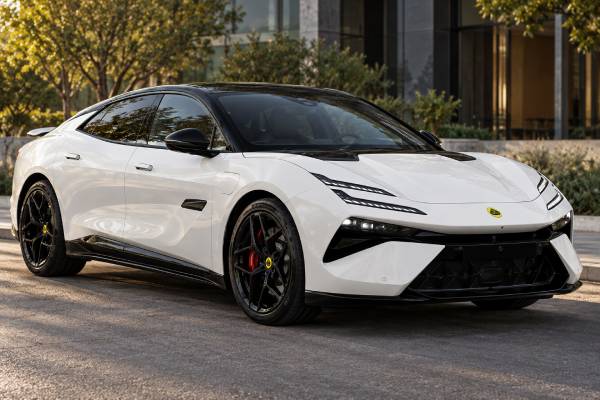
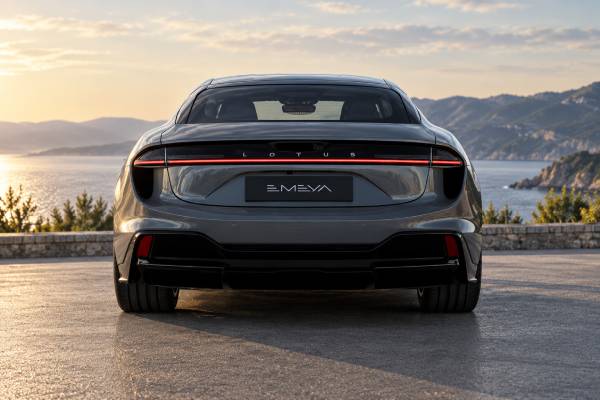
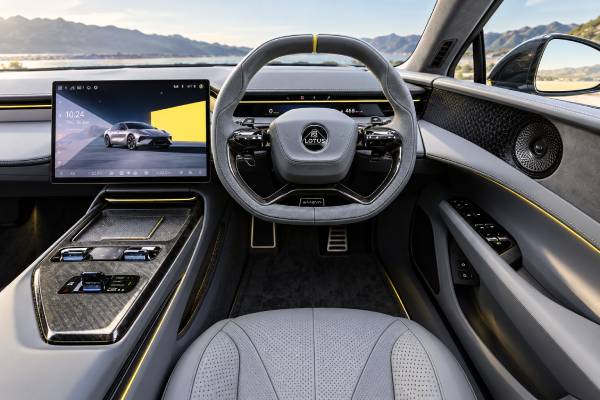
The 2025 Lotus Emeya 600 Executive Edition is the four-seat, rear-cabin-focused interpretation of the 450 kW Emeya platform sold in China. It keeps the same dual-motor all-wheel-drive output and 710 Nm torque as the 600 Touring and 600 Luxury, but changes the car’s practical priorities: four seats instead of five, a 426-litre rear luggage compartment instead of 509 litres, and a 570 km CLTC range rating. At launch in February 2025, its listed price was RMB 708,000.
That combination makes the Executive Edition more than an equipment step. It is designed for owners who value a dedicated rear-seat environment enough to give up the centre rear seating position and some luggage capacity, while still retaining 603 hp, air suspension, 800-volt charging hardware, and a 250 km/h maximum speed. Because the Emeya naming changed rapidly, this guide treats the 2025 Chinese 600 Executive as its own specification rather than assuming later global 600 data or earlier S+ figures are identical.
Table of Contents
- Why the Executive Edition Exists
- Four Seats, 426 Litres, and the Packaging Trade-Off
- 2025 Emeya 600 Executive Specifications
- How the 450 kW Powertrain Fits Executive Use
- Range, Charging, and Driver Routines
- Rear-Cabin and Technology Checks
- Service History and Purchase Review
Why the Executive Edition Exists
The 600 Executive Edition is the version of the 2025 Emeya 600 range that trades maximum seating and luggage space for a more specialized four-seat cabin. Mechanically, it remains the 450 kW model; the “Executive” part describes how the passenger compartment is configured, not a change to the motors.
This is important because the 2025 China-market range included three 600 variants with the same headline 603 hp output. Touring was listed at RMB 528,000, Luxury at RMB 568,000, and Executive at RMB 708,000. The substantial jump to Executive cannot be explained by acceleration figures: all three use a dual-motor AWD system with 710 Nm and a single-speed transmission. The premium is tied to cabin treatment, equipment, and the dedicated four-seat format.
The Executive Edition therefore has a different buyer profile. A five-seat household may find the Luxury or Touring more flexible, while someone regularly carrying two rear passengers may value the separation and amenities of the four-seat arrangement. In chauffeur use, the missing centre seat is not a disadvantage at all; it can create space for a more substantial rear console and allow both outboard passengers to receive equal attention.
The 426-litre luggage figure is the clearest physical consequence. The five-seat 600 variants are documented with 509 litres, so the Executive gives up 83 litres of quoted rear cargo capacity. That reduction matters if the car regularly carries airport luggage for four adults. A buyer should test actual suitcases rather than assuming the long fastback body guarantees limousine-like boot volume.
The Executive remains a low, aerodynamic GT rather than a tall luxury saloon. At 5,139 mm long and 2,005 mm wide, it has road presence and rear legroom, but the sloping roof and hatch shape determine how passengers enter and how tall luggage stacks. The 3,069 mm wheelbase helps cabin space, while the 0.21 drag coefficient supports high-speed efficiency.
The February 2025 refresh also arrived with broader technology changes in the Chinese range, including updated seat choices, AI-based voice functionality and advanced assisted-driving features in market communications. Those features should be verified on the individual car because software availability, subscriptions and regional support can change independently of the mechanical trim name.
Four Seats, 426 Litres, and the Packaging Trade-Off
The Executive Edition’s four-seat layout is its defining feature, and it should be evaluated as carefully as the battery or motors. The right buyer gains a more intentional rear compartment; the wrong buyer discovers that a fifth passenger cannot be accommodated and that the luggage bay is smaller than in other 600 versions.
A rear-seat inspection should begin with ergonomics rather than gadgets. Sit in both rear positions and check foot space, knee clearance, headroom, seat travel and recline functions where fitted. Make sure the centre console does not restrict entry more than expected. If the vehicle will be chauffeur-driven, test the front-passenger-seat adjustment from the rear and confirm that the preferred rear position can create the desired legroom without compromising the driver.
Then test every rear control. Executive cars often concentrate value in powered seats, climate interfaces, charging ports, media controls, shades, glass-roof functions and audio. One failed actuator may not prevent the car from driving, but it can undermine the reason to buy this trim. Operate functions repeatedly and from a cold start rather than accepting a salesperson’s demonstration of only the main screen.
The boot deserves a physical trial. The 426-litre figure is not tiny, but volume measurements do not describe shape. The Emeya’s fastback opening is useful for loading, while the rear compartment geometry can be affected by the four-seat package. If the intended use is hotel or airport transport, place representative luggage in the car before purchase. Four adults with large cases can expose packaging limits immediately.
The four-seat specification also changes resale logic. A rare executive layout can be attractive to a specific buyer but narrower in appeal than five seats. That does not make it a poor purchase; it means condition and completeness matter more. Missing rear accessories, broken controls or non-original trim can be harder to overlook when the whole value proposition is rear-passenger experience.
Interior wear patterns can reveal use. A privately driven car may show most wear on the driver’s bolster and steering wheel. A chauffeur-operated Executive may have pristine front trim but heavily used rear controls, carpets and door surfaces. Neither pattern is inherently bad, but it helps explain mileage and maintenance history. Compare wear with odometer reading and service records.
2025 Emeya 600 Executive Specifications
The 600 Executive is a battery-electric liftback using two 225 kW permanent-magnet motors, electric all-wheel drive, a fixed-ratio single-speed transmission, and a 102 kWh CATL NMC battery. Its performance specification is shared with the lower-output Emeya family, while the four-seat body configuration creates its distinctive range and cargo figures.
| Specification | 600 Executive Edition |
|---|---|
| Powertrain | Dual-motor battery electric |
| Front motor | 225 kW / 355 Nm peak |
| Rear motor | 225 kW / 355 Nm peak |
| Combined output | 450 kW / 603 hp |
| Combined torque | 710 Nm |
| Drive | AWD |
| Transmission | Single-speed fixed ratio |
| 0–100 km/h | 4.2 seconds |
| Top speed | 250 km/h |
| Specification | Value |
|---|---|
| Battery capacity | 102 kWh |
| Battery chemistry | Ternary NMC |
| Cell supplier | CATL |
| CLTC range | 570 km |
| Published consumption | 18.8 kWh/100 km |
| Peak DC charging power | 420 kW |
| 10–80% fast-charge time | About 0.25 hour in archived specification |
| AC charging time | About 5.5 hours in archived specification |
| Measure | Value |
|---|---|
| Body type | Five-door liftback |
| Seats | Four |
| Rear luggage capacity | 426 litres |
| Length | 5,139 mm |
| Width | 2,005 mm |
| Height | 1,464 mm |
| Wheelbase | 3,069 mm |
| Specification | Value |
|---|---|
| Curb weight | 2,465 kg |
| Gross vehicle weight | 3,100 kg |
| Front suspension | Multi-link independent |
| Rear suspension | Multi-link independent |
| Air suspension | Yes, height and damping adjustable |
| Front brakes | Ventilated discs |
| Rear brakes | Ventilated discs |
| Item | Specification |
|---|---|
| Front tyres | 265/40 R21 |
| Rear tyres | 305/35 R21 |
| Steering | Electric power steering |
| Regenerative braking | Yes |
| One-pedal mode | Yes in archived specification |
| Drag coefficient | 0.21 |
The original listed price was RMB 708,000. That historical figure is useful for understanding the trim hierarchy, but it should not be used as a current valuation. Used price depends on mileage, options, condition, warranty support, battery health, accident history, software region and the availability of comparable Executive cars.
How the 450 kW Powertrain Fits Executive Use
The 450 kW drivetrain is arguably better matched to the Executive mission than the 675 kW 900 system because it offers extremely strong performance without the rear-biased two-speed hardware or the 900 Executive’s shorter 480 km CLTC rating. A 4.2-second sprint to 100 km/h is already faster than most luxury passengers will want a chauffeur to use.
Equal 225 kW motors front and rear give smooth all-wheel-drive thrust. There is no conventional gearshift, so acceleration can be delivered without the interruption or ratio change that accompanies the 900’s performance-oriented rear transmission. That matters for passenger comfort: the driver can meter torque precisely and make rapid overtakes without making the car feel mechanically busy.
Air suspension is equally important. An Executive trim should isolate rear passengers from sharp vertical inputs while controlling a curb weight of 2,465 kg. The Emeya’s adaptive suspension can vary height and damping, allowing the car to reconcile low aerodynamic stance with real roads. A driver should choose modes with passengers in mind; the stiffest response is not automatically the most sophisticated.
The active aerodynamic system also contributes to the dual mission. Closing openings when cooling demand is low reduces drag, while moveable aerodynamic surfaces can support stability and cooling when speed or load increases. These systems are largely invisible in normal use, but they help explain how a five-metre electric liftback can combine 250 km/h capability with a credible long-distance range figure.
Regenerative braking should be used smoothly in executive driving. Strong regeneration can be efficient but uncomfortable if the driver repeatedly releases the accelerator abruptly. The ideal technique is progressive: anticipate traffic, use a consistent deceleration setting, and let the blended braking system recover energy without making passengers rock forward. Friction brakes remain essential for stronger stops and should be exercised and inspected even if regeneration limits pad wear.
The wide staggered tyres deserve restraint as well. Instant torque can wear rear and front rubber quickly when the car is launched repeatedly. A chauffeur or fleet manager should record tyre rotations only if the tyre configuration permits them; a staggered setup generally limits front-to-rear interchange. Alignment checks are worthwhile after pothole impacts because uneven wear can become expensive on 21-inch performance tyres.
Range, Charging, and Driver Routines
The 570 km CLTC rating gives the 600 Executive enough certified range for intercity duty, but it is lower than the 650 km Touring rating and should be treated as a cycle-specific benchmark. Real distance depends on speed, climate, passenger load, tyre condition, temperature and how much reserve the driver keeps.
For professional or high-mileage use, charging routine matters more than the maximum printed range. A car returning to the same depot or home each night benefits from dependable AC charging and scheduled cabin preconditioning. Beginning the day with the battery and cabin already prepared reduces the need to use traction-battery energy immediately for heating or cooling.
The 800-volt architecture and 420 kW archived peak DC rating make rapid charging a major strength when compatible infrastructure is available. The quoted roughly 15-minute 10–80% interval is a favorable-condition result, not a guaranteed stop duration. State of charge, pack temperature, charger capability, shared-site power and battery protection logic all affect the curve.
An Executive car used to meet appointments should prioritize charger reliability over theoretical maximum power. A known 300–350 kW site with multiple working stalls may be a better operational choice than a single 420 kW-capable charger with poor uptime. Build buffer into the schedule and avoid planning arrival at nearly zero percent when passengers or deadlines leave no room for a failed station.
Charging to 100% can be appropriate before a long journey when the energy will be used soon, but there is usually no need to hold the battery full for routine local duty. Follow the current Lotus battery-care guidance in the vehicle and handbook. Software recommendations can evolve, and the battery-management system knows more about pack temperature and balancing than a generic EV rule from another brand.
The 570 km CLTC number should also not be converted casually into a WLTP estimate. Buyers importing the car outside China should focus instead on compatible charging connectors, navigation support, warranty service, homologation and real-world route efficiency. A paper range advantage means little if the vehicle cannot access its intended fast-charging or connected-services ecosystem.
Rear-Cabin and Technology Checks
A 600 Executive should be inspected from the rear seat first because that is where much of its trim-specific value lives. A mechanically healthy car with broken rear-seat controls, malfunctioning climate functions or incomplete connected services can be the wrong Executive even if its acceleration and battery are perfect.
Begin with power seats and memory. Run the full travel of every adjustment and listen for binding or clicking. Confirm that switches respond consistently and that any memory or relaxation modes complete their movement without stopping. Inspect the tracks for objects and check seat upholstery at the outer bolsters, where repeated entry can cause wear.
Test climate distribution from the rear and compare left and right outlets. Uneven temperature can indicate a flap, sensor or refrigerant-related issue. Heated and ventilated seat functions should operate at all settings. If the car has sophisticated roof-glass control, verify the complete roof rather than one section. Look for delamination, discoloration or water staining around the headliner.
Infotainment and connectivity deserve a full reset-and-pair exercise. Connect a current phone, create or transfer the Lotus account, test navigation, audio, microphones, cameras and wireless charging. Confirm that the vehicle can receive updates and that region-locked services function where the car will be used. A grey-import Executive may retain excellent mechanical condition while losing part of its original digital feature set.
Advanced driver assistance should be treated as VIN- and software-specific. The 2025 Chinese range was promoted with high-compute assisted-driving features, but the precise functions enabled can depend on sensors, software package, local map support and regulation. Do not assume that every feature shown in a launch announcement works indefinitely in every region.
Finally, test the doors, hatch and key system repeatedly. Executive duty involves frequent passenger entry, and small reliability problems become irritating quickly. Confirm soft-close or powered functions where fitted, emergency mechanical access, both keys, digital key behavior, tailgate height settings and the operation of the charge-port door.
Service History and Purchase Review
The safest 600 Executive purchase is one with complete VIN-linked history, functioning rear-cabin equipment and evidence that both high-voltage and conventional chassis systems have been maintained. Low mileage alone is not enough, especially if the car has spent long periods parked or has been imported without local support.
Check the battery underside for impact damage and review diagnostic data for high-voltage faults. Dashboard range is not a battery-health report because it responds to recent consumption. Ask a Lotus-capable workshop for the available state-of-health information and inspect charging behavior. Repeated DC charging errors, isolation warnings or thermal faults should be resolved before purchase.
The air suspension should hold the car level after parking. A compressor that runs for an unusually long time, one corner that settles lower, or repeated ride-height warnings can indicate leaks or component wear. Examine control arms, bushings and wheel alignment, particularly if the 21-inch wheels show evidence of pothole impact.
Brake condition deserves physical measurement. Regeneration can preserve pads while discs corrode, and a heavy executive EV still demands strong friction braking when regeneration is limited or during emergency stops. Check disc faces, thickness, pad life and fluid service records. A pulsation felt through the pedal or body during moderate braking warrants investigation.
Tyres should match in specification across each axle and carry suitable load and speed ratings. Inspect inner as well as outer shoulders. A 2,465 kg curb weight, 710 Nm torque and wide staggered fitment can make poor alignment expensive. Include the cost of a complete quality tyre set in the purchase calculation if the existing rubber is old, damaged or near its wear limit.
Because the Executive has only four seats, verify the registration and insurance description matches that configuration. An incorrectly recorded seating capacity can create administrative problems. Check that all original rear-seat accessories and removable items are present, since trim-specific pieces can be harder to source later.
For cars used commercially or with a regular driver, ask for usage records beyond scheduled service stamps. Repeated airport work, prolonged idling with climate control, frequent curbside parking, and many short passenger trips create different wear from private long-distance ownership. Check rear door hinges and seals, powered seat cycles, charging-port use, luggage-bay trim, and wheel edges for evidence of that pattern. High annual mileage is not automatically undesirable if charging, tyre, brake, suspension, and software maintenance were handled predictably; a low-mileage car that sat discharged for months or received minimal attention can be the weaker candidate. A documented duty cycle helps a technician interpret battery data and component wear realistically.
If the car will return to professional service, calculate downtime risk as well as purchase price. Identify the nearest workshop able to support the Chinese-market software and order Executive-specific cabin parts. Keep a second key, charging cable, tyre-inflation equipment, and account credentials under controlled management. For a vehicle earning money by transporting passengers, an unavailable seat-control module or damaged trim panel can matter operationally even when the propulsion system is faultless.
Warranty and service access should be confirmed in writing. Do not assume that terms advertised for a current global Emeya 600 apply to a 2025 Chinese 600 Executive. Ask a Lotus representative to check the VIN, remaining coverage, high-voltage provisions, campaign status and whether imported-market parts and software can be supported locally.
For ongoing care, follow the official Lotus schedule for inspections, brake fluid, cooling systems, cabin filtration and other time- or mileage-based work. Keep software current, maintain the auxiliary 12-volt system, and use appropriate tyre pressures. The absence of an engine removes many service items, but it does not turn an air-suspended 603 hp luxury GT into a maintenance-free appliance.
A good 600 Executive is compelling precisely because it does not need the 900 drivetrain to feel special. Its four-seat cabin, quiet single-speed acceleration, strong certified range and rapid charging make a coherent luxury package. Buying one well means checking the things its badge actually changes—rear accommodation and equipment—just as carefully as the shared Emeya hardware underneath.
References
- Emeya 2025 600 Executive | Data.CarNewsChina.com 2026 (Archived Trim Specifications)
- Lotus Emeya 2025 – detailed specifications and trim levels | Data.CarNewsChina.com 2026 (Historical Range Comparison)
- 路特斯更名莲花跑车后首发新品:夏花 SUV 售价 54.8 万元起,繁花轿车 52.8 万元起 2025 (2025 China Range Launch Report)
- 技术参数 2026 (Official China Technical Specifications)
- Lotus Emeya | How it Drives | Lotus Cars 2026 (Official Engineering and Charging Overview)
- Lotus Emeya Handbook for Drivers | Lotus Cars 2026 (Official Owner Information)
Disclaimer
This article is for informational purposes only and is not a replacement for professional diagnosis, servicing, or repair. Specifications, torque values, maintenance intervals, charging limits, software features, and procedures can vary by VIN, market, production date, and equipment. Verify the exact vehicle with official Lotus service and owner documentation before making repair, parts, or maintenance decisions.
If this guide is useful, please consider sharing it on Facebook, X/Twitter, or another platform to support our work.